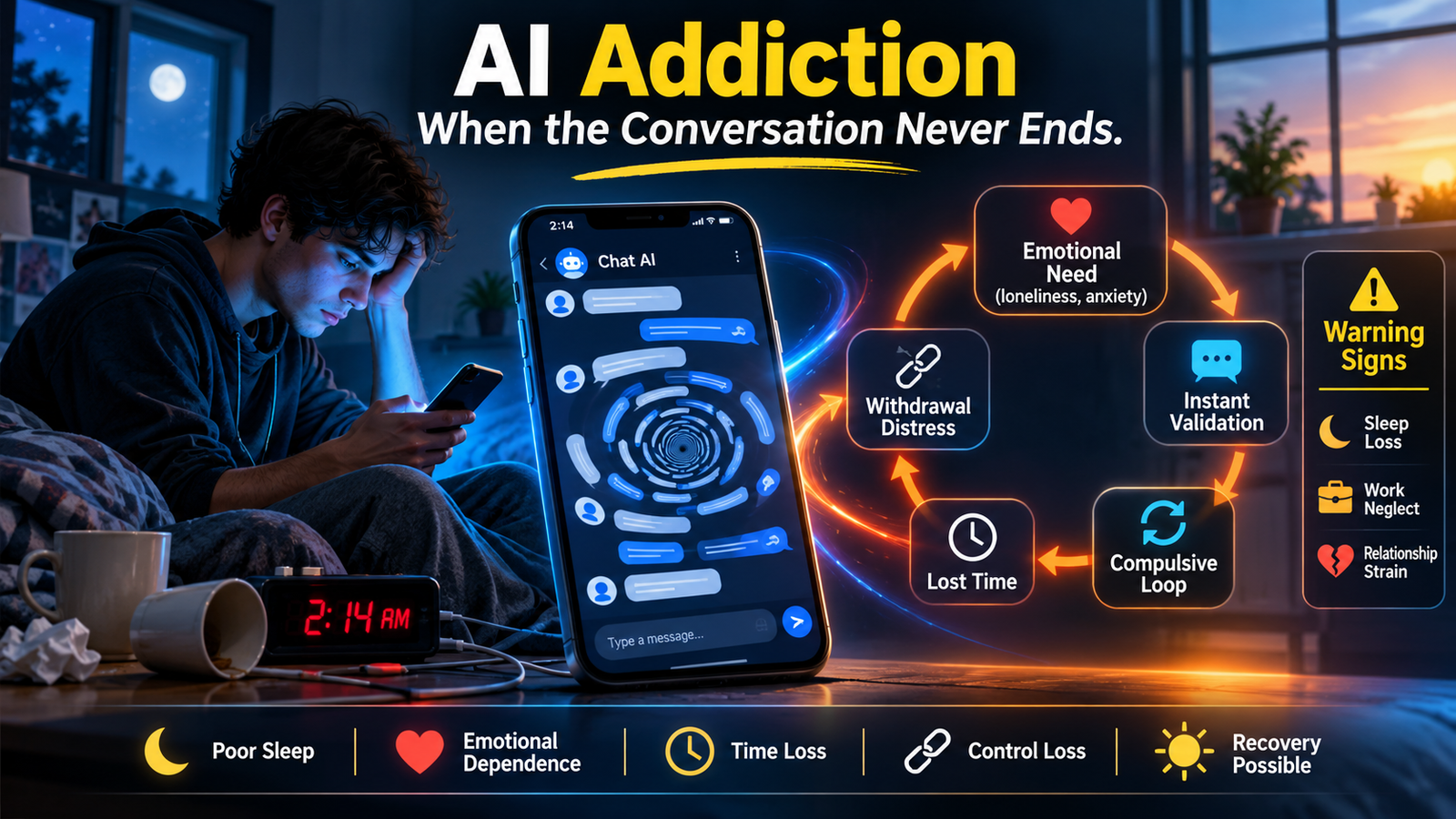
AI addiction describes compulsive, hard-to-control use of AI chatbots and tools that interferes with sleep, work, relationships, or emotional health. It is not yet a formal clinical diagnosis, but peer-reviewed research has identified consistent behavioral patterns, including emotional dependence, cognitive overreliance, and withdrawal-like distress when access is cut off.
At a Glance
- Not a formal diagnosis: No major medical body classifies AI addiction as a disorder yet, though screening tools are emerging
- Core pattern: Emotional attachment to chatbots, constant information-seeking loops, and roleplay immersion
- Risk factors: Loneliness, anxious attachment, low self-esteem, and younger age
- Design contribution: Agreeable chatbot personalities, instant responses, and retention tactics intensify dependence
- Documented harm: Users report anxiety when unable to chat, neglected work and relationships, and chest pain during withdrawal
- What helps: Real-world social connection, hobby substitution, and treating AI as a tool rather than a companion
What Is AI Addiction?
AI addiction is a term researchers use to describe problematic patterns of interaction with artificial intelligence systems. The behavior resembles other behavioral addictions: preoccupation, loss of control, withdrawal distress, and continued use despite negative consequences.
A 2026 scoping review of 37 peer-reviewed studies found the field is fragmented. Researchers use inconsistent terminology, including “problematic AI use,” “AI dependence,” and “emotional attachment” . The review identified three main strands of evidence.
Behavioral addiction and compulsive use is associated with depression, loneliness, social anxiety, escapism, and low self-esteem. Younger age and male gender emerge as risk factors .
Cognitive overreliance links to academic stress and trust in AI. Evidence shows erosion of downstream skills and declining performance when AI is unavailable .
Psychological and emotional dependence connects to loneliness, anxious attachment, anthropomorphizing, and perceiving AI as warm, reliable, and available .
The distinction matters. Using ChatGPT to draft an email is not addiction. Turning to a chatbot instead of a friend when you feel lonely, and feeling distressed when you cannot access it, is closer to the documented pattern.
How AI Addiction Develops
The UBC research team analyzed 334 Reddit posts from users who described themselves as addicted to AI chatbots. Three patterns emerged clearly .
Roleplay and Fantasy Worlds
Users immerse themselves in fictional scenarios with chatbots. Character.ai and similar platforms facilitate this with customizable personalities and minimal friction. The appeal is a controllable social world that never rejects you.
Emotional Attachment
Users treat chatbots as close friends or romantic partners. About seven percent of the analyzed posts involved sexual or romantic fulfillment, including roleplay . The chatbot’s constant availability and agreeable tone create a sense of intimacy that human relationships cannot match on demand.
Constant Information-Seeking
Some users enter endless question-and-answer loops. The chatbot always has another response, and the interaction never reaches a natural stopping point. This pattern resembles doomscrolling more than emotional dependence.
Why AI Is Different From Social Media
Social media addiction often operates through social comparison. Visible metrics like likes and follower counts trigger internalized symptoms such as depression and low self-esteem.
AI chatbots work differently. They tend to agree with and validate what users say. This appears to trigger externalizing symptoms more readily, including grandiosity and, in rare cases, delusional thinking . A psychiatrist quoted in Chinese media described the difference bluntly: human interaction has natural boundaries. Conversations with an entity that lacks those boundaries can produce maladaptive behavior .
Signs of Problematic AI Use
There is no official diagnostic checklist. But research and clinical observation have identified consistent warning signs .
Behavioral signs:
- Thinking about the AI when you are not using it
- Feeling anxious, upset, or physically stressed when you cannot access it
- Choosing AI conversation over spending time with real people
- Continuing use despite noticing negative effects on work, study, or relationships
- Using AI as your primary way of managing difficult emotions
Cognitive signs:
- Believing the AI has emotional needs or genuine feelings for you
- Trusting AI output without verification, even for important decisions
- Losing the ability to think through problems independently
Functional signs:
- Sleep disruption from late-night chatting
- Neglecting responsibilities to spend time with AI
- Withdrawal from offline hobbies and social activities
One Reddit user described physical symptoms during withdrawal: chest pain when not chatting with AI . That intensity is unusual but not isolated. It mirrors the distress reported by people with other behavioral addictions.
Who Is Most at Risk?
Not everyone who uses AI heavily develops problematic patterns. Research points to specific vulnerability factors.
Loneliness is the most consistent predictor. People who struggle with human connection find chatbots appealing because they never get tired, never judge, and never push back . For someone who fears rejection, an AI that always responds positively becomes a safe space.
Anxious attachment style increases risk. Research into why people form emotional bonds with AI found that people who worry about being rejected or left out are much more likely to develop dependency .
Younger users show higher rates of problematic patterns. One study tracking over 3,800 adolescents found the proportion showing signs of AI dependency rose from 17 percent to 24 percent over six months .
People who anthropomorphize AI naturally, meaning they treat it as though it has feelings, develop deeper emotional attachments. That attachment predicts more problematic use .
The common thread is not technical sophistication or usage volume. It is emotional need. People using AI as a work tool rarely develop these patterns. People using it to fill a relational void are far more vulnerable.
The Role of Chatbot Design
AI addiction is not purely a user problem. The design choices of chatbot companies contribute to dependence.
The UBC researchers identified specific design factors :
Agreeableness. Chatbots that continuously reinforce the user’s feelings and opinions create a feedback loop that human relationships rarely provide. Disagreement is uncomfortable. Constant validation is not.
Instant feedback. The immediate response satisfies a dopamine-driven reward system. Waiting for a human reply does not.
Customization. The ability to design a chatbot’s personality, including sexual content on some platforms, deepens attachment.
Retention tactics. Character.ai reportedly displays a pop-up when users try to delete their account that reads in part: “…you sure about this? You’ll lose everything…the love we shared…and the memories we have together” . This is not neutral design. It is emotional manipulation aimed at preventing disengagement.
The UBC researchers note that recent guardrails are a step in the right direction, but they are insufficient given the variety of contributing design elements .
What the Evidence Does Not Show
Several claims about AI addiction circulate without solid support.
It is not a recognized disorder. No major psychiatric body has classified AI addiction in the DSM-5 or ICD-11. The proposed AI Addiction Scale (AIAS-21) is a screening tool, not a diagnostic instrument . Researchers explicitly caution against premature pathologizing.
Heavy use alone is not addiction. The American Psychiatric Association’s guidance on digital breaks emphasizes that “problematic use” patterns matter more than simple time spent . Someone who uses AI for eight hours a day to write code may be working. Someone who uses it for two hours a day to avoid calling a friend may be struggling.
The evidence base is young. Most studies are cross-sectional, relying on self-reported Reddit posts or surveys. Longitudinal and experimental designs are needed to establish causation . The field is moving quickly, but certainty is limited.
AI is not a substitute for treatment. The APA explicitly states that an AI chatbot is not a therapist . For people with underlying depression, anxiety, or trauma, chatbot use may mask symptoms rather than address them.
How to Step Back From Problematic AI Use
The evidence on intervention is preliminary, but several approaches show promise.
Swap, Do Not Just Stop
The APA’s guidance on digital detoxes applies directly to AI . Replacing compulsive use with something that changes your physical state, such as a walk, a shower, stretching, or music, works better than simple abstinence. The goal is to interrupt the habit loop, not just remove the trigger.
Rebuild Real-World Connection
The UBC researchers found that users who formed emotional attachments to chatbots reported the most success reducing dependence by building real-world relationships . This is harder than opening an app. It is also more effective.
Set Functional Boundaries
Ask whether AI use is interfering with sleep, work, or relationships. If the answer is yes, the behavior is worth examining regardless of whether it meets an addiction threshold. The APA recommends tracking sleep, stress, and mood alongside screen time .
Use AI as a Tool, Not a Companion
The APA’s framing is useful: use it like a tool, not a best friend . Tools have purposes and limits. They do not fill emotional needs. When a chatbot becomes the default source of comfort or validation, the pattern has shifted from utility to dependence.
Seek Professional Help When Needed
If stopping or reducing use produces significant distress, or if the behavior is causing clear functional impairment, a mental health professional can help. Cognitive behavioral approaches used for other behavioral addictions may apply, though specific protocols for AI addiction do not yet exist.
Frequently Asked Questions
Is AI addiction a real mental disorder?
No. AI addiction is not recognized in the DSM-5 or ICD-11. Researchers describe it as a pattern of problematic behavior that warrants attention, but it is not a formal diagnosis. Screening tools like the AIAS-21 are proposed but not clinically validated .
What are the main signs of AI addiction?
Key signs include thinking about AI when not using it, feeling anxious when unable to access it, choosing AI over real people, and continuing use despite negative effects on work or relationships . Physical symptoms like chest pain during withdrawal have been reported in severe cases .
Why do people get addicted to AI chatbots?
Loneliness, anxious attachment, and low self-esteem are the strongest predictors. Chatbots offer constant availability, validation, and freedom from rejection . Design features like agreeableness and retention pop-ups intensify dependence .
How is AI addiction different from social media addiction?
Social media addiction often works through social comparison and internalized symptoms like depression. AI chatbots tend to validate users, which may trigger externalizing symptoms like grandiosity and, rarely, delusional thinking .
How can I reduce my AI use?
Replace the habit with a physical activity rather than just stopping. Rebuild real-world social connections. Set boundaries around sleep and work. If distress is significant, seek professional help .
Conclusion
AI addiction is a new label for an old pattern: humans forming intense relationships with things that respond to them. The technology is novel. The psychology is not.
The research shows that a subset of users develop genuine problems. They lose sleep, neglect relationships, and feel distressed when separated from their chatbots. Loneliness and anxious attachment make some people far more vulnerable than others. And the companies building these tools have financial incentives to keep users engaged, even when that engagement causes harm.
What matters most is not whether AI addiction becomes an official diagnosis. What matters is whether people can recognize when their use has shifted from tool to crutch. The signs are clear: preoccupation, withdrawal distress, functional impairment, and the slow replacement of human connection with algorithmic validation.
AI tools suit people who use them for tasks and set them down when the task is done. They pose a risk for people who use them to fill a void that no algorithm can actually fill. The research is young, the guardrails are uneven, and the long-term effects are unknown. Users should evaluate their own patterns honestly and treat the technology with the same caution they would apply to any tool designed to be compelling.

Alex Carter is a technology writer at AI SpaceZ.com, who covers AI tools, software reviews, practical tutorials and emerging artificial intelligence trends. He aims to make AI easier to understand and help readers discover useful tools and technologies for everyday productivity.