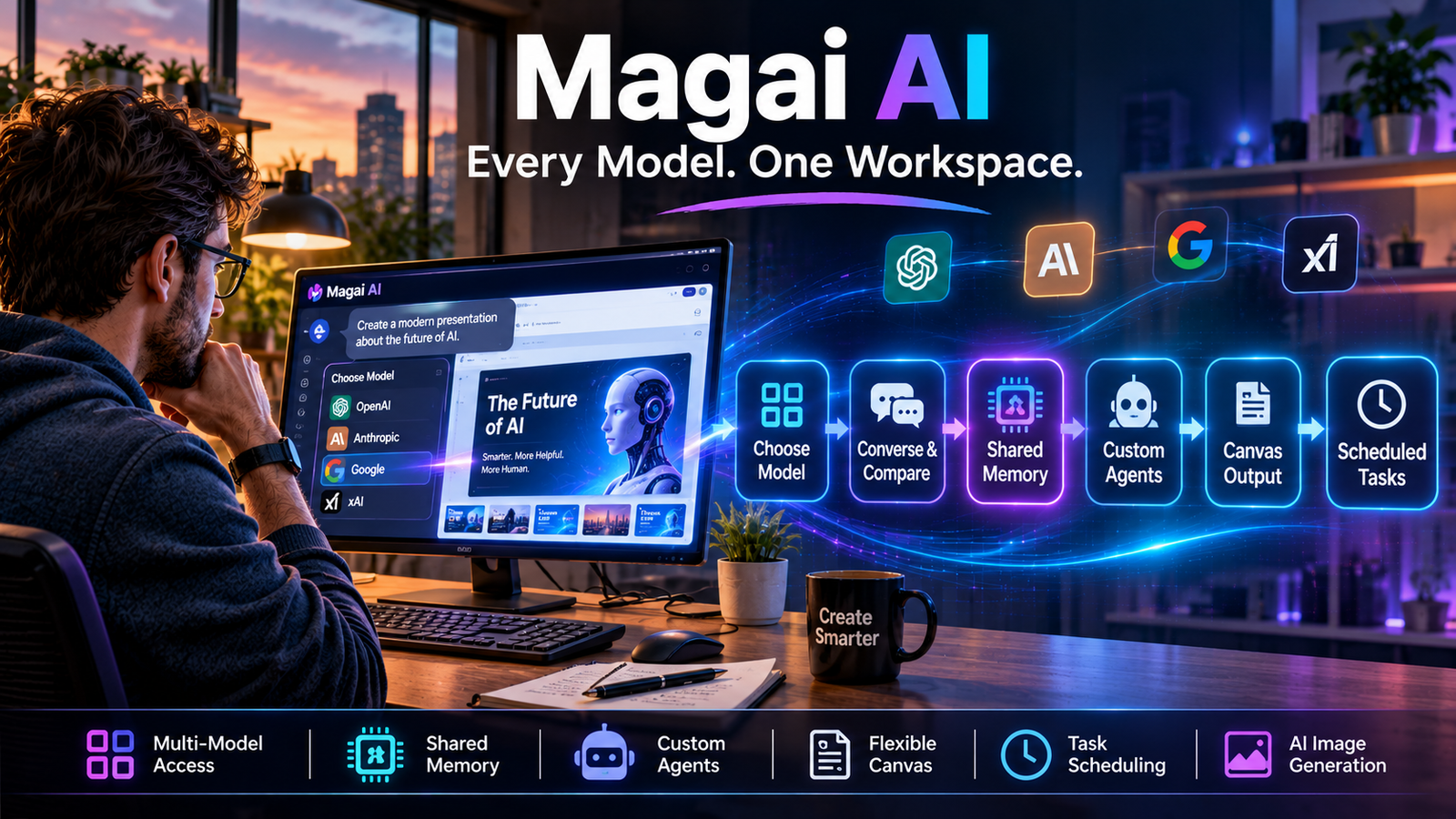
Magai AI is a multi-model workspace that gives users access to dozens of AI models from OpenAI, Anthropic, Google, and others through a single subscription. It combines model switching, shared memory, custom agents, and scheduled tasks into one interface, starting at $20 per month with no free tier.
At a Glance
- What it is: An AI aggregator and productivity workspace, not a model developer
- Models included: Dozens from OpenAI, Anthropic, Google, xAI, DeepSeek, and more
- Key differentiator: Switch models mid-conversation without losing context or memory
- Pricing: Standard at $20/month, Pro at $40/month, Ultra at $200/month; no free trial, 30-day money-back policy
- Founder story: Built by former actor Dustin Stout using no-code tools in roughly 8 weeks, reaching seven-figure ARR without venture funding
- Best fit: Content creators, marketers, and small teams who juggle multiple AI subscriptions
What Is Magai AI?
Magai AI is not an AI model. It is a workspace that connects to models built by other companies.
The platform aggregates dozens of leading models, including GPT, Claude, Gemini, Grok, and DeepSeek, into a single interface . Users pay one subscription instead of maintaining separate accounts with each provider.
This distinction matters. Magai competes on workflow, not on model capability. Its value comes from reducing friction: one login, one bill, one place where conversations and context persist across different AI systems.
The company was founded in 2023 by Dustin Stout, a former actor with a marketing background and no engineering degree. He built the initial product using no-code tools in about eight weeks and grew it to over $1 million in annual recurring revenue without venture capital .
How Magai AI Works
The workflow is built around a single chat interface with a document canvas beside it.
Step 1: Choose a model or let Auto decide. You can select from dozens of models or let Magai’s Auto mode pick one based on your prompt .
Step 2: Work in the conversation. The chat handles instructions, research, and back-and-forth refinement.
Step 3: Switch models without losing context. If Claude is drafting and you want GPT to tighten the introduction, you switch mid-thread. The full conversation carries over .
Step 4: Use the canvas for deliverables. Documents, slide decks, and even small HTML apps render beside the chat and export to PDF or DOCX .
Step 5: Automate with agents and schedules. You can build reusable agents that run on any model and schedule tasks to execute without manual prompts .
The core technical promise is context persistence. Magai caches conversation state so that switching models does not require re-explaining your project.
Key Features
Multi-Model Access with Mid-Chat Switching
This is the foundation. Magai includes models from every major lab, and you can change models inside an active conversation . The context travels with you.
The practical benefit is comparison without repetition. You can draft with one model, fact-check with another, and polish with a third, all in one thread.
Shared Memory Across Models
Magai’s memory system stores facts, preferences, and routines that every model in the workspace can access . Tell it once that you prefer short paragraphs and no exclamation marks, and Claude, GPT, and Gemini all remember.
This addresses a real pain point in multi-model workflows. Without shared memory, every switch requires re-establishing context.
Custom Agents
Users can build no-code agents with specific instructions, skills, and knowledge bases. Agents can run on any model, and they can even create other agents .
A marketer could build an agent for SEO content briefs, another for social media drafts, and a third for client research, all without writing code.
Scheduled Tasks
Magai can run prompts on a schedule. A user could set a weekly competitive analysis or a daily content draft to generate automatically . This moves the platform beyond reactive chat toward lightweight automation.
AI Canvas
The canvas is a document editor that sits beside the conversation. It supports long-form writing, slide deck rendering, and small functional apps built in HTML and JavaScript . Finished documents export to PDF or DOCX.
This makes Magai more than a chat wrapper. It is a lightweight production environment.
Image and Video Generation
Magai includes image and video generation models alongside text models . Users do not need separate subscriptions for visual content.
Pricing: What You Actually Pay
Magai does not offer a free trial. Every plan includes all models and tools. What changes is usage capacity .
| Plan | Monthly Price | Annual Price | Usage Multiplier | Best For |
|---|---|---|---|---|
| Standard | $20 | $200 | 1x baseline | Individuals, light use |
| Pro | $40 | $400 | 3x baseline | Regular users, small teams |
| Ultra | $200 | $2,000 | 15x or 20x baseline | Power users, agencies |
Important usage detail: Magai does not count messages or tokens. It uses a credit balance tied to model cost. Cheap models consume little; expensive models consume more . This is transparent in principle, but it means heavy use of premium models can drain a plan faster than expected.
Team seats: Additional users cost $20 per month on Standard .
Refund policy: New subscriptions are covered by a 30-day money-back policy .
Top-ups: If you hit your limit, you can buy additional usage without changing plans .
Compared to paying for ChatGPT Plus, Claude Pro, and Gemini Advanced separately, Magai’s Standard plan is cheaper. The trade-off is that you are accessing these models through Magai’s interface, not their native apps.
Who Should Use Magai AI?
Magai fits well for:
- Content creators who compare outputs from different models
- Marketers managing multiple client brands in separate workspaces
- Small teams that want shared AI access without per-provider accounts
- Users who value workflow consolidation over native app features
- Anyone who wants to avoid vendor lock-in to a single AI provider
Magai may not fit for:
- Users who need a free tier to evaluate the product
- Developers who need raw API access for custom applications
- Heavy users of one specific model who prefer that provider’s native interface
- Organizations that require SOC 2 or Zero Data Retention certification, which Magai has not publicly disclosed
A review from The Daily Workflow noted the platform is “particularly valuable for freelancers and small businesses that need enterprise-level AI access without the complexity and cost of managing numerous individual subscriptions” .
Privacy and Data Handling
Magai’s privacy position is unusually clear for an aggregator: the company states that user prompts, files, and outputs are never used to train any model, on any plan .
This matters because several AI providers use consumer conversations for training unless users opt out. Magai removes that burden by making no-training the default.
Conversations are visible only to the user and invited teammates . The company states it serves regulated industries including education, legal, and finance.
What is not disclosed: Magai has not published SOC 2 certification, ISO 27001, or Zero Data Retention policies. Its no-training commitment is a company statement, not an independently audited certification. Enterprise buyers should request documentation directly.
The platform’s reliance on third-party model providers also means that while Magai promises not to train on your data, the underlying providers’ data handling still applies at the inference layer. Magai’s agreements with those providers determine what happens to prompts during processing.
Magai AI vs. Alternatives
| Platform | Target User | Key Strength | Pricing Transparency | Core Limitation |
|---|---|---|---|---|
| Magai AI | Multi-model users, creators | Mid-chat switching, shared memory, agents | High (public tiers) | No free trial, no SOC 2 |
| TypingMind | Technical users | One-time payment, bring your own keys | High | API costs separate, no memory |
| Poe | General users | Free tier, multiple bots | High | Less workflow depth |
| Claude Pro | Single-model loyalists | Best-in-class writing | High | Anthropic models only |
| ChatGPT Plus | General users | Ecosystem, plugins | High | OpenAI models only |
Magai’s closest competitor is TypingMind, which offers a similar multi-model interface but requires users to bring their own API keys. Magai includes model usage in the subscription, which simplifies billing but reduces cost control .
Compared to single-provider subscriptions, Magai’s advantage is breadth. Its disadvantage is depth: native apps from OpenAI and Anthropic often have features that Magai cannot replicate.
Common Mistakes When Evaluating Magai AI
Expecting a free trial. Magai does not offer one. The 30-day money-back policy is the only evaluation path . Budget for a month before committing.
Underestimating usage burn. Premium models consume credits faster. If you default to the most expensive model for every task, the Standard plan will run out quickly .
Ignoring the native app gap. Magai’s interface is capable but not identical to ChatGPT or Claude’s native apps. Features like advanced voice mode or specific plugins may not carry over.
Assuming SOC 2 compliance. Magai’s no-training policy is strong, but it is not a certification. Regulated industries should verify independently.
Overlooking the canvas. Users who treat Magai as just a chat interface miss its most differentiated feature. The canvas turns conversations into documents, decks, and apps .
Frequently Asked Questions
Does Magai AI have a free plan?
No. Magai does not offer a free trial or free tier. Plans start at $20 per month, and new subscriptions include a 30-day money-back policy .
Which AI models does Magai include?
Magai includes dozens of models from OpenAI, Anthropic, Google, xAI, DeepSeek, and other providers. You can switch models mid-conversation without losing context .
How does Magai’s usage pricing work?
Magai uses a credit balance rather than fixed message counts. Each model has a cost multiplier, so expensive models consume more credits. Your plan tier determines how much credit you receive .
Is Magai AI safe for business use?
Magai states that user data is never used to train any model and that conversations are private to the user and invited teammates . However, the company has not publicly disclosed SOC 2 or ISO 27001 certification. Regulated businesses should request documentation.
What makes Magai different from ChatGPT or Claude?
Magai is a workspace that includes those models alongside competitors. You get model-switching, shared memory, custom agents, and a document canvas in one subscription. Single-provider tools offer deeper integration with their own models but no cross-model flexibility.
Conclusion
Magai AI solves a problem that grows as the AI market fragments: too many models, too many subscriptions, too much context lost when switching between them. Its workspace approach consolidates access, preserves conversation state, and adds productivity features that native chat interfaces lack.
The platform’s strengths are practical. Mid-chat model switching works. Shared memory reduces repetition. The canvas turns conversations into usable deliverables. The founder’s no-code, no-funding story suggests a product built around real user friction rather than venture-scale ambition .
The limitations are equally practical. No free trial means you pay to evaluate. Usage-based credits require attention. The absence of published security certifications limits enterprise adoption. And as an aggregator, Magai depends on model providers who could change pricing or access terms.
Magai suits creators, marketers, and small teams who already use multiple AI models and want one bill, one workspace, and persistent context. It may not suit users who need a free entry point, developers who need raw API access, or enterprises that require audited security certifications.
Before subscribing, decide whether the 30-day refund window is enough to test your specific workflow. Track your usage carefully in the first month. And compare the total cost against the native subscriptions you would otherwise maintain. Magai’s value depends entirely on how many models you actually use and how much you value having them in one place.

Alex Carter is a technology writer at AI SpaceZ.com, who covers AI tools, software reviews, practical tutorials and emerging artificial intelligence trends. He aims to make AI easier to understand and help readers discover useful tools and technologies for everyday productivity.