Gideon AI is a robotics company that builds autonomous mobile robots, most notably the TREY autonomous forklift, for warehouse trailer loading and unloading. Founded in Croatia in 2017, it uses proprietary 3D vision and physical AI to automate one of the most labor-intensive tasks in logistics.
At a Glance
- Core product: TREY, an autonomous forklift for trailer loading and unloading from first pallet to last
- Technology: Proprietary Vision Modules with stereoscopic cameras, sensor fusion, and NVIDIA-powered AI infrastructure
- Target customer: Warehouses and manufacturing plants receiving 30+ trailers per day
- Funding: $31M Series A led by Koch Disruptive Technologies, with participation from DB Schenker, Prologis Ventures, and Rite-Hite
- Headquarters: Dual entities in Dover, Delaware, and Osijek, Croatia
- Key limitation: Enterprise-only sales with no public pricing; deployment requires dock volume that smaller facilities may not have
What Is Gideon AI?
Gideon AI is not a chatbot, a writing assistant, or a general-purpose AI tool. It is a robotics company that builds autonomous mobile robots for material handling.
The company’s flagship product is TREY, an autonomous forklift designed to handle trailer loading and unloading completely. It moves pallets from the first to the last without human intervention. The system runs on Gideon’s “Physical AI Platform,” which combines proprietary vision hardware with real-time autonomy software.
Gideon was founded in 2017 by Matija Kopić, Josip Ćesić, Kruno Stražanac, Edin Kočo, and Milan Račić. The company operates through Gideon Brothers (USA) Inc. in Delaware and Gideon Brothers d.o.o. in Croatia . Its robots are deployed in automotive manufacturing, food and beverage distribution, and third-party logistics operations across North America .
How Gideon AI Works
Gideon’s approach centers on perception. The system does not rely on predefined loading patterns or tightly controlled environments. It interprets what it sees and adapts.
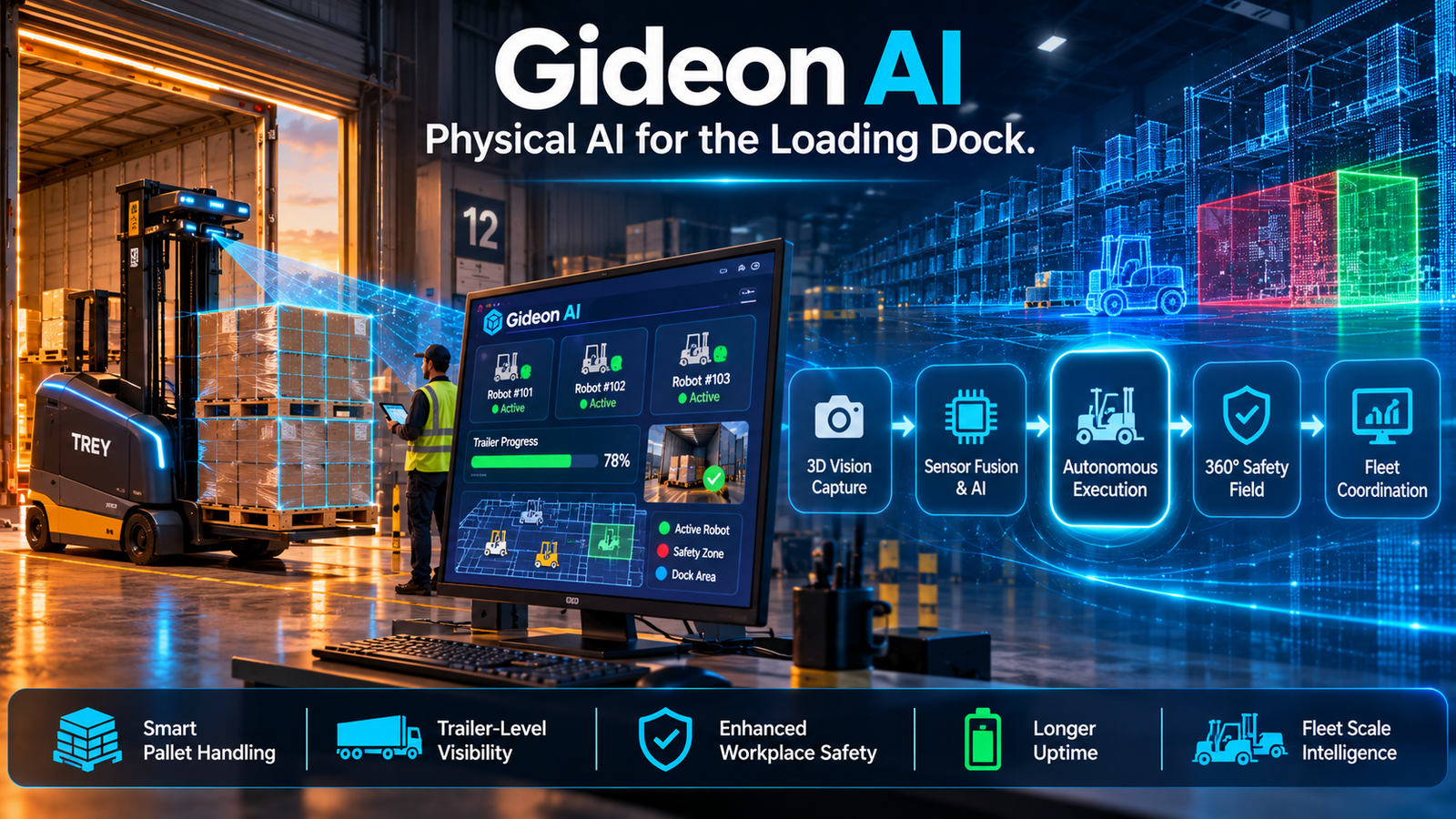
Step 1: Vision-based perception. Each robot uses a proprietary Vision Module with a two-camera stereoscopic system. This captures depth information and builds context about objects in the forklift’s path .
Step 2: Sensor fusion and AI processing. The system combines image data with laser scanner inputs and runs neural networks to identify loads, obstacles, and people. It recognizes over 119 load carrier types and more than 30 other objects common on warehouse floors .
Step 3: Autonomous execution. TREY plans movements in real time. It can rotate pallets as needed, detect dunnage that requires human removal, and share staging areas with manual forklifts during congestion .
Step 4: Fleet coordination. Gideon’s fleet management software coordinates multiple robots across dock doors. It integrates with Warehouse Management Systems and Warehouse Execution Systems, and provides a dashboard tracking trailers loaded, robot performance, and associate interventions .
The company’s technical foundation leans on NVIDIA infrastructure, including Jetson Xavier NX and RTX GPUs, for on-robot inference and training .
Key Capabilities of TREY
Full Trailer Automation
TREY handles loading and unloading from the first pallet to the last. It is designed for docks receiving 30 or more trailers per day, where the volume justifies full automation .
The performance claims are specific: up to 28 pallets per hour, or 224 per eight-hour shift. The heavy-duty model carries 6,000 pounds with 10 hours of battery life. The medium-duty model carries 3,500 pounds with 12 hours of operation .
Variability Handling
Most dock automation struggles with unpredictability. TREY is built to handle it. It recognizes different pallet orientations and rotates them as needed. It detects dunnage, insulation, or straps and notifies an associate for removal. It adapts to various trailer styles, including dry van, refrigerated, drop deck, and intermodal .
Safety Systems
TREY uses two laser scanners to create a 360-degree safety field with zones that adjust to operating conditions. It has six emergency-stop buttons plus a remote stop control. The system complies with ANSI/ITSDF B56.5-2019 and ISO 3691-4:2023 safety standards .
Autonomous Charging
The forklift charges between cycles without human intervention, extending operating time across multiple shifts. This matters for facilities running 24/7 operations where manual charging creates downtime .
Who Should Use Gideon AI?
Gideon’s product is not designed for every warehouse. The dock volume requirement alone filters the addressable market.
Gideon fits well for:
- Automotive manufacturing plants with high dock throughput and low tolerance for downtime
- Food and beverage distribution centers handling diverse load types
- Third-party logistics operations with 24/7 schedules
- Facilities receiving 30+ trailers daily where manual forklift labor is difficult to staff
Gideon may not fit for:
- Smaller warehouses with low trailer volume
- Operations with highly standardized, single-format loads where simpler automation suffices
- Facilities unwilling to integrate with existing WMS or WES systems
The company’s customer base reflects this focus. DB Schenker deployed Gideon robots in Leipzig as early as 2019 and later invested in the company. Automotive manufacturers have adopted TREY for production dock operations .
Funding and Corporate Structure
Gideon’s funding history provides context for its stage and trajectory.
| Round | Amount | Lead Investor | Participants |
|---|---|---|---|
| Series A | $31M | Koch Disruptive Technologies | DB Schenker, Prologis Ventures, Rite-Hite |
The participation of DB Schenker is notable because the logistics giant also deployed Gideon robots in its facilities. That combination of investment and deployment suggests genuine operational validation, not just financial backing.
The company appointed Iva Vukina, a former Goldman Sachs director, as Chief Commercial Officer in May 2025. The hire signals a push toward enterprise sales scaling with large customers .
Financial filings for the Croatian entity show a 2025 net loss of approximately €4 million on revenue of €2.8 million . This is consistent with a growth-stage hardware company investing ahead of scale.
Limitations and Considerations
No Public Pricing
Gideon does not publish pricing for TREY or its fleet software. Enterprise robotics deployments are quoted per project, factoring in robot count, dock configuration, integration requirements, and support terms. Buyers cannot self-evaluate cost without engaging sales.
Infrastructure Dependency
TREY requires integration with existing warehouse systems. Facilities without a modern WMS or WES may face additional implementation costs. The fleet software coordinates robots but depends on clean data from upstream systems.
Competitive Landscape
The autonomous forklift space includes established players like Vecna Robotics and emerging competitors. Gideon’s differentiation rests on its vision-based approach and ability to handle variability without predefined patterns. Whether that advantage holds as competitors improve their own perception systems is an open question.
Employee and Organizational Signals
Gideon’s Glassdoor presence is limited. One review describes “immature leadership” and favoritism, while another calls the product “okay, not solving a deep problem.” These are isolated data points, not patterns. But they are the only public employee signals available for prospective hires or partners evaluating culture.
Privacy and Security
Gideon is a robotics company, not a data platform. Privacy considerations center on operational data rather than personal information.
The robots collect video and sensor data for navigation and perception. This data stays on the robot or within the customer’s fleet management system. Gideon has not publicly disclosed whether it retains customer operational data for model training or product improvement. Enterprise buyers should clarify data handling terms during procurement.
For safety and compliance, TREY holds certifications under ANSI/ITSDF B56.5-2019 and ISO 3691-4:2023 . These are operational safety standards, not data security certifications. Gideon has not published SOC 2 or ISO 27001 status.
Gideon AI vs. Alternatives
| Platform | Target User | Key Strength | Pricing Transparency | Core Limitation |
|---|---|---|---|---|
| Gideon AI | High-volume docks | Full trailer automation, variability handling | None (enterprise) | Requires 30+ trailers/day |
| Vecna Robotics | Warehouse logistics | Autonomous pallet trucks, orchestration software | None (enterprise) | Different hardware focus |
| Seegrid | Manufacturing and warehousing | Vision-guided AMRs, established track record | None (enterprise) | Less specialized in trailer loading |
| Boston Dynamics | Broad robotics | Advanced mobility, Stretch for unloading | None (enterprise) | Higher cost, broader focus |
Gideon’s closest functional competitor is Vecna Robotics, which also targets material handling automation. Seegrid offers vision-guided vehicles but with less emphasis on full trailer cycles. Boston Dynamics’ Stretch handles case unloading but not full pallet loading and unloading.
The choice depends on the specific dock workflow. Gideon’s claim is end-to-end trailer automation, not partial task support.
Frequently Asked Questions
What is Gideon AI?
Gideon AI is a robotics company that builds autonomous mobile robots for warehouse material handling. Its flagship product, TREY, is an autonomous forklift that handles trailer loading and unloading from the first pallet to the last.
Is Gideon AI a chatbot or software tool?
No. Gideon AI is a hardware robotics company. The confusion likely comes from unrelated products using the “Gideon AI” name, including an open-source desktop agent on Product Hunt . The Gideon discussed here builds physical autonomous forklifts.
How much does Gideon AI cost?
Gideon does not publish pricing. TREY deployments are quoted through enterprise sales based on robot count, dock configuration, and integration requirements.
Who uses Gideon AI?
Automotive manufacturers, food and beverage distributors, and third-party logistics providers use Gideon robots. The company targets facilities receiving 30 or more trailers per day.
Where is Gideon AI headquartered?
Gideon operates through Gideon Brothers (USA) Inc. in Dover, Delaware, and Gideon Brothers d.o.o. in Osijek, Croatia. It also has an office in Bolingbrook, Illinois .
Conclusion
Gideon AI addresses a concrete problem in logistics: the loading dock is one of the hardest areas to automate, and labor shortages make manual forklift operation increasingly difficult to sustain. TREY’s vision-based approach handles variability that older automation could not, and its safety certifications and customer deployments provide evidence that the technology works in production environments.
The limitations are those of enterprise robotics. Pricing is opaque, deployment requires substantial dock volume, and the company is still scaling commercially. The name collision with unrelated “Gideon AI” products complicates search and discovery, which matters for anyone trying to evaluate the company online.
Gideon suits large warehouses and manufacturing plants with high trailer throughput and the engineering resources to integrate fleet management software. It may not suit smaller facilities or operations with highly standardized loads that simpler automation could handle.
Before engaging, request a site assessment and a total cost of ownership model that includes integration, maintenance, and software licensing. Ask for customer references in your specific industry. Confirm data handling practices for operational video and sensor data. The technology is real and deployed; the procurement diligence is where buyers should focus.