David AI is a venture-backed audio data research lab that builds high-quality, multilingual speech datasets for training voice AI models. Founded in 2024 by former Scale AI engineers, it has raised over $80 million and serves major AI labs and several “Magnificent Seven” tech companies.
At a Glance
- What it is: Audio-native data platform specializing in channel-separated speech datasets for voice AI training
- Founded: 2024 by Tomer Cohen and Ben Wiley, both formerly of Scale AI
- Funding: $80.5 million total, including a $50 million Series B in October 2025 led by Meritech and NVIDIA
- Customer base: Leading AI labs and multiple “Magnificent Seven” tech giants; crossed eight-figure annual revenue run rate
- Key differentiator: Largest corpus of channel-separated speech data on the market, roughly 10x the next largest, spanning about 15 languages
- Pricing: Not publicly disclosed; enterprise sales only
What Is David AI?
David AI is not a consumer product. It is an infrastructure company that sells training data to organizations building speech and audio AI models.
The company describes itself as the world’s first dedicated audio data research lab . Its core product is high-quality, diverse audio datasets that capture the real-world variability of human speech: accents, dialects, emotional tones, background noise, and recording conditions. Model developers use these datasets to train systems for speech recognition, translation, synthesis, and voice interaction.
This positioning matters for anyone searching for “David AI.” The name does not point to a chatbot, a writing assistant, or a productivity app. It points to a B2B data vendor operating behind the scenes of the voice AI industry.
How David AI Works
David AI’s operation is built around collecting audio data at scale, something the founders identified as a major bottleneck in audio AI development .
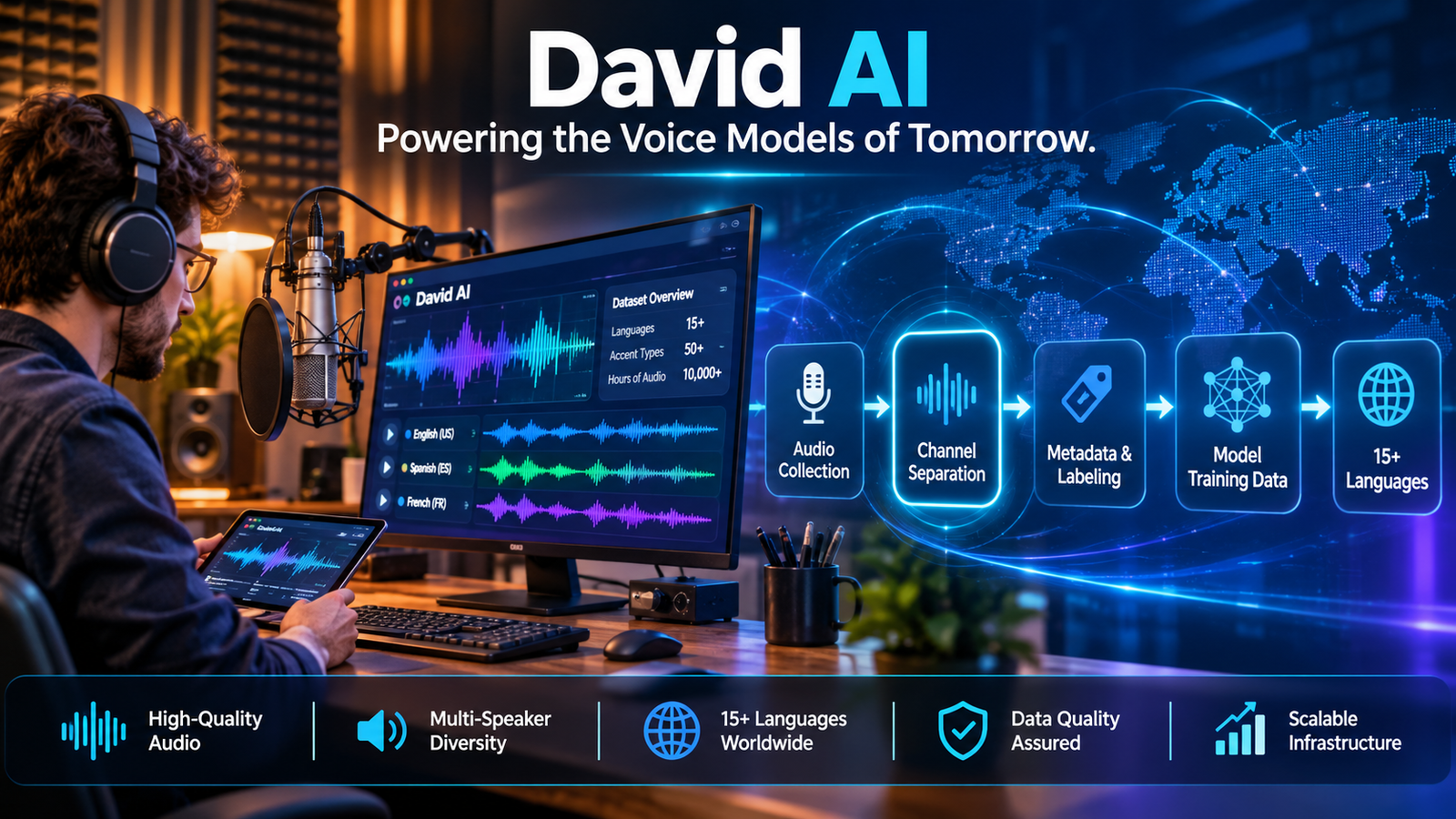
Step 1: Audio collection. The company runs an operation designed for what it calls “1,000x scale” audio collection. This involves studio-grade recording across multiple languages and geographies .
Step 2: Channel separation. David AI emphasizes channel-separated speech data, meaning individual speakers are recorded on separate audio channels. This produces cleaner training data than mixed recordings.
Step 3: Metadata and qualification. The platform captures rich metadata about accents, dialects, recording environments, and speaker characteristics. It also qualifies and labels data to meet model developers’ quality requirements .
Step 4: Delivery to model developers. Customers receive datasets formatted for training. David AI states its data has been used to train “several of the best speech models on the market” .
The company’s pitch is straightforward: audio models need far more high-quality data than currently exists, and David AI builds the infrastructure to supply it.
Key Capabilities
Channel-Separated Speech Data
David AI claims to hold the largest corpus of channel-separated speech data on the market, roughly 10 times the size of the next largest dataset . This format is valuable because it preserves individual speaker audio cleanly, reducing the noise that mixed recordings introduce.
Multilingual Coverage
The dataset spans approximately 15 languages with detailed accent and dialect metadata . For companies building voice models for global markets, this breadth reduces the need to source data from multiple vendors.
Data Qualification and Labeling
David AI does not just collect audio. It generates, qualifies, and labels multimodal datasets, and it identifies and manages quality requirements for model training . The platform also automates metadata creation to track data origin, changes, and timestamps.
Enterprise-Grade Data Governance
The platform is designed for enterprises with challenging multimodal data needs. This includes detecting and removing irrelevant, duplicated, or tampered data before delivery .
Who Uses David AI?
David AI targets a narrow but high-value customer segment: organizations training speech and audio models at scale.
The customer profile includes:
- Foundation model labs building speech recognition or synthesis systems
- “Magnificent Seven” tech companies developing voice interfaces
- Robotics companies using voice interaction
- Wearables and generative media firms
- Customer support automation providers
A Glassdoor review from an engineer at the company offered a candid internal perspective: “Product is okay, not solving a deep problem” . That is one employee’s opinion, not a market verdict. But it hints at a debate about whether audio data infrastructure is a durable moat or a commodity service.
The company’s revenue trajectory suggests the market disagrees with that reviewer. David AI crossed an eight-figure annual revenue run rate within roughly two years of founding .
Funding and Investors
David AI’s fundraising history signals strong institutional confidence.
| Round | Date | Amount | Lead Investors |
|---|---|---|---|
| Seed | September 2024 | $5M | First Round Capital |
| Series A | May 2025 | Not disclosed | Not disclosed |
| Series B | October 2025 | $50M | Meritech Capital, NVIDIA |
Total raised: $80.5 million . NVIDIA’s participation is notable. The chipmaker invests in companies that feed the AI training pipeline, and audio data sits squarely in that ecosystem.
Limitations and Open Questions
David AI operates in a specialized B2B category, which means several standard evaluation criteria do not apply. But important questions remain.
No Public Pricing
David AI does not publish pricing. A third-party directory lists tiers at $20, $50, and $100 per month, but these figures are unverified and may reflect a different product or outdated information . Enterprise data deals are typically negotiated per project, with pricing dependent on dataset size, language coverage, and exclusivity terms.
Wrapper Risk and Data Provenance
David AI collects and qualifies data, but the underlying audio comes from human speakers. The company has not publicly detailed how it obtains consent, compensates contributors, or handles privacy for recorded individuals. For enterprise buyers in regulated industries, provenance documentation is a critical procurement question.
Competitive Pressure
CB Insights lists competitors including Argilla, Snorkel AI, Defined.ai, and several Chinese data providers . The audio data market is not empty. David AI’s claimed scale advantage in channel-separated speech is its primary defense.
Employee Sentiment
The single Glassdoor review available describes “immature leadership” and “extreme favoritism” . One review is not a pattern, but it is the only public employee signal available. Prospective hires should seek additional perspectives.
Privacy and Data Handling
David AI’s public privacy policy at getdavid.ai covers website visitors and contact information, not the audio data products themselves . The policy describes standard collection of names, emails, and usage data, with sharing limited to service providers and legal requirements.
What is not disclosed: The company has not published details on how audio contributors are consented, whether speaker data is anonymized, or what rights customers receive regarding dataset exclusivity. It has not disclosed SOC 2 or ISO 27001 certification.
For enterprises training voice models, these gaps matter. Audio datasets can contain biometric-adjacent information. Buyers should require written data provenance documentation and confirm consent frameworks before signing contracts.
David AI vs. Alternatives
| Platform | Target User | Key Strength | Pricing Transparency | Core Limitation |
|---|---|---|---|---|
| David AI | Foundation model labs, large tech | Channel-separated speech at scale | None (enterprise sales) | Limited public documentation |
| Defined.ai | AI teams needing diverse data | Broad marketplace, multiple modalities | Moderate | Less specialized in audio |
| Snorkel AI | Enterprises with labeling needs | Programmatic labeling, data-centric AI | Low (enterprise) | Not audio-native |
| Argilla | NLP teams | Open-source labeling tools | High (open-source) | Not a data supplier |
David AI competes on specialization. Defined.ai offers broader data categories. Snorkel focuses on labeling workflows rather than raw audio collection. Argilla serves teams that want to label their own data.
The choice depends on whether a buyer needs a finished audio dataset or the tools to build one.
Frequently Asked Questions
Is David AI a consumer app?
No. David AI is a B2B audio data platform that sells training datasets to AI labs and enterprises. There is no consumer-facing product or free tier.
How much funding has David AI raised?
David AI has raised $80.5 million total, including a $50 million Series B in October 2025 led by Meritech Capital and NVIDIA .
What makes David AI different from other data vendors?
David AI specializes in channel-separated speech data, meaning individual speakers are recorded on separate channels. It claims the largest corpus of this data on the market, roughly 10 times the next largest .
Does David AI publish pricing?
No. Pricing is negotiated through enterprise sales. Third-party estimates exist but are unverified.
Who are David AI’s customers?
The company serves leading AI labs and several “Magnificent Seven” tech companies, according to Tech Funding News . It also works with robotics, wearables, and customer support automation firms.
Conclusion
David AI addresses a genuine bottleneck in voice AI development: the scarcity of high-quality, diverse audio training data. Its channel-separated speech datasets, multilingual coverage, and rapid revenue growth suggest real market demand. The backing from NVIDIA and Meritech adds credibility to its technical claims.
The limitations are those of a young, specialized infrastructure company. Pricing is opaque. Data provenance and contributor consent practices are not publicly documented. Employee sentiment, while limited to a single review, raises questions about internal culture.
David AI suits foundation model developers and large enterprises that need audio training data at scale and can navigate a custom procurement process. It may not suit smaller teams, researchers on tight budgets, or organizations that require transparent, self-serve pricing.
Before engaging, request written documentation on data provenance, contributor consent, and licensing terms. Ask for references from customers training similar model types. Confirm whether datasets are exclusive or shared across buyers. The platform’s technical claims are strong; the procurement due diligence is where buyers should focus.

Alex Carter is a technology writer at AI SpaceZ.com, who covers AI tools, software reviews, practical tutorials and emerging artificial intelligence trends. He aims to make AI easier to understand and help readers discover useful tools and technologies for everyday productivity.