Electric AI is a New York-based IT management platform that combines software with managed support services for small and mid-sized businesses. It offers device management, help desk support, and onboarding automation, but user reviews reveal significant concerns about service quality, billing practices, and security protocols.
At a Glance
- Core offering: IT management software plus outsourced help desk and device support for SMBs
- Target customer: Companies with 10 to 300 employees that lack dedicated IT staff
- Pricing model: Per-employee subscription with custom quotes; Vendr data suggests mid-sized teams pay $50,000 to $150,000 annually
- Reported issues: License over-purchasing, missed security deployments, billing disputes, and security protocol violations
- Company status: CEO Ryan Denehy describes a recent “AI-native” relaunch, but reviews reference layoffs and leadership changes affecting service
- Key risk: Contractual disputes and post-cancellation billing attempts, according to Capterra reviews
What Is Electric AI?
Electric AI is not a pure software product. It is a managed IT service wrapped in a software platform.
The company sells to businesses that need IT support but do not want to hire a full internal team. Electric handles device procurement, employee onboarding and offboarding, help desk tickets, and network security. Its software layer, including the Turbine device management system, gives customers visibility and control .
The pitch is consolidation. Instead of juggling separate tools for device management, help desk, and security, customers get one vendor with one subscription. For a 50-person company without a dedicated IT hire, that proposition has obvious appeal.
How Electric AI Works
The workflow depends on which services a customer buys. The core pattern is consistent.
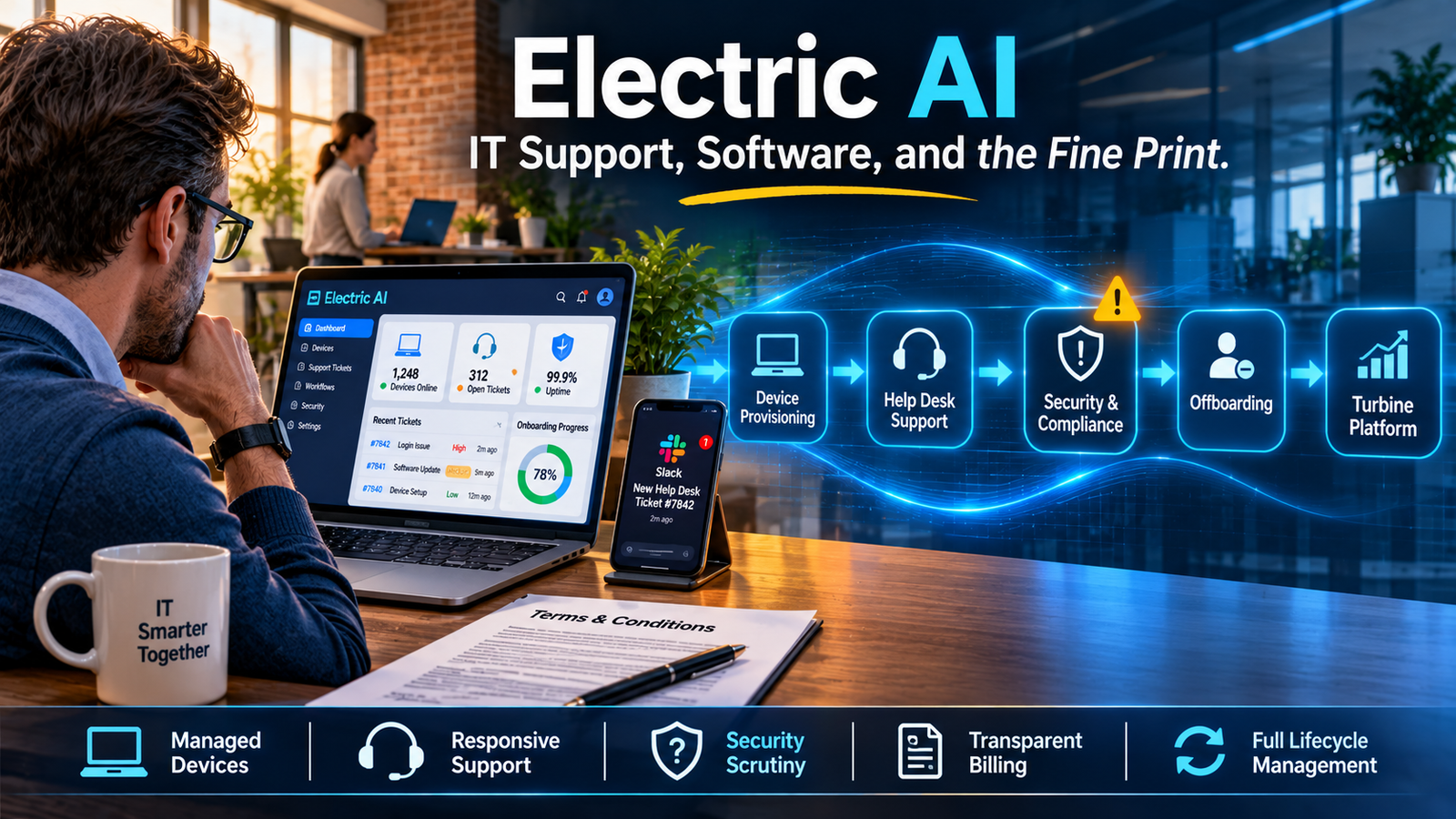
Step 1: Onboarding and provisioning. Electric ships laptops to new employees, sets up accounts, and configures devices according to company policies. The platform integrates with HR systems to trigger these workflows automatically.
Step 2: Ongoing device management. The Turbine platform tracks hardware, manages software licenses, and enforces security policies. IT admins access a dashboard to view device status and user assignments.
Step 3: Help desk support. Employees submit tickets through Slack or email. Electric’s support team handles issues remotely, with escalation paths for complex problems.
Step 4: Offboarding. When employees leave, Electric retrieves devices, wipes data, and deprovisions accounts.
The managed service component is central. Electric does not just sell software and walk away. Its team executes the IT work. That is the value proposition, and also the source of most complaints.
Key Features
Device Management (Turbine)
Turbine is Electric’s hardware and software management platform. It tracks devices, manages licenses, and enforces policies. A Software Advice reviewer praised the interface as intuitive for task management and collaboration .
However, the same reviewer flagged issues with license over-purchasing, incorrect assignments, and missing security software deployments . These are not cosmetic problems. They suggest gaps in execution that can leave companies exposed.
Help Desk and Support
Electric provides remote support through Slack and email. Response times and resolution quality vary widely in user accounts.
One reviewer described fast resolution of device issues that saved downtime . Another called the help desk “more or less useless” and said their staff ended up managing IT issues themselves .
Onboarding and Offboarding
This is Electric’s strongest reported use case. Multiple reviewers acknowledge that the platform simplifies employee lifecycle management, including laptop shipping and account setup .
The caveat is that bundling multiple tools creates fragmentation. One reviewer noted that Electric uses separate systems for MDM and EDR, forcing the customer’s team to manage multiple interfaces or rely on Electric for help .
Pricing: What You Actually Pay
Electric does not publish pricing on its website. Third-party data provides directional estimates.
| Company Size | Reported Annual Contract Range | Source |
|---|---|---|
| 10 to 50 employees | $15,000 to $50,000 | Vendr |
| 50 to 150 employees | $50,000 to $150,000 | Vendr |
| 150 to 300 employees | $150,000 to $350,000+ | Vendr |
Hidden costs to expect: Vendr’s analysis identifies several add-on fees that inflate the total :
- Onboarding fees: $0 to $10,000+ depending on company size
- Compliance add-ons: SOC 2 support and HIPAA packages priced separately
- Hardware markups: Electric may mark up laptops and monitors
- Overage charges: Mid-contract employee growth triggers additional fees
The per-employee model sounds simple. The actual contract is more complex. Buyers should request an itemized quote that includes every add-on before signing.
Service Quality and Billing Concerns
This is where Electric AI’s reputation becomes complicated.
Security Protocol Violations
A Software Advice reviewer made a serious allegation: Electric repeatedly remoted into their secure environment from India without using the contractually required US-based VPN .
If accurate, this represents a network security failure, not just a service lapse. The reviewer stated they eventually cancelled and blocked Electric from their systems.
Billing After Cancellation
A Capterra reviewer reported that Electric continued attempting to charge their card for a contract extension after cancellation, even after direct outreach to stop .
This pattern appears in multiple reviews. It suggests a collections process that does not gracefully handle cancellations.
License and Deployment Errors
The same Software Advice review that praised the interface also documented license over-purchasing, incorrect assignments, and missing security software . For an IT vendor, missing security deployments is a critical failure.
Internal Turbulence
A reviewer who chose Electric for its premium positioning described major staff layoffs shortly after onboarding began. They reported that a promised dedicated account manager never materialized, and that a Meraki licensing error halted operations for two hours without resolution from Electric .
CEO Ryan Denehy’s LinkedIn post about relaunching as an “AI-native” company suggests the business is pivoting . Pivots can improve products. They can also disrupt service for existing customers.
Privacy and Security
Electric AI’s security posture is difficult to assess from public information.
The company serves as a managed security provider, which means it accesses customer networks and devices. A Check Point case study quotes an Electric director saying the company’s goal is “keeping ourselves as secure as possible” .
What is not publicly disclosed: Electric has not published SOC 2 certification details, ISO 27001 status, or Zero Data Retention policies in its marketing materials. The allegations about remote access without VPN raise questions about whether contractual security requirements are consistently enforced.
For businesses handling sensitive data, these gaps matter. Request written security documentation and confirm access controls before signing.
Who Should Use Electric AI?
Electric may fit for:
- SMBs with 10 to 100 employees and no internal IT staff
- Companies that prioritize onboarding/offboarding automation over advanced security customization
- Buyers willing to negotiate contract terms carefully and document every commitment in writing
Electric may not fit for:
- Organizations with strict security or compliance requirements
- Businesses that need consistent, high-touch support
- Companies uncomfortable with offshore support teams
- Anyone who cannot afford to litigate a billing dispute
The value proposition is real for the right buyer. The risk profile is also real. The decision depends on tolerance for the issues documented in user reviews.
Electric AI vs. Alternatives
| Platform | Target User | Key Strength | Pricing Transparency | Core Limitation |
|---|---|---|---|---|
| Electric AI | SMBs without IT staff | Bundled software and managed support | Low (custom quotes) | Service quality and billing complaints |
| Rippling IT | Growing SMBs | Unified HR and IT platform | Moderate | Less managed service depth |
| Kandji | Mac-focused businesses | Strong Apple device management | High (public tiers) | No managed help desk |
| NinjaOne | IT teams and MSPs | Comprehensive RMM features | Moderate | Software only, no service layer |
Rippling competes on integration with HR and payroll. Kandji focuses on Apple device management with clear pricing. NinjaOne serves IT teams that want tools, not outsourcing. Electric competes on the managed service model, which is both its differentiator and its weak point when execution fails.
Frequently Asked Questions
Is Electric AI a software company or a service company?
Both. Electric sells a device management platform (Turbine) bundled with managed IT support. Customers pay for the software and the human team that executes IT tasks.
How much does Electric AI cost?
Pricing is custom-quoted. Vendr data suggests small teams pay $15,000 to $50,000 annually, while mid-sized teams pay $50,000 to $150,000 . Onboarding fees and compliance add-ons increase the total.
What are the main complaints about Electric AI?
User reviews document license over-purchasing, missing security deployments, billing after cancellation, and security protocol violations including remote access without required VPNs .
Does Electric AI have security certifications?
The company has not publicly disclosed SOC 2 or ISO 27001 certification in its marketing materials. Businesses with compliance requirements should request documentation directly.
Is Electric AI still operating?
Yes. CEO Ryan Denehy described an “AI-native” relaunch in 2026 . However, reviews reference layoffs and internal changes that affected customer service .
Conclusion
Electric AI addresses a real need: SMBs without IT staff need someone to manage devices, support employees, and handle the tedious work of onboarding and offboarding. The bundled software and service model offers a single vendor solution that appeals to resource-constrained teams.
The documented problems are equally real. Security protocol violations, license errors, billing disputes after cancellation, and service disruptions during internal restructuring paint a picture of a company struggling to execute consistently. Some users report positive experiences, particularly around onboarding automation. Others describe failures serious enough to warrant cancellation and public warnings.
Electric AI suits buyers who negotiate carefully, document every commitment, and have the resources to manage a vendor relationship closely. It may not suit organizations with strict security requirements or those unwilling to risk the service inconsistencies documented in reviews.
Before signing, request an itemized quote with all add-ons. Confirm security protocols in writing, including VPN requirements for remote access. Negotiate cancellation terms explicitly. Ask for references from companies of similar size and industry. The platform has genuine utility, but the contract terms and service execution require the same scrutiny you would apply to any critical infrastructure vendor.