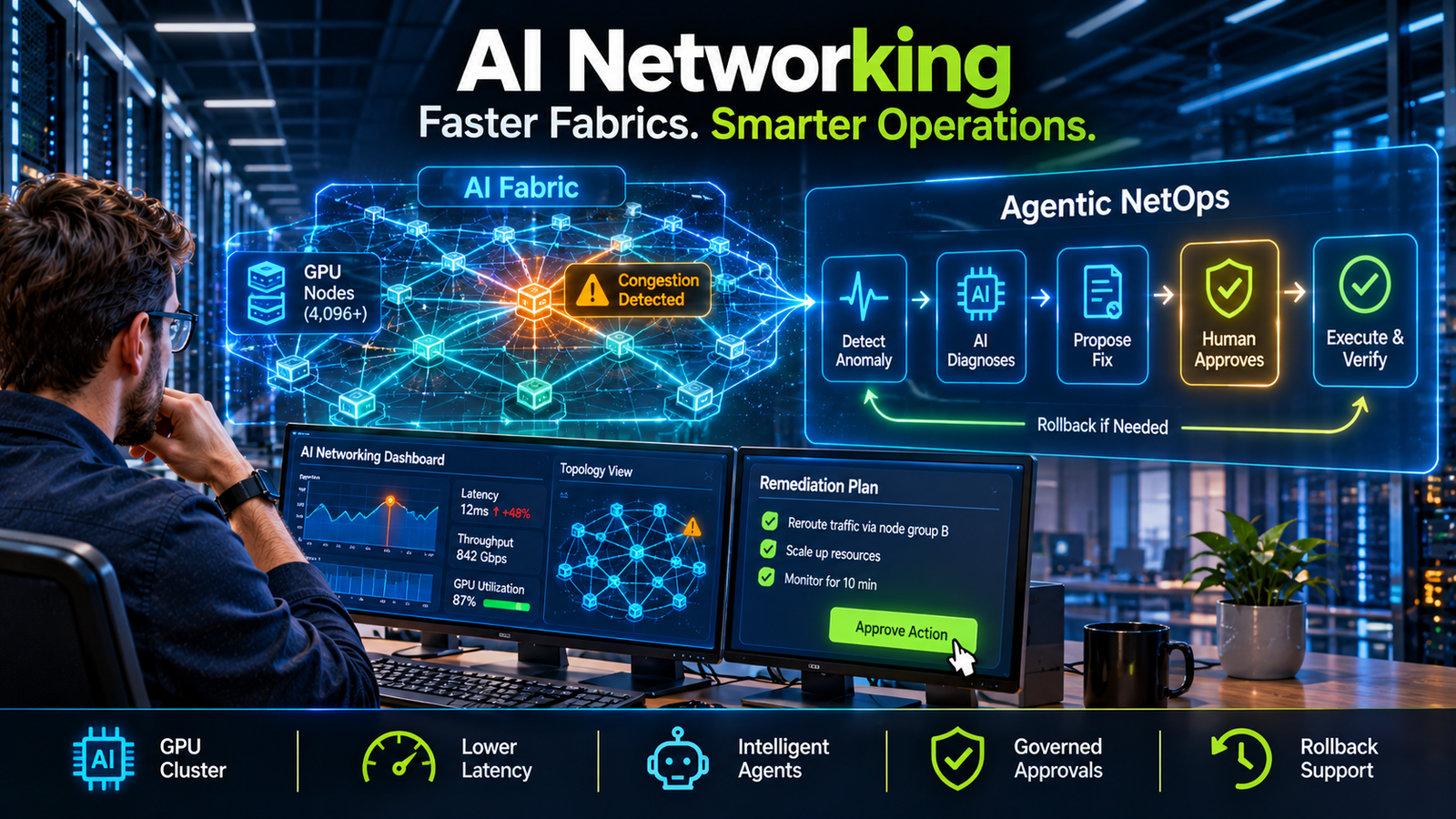
AI networking refers to two connected ideas: network infrastructure purpose-built to handle AI workloads, and network operations managed by AI agents. The first drives massive data center fabrics for GPU clusters. The second automates fault detection, remediation, and configuration with varying degrees of human oversight.
At a Glance
- Two distinct meanings: AI infrastructure networking (fast, lossless fabrics for GPU clusters) and AI-driven network operations (agentic automation)
- Market growth: HPE projects 44% CAGR for data center networking through 2029, driven largely by AI demand
- Key vendors: Cisco, NVIDIA, Arista, HPE Juniper, Broadcom, and Huawei dominate the infrastructure side
- Technical core: Job completion time (JCT) is the metric that matters most for AI training fabrics, not raw bandwidth
- Operational reality: Agentic NetOps remains early. Gartner outlines realistic pilots with 15–25% ticket reduction targets, not fully autonomous networks
- Critical caveat: Vendor claims about performance gains are rarely independently benchmarked
What Is AI Networking?
AI networking covers two related but distinct domains. Confusing them leads to poor procurement decisions and inflated expectations.
Domain one: networking for AI. This is the physical and logical infrastructure that connects thousands of GPUs into a single training cluster. AI workloads create traffic patterns that traditional data center networks handle poorly. The network must deliver extremely low latency and near-zero packet loss across massive scale .
Domain two: AI for networking. This is the application of machine learning and AI agents to network operations. It includes predictive analytics, automated fault remediation, and intent-based configuration. The promise is fewer manual tickets and faster mean time to repair (MTTR) .
Most vendor marketing blurs these categories. A switch vendor selling 800G fabrics and a software vendor selling AIOps agents are solving different problems. Buyers should know which one they actually need.
How AI Networking Works (Infrastructure Side)
Training large language models requires thousands of GPUs to communicate constantly. The network becomes part of the compute system, not just a pipe between servers.
The core challenge is job completion time. Every millisecond of network delay extends training runs. Congestion, load imbalance, and link failures directly increase JCT and cost .
Traditional Ethernet struggles here. Standard load balancing uses stateless ECMP, which distributes traffic evenly but ignores congestion. AI traffic is bursty and synchronized, creating conditions like incast congestion that standard Ethernet handles poorly.
Enhanced Ethernet fabrics address this. Cisco’s approach includes stateful flowlet load balancing, congestion-aware distribution, and packet spraying with reordering. The goal is to keep every link busy without dropping packets .
Scheduled Ethernet represents the most advanced tier. It sprays packets across all paths and reorders them at the destination, decoupling load balancing from traffic characteristics entirely. This delivers the best JCT but requires tighter NIC-to-fabric coupling .
Ultra Ethernet Consortium is developing open standards for these capabilities. Cisco is a steering member, and its N9000 series switches are positioned as Ultra Ethernet ready .
How AI Networking Works (Operations Side)
Agentic NetOps replaces scripted automation with AI agents that can reason through unfamiliar problems.
Scripted automation fails on novel faults. It executes predefined steps and cannot adapt when conditions differ from the playbook. AI agents are designed to plan, diagnose, and execute with verification .
Gartner’s BRITE framework defines what counts. True agentic software must demonstrate explainable planning, event-driven initiation, governed execution with verification and rollback, and integration with existing toolchains. Chatbots that summarize alerts do not qualify .
A realistic academic example: Researchers built a six-agent pipeline using GPT-4o for cognitive reasoning over a virtualized routing testbed. It achieved 100% remediation success across 30 controlled trials with a mean MTTR of 29.9 seconds. That is a 67.5% reduction versus a developer baseline. The system used a human-in-the-loop safety gate for approval before action .
What this means in practice: AI can handle well-scoped diagnostic and remediation tasks today. Fully autonomous network operations remain a research goal.
Key Vendors and Platforms
Cisco claims its Intelligent Collective Networking improves network utilization by 33% and reduces job completion time by 28% compared to non-optimized path selection . These are company claims, not independently verified benchmarks.
HPE’s networking revenue reached $2.9 billion in fiscal Q3 2026, up 74.9% year-on-year, largely reflecting the Juniper acquisition. Data center networking alone grew 112.2% . The company is betting heavily on AI fabrics as a growth driver.
Main Use Cases
Large-scale model training. GPU clusters require lossless, low-latency fabrics. This is the highest-stakes use case and drives most infrastructure spending.
Inference at scale. Inference has different traffic patterns than training. Cisco positions its N9000 portfolio for both, but the load balancing requirements differ .
Network operations automation. Agentic NetOps targets Day 2 operations: diagnostics, root cause analysis, drift remediation, and change plan generation. Gartner recommends starting with cross-signal diagnostics and drift correction, where traditional automation struggles most .
5G and edge networking. Ericsson partnered with Intel in June 2025 to integrate AI accelerators into 5G network optimization . This is a separate market from data center fabrics but shares the AI-driven operations theme.
Limitations and Honest Concerns
Vendor claims lack independent verification. Cisco’s 28% JCT reduction figure and HPE’s growth projections are company statements. Buyers should run their own benchmarks on representative workloads before committing.
Agentic NetOps is not autonomous. Gartner’s own guidance describes supervised execution with rollback, not hands-off operations. The 15–25% ticket reduction target assumes careful pilot scoping and mature operational hygiene . Organizations with poor telemetry or undocumented configurations will see worse results.
Ecosystem fragmentation is real. Ultra Ethernet standards are still developing. NVIDIA’s Spectrum-X creates deep integration with NVIDIA compute but raises lock-in questions. Cisco offers vendor-agnostic validation across NVIDIA, AMD, and Intel, but the practical complexity of multi-vendor fabrics remains high .
Operational skills gap. AI fabrics require different troubleshooting skills than traditional enterprise networks. Congestion analysis, packet spraying behavior, and JCT optimization are not standard NetOps competencies.
Pricing opacity. None of the major vendors publish transparent pricing for AI networking hardware. Procurement requires direct engagement, which disadvantages smaller buyers.
Privacy and Security Considerations
AI networking infrastructure itself is primarily a hardware and protocol concern. The security questions differ by domain.
For AI fabrics: The primary risks are configuration errors that create security gaps, and supply chain concerns around switch silicon and optics. Buyers should verify vendor security certifications and validate firmware update processes.
For agentic NetOps: AI agents that can execute network changes carry operational risk. Gartner emphasizes governed execution with verification and rollback as a baseline requirement . Without these controls, an agent error can cause outages rather than prevent them.
Important distinction: SOC 2 or ISO 27001 certification for a network management platform does not guarantee that AI agents make safe decisions. Security certification covers data handling and organizational controls, not model reliability.
Who Should Care About AI Networking?
Enterprises building or renting GPU capacity. If you are training models at scale, fabric design directly affects cost and time-to-result.
Network operations leaders facing alert fatigue. Agentic NetOps pilots can reduce MTTR for scoped incident types. Start with diagnostics, not execution.
Cloud and neocloud providers. Infrastructure differentiation increasingly depends on network performance for AI workloads.
Traditional enterprise IT teams. AI networking may not be urgent yet. Standard campus and branch networking growth is projected at just 6% CAGR, far below data center rates . Prioritize based on actual AI workload plans.
Common Mistakes
Confusing the two domains. Buying a fast switch does not give you AI-driven operations. Buying an AIOps tool does not improve fabric performance.
Chasing raw bandwidth. JCT and effective utilization matter more than port speed. A 400G fabric with intelligent load balancing can outperform an 800G fabric with static ECMP.
Skipping pilot scoping. Agentic NetOps pilots that target too broad a scope fail. Start with one incident type and measure against a baseline.
Ignoring operational hygiene. AI agents need good telemetry, documented configurations, and clear policies. Gartner explicitly warns against waiting for perfection, but also notes that hygiene improvements directly improve agent accuracy .
Accepting vendor benchmarks. Run your own tests on your own workloads. Fabric performance is workload-dependent.
Frequently Asked Questions
What is AI networking in simple terms?
AI networking has two meanings. It can mean the high-speed network infrastructure that connects GPUs for AI training and inference. It can also mean using AI to automate network operations, such as fault detection and remediation.
Is AI networking the same as AIOps?
No. AIOps platforms correlate alerts and surface insights, but they do not plan or execute actions. Agentic NetOps software adds planning, governed execution, and verification with rollback .
Do I need special switches for AI workloads?
For large-scale training, yes. Standard Ethernet with stateless load balancing creates congestion and extends job completion time. Enhanced Ethernet fabrics with congestion-aware load balancing and packet spraying perform better for AI traffic patterns .
How mature is agentic network automation?
It is early but usable for scoped tasks. Academic research shows strong results in controlled environments . Gartner recommends pilots targeting 15–25% ticket reduction, not full autonomy .
Will AI replace network engineers?
Not in the near term. The realistic shift is from manual troubleshooting to reviewing, approving, and governing agent-initiated work. Headcount scaling without proportional outcome gains is the problem AI addresses, not replacing engineers entirely .
Conclusion
AI networking is a real and rapidly growing field, but it is not one thing. It is a hardware problem and an operations problem, with different vendors, different maturity levels, and different risks.
The infrastructure side is advancing quickly. Cisco, NVIDIA, Arista, and HPE are shipping high-capacity fabrics designed for GPU clusters. The technical direction is clear: lossless Ethernet, intelligent load balancing, and job completion time as the primary metric.
The operations side is more nuanced. Agentic NetOps can deliver measurable MTTR reductions in scoped pilots. It cannot deliver autonomous networks today. Vendors that claim otherwise are overselling.
What matters most: Understand which problem you are solving. Benchmark before buying. Start small with agentic automation and measure against a baseline. Do not accept vendor performance claims without independent validation.
Who should evaluate AI networking now: Organizations with active GPU training plans or significant network operations pain. Who can wait: Enterprises with stable, modest networking needs and no near-term AI infrastructure requirements.

Alex Carter is a technology writer at AI SpaceZ.com, who covers AI tools, software reviews, practical tutorials and emerging artificial intelligence trends. He aims to make AI easier to understand and help readers discover useful tools and technologies for everyday productivity.