Protex AI is an Irish computer vision platform that connects to existing CCTV cameras to detect unsafe behaviors and operational risks in industrial facilities. It serves enterprise EHS teams in warehousing, manufacturing, and logistics, with a privacy-first architecture that processes video on-site rather than in the cloud.
At a Glance
- Core function: Computer vision on existing CCTV to detect safety events like missing PPE, unsafe forklift driving, and pedestrian-vehicle proximity
- Founded: 2021, headquartered in Dublin, Ireland
- Funding: $36 million Series B, with backing from W23 and Playfair Capital
- Pricing: No public pricing; third-party planning estimates suggest first-year costs around $103K to $259K for a single production deployment
- Certifications: ISO 27001 certified, aligned with GDPR, CCPA, and the EU AI Act
- Notable customers: Dot Foods, Marks & Spencer, DHL, Nucor, Sysco, Bendix
What Is Protex AI?
Protex AI is not a general-purpose AI tool. It is a specialized platform built for environment, health, and safety teams in industrial settings.
The company was founded in 2021 in Dublin, Ireland, and has positioned itself at the intersection of computer vision and workplace safety . Its core proposition is straightforward: most industrial facilities already have cameras. Protex AI makes those cameras intelligent.
The platform plugs into existing CCTV infrastructure and applies computer vision models to detect unsafe behaviors and operational conditions. It captures events autonomously, turning passive video feeds into searchable, actionable safety data.
Protex AI launched Protex Intelligence in November 2025, an AI assistant that lets safety professionals query their data in plain language and receive instant dashboards and reports . The company reports one customer achieved a 90% reduction in reporting times using the feature .
How Protex AI Works
The technical architecture is designed around privacy and minimal hardware disruption.
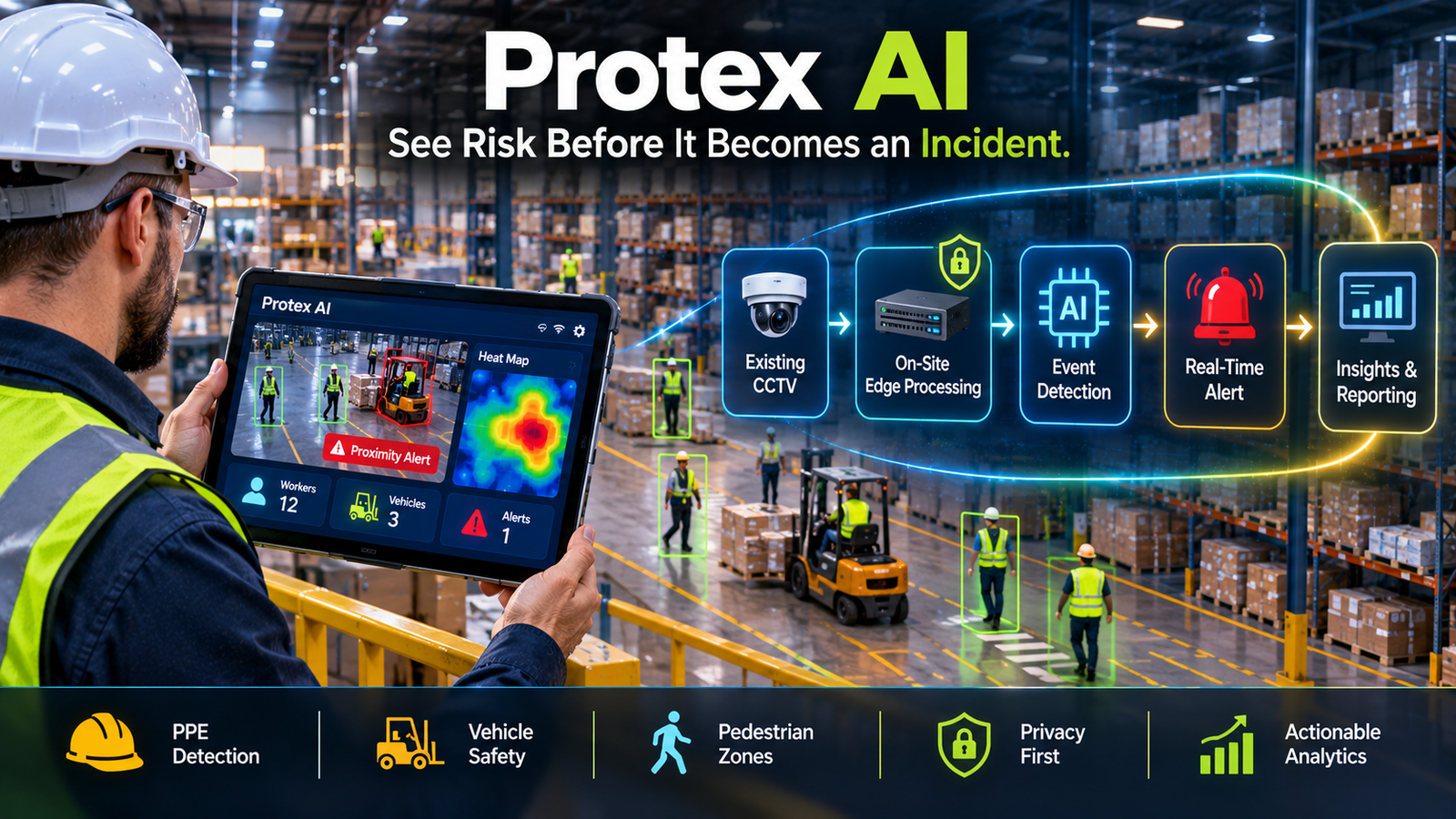
Step 1: Connect to existing cameras. Protex AI runs on the CCTV infrastructure a facility already operates. No new camera hardware is required. A secure edge device is installed on-site to process video locally .
Step 2: Process video at the edge. The edge device analyzes the continuous video stream locally. The raw video feed stays on-site. Only short encrypted event clips and metadata travel to the cloud, according to how the site configures its settings .
Step 3: Define zones and rules. Safety teams configure the zones and event types that matter for their site. This includes dock lanes, work cells, pedestrian walkways, and specific behaviors like PPE compliance or forklift speed .
Step 4: Receive alerts and insights. Events appear in dashboards and reports. On-site operational alerts arrive in near-real-time, roughly 15 to 20 minutes after an event .
Step 5: Investigate and act. Teams review video evidence, identify root causes, and implement corrective actions. The system describes observable states and movements; it does not read intent or identify individuals .
Key Features
Computer Vision Safety Detection
Protex AI detects observable safety events across industrial environments. The platform can flag missing PPE, unsafe forklift operation, pedestrian-vehicle proximity, and process deviations.
The system measures what cameras can see: counts of people or vehicles, dwell time, movement within a camera view, congestion, throughput, and proximity between people and vehicles . It does not claim to interpret intent or emotion.
Protex Intelligence AI Assistant
Launched in November 2025, Protex Intelligence lets safety leaders ask questions in natural language and receive instant dashboards, reports, and insights . The assistant combines video intelligence, incident data, and behavioral trends.
Users can generate real-time reports for different audiences, explore the “why” behind incidents with video context, save custom prompts for repeatable reporting, and prioritize actions with data-driven suggestions . A Neovia Logistics executive described the prompting feature as “phenomenal” for ensuring consistent analysis .
Edge Processing and Privacy Controls
Video is processed on an edge device on-site, and each organization sets its own privacy controls . This architecture addresses a common enterprise objection to cloud-based video analytics: data exposure.
The system can be configured to anonymize individuals, and raw footage does not leave the facility by default. Only event clips and metadata are transmitted to the cloud, and sites control what is shared .
Open API and EHS Integrations
Protex AI provides an open API that connects with existing EHS systems, business intelligence platforms, and other safety tools . This allows safety data to flow into the systems teams already use, rather than creating another silo.
Configurable Rules and Dashboards
Safety teams build custom rules for their specific facility conditions. Dashboards visualize data in real time, and heatmaps surface congestion patterns and risk zones . One customer identified a single area responsible for 90% of weekly events using the platform’s data .
Pricing: What Buyers Should Expect
Protex AI does not publish pricing. It sells through commercial enterprise contracts, and costs depend on deployment scale, number of cameras, and site count.
Important caveat: TriVista explicitly states these are planning allowances, not verified prices. The figures include implementation, integration, and ongoing costs beyond licensing. Prospective buyers should request a scoped quote based on their actual camera count, site count, and integration requirements.
The pricing positions Protex AI firmly in enterprise territory. This is not a tool for small facilities or single-site operations with limited budgets.
Privacy and Security
Protex AI’s security posture is one of its stronger selling points, with specific disclosures that matter for enterprise procurement.
Verified certifications: Protex AI holds ISO 27001 certification and undergoes annual independent audits to maintain it . The platform is hosted on AWS infrastructure and is designed to support GDPR, CCPA, the UK Data Protection Act, and the EU AI Act .
Edge-first architecture: Video processing happens on-site. Raw footage stays within the facility. Only encrypted event clips and metadata are transmitted to the cloud, and each site configures what is shared . This is a meaningful architectural choice, not just a policy claim.
What to verify: ISO 27001 covers the information security management system. It does not automatically mean Zero Data Retention. Buyers should ask specifically about event clip retention periods, whether clips are used for model training, and what anonymization options are available for their workforce. Protex AI’s Trust Center provides detailed documentation, but access requires an NDA .
Who Should Use Protex AI?
Protex AI fits well for:
- Enterprise EHS teams managing multiple industrial sites
- Warehousing and logistics operations with high pedestrian-vehicle interaction
- Manufacturing facilities seeking proactive safety detection beyond manual audits
- Organizations with existing CCTV infrastructure they want to leverage
- Companies requiring on-premise or edge processing for privacy compliance
Protex AI may not fit for:
- Small facilities with limited safety budgets
- Operations without existing camera infrastructure
- Companies seeking a lightweight, self-serve safety tool
- Organizations that cannot support edge device installation
The customer roster confirms the enterprise focus. Dot Foods, Marks & Spencer, DHL, Nucor, and Sysco are large-scale operations with dedicated safety teams and the resources to implement and manage the platform .
Protex AI vs. Alternatives
| Platform | Target User | Key Strength | Pricing Transparency | Core Limitation |
|---|---|---|---|---|
| Protex AI | Enterprise industrial EHS | Edge processing, ISO 27001, Protex Intelligence | Low (custom enterprise quotes) | High entry cost, enterprise-only |
| Buddywise | Industrial safety teams | Integrates with 90% of digital cameras, mobile alerts | Low | Smaller vendor, less enterprise track record |
| Surveily AI | Logistics and manufacturing | Hazard detection and compliance monitoring | Low | Based in Poland, less North American presence |
| Safety Mojo | Construction and oil/gas | Safety management software with analytics | Moderate | Software-focused, not computer vision-native |
CB Insights lists Surveily AI as a direct competitor, founded in 2018 and based in Poland, serving similar industrial sectors . Buddywise, a Swedish startup, offers comparable computer vision safety monitoring with broad camera compatibility .
Protex AI differentiates through its enterprise customer base, ISO 27001 certification, and the Protex Intelligence AI assistant. Competitors may offer lower entry points or different regional strengths. The choice depends on deployment scale, existing infrastructure, and procurement requirements.
Common Mistakes When Evaluating Protex AI
Assuming pricing is comparable to SaaS tools. Protex AI is an enterprise deployment with hardware, implementation, and integration costs. Budget for the full scope, not just a license fee.
Skipping the privacy architecture review. Edge processing is a genuine differentiator, but buyers should verify exactly what data leaves the site, how long event clips are retained, and what anonymization options exist for their specific workforce.
Underestimating change management. Protex AI surfaces behaviors that safety teams may not have known about. One customer discovered operators climbing on stacked pallets to reach items, a behavior leadership had not anticipated . Acting on these findings requires coaching and process changes, not just software deployment.
Expecting instant ROI across all sites. The Dot Foods case study shows meaningful results at two sites before expansion to seven more . A phased rollout with measured results at each stage is more realistic than enterprise-wide deployment on day one.
Ignoring integration requirements. Protex AI connects to EHS systems and business intelligence platforms via API. Teams should confirm their existing stack supports the integrations they need before committing.
Real-World Results
Protex AI’s customer case studies provide concrete outcome data, though these are company-published and should be read as vendor-reported results.
Dot Foods deployed Protex AI at two distribution centers. The hub site achieved a 39% reduction in overall safety events and a 71% reduction in person/vehicle near-miss events. The satellite site saw a 30% reduction in overall safety events and a 33% reduction in vehicle/vehicle near misses . The company is expanding to seven additional sites.
Bendix Commercial Vehicle Systems used continuous video to identify an automated work cell repeatedly striking racks. The evidence justified a permanent fix that recovered an estimated 226 labor hours per month .
Marks & Spencer reported an 80% reduction in overall incidents within the first 10 weeks of deployment, according to Protex AI’s product page .
These results are vendor-published and should be verified through reference calls with customers of similar scale and industry.
Frequently Asked Questions
Is Protex AI free?
No. Protex AI does not offer a free tier or self-serve trial. It sells through enterprise contracts with custom pricing. Third-party planning estimates suggest first-year costs starting around $103,000 for a single deployment, though these are not verified vendor quotes .
What certifications does Protex AI hold?
Protex AI holds ISO 27001 certification and states alignment with GDPR, CCPA, the UK Data Protection Act, and the EU AI Act . The company provides a Trust Center with security documentation, accessible under NDA.
Does Protex AI store video in the cloud?
By default, video is processed on an edge device on-site, and raw footage stays within the facility. Only short encrypted event clips and metadata are transmitted to the cloud, according to how each site configures its settings .
What industries does Protex AI serve?
Protex AI primarily serves warehousing, logistics, manufacturing, and distribution operations. Its customers include food distribution, automotive manufacturing, retail supply chains, and industrial production facilities .
How does Protex AI differ from traditional safety audits?
Traditional audits sample behavior at specific times. Protex AI monitors continuously, capturing events that occur between audits. One customer discovered near-miss frequencies that surprised even experienced safety managers, including close calls during shift transitions that no existing process captured .
Conclusion
Protex AI addresses a specific and valuable problem: industrial facilities generate enormous amounts of video data that traditional safety processes cannot use. The platform turns existing cameras into continuous safety observers, surfacing risks that manual audits miss.
The strengths are substantial. Edge processing addresses legitimate privacy concerns. ISO 27001 certification and alignment with major regulatory frameworks support enterprise procurement. Customer results from Dot Foods, Marks & Spencer, and Bendix demonstrate measurable impact, though these are vendor-published and should be independently verified.
The limitations are equally real. Pricing is opaque and positioned for enterprise budgets. Deployment requires edge hardware, integration work, and change management. The platform describes observable states and movements; it does not replace human judgment about causes and solutions.
Protex AI suits enterprise EHS teams with existing CCTV infrastructure, multiple sites, and the resources to implement and act on continuous safety data. It may not suit small facilities, operations without camera infrastructure, or teams seeking a lightweight, low-cost tool.
Before engaging, request a scoped quote for a single-site pilot. Verify data retention and anonymization practices directly. Speak with reference customers of similar scale and industry. The platform offers genuine capability for the right enterprise buyer, but the commitment requires the diligence any six-figure deployment deserves.