Jellyfish AI is a software engineering intelligence platform that helps engineering leaders measure the adoption, cost, and business impact of AI coding tools across their development teams. It connects data from GitHub, Jira, and AI vendors like Copilot and Claude to show whether AI investments are actually improving delivery outcomes.
At a Glance
- Core function: Engineering intelligence with a dedicated AI Impact module for tracking AI tool adoption, spend, and ROI
- Key differentiator: Vendor-agnostic visibility across multiple AI coding tools, not tied to a single provider
- Customer base: Over 1,000 companies, with 500+ cited in earlier company materials, including DraftKings and Blue Yonder
- Pricing: Quote-only, with one public AWS Marketplace bundle at $30,800 per year for 15 engineering seats
- Certifications: SOC 1 Type II, SOC 2 Type II, GDPR, CCPA, and CSA STAR
- Best fit: Engineering leaders at organizations with significant AI tool spend who need to justify or optimize that investment
What Is Jellyfish AI?
Jellyfish AI is not a standalone AI product. It is a module within the broader Jellyfish software engineering intelligence platform, specifically built to answer a question that has become urgent for engineering leaders: is our AI tooling actually working?
The platform aggregates data from source control systems, issue trackers, CI pipelines, and AI vendor APIs. It then presents that data through dashboards and a natural language assistant called Jellyfish Assistant . The AI Impact module focuses specifically on AI adoption, token spend, and productivity outcomes.
Jellyfish has held a Leader position in G2’s Software Development Analytics Tools grid for 17 consecutive quarters, as of Fall 2026 . G2 review data cited by the company shows 98% of reviewers gave a 4- or 5-star rating . These are company-published figures, but the consistency of the recognition suggests genuine market presence rather than marketing spin.
How Jellyfish AI Works
The workflow is built around connecting fragmented engineering data into a single view.
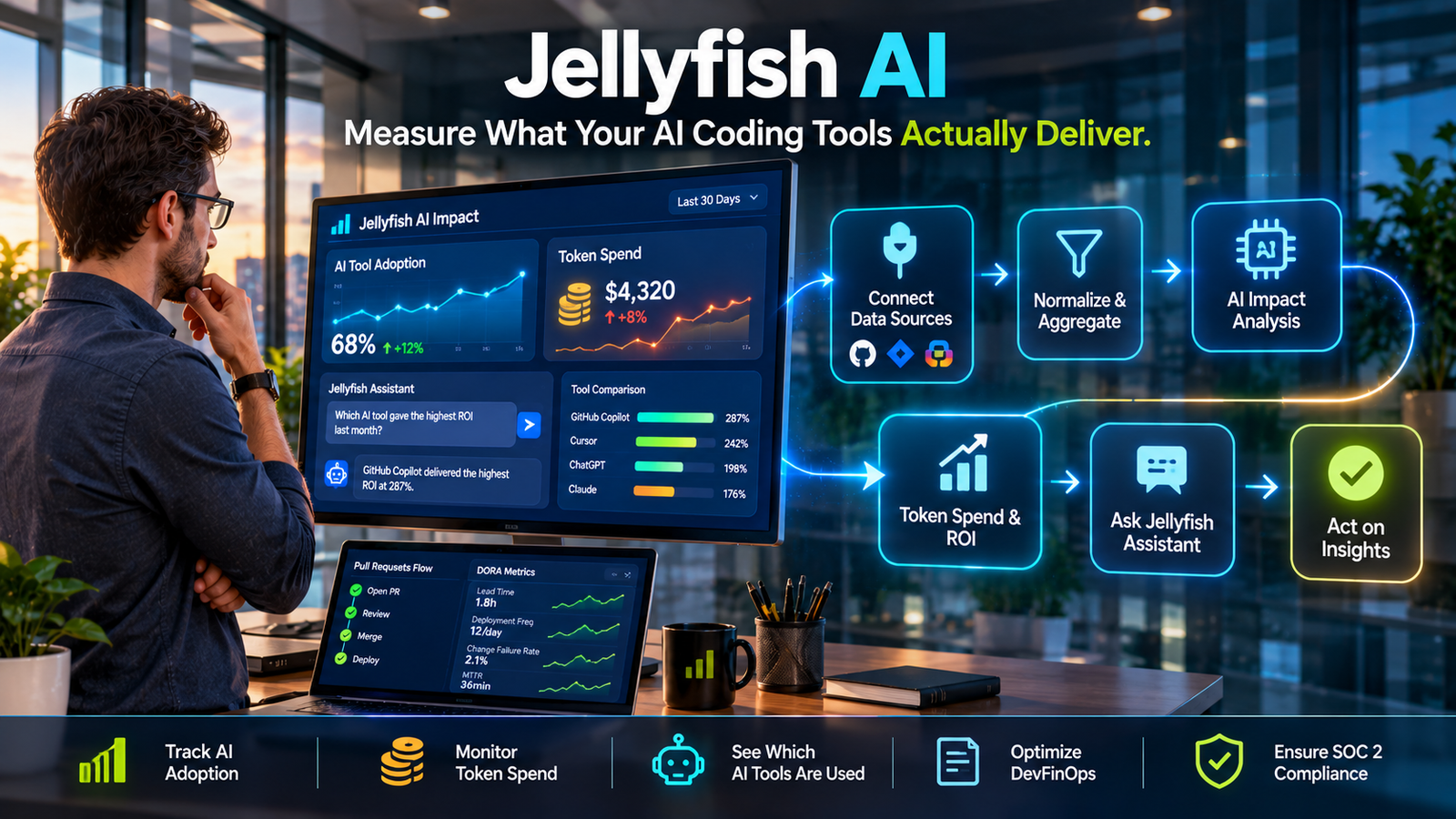
Step 1: Connect data sources. Jellyfish integrates with GitHub, GitLab, Jira, CI systems, and AI tool APIs including GitHub Copilot, Cursor, Claude Code, Gemini, and Amazon Q . Setup is handled through vendor APIs and pull request analysis.
Step 2: Aggregate and normalize. The platform pulls adoption metrics, usage data, and spend information from each connected system. It normalizes this data so teams can be compared consistently.
Step 3: Surface insights. Users access dashboards or ask questions through Jellyfish Assistant. The assistant interprets natural language queries, pulls relevant data, and returns answers with context and recommendations .
Step 4: Act on findings. Insights feed into decisions about tool consolidation, seat provisioning, team coaching, and budget allocation.
The platform runs as multi-tenant SaaS and is available through AWS Marketplace .
Key Features
AI Impact Module
This is the core offering for teams evaluating jellyfish ai. It tracks adoption and usage trends across AI coding tools, analyzes developer experience by tool, compares multiple tools side by side, monitors token spend, and surfaces productivity insights .
The multi-tool comparison feature is particularly relevant. Most organizations have developers using different AI assistants, sometimes without centralized procurement knowledge. Jellyfish pulls adoption, cost, and impact data into one view so leaders can identify which tools deliver value and which do not .
Jellyfish Assistant
The natural language interface lets users ask questions like “How much is our team spending on tokens?” or “Are we delivering faster with AI?” The assistant queries the underlying data and returns synthesized answers with supporting context .
A customer quoted by Jellyfish described the difference from traditional dashboards: “When I asked for a team’s average velocity, it didn’t just give me a number, it provided key insights and actionable recommendations” .
DevFinOps
This module addresses the finance side of engineering. It supports R&D tax credits, software capitalization, and investment allocations. The company states it is SOC 1 Type II compliant for audit-ready reporting . For organizations where engineering spend must be categorized for accounting purposes, this closes a gap that pure productivity tools leave open.
Developer Productivity
This tier bundles DORA metrics, SPACE framework metrics, industry benchmarking, and developer experience surveys. It includes the AI Impact capabilities as a foundation .
Natural Language Queries
Beyond the Assistant, users can build custom dashboards and run AI-powered queries against engineering data. This matters for teams that need answers outside pre-built reports.
Pricing: What Jellyfish AI Actually Costs
Jellyfish does not publish standard pricing. The company’s pricing page states that cost depends on seat count and selected modules .
What the public bundle tells us: At 15 seats, the annual cost works out to roughly $2,053 per seat per year, or about $171 per seat per month. That is a meaningful investment, though it competes against the cost of engineering time and AI tool overspend rather than against cheaper analytics tools.
Hidden cost considerations: Jellyfish itself published analysis showing that AI tool costs often exceed list prices due to overages and unmanaged subscriptions . The platform is designed to surface those hidden costs, but buyers should also apply that scrutiny to Jellyfish’s own contract. Ask for the total annual cost including all modules and seats before signing.
No free trial or free tier is listed. The entry path is a demo request .
Privacy and Security
Jellyfish publishes specific security certifications that matter for enterprise procurement.
Verified certifications: SOC 1 Type II, SOC 2 Type II, GDPR, CCPA, and CSA STAR . The company states it uses encryption at rest and TLS 1.2+ in transit, role-based access controls, least-privilege access, and ongoing third-party security testing .
Data access: The platform connects to source control, issue trackers, and AI vendor APIs. It analyzes pull requests and usage data but does not appear to require access to proprietary source code content beyond metadata. The company describes its pull request analysis as focused on delivery metrics.
What is not disclosed: Jellyfish has not published a Zero Data Retention policy for third-party LLM processing in its public materials. The Jellyfish Assistant processes natural language queries, and the underlying model provider is not specified. Enterprises with strict data handling requirements should request specifics about how Assistant queries are processed and whether query data is retained.
Important distinction: SOC 2 Type II certification covers the platform’s security controls. It does not automatically mean Zero Data Retention. Buyers should ask directly.
Who Should Use Jellyfish AI?
Jellyfish fits well for:
- Engineering leaders at organizations spending significant budget on AI coding tools
- Teams with multiple AI assistants in use and no centralized visibility into adoption or cost
- Finance and engineering collaboration on R&D capitalization and tax credits
- Organizations that need to demonstrate AI ROI to executive leadership or boards
Jellyfish may not fit for:
- Small teams with fewer than 15 to 20 engineers where the cost per seat is hard to justify
- Organizations without existing AI tool sprawl or budget pressure
- Teams seeking a lightweight, self-serve productivity tracker
- Companies that need pricing information before a sales conversation
A Tempo.io comparison notes that quote-only pricing means “you can’t model cost before a sales conversation” . This is a legitimate friction point for budget-conscious buyers.
Jellyfish AI vs. Alternatives
| Platform | Target User | Key Strength | Pricing Transparency | Core Limitation |
|---|---|---|---|---|
| Jellyfish | Mid-to-large engineering orgs | Vendor-agnostic AI impact measurement, DevFinOps | Low (quote-only, one public bundle) | High entry cost |
| LinearB | Engineering teams wanting workflow automation | Free tier, broad integration | High (public pricing) | Less depth on AI spend analysis |
| Swarmia | Product and engineering alignment | Developer experience focus | Moderate | Smaller AI impact feature set |
| Faros AI | Data-driven engineering orgs | Open architecture, customizable | Low (enterprise sales) | Requires data engineering resources |
Jellyfish’s closest competitor on AI impact specifically is probably Faros AI, which also emphasizes connecting engineering data to business outcomes. LinearB offers broader accessibility with a free tier but less specialized AI spend tracking. The choice depends on whether the priority is depth of AI ROI analysis or breadth of accessibility.
Common Mistakes When Evaluating Jellyfish AI
Underestimating the seat count. The public bundle is 15 seats. Organizations with 50 or more engineers should expect a substantially higher annual commitment. Get a quote scoped to your actual team size.
Buying without a clear measurement goal. Jellyfish surfaces insights, but someone must act on them. Teams that buy analytics tools without a plan for using the data often see low adoption.
Ignoring the module structure. AI Impact is the entry point, but Developer Productivity and DevFinOps are separate tiers. Confirm which modules you need before requesting a quote.
Assuming data quality is automatic. Gartner review commentary notes that “data hygiene is critical” for getting value from the platform . The insights are only as good as the data feeding them.
Overlooking the finance use case. DevFinOps can address R&D tax credit and capitalization workflows that often sit outside engineering’s visibility. If finance is already doing this work manually, the platform may deliver value beyond engineering productivity.
Frequently Asked Questions
What is Jellyfish AI?
Jellyfish AI refers to the AI Impact module within the Jellyfish software engineering intelligence platform. It tracks adoption, spend, and productivity impact of AI coding tools like GitHub Copilot, Cursor, and Claude Code across engineering teams.
How much does Jellyfish AI cost?
Jellyfish does not publish standard pricing. The only public price is an AWS Marketplace bundle at $30,800 per year for 15 engineering seats, which works out to roughly $2,053 per seat annually. Other configurations require a custom quote.
Does Jellyfish have a free trial?
No. Jellyfish does not list a free trial or free tier. The entry path is to request a demo through the company’s website.
What AI tools does Jellyfish track?
Jellyfish integrates with GitHub Copilot, Cursor, Claude Code, Gemini, Amazon Q, and Windsurf, among others. It also tracks code review agents like CodeRabbit, Graphite, and Greptile .
Is Jellyfish secure for enterprise use?
Jellyfish holds SOC 1 Type II, SOC 2 Type II, GDPR, CCPA, and CSA STAR certifications and attestations. The company states it uses encryption in transit and at rest, role-based access controls, and third-party security testing. Buyers should request specifics on data retention for the Jellyfish Assistant feature.
Conclusion
Jellyfish AI addresses a problem that emerged faster than most organizations anticipated: AI coding tools proliferated across engineering teams before anyone built a system to measure their value. The platform’s AI Impact module provides that measurement layer, connecting vendor APIs, source control data, and delivery metrics into a single view.
The strengths are clear. Jellyfish has sustained G2 leadership, published specific security certifications, and built a natural language interface that reduces the friction of data exploration. The DevFinOps module extends value beyond engineering into finance workflows that often operate in spreadsheets.
The limitations are equally real. Pricing is opaque, with the only public data point suggesting a meaningful annual commitment. The platform requires connected data sources and organizational discipline to deliver value. And buyers should verify data retention practices for the Assistant feature rather than assuming certifications cover every processing path.
Jellyfish suits engineering organizations with enough AI tool spend to justify dedicated measurement, and leaders who need to demonstrate ROI to executive stakeholders. It may not suit smaller teams or organizations without existing AI adoption to measure.
Before committing, request a scoped quote for your actual seat count and required modules. Ask for a reference customer of similar size and AI maturity. Confirm what data Jellyfish accesses and retains. The platform offers genuine utility for the right organization, but the investment requires the same diligence Jellyfish helps its customers apply to their AI tooling.