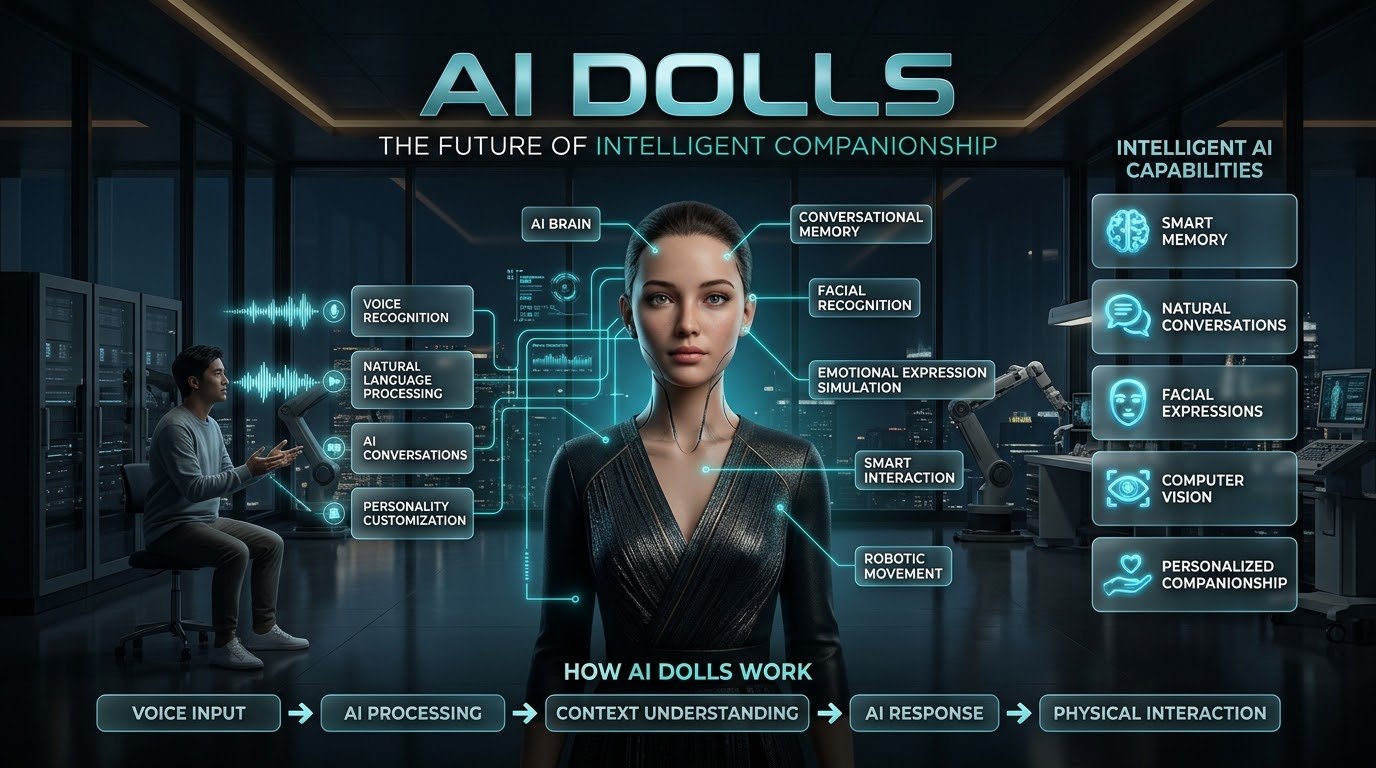
AI dolls are physical dolls or humanoid companions that use artificial intelligence to communicate, respond to voice commands, remember interactions, and simulate personalized conversations. Depending on their design, they can serve as interactive toys, adult companions, or experimental human-robot interfaces, although their capabilities, costs, and safety protections vary considerably.
At a Glance: What You Need to Know
- Conversational interaction: AI dolls can use speech recognition and generative AI to respond to spoken questions.
- Personalization: Some systems support customizable personalities, voices, and conversational memories.
- Different product categories: The market includes children’s smart dolls, adult AI companion dolls, and humanoid robots.
- Advanced technology: Some products combine microphones, cameras, facial movement, sensors, and language models.
- Subscription costs: Certain premium systems require recurring payments for AI conversations and advanced features.
- Important concerns: Privacy, inappropriate responses, emotional dependency, product reliability, and data security deserve careful evaluation.
What Are AI Dolls?
AI dolls are interactive physical products that use artificial intelligence to create more dynamic conversations and experiences than traditional dolls.
Unlike conventional talking dolls, which play prerecorded sentences, AI-powered models can interpret speech and generate responses based on conversational context.
Some products look like traditional children’s toys. Others resemble realistic human companions or advanced humanoid robots.
The term also covers different technologies, so it is important to understand three major categories.
1. AI Dolls for Children
These products combine traditional play with conversational technology.
A child might ask a smart doll to tell a story, answer a basic question, or participate in an imaginary conversation.
Some models use connected applications and cloud-based AI services. Others provide simpler voice interactions through predefined responses.
However, parents should not automatically interpret conversational ability as educational value. AI-generated responses can be inaccurate or unsuitable for young users.
2. Adult AI Companion Dolls
Adult AI companion dolls combine realistic physical designs with conversational software and, in some cases, robotic features.
Depending on the manufacturer, they may offer:
- Customizable personalities.
- Voice-based conversations.
- Long-term conversational memory.
- Facial expressions and eye movement.
- Touch-responsive interactions.
- Mobile application connectivity.
Not every product includes these features. Some manufacturers sell an AI module separately from the physical doll.
3. Humanoid AI Companions
Humanoid AI companions represent a more advanced category.
They combine humanlike appearances with robotics, computer vision, microphones, speakers, and conversational AI.
Unlike traditional dolls, some can move their heads, make facial expressions, recognize people, and respond to visual information.
Companies such as Realbotix are developing products in this space.
How Do AI Dolls Work?
AI dolls combine several technologies to make physical objects more interactive.
Their complexity depends on the product. A basic smart toy may only need a microphone and an internet connection, while a humanoid companion can require multiple sensors and robotic components.
Here is how a typical AI conversation works.
1. Voice Recognition
The interaction usually begins when someone speaks to the doll.
A microphone captures the audio and sends it to a speech recognition system.
Automatic Speech Recognition (ASR) converts spoken words into text that software can process.
Some devices use wake words or push-to-talk controls to activate listening.
2. Natural Language Processing
Natural Language Processing (NLP) helps the system interpret what someone means.
For example, consider this question:
“Can you tell me a bedtime story about a dragon?”
The system identifies the request and its context before generating an appropriate response.
More advanced products can use previous conversational information to personalize their answers.
3. Large Language Models
Some AI companions rely on Large Language Models (LLMs).
These models generate humanlike text by predicting appropriate language based on their training and the conversation.
A conversational AI system may also use:
- Context management to follow ongoing discussions.
- Memory systems to retain selected information.
- Safety filters to restrict certain responses.
- Character instructions to maintain a consistent personality.
However, not every AI doll uses an LLM. Some rely on smaller models, predefined conversational systems, or third-party AI services.
4. Speech Generation
Once the AI creates a response, text-to-speech technology converts it into spoken language.
Voice quality varies significantly.
Basic products may sound robotic, while advanced systems can use more natural speech, different accents, and customizable voices.
5. Sensors and Physical Responses
Premium humanoid systems can combine conversational AI with physical hardware.
Examples include:
- Cameras for visual recognition.
- Microphones for voice detection.
- Touch sensors for physical interaction.
- Motors for head and facial movement.
- Speakers for audio output.
- Position sensors for controlled movement.
This combination creates a more interactive experience, although realistic movement remains technically challenging.
Key Features of Modern AI Dolls
AI dolls vary widely in functionality. The following features are available in some products, not universally across the category.
Conversational AI
Conversational AI is one of the defining features.
Instead of repeating a fixed sentence, an AI-enabled doll can generate different answers to different questions.
This makes conversations less predictable and more personalized.
Customizable Personalities
Certain platforms allow owners to configure personality characteristics.
For example, a companion might be configured to sound:
- Friendly and cheerful.
- Calm and supportive.
- Humorous and expressive.
- Professional and informative.
These settings generally control the AI’s response style rather than creating genuine human emotions.
Memory and Personalization
Some systems can retain information from earlier conversations.
This may include preferred topics, names, interests, or previously discussed subjects.
Memory can improve continuity, but it introduces additional privacy considerations.
Users should check whether memories are stored locally, transmitted to external servers, or retained by third-party providers.
Facial Expressions and Movement
Advanced robotic dolls can use motors to create physical expressions.
Depending on the hardware, they may move their eyes, lips, eyebrows, neck, or hands.
Lip synchronization can make conversations feel more natural.
However, facial movement does not mean a device understands human emotions.
Mobile Application Integration
Some AI companion products use smartphone applications for configuration and control.
Applications may provide access to:
- Voice settings.
- Personality customization.
- Conversation history.
- Software updates.
- AI subscription management.
- Device configuration.
The application can become an important part of the product’s functionality. Buyers should evaluate whether the doll remains useful without an internet connection or paid subscription.
Leading AI Doll and Companion Technology Companies
The AI doll market does not have one universal category leader. Different manufacturers focus on children’s toys, realistic companion products, or humanoid robotics.
The following examples illustrate the current landscape.
Realbotix
Realbotix develops humanlike robots that combine physical movement, facial expressions, and conversational AI. Its Series 1 Echo products include tabletop and full-body configurations.
The company’s published specifications list:
- Tabletop configuration: $11,950.
- Full-body configuration: $59,950.
- AI subscriptions starting at $19.99 monthly.
- Optional Vinci Vision System: an additional $24,950.
The published first production run is limited to 225 tabletop and 25 full-body units, with deliveries estimated for the second half of 2027.
These are company-published prices and projected delivery details, not confirmation that every configuration is currently available for delivery. The company also specifies that the AI subscription is required. Realbotix+2
RealDoll AI
RealDoll offers adult companion products, including an AI Companion system designed around conversational interaction and robotic head functionality.
Its published FAQ describes speech, facial animation, gaze, eye movement, memory, touch response, vision, and application connectivity.
The company lists AI Companion pricing starting at $21,999. It also clarifies that the current system does not walk. Its robotic functionality focuses on the head, face, and connected hardware. Price, Care, Shipping & AI Companions
Haivivi
Haivivi focuses on AI-powered companion toys, interactive plush products, and conversational experiences for children.
Its 2026 product announcement introduced products including BubblePal AI Charm and the CocoMate series. These products illustrate how conversational AI is moving beyond traditional plastic dolls into interactive plush companions. PR Newswire
Mattel and OpenAI
Mattel and OpenAI are relevant to the wider AI toy conversation.
Their announced collaboration attracted attention because it explored bringing generative AI into Mattel’s toy ecosystem.
However, an announcement or partnership discussion should not be confused with a commercially available AI doll. Buyers should verify actual product launches, capabilities, and availability before treating a concept as a purchasable product. Los Angeles Times+1
AI Dolls Compared: Products, Audiences, and Pricing
The following comparison highlights how different companies approach the market.
| Platform | Target audience | Main strength | Pricing transparency |
|---|---|---|---|
| Realbotix | Adult companion and robotics enthusiasts | Humanoid movement and conversational AI | High |
| RealDoll AI | Adult companion buyers | Realistic design and AI interaction | Starting price published |
| Haivivi | Children and families | Interactive companion toys | Verify individual product |
| Mattel AI initiatives | Toy consumers | Established toy ecosystem and generative AI exploration | No confirmed AI doll price |
Important distinction: These products are not direct substitutes. A children’s interactive toy and a full-body humanoid companion serve different audiences and require different safety standards.
What Makes AI Dolls Different From Traditional Talking Dolls?
Traditional talking dolls generally use prerecorded audio, simple sensors, or predefined response systems.
AI-powered dolls can generate responses dynamically, depending on their software and connectivity.
| Feature | Traditional talking dolls | AI-powered dolls |
|---|---|---|
| Responses | Usually prerecorded | Potentially generated dynamically |
| Conversation | Limited scripts | Context-aware interaction |
| Personalization | Usually minimal | May support custom personalities |
| Memory | Usually none | Available in selected products |
| Internet connection | Often unnecessary | Frequently required |
| Updates | Limited | May receive software updates |
| Physical movement | Usually basic | Advanced robotic movement in selected models |
The biggest difference is conversational flexibility.
However, a product advertised as an AI doll may still use basic voice commands and scripted answers. Buyers should look beyond marketing terminology.
Benefits of AI Dolls
AI dolls introduce several interesting possibilities across entertainment, companionship, and interactive technology.
More Personalized Interaction
AI systems can adapt conversations to individual preferences.
For example, a companion might remember a preferred conversation topic or respond differently depending on the configured personality.
This can create a more personalized experience than traditional toys.
Interactive Entertainment
AI dolls can support storytelling, role-playing, quizzes, and conversational activities.
Children’s products may introduce interactive learning experiences, while adult companion systems can focus on personalized conversations.
The actual experience depends on content controls and the underlying AI model.
Accessibility and Communication Practice
Conversational systems may provide opportunities to practice speaking, explore languages, or rehearse everyday conversations.
For some users, a predictable digital interaction can feel less intimidating than speaking in unfamiliar social situations.
However, AI companions should complement rather than replace appropriate human interaction or professional support.
Advancing Robotics Research
AI dolls also demonstrate how conversational software can work with physical machines.
Their development contributes to broader research into:
- Human-robot interaction.
- Speech recognition.
- Facial animation.
- Computer vision.
- Natural language generation.
- Personalized robotics.
These technologies have potential applications beyond companion products.
Limitations and Challenges of AI Dolls
Despite their advanced features, AI dolls have significant limitations.
AI Responses Are Not Always Accurate
Generative AI can produce incorrect information or misunderstand questions.
A doll might confidently provide an inaccurate answer, misunderstand a conversation, or respond inappropriately.
This is particularly important when products interact with children.
Emotional Intelligence Is Simulated
AI dolls can imitate supportive language, emotional expressions, and conversational empathy.
However, they do not experience emotions in the human sense.
A system may recognize certain language patterns without genuinely understanding someone’s emotional situation.
Limited Physical Autonomy
Many products marketed as lifelike companions cannot walk, independently navigate rooms, or perform complex physical tasks.
Facial movement and conversational ability should not be confused with general-purpose humanoid intelligence.
Internet Dependency
Cloud-connected AI dolls may require an active internet connection.
If the manufacturer’s servers become unavailable, some conversational features may stop working.
Long-term product support is therefore an important purchasing consideration.
High Ownership Costs
Premium products can involve several separate expenses:
- Initial hardware purchase.
- AI subscription.
- Optional vision systems.
- Maintenance and replacement parts.
- Shipping and import charges.
- Software or application requirements.
A product’s advertised purchase price may not represent its total ownership cost.
How Much Do AI Dolls Cost?
AI doll prices vary significantly according to physical construction, software capabilities, and intended use.
There is no reliable universal price for the entire category.
Here are two examples with published manufacturer pricing.
| Product | Published price |
|---|---|
| Realbotix tabletop Echo | $11,950 |
| Realbotix full-body Echo | $59,950 |
| Realbotix Base AI plan | $19.99/month |
| RealDoll AI Companion | Starting at $21,999 |
These prices are based on manufacturer information available in November 2026. Realbotix+1
For context, simpler children’s interactive dolls and smart toys occupy a different price segment. Their costs depend on hardware, brand, application requirements, and available AI features.
Hidden Costs Buyers Should Consider
Before purchasing an AI doll, investigate the complete pricing structure.
- Subscription requirements: Does conversational AI stop working when the subscription expires?
- Usage limits: Are conversations restricted by monthly hours or credits?
- Optional hardware: Are cameras, sensors, or robotic features sold separately?
- Maintenance: Are replacement components available?
- Regional availability: Does the company ship to your country?
- Long-term support: What happens if the manufacturer discontinues its application or cloud service?
These details can make a substantial difference to the long-term ownership experience.
Privacy and Security: What Buyers Should Know
Privacy is one of the most important considerations when evaluating AI dolls.
Many conversational products collect information through microphones, applications, connected accounts, and other sensors.
Depending on the design, collected information may include:
- Voice recordings.
- Conversation transcripts.
- Account details.
- Device identifiers.
- Usage patterns.
- Images or video from cameras.
Not every product collects every category of information.
The manufacturer’s privacy policy should explain exactly what information it collects, why it collects it, and how long it retains that information.
Cloud Processing Versus Local AI
Two common approaches determine how AI dolls process conversations.
Cloud-based AI: Audio or text is transmitted to external servers for processing. This can provide access to more powerful language models, but it creates additional data-sharing considerations.
On-device AI: Processing happens directly on the device. This can reduce dependence on external servers, although local hardware may limit model size and capabilities.
Some products use a hybrid approach.
Buyers should ask whether conversations are stored, whether third-party AI providers receive information, and whether data can be deleted.
Children’s Privacy Requires Additional Protection
AI dolls designed for children deserve particularly careful scrutiny.
Children may share names, family information, routines, school details, and other personal information without understanding the consequences.
In January 2026, Common Sense Media’s Youth AI Safety Institute published an assessment of AI companion toys. It classified the tested category as presenting unacceptable risks, highlighting privacy, reliability, and emotional attachment concerns.
The assessment covered Grem, Bondu, and Miko 3. It recommended avoiding AI companion toys for children five and under and exercising extreme caution for children aged six to twelve. This is the organization’s assessment, not a universal regulatory ruling. Youth AI Safety Institute+1
A separate 2026 review published in Computers in Human Behavior Reports examined 51 studies on AI toy ethics and governance. It identified privacy, security, and regulatory challenges. DOI
Parents should prioritize:
- Clear parental controls.
- Transparent data collection policies.
- Age-appropriate conversational restrictions.
- Accessible recording and deletion controls.
- Independent security assessments.
- The ability to disable microphones and cameras.
An AI doll should never become a substitute for parental supervision.
Are AI Dolls Safe?
The answer depends on the product, its intended audience, and how it is used.
For adults, the main concerns include privacy, physical product reliability, unrealistic expectations, and recurring costs.
For children, the risks extend to inappropriate conversations, exposure of personal information, emotional attachment, and reduced opportunities for human interaction.
A particularly important issue is conversational trust.
When a doll sounds caring and remembers personal details, users may begin treating it like a human relationship.
This does not mean every AI companion causes harm. It does mean manufacturers should design transparent systems that clearly communicate their artificial nature.
How to Choose the Right AI Doll
Choosing an AI doll requires more than comparing appearance and advertised features.
The following checklist can help buyers make a better-informed decision.
| Evaluation factor | What to investigate |
|---|---|
| AI capabilities | Does it generate original responses or play scripts? |
| Memory | Can it remember conversations? |
| Connectivity | Does it require Wi-Fi or an application? |
| Privacy | Are recordings stored or shared? |
| Customization | Can users change voices and personalities? |
| Subscriptions | Are monthly payments mandatory? |
| Hardware | What movements and sensors are actually included? |
| Support | Are software updates and replacement parts available? |
| Safety | Are age restrictions and content controls documented? |
| Availability | Does the manufacturer support your country? |
Common Mistakes to Avoid
Buying based on appearance alone: A realistic exterior does not guarantee sophisticated AI.
Ignoring subscription restrictions: Some conversational features may stop working without an active plan.
Assuming every AI doll has memory: Memory capabilities differ between manufacturers and software versions.
Overlooking data retention: A privacy policy matters just as much as the physical product.
Confusing demonstrations with actual functionality: Promotional videos may show features that require optional hardware or future software releases.
The Future of AI Dolls
The future of AI dolls will likely depend on improvements in language models, robotics, computer vision, and personalized interaction.
Several developments are particularly important.
More Natural Conversations
Improvements in LLMs and speech generation could make conversations faster and more natural.
Future systems may better understand conversational context, recognize interruptions, and maintain consistent personalities.
However, more natural communication does not necessarily mean greater intelligence or emotional understanding.
Better Facial Animation
Advances in compact motors, synthetic materials, and robotics could improve facial expressions.
More precise eye movement, lip synchronization, and head positioning may make humanoid companions appear more lifelike.
Improved Personalization
Future AI companions may offer more sophisticated memory systems.
Users could potentially configure conversational preferences, personalities, and knowledge sources.
Manufacturers will need to balance personalization with transparent data controls.
Stronger Privacy Protection
Privacy is likely to become a major competitive factor.
Consumers may increasingly expect:
- Local processing options.
- Encrypted communication.
- Clear recording indicators.
- User-controlled memory.
- Simple data deletion.
- Independent security testing.
Manufacturers that prioritize privacy and responsible AI design may earn greater consumer trust.
Greater Human-Robot Interaction
AI dolls represent one part of a larger human-robot interaction industry.
Similar technologies are being explored in education, entertainment, accessibility, customer service, and research.
The long-term opportunity is not simply making dolls look more realistic. It is developing systems that interact naturally while remaining safe, transparent, and predictable.
Who Should Consider AI Dolls?
Different AI doll categories serve different audiences.
| Audience | Potential application | Important consideration |
|---|---|---|
| Technology enthusiasts | Exploring conversational robotics | Hardware and software limitations |
| Adult companion buyers | Personalized interactive companionship | Privacy and ownership costs |
| Toy collectors | Interactive character experiences | Product longevity |
| AI researchers | Studying human-robot interaction | Research access and technical transparency |
| Parents | Exploring interactive play technology | Child safety and developmental suitability |
Parents should be especially cautious about conversational AI products intended for young children.
Adults interested in companion products should distinguish between genuine conversational capabilities and marketing claims.
Researchers may find these systems useful for examining how people interact with humanlike artificial agents.
AI Dolls vs. AI Chatbots: What’s the Difference?
AI chatbots and AI dolls can use similar conversational technology, but their interfaces are different.
An AI chatbot generally operates through a website, smartphone application, or computer interface.
An AI doll combines conversational software with a physical object.
This physical presence introduces additional considerations, including:
- Microphone placement.
- Physical sensors.
- Facial movement.
- Hardware maintenance.
- Device security.
- Physical accessibility.
The underlying AI may even come from the same third-party model provider used by a conventional chatbot.
Therefore, the physical appearance of an AI doll does not necessarily indicate that it contains a more advanced AI model.
Frequently Asked Questions
1. What are AI dolls used for?
AI dolls are used for interactive entertainment, conversational companionship, storytelling, and human-robot interaction research. Depending on their design, they may target children, adult companion buyers, or technology enthusiasts.
2. Can AI dolls have real conversations?
Yes. Some AI dolls use speech recognition and generative AI to understand questions and produce original spoken responses. However, their conversational quality depends on the underlying software, internet connectivity, and hardware.
3. How much does an AI doll cost?
AI doll prices vary widely. For example, Realbotix lists its Echo tabletop model at $11,950 and its full-body model at $59,950, with additional AI subscription costs. Simpler interactive toys generally occupy a different price category.
4. Are AI dolls safe for children?
Not automatically. AI dolls may expose children to inappropriate responses, collect personal information, and encourage emotional attachment. Parents should examine age restrictions, parental controls, privacy policies, and independent safety assessments before purchasing one.
5. Do AI dolls need an internet connection?
Many advanced AI dolls require internet access because their conversational systems process information through cloud-based services. Some products offer local processing or offline functions, but capabilities depend on the manufacturer.
Conclusion
AI dolls represent an interesting combination of artificial intelligence, robotics, and physical interaction.
They are evolving beyond traditional talking toys through conversational models, customizable personalities, memory systems, and increasingly sophisticated hardware.
However, their capabilities differ considerably. Some are simple interactive toys, while others are expensive humanoid companion systems.
For buyers, the most important factors are genuine AI functionality, transparent pricing, privacy protection, product reliability, and long-term support.
For parents, child safety should take priority over novelty. For adult buyers and technology enthusiasts, understanding the distinction between realistic appearance and actual intelligence is equally important.
The future of AI dolls will depend not only on how convincingly they communicate, but also on how responsibly manufacturers develop and maintain them.