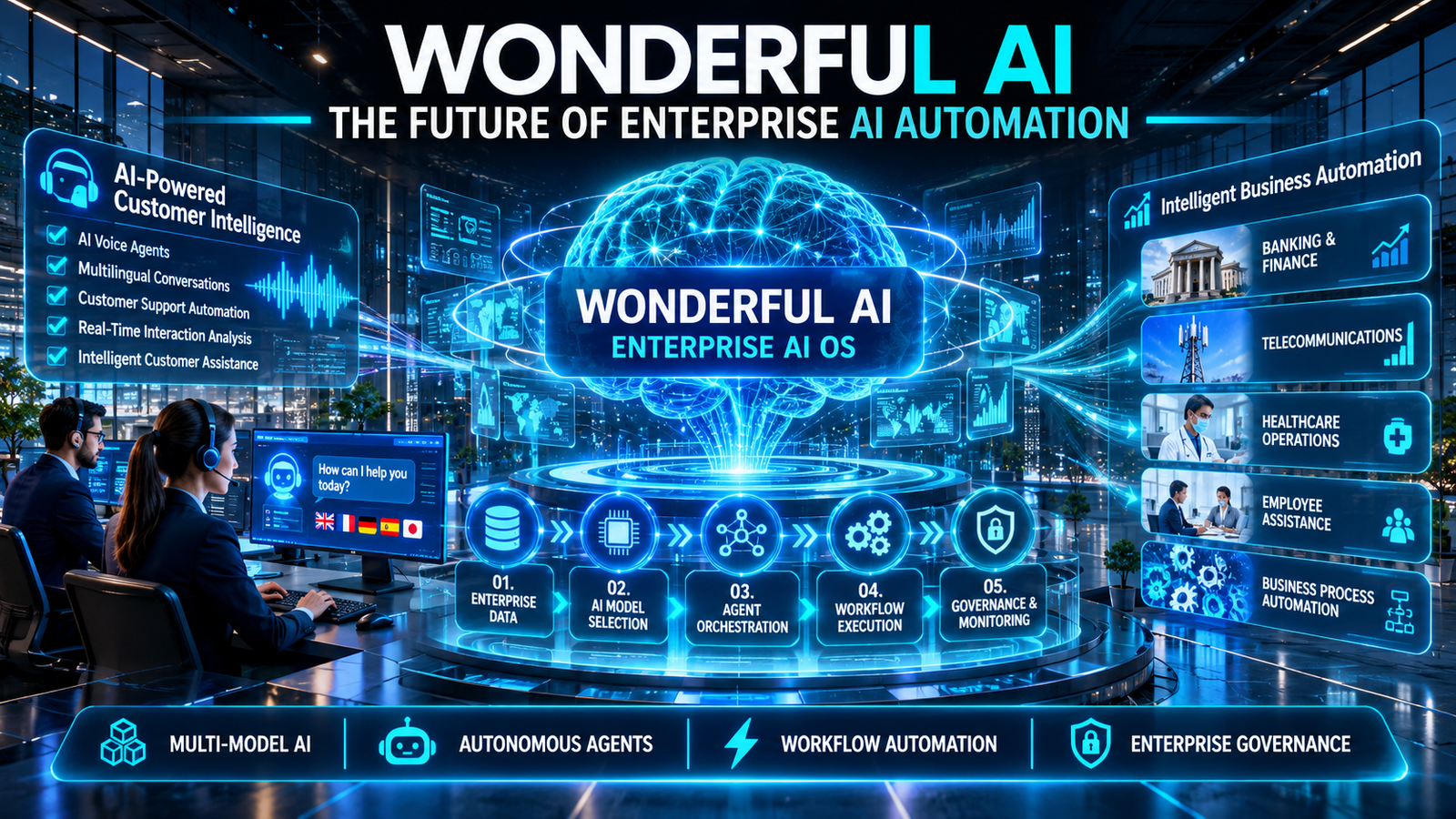
Wonderful AI is an enterprise artificial intelligence platform that helps organizations build, deploy, and manage AI agents across business operations. Its Wonderful AI OS connects AI models, enterprise data, applications, workflows, and governance tools to support organization-wide automation.
Wonderful AI at a Glance
| Category | Details |
|---|---|
| Company | Wonderful |
| Official website | https://www.wonderful.ai/ |
| Main product | Wonderful AI OS |
| Founded | 2025 |
| Founders | Bar Winkler and Roey Lalazar |
| Headquarters | Amsterdam, Netherlands |
| Platform category | Enterprise AI operating system |
| Core capabilities | AI agents, workflow orchestration, integrations, governance |
| Communication channels | Voice, chat, email, and other enterprise interfaces |
| Target customers | Medium-to-large and large enterprises |
| Pricing | Custom enterprise pricing |
| Main industries | Banking, telecommunications, healthcare, insurance, retail, and utilities |
Key Takeaways
- Wonderful is an enterprise AI company, not a general-purpose chatbot.
- Its AI OS connects agents, applications, data, and business workflows.
- Organizations can use different AI models for different tasks.
- The platform combines software with enterprise implementation support.
- Pricing is customized rather than offered through a conventional public subscription.
- Businesses should evaluate integration requirements, security documentation, and total ownership costs before adopting it.
What Is Wonderful AI?
Wonderful AI is an enterprise artificial intelligence platform developed by Wonderful, a technology company founded in 2025 by Bar Winkler and Roey Lalazar.
The company focuses on helping organizations integrate AI into their existing business operations.
Its main product, Wonderful AI OS, provides a shared operating layer for managing AI agents, applications, workflows, enterprise information, and permissions.
This approach goes beyond conventional chatbot technology.
A traditional chatbot generally responds to questions. An enterprise AI agent can retrieve information, interact with connected applications, and perform approved actions within a business process.
For example, a telecommunications company might use an AI agent to handle billing questions. The agent could retrieve customer information, check payment records, explain charges, and update an authorized service request.
Wonderful aims to coordinate these activities through one enterprise AI environment.
What Makes Wonderful Different?
The platform combines three important elements:
- Enterprise AI software: Tools for developing, deploying, and managing AI agents and applications.
- Implementation teams: Engineers who work with organizations to integrate AI into their existing systems.
- Strategic support: Assistance with identifying suitable automation opportunities and planning broader AI adoption.
This combination is important because enterprise AI implementation involves more than selecting a powerful language model.
Companies also need reliable data access, system integrations, security controls, operational monitoring, and employee adoption.
Wonderful’s business model addresses these requirements through a combination of technology and hands-on deployment support.
What Is Wonderful AI OS?
Wonderful AI OS is the central platform behind the company’s enterprise offering.
It is designed to provide a unified environment where organizations can build and coordinate AI-powered business operations.
Rather than developing disconnected agents for individual departments, companies can use shared infrastructure, integrations, knowledge, and governance controls.
The platform includes several major capabilities.
1. AI Agents and Applications
Organizations can build AI agents that assist employees, communicate with customers, and execute business tasks.
These agents can operate independently or work together within larger workflows.
Wonderful also positions AI-native applications as part of its platform. These applications can complement existing enterprise software or support the modernization of older business processes.
2. Workflow Orchestration
Workflow orchestration coordinates different tasks, systems, and AI agents.
For example, an insurance workflow might involve:
- Receiving a customer claim.
- Collecting relevant documents.
- Retrieving policy information.
- Checking predefined requirements.
- Preparing an assessment.
- Sending the case for human approval when necessary.
The orchestration layer helps coordinate these steps rather than treating every interaction as a separate AI conversation.
3. Shared Enterprise Knowledge
Business information often exists across multiple databases, documents, applications, and departments.
Wonderful’s shared knowledge and context capabilities aim to make relevant information available to authorized agents and applications.
This can reduce repeated information retrieval and disconnected workflows.
However, the quality of the results still depends on data accuracy, permissions, and integration quality.
4. Model Flexibility
Wonderful describes its platform as open and model-agnostic.
This means organizations can select different AI models for different workloads instead of depending entirely on one model provider.
For example, a business might select one model for customer conversations and another for document analysis.
The platform’s model-routing approach can help organizations adapt as AI models improve.
However, model flexibility does not automatically guarantee lower costs or better results. Businesses still need to evaluate model performance, latency, licensing, and usage expenses.
5. Enterprise Security and Governance
The platform includes capabilities such as permissions, guardrails, evaluations, alerts, and centralized governance.
These controls help organizations manage which agents can access particular information and perform specific actions.
This is particularly important in industries where inaccurate responses or unauthorized transactions can create financial and legal consequences.
How Does Wonderful AI Work?
Wonderful AI brings together enterprise information, AI models, connected applications, and workflow controls.
A typical implementation can be understood through five stages.
Step 1: Connect Business Systems
The organization identifies the applications and information sources required for its AI workflows.
These may include:
- Customer relationship management systems.
- Enterprise resource planning software.
- Internal databases.
- Customer-support platforms.
- Knowledge bases.
- Business documents.
The exact integrations depend on the customer’s technology environment.
Step 2: Select Appropriate AI Models
Different tasks require different AI capabilities.
The organization evaluates available models according to accuracy, language support, response time, cost, and other requirements.
Wonderful’s model-agnostic approach is intended to provide flexibility in this process.
Step 3: Build and Configure AI Agents
Developers and implementation teams configure agents around specific business objectives.
This involves defining their responsibilities, instructions, available information, connected tools, and permitted actions.
For sensitive workflows, companies can introduce approval requirements and human escalation procedures.
Step 4: Execute Business Workflows
Once deployed, agents can participate in customer interactions and internal processes.
Depending on their configuration, they may retrieve information, communicate with users, update connected systems, and coordinate additional workflow steps.
Step 5: Monitor and Improve Performance
Organizations need to evaluate agent performance after deployment.
Important measurements include:
- Successful task completion.
- Response accuracy.
- Customer satisfaction.
- Human escalation rates.
- Processing time.
- Operational costs.
- Policy compliance.
Continuous monitoring helps businesses identify errors and improve their AI workflows.
Key Features of Wonderful AI
Autonomous Enterprise AI Agents
Wonderful supports agents designed to perform tasks rather than simply generate text.
These agents can work with enterprise information and connected applications.
Their responsibilities may include customer support, employee assistance, operational processes, and business communication.
The actual level of autonomy depends on permissions, integrations, and workflow configuration.
Multichannel Customer Communication
Wonderful’s conversational AI capabilities support customer interactions through channels such as voice, chat, and email.
This makes the platform relevant to organizations managing large customer-service operations.
For example, a telecommunications company could use AI agents to answer billing questions and help customers navigate service requests.
Businesses should test language accuracy, accent recognition, response quality, and escalation behavior before deploying these agents at scale.
Multi-Model AI Support
The platform’s model-agnostic positioning allows enterprises to avoid building every workflow around one AI provider.
This provides flexibility when evaluating new models or changing providers.
It can also help organizations select models according to the complexity of individual tasks.
However, switching models still requires testing. Different models may produce different outputs, response times, and operating costs.
Enterprise Workflow Automation
Wonderful focuses on connecting agents with broader business processes.
This is useful when a task requires information from several systems.
Instead of automating only one step, organizations can coordinate complete workflows through connected agents and applications.
Centralized Governance
Enterprise AI requires consistent rules across different departments.
Wonderful provides governance-related capabilities designed to manage permissions, data access, agent behavior, and monitoring.
Centralized controls can help organizations maintain oversight as their number of AI agents increases.
Forward-Deployed Engineering
One of Wonderful’s important differentiators is its deployment model.
The company provides local engineering teams that work directly with customers to develop and implement AI solutions.
This can help organizations with complicated legacy systems or specialized business requirements.
It also means implementation is more involved than simply registering for a software subscription.
Main Use Cases of Wonderful AI
Wonderful targets organizations that handle large volumes of repetitive interactions and interconnected business processes.
1. Banking and Financial Services
Banks manage customer inquiries, payment questions, account requests, and collections activities.
AI agents can support these workflows by retrieving authorized information, communicating with customers, and recording approved actions.
For example, a collections agent might contact customers, explain outstanding balances, and record payment commitments.
Financial institutions must carefully evaluate accuracy, customer consent, transaction permissions, and regulatory requirements.
2. Telecommunications
Telecommunications companies handle enormous volumes of customer interactions.
These include billing inquiries, subscription questions, technical support, and account-related requests.
AI agents can automate routine conversations and assist customers through different communication channels.
This can reduce repetitive work for human support teams.
3. Healthcare Administration
Healthcare organizations manage appointment requests, administrative inquiries, patient communication, and internal support processes.
AI agents can assist with routine administrative tasks and information retrieval.
However, clinical decisions and sensitive patient interactions require appropriate professional oversight and strict data protection controls.
4. Insurance Operations
Insurance companies handle policy inquiries, documentation, claims, and customer-service requests.
AI agents can help retrieve policy information, collect documents, and coordinate administrative workflows.
Human review remains important for decisions involving coverage, liability, and complex claims.
5. Employee and IT Support
Large organizations receive thousands of internal requests.
Employees may need help with account access, IT problems, HR policies, or workplace procedures.
AI agents can answer approved questions and guide employees through internal processes.
This can help support teams focus on more complicated cases.
6. Retail and Utilities
Retail businesses can use AI agents to support customer inquiries and service requests.
Utility companies can apply AI to billing questions, account management, and routine service workflows.
These applications can be particularly useful when customer interactions involve multiple systems.
Wonderful AI Real-World Examples
Company case studies provide useful insight into how Wonderful’s technology is being applied.
However, performance figures should be treated as company-reported results rather than independently verified guarantees.
Telefónica
Wonderful highlights an enterprise deployment involving Telefónica.
The company reports a 91.5% customer-interaction containment rate across millions of customers.
Containment generally refers to interactions handled without requiring escalation to a human agent.
The result is an important example of Wonderful’s focus on large-scale telecommunications automation.
However, buyers should request the measurement methodology, reporting period, and escalation definitions before using this figure in financial projections.
Banco Caja Social
Wonderful published a case study about its work with Banco Caja Social in Colombia.
The project involved an AI collections agent called María.
According to the company’s June 2026 case study, the agent reached production within 19 days.
The case study reports that María handled 43,658 calls during its first three weeks and that the bank’s promise-to-pay conversion rate increased from 31% to 37%.
Wonderful also describes a second agent, Gloria, for inbound customer service.
These examples demonstrate how the company applies AI to specific financial-services workflows.
Other Enterprise Applications
Wonderful also highlights projects involving OTE, Petrol Ofisi, and PPC Energie.
The applications include telecommunications operations, internal IT automation, and energy-billing workflows.
These examples suggest that the company’s offering extends beyond customer-service chatbots into broader operational processes.
Wonderful AI Pricing: How Much Does It Cost?
Wonderful uses an enterprise-oriented pricing model.
Its website does not provide a conventional public subscription table with standard monthly plans.
Interested organizations generally need to contact the company for a customized proposal.
What Does the AWS Marketplace Listing Show?
An AWS Marketplace listing displays a $2,500,000 figure for a 12-month Enterprise contract.
However, the listing also states that buyers must request a private offer.
This distinction matters because the displayed figure should not be treated as a confirmed universal selling price or a guaranteed final contract amount.
The listing does not publicly establish a standard price for every deployment.
What Determines the Final Cost?
The commercial proposal may depend on:
- Number and complexity of AI workflows.
- Required business integrations.
- Deployment architecture.
- Model usage and infrastructure.
- Implementation requirements.
- Ongoing support arrangements.
- Contract duration.
Is There a Free Plan?
Wonderful does not publicly advertise a conventional self-service free tier or standard free trial.
Its sales-led enterprise approach is different from subscription-based AI tools that let individuals sign up immediately.
Buying advice: Request an itemized quotation. Clarify implementation costs, recurring fees, AI usage charges, support commitments, renewal terms, and data-exit arrangements.
Wonderful AI Security and Privacy
Security is a major consideration when deploying AI across enterprise systems.
AI agents may interact with customer information, internal documents, financial records, and sensitive business applications.
Wonderful describes several security and compliance capabilities on its official AI OS website.
These include:
- Zero Data Retention with AI providers.
- Automatic personally identifiable information redaction.
- AES-256 encryption.
- SOC 2 Type II.
- ISO 27001:2022.
- GDPR-related compliance.
- PCI DSS.
- Alignment with the EU AI Act.
These are company-documented security and compliance statements. Organizations should request the relevant audit reports, certificates, contractual commitments, and scope documentation.
What Is Zero Data Retention?
Zero Data Retention means that a covered AI provider does not retain submitted data under the applicable agreement and configuration.
However, organizations should verify exactly which providers and data flows are covered.
They should also distinguish between model-provider retention and retention by other components, such as application logs, databases, monitoring systems, and backups.
Questions to Ask Before Deployment
- Which AI providers are used for each workflow?
- Does Zero Data Retention cover every provider?
- Where are enterprise records stored and processed?
- Can data residency requirements be enforced?
- Are audit logs available?
- How are employee and customer permissions managed?
- What happens to customer data after contract termination?
- Are independent penetration-test reports available?
A SOC 2 Type II report alone does not establish Zero Data Retention. Both requirements should be evaluated separately.
Advantages and Limitations of Wonderful AI
Wonderful offers a broader enterprise AI approach, but its suitability depends on organizational requirements.
Advantages
- Unified AI infrastructure: Connects agents, applications, workflows, and enterprise information.
- Model flexibility: Supports a model-agnostic approach.
- Enterprise integrations: Designed to work with existing technology environments.
- Implementation support: Provides deployment teams for complex projects.
- Governance capabilities: Includes permissions, guardrails, and evaluation tools.
- Multiple industries: Targets banking, telecommunications, healthcare, insurance, retail, and utilities.
Limitations
- Custom pricing: Buyers cannot easily compare standard public subscription rates.
- Complex procurement: Enterprise adoption requires technical and commercial evaluation.
- Implementation requirements: Integrations and workflow configuration may require significant resources.
- Performance validation: Company-reported results need independent assessment.
- Vendor dependence: Organizations must examine portability and exit arrangements.
- Not a consumer tool: Individuals and freelancers may find simpler AI products more appropriate.
Wonderful AI vs. Competitors
Wonderful operates in the enterprise AI operating-system and agent-orchestration market.
Its competitors differ in their focus, deployment models, and integration ecosystems.
The following platforms are relevant alternatives to evaluate.
| Platform | Target audience | Main strength | Pricing transparency | Main consideration |
|---|---|---|---|---|
| Wonderful AI | Large enterprises | Enterprise AI operating layer and deployment teams | Custom quotation | Enterprise implementation |
| Salesforce Agentforce | Salesforce customers | CRM-connected AI agents | Published pricing options | Salesforce ecosystem |
| Microsoft Copilot Studio | Business and IT teams | Agent development and Microsoft integrations | Published licensing information | Licensing and configuration |
| ServiceNow AI Agents | Enterprise IT and operations | Service management workflows | Enterprise-oriented pricing | ServiceNow ecosystem |
| Kore.ai | Enterprise customer experience teams | Conversational AI and agent platforms | Sales-led pricing | Implementation complexity |
| n8n | Developers and automation teams | Flexible workflow automation | Public plans available | Technical configuration |
Wonderful AI vs. Salesforce Agentforce
Salesforce Agentforce focuses on AI agents connected to Salesforce applications and business data.
It is particularly relevant to organizations that already rely on Salesforce for customer relationship management.
Wonderful offers a broader enterprise AI operating-layer proposition, including deployment support and cross-system workflows.
Choose between them based on your existing infrastructure and the level of customization required.
Wonderful AI vs. Microsoft Copilot Studio
Microsoft Copilot Studio enables businesses to create and manage AI agents.
It is relevant to organizations already using Microsoft 365, Power Platform, and related services.
Wonderful focuses more heavily on enterprise-wide AI implementation and managed deployment.
Microsoft may be more practical for organizations seeking to build agents within an established Microsoft environment.
Wonderful AI vs. ServiceNow AI Agents
ServiceNow focuses on enterprise service management, IT operations, and business workflows.
Its AI capabilities are particularly relevant to organizations already using ServiceNow.
Wonderful is worth considering when AI adoption needs to extend across several departments and business systems.
Wonderful AI vs. Kore.ai
Kore.ai provides conversational AI and enterprise agent solutions.
It is relevant to organizations exploring customer experience automation and enterprise virtual assistants.
Wonderful offers a broader AI operating-system approach that combines platform capabilities with strategic and implementation support.
Wonderful AI vs. n8n
n8n is a workflow automation platform that connects applications, APIs, and AI services.
It is useful for technical teams that want control over automation logic and integrations.
Wonderful targets a different level of organizational complexity, focusing on enterprise AI adoption and managed implementation.
For smaller automation projects, n8n may be more accessible. For large enterprise transformations, Wonderful may deserve a closer evaluation.
Who Should Use Wonderful AI?
Wonderful is most relevant to organizations that want to introduce AI across several departments rather than purchase one isolated automation tool.
Good Fit
- Large enterprises with complex operational workflows.
- Banks and financial institutions.
- Telecommunications providers.
- Healthcare and insurance organizations.
- Businesses with extensive legacy systems.
- Organizations managing multilingual customer operations.
- Enterprise IT teams coordinating multiple AI projects.
Not the Best Fit
- Individuals looking for a general AI assistant.
- Students seeking free AI tools.
- Freelancers needing content-generation software.
- Small businesses looking for inexpensive chatbot subscriptions.
- Developers wanting a simple, self-service API.
These users may find specialized AI applications or developer-focused automation platforms easier to adopt.
What Should Businesses Evaluate Before Choosing Wonderful AI?
Selecting an enterprise AI platform requires more than comparing feature lists.
The following five areas deserve particular attention.
1. Integration Compatibility
Check whether Wonderful can connect with your current CRM, ERP, databases, communication platforms, and internal applications.
Ask which integrations are available immediately and which require custom engineering.
2. Total Cost of Ownership
Evaluate the complete financial commitment.
Include implementation, infrastructure, AI model usage, maintenance, support, and future expansion.
A platform with flexible model selection is not automatically the least expensive option.
3. Agent Accuracy and Reliability
Test agents using realistic business scenarios.
Measure successful task completion, incorrect responses, escalation rates, and human intervention.
Do not rely exclusively on carefully prepared product demonstrations.
4. Security and Compliance
Review data-retention policies, encryption, access permissions, hosting arrangements, audit reports, and contractual security obligations.
For regulated industries, involve security, legal, and compliance teams before deployment.
5. Vendor Independence
Ask how your organization can export its business data, workflows, configurations, and relevant operational records.
Also clarify what happens if you change AI model providers or terminate the agreement.
Portability can reduce long-term vendor dependence.
Frequently Asked Questions
1. What is Wonderful AI used for?
Wonderful AI is used to build, deploy, and manage enterprise AI agents and applications. Organizations can use its platform to automate customer interactions, employee support, and complex business workflows.
2. Is Wonderful AI free to use?
Wonderful does not publicly advertise a standard self-service free plan or free trial. Its platform follows an enterprise sales model, with pricing discussed through customized commercial proposals.
3. Who founded Wonderful AI?
Wonderful was founded in 2025 by Bar Winkler and Roey Lalazar. The company is headquartered in Amsterdam and develops enterprise AI software and deployment services.
4. How much does Wonderful AI cost?
Wonderful uses customized enterprise pricing. An AWS Marketplace listing displays $2.5 million for a 12-month Enterprise contract, but it requires a private offer and should not be interpreted as a universal final price.
5. Is Wonderful AI secure?
Wonderful documents security capabilities that include encryption, data-retention controls, and enterprise compliance standards. Businesses should independently review the relevant certifications, audit reports, data-processing agreements, and security configurations before deployment.
Conclusion
Wonderful is an enterprise AI platform designed to connect autonomous agents, business applications, enterprise information, and operational workflows.
Its main proposition is not simply generating AI responses. It aims to help organizations integrate AI into the way their businesses operate.
The combination of model flexibility, workflow orchestration, governance, and deployment support makes it relevant to large enterprises.
However, customized pricing, integration complexity, and the need for independent performance testing deserve careful consideration.
For organizations planning large-scale AI transformation, Wonderful is worth evaluating. Smaller businesses and individual users may find more accessible alternatives better suited to their needs.
The most important decision is whether its platform, implementation model, and commercial terms match your organization’s actual requirements.