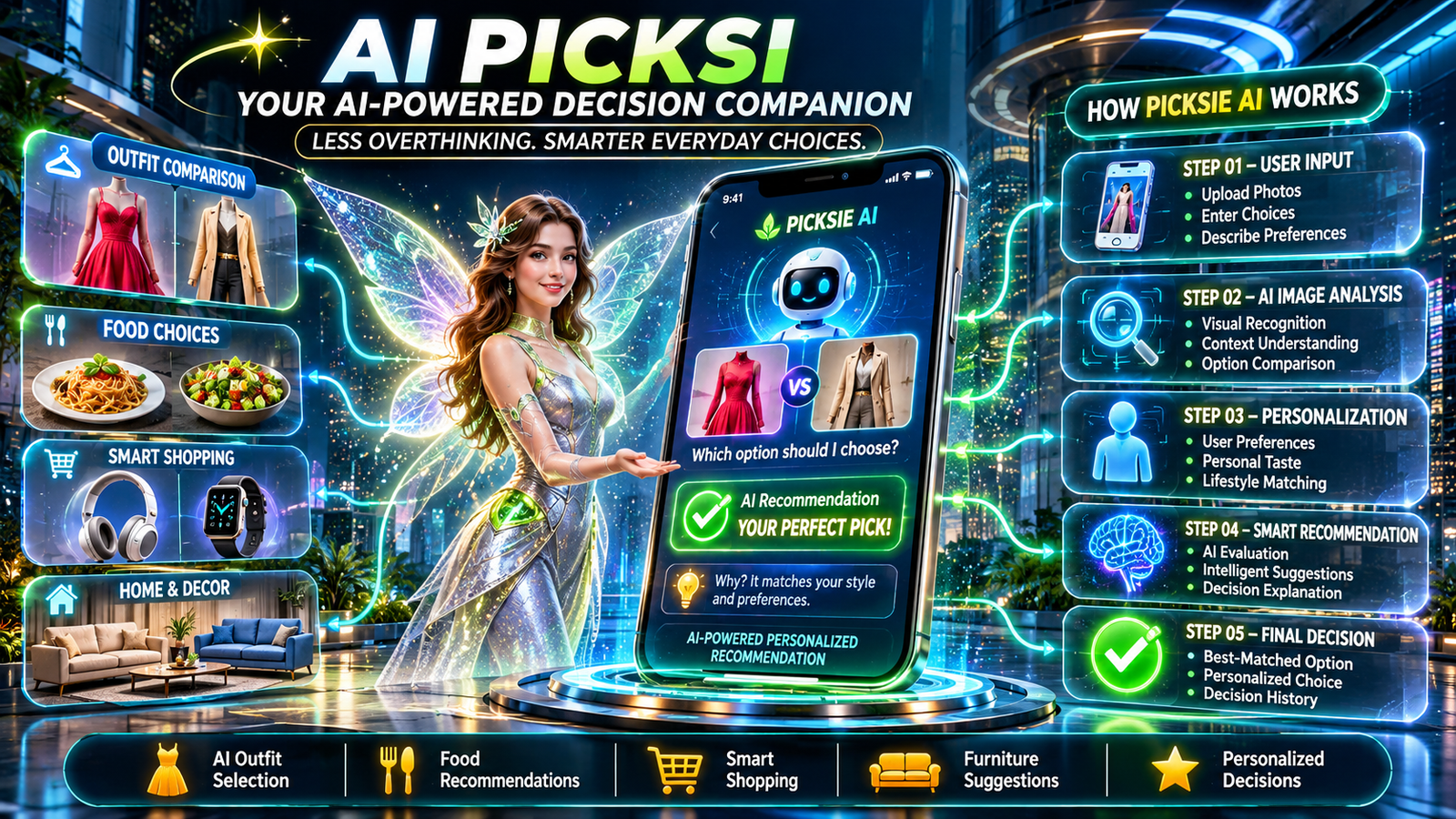
AI Picksi, officially known as Picksie, is an AI-powered decision assistant that helps users choose between everyday options, including outfits, meals, products, and furniture. It accepts photos or text, analyzes the available choices, and provides a recommendation with an explanation based on the user’s preferences.
At a Glance: What You Should Know About AI Picksi
- Product: Picksie, also known as Picksie: Your AI Decision Fairy.
- Developer: dOcL.
- Primary purpose: Helping users make everyday decisions using artificial intelligence.
- Main features: Photo-based recommendations, outfit selection, food suggestions, shopping comparisons, and personalized recommendations.
- Availability: Android through Google Play.
- Pricing: Free access with usage limits; optional monthly and annual Picksie Pro subscriptions.
- Technology: Uses OpenAI services alongside other third-party providers.
- Best suited for: People who want quick assistance with small, everyday decisions.
What Is AI Picksi (Picksie)?
AI Picksi is a search term referring to Picksie, an AI-powered mobile application designed to simplify everyday decision-making.
Developed by dOcL, Picksie works like a digital decision companion. Instead of spending time comparing multiple options, users can submit a photograph or describe their choices.
The application evaluates the available information and recommends an option with a reason.
For example, imagine choosing between two outfits before attending an event. You can show Picksie your clothing options and ask which combination looks better.
It can also help with food choices, shopping decisions, furniture selection, and other everyday A-or-B questions.
Unlike a general-purpose AI chatbot, Picksie focuses on making recommendations rather than requiring users to construct detailed prompts.
Its official website describes the product as an AI decision fairy that helps people stop overthinking everyday choices. picksie.app+1
Who Developed Picksie?
Picksie is operated by dOcL. Its official website identifies the product and provides access to its Android download, privacy policy, and terms of service.
The application is designed around a relatively simple idea: people frequently struggle with small decisions, even when they already have several reasonable options.
Picksie attempts to reduce that friction through AI-generated suggestions.
It is important to distinguish its purpose from professional decision-support software. Picksie is intended for everyday guidance and entertainment, not professional medical, financial, or legal decisions. picksie.app+1
How Does AI Picksi Work?
Picksie follows a straightforward workflow. Users provide their choices, and the application generates a recommendation.
The process involves three main steps.
1. Select a Decision Category
First, choose the category that matches your situation.
Depending on your needs, this could involve:
- Choosing an outfit.
- Selecting something to eat.
- Comparing products.
- Finding furniture.
- Making an everyday A-or-B decision.
The category helps establish the context for the recommendation.
2. Upload a Photograph or Enter Your Options
Next, provide the information Picksie needs.
You can upload a photograph or describe your available choices using text.
For example:
- A photograph of two clothing combinations.
- A restaurant menu.
- Pictures of two furniture pieces.
- Names of two products you are considering.
The application can use these inputs to understand the decision.
3. Receive an AI Recommendation
After receiving your information, Picksie generates a recommendation and explains its reasoning.
The recommendation may consider your preferences, the category, and the information provided.
According to the official website, Picksie can also learn your taste over time, making subsequent suggestions more personalized. picksie.app+1
Important distinction: The developer does not publicly document the complete internal recommendation algorithm, model architecture, or exact model configuration. Therefore, it would be inaccurate to claim that Picksie uses a particular proprietary machine learning architecture.
Key Features of AI Picksi
Picksie’s main attraction is its focus on practical, everyday decisions.
Rather than offering a large collection of unrelated AI tools, it concentrates on helping users select between available options.
1. AI Outfit Selection
Choosing clothes can become surprisingly complicated when several combinations look appealing.
Picksie allows users to show their outfits and ask which option pairs better.
Its recommendation can help users think about:
- Color combinations.
- Clothing coordination.
- Overall appearance.
- Personal style preferences.
- Suitability for a particular occasion, depending on the information provided.
This feature may appeal to people who want quick outfit feedback without consulting a professional stylist.
However, AI-generated fashion suggestions remain subjective. Lighting, image quality, and missing context can influence the result.
2. AI Food and Meal Recommendations
Picksie also supports food-related decisions.
Users can compare meal options and request a recommendation about what to eat or prepare.
The application also describes recipe suggestions based on selected meals.
Another useful scenario involves restaurant menus. Users can photograph a menu and ask Picksie to recommend a dish.
This can reduce the time spent deciding between several available options.
Nevertheless, users should verify ingredients, allergens, and dietary suitability independently. The application’s terms specifically warn that recipe and third-party information may be inaccurate or outdated. Apps on Google Play+1
3. AI Shopping Assistant
Shopping decisions are another important part of Picksie’s functionality.
The application helps users compare products based on their preferences and identify potentially attractive deals.
For example, someone considering two chairs might submit both options and ask which better matches their taste.
Potential evaluation factors include:
- Product appearance.
- Personal preferences.
- Budget considerations.
- Available product information.
- Shopping offers.
The official website also promotes product recommendations and deal discovery. picksie.app+1
However, users should independently verify merchant reputation, current prices, product specifications, shipping charges, and return policies.
An AI recommendation does not automatically establish that a deal offers the lowest market price.
4. Furniture and Interior Decoration Suggestions
Selecting furniture involves more than choosing an attractive product.
People must consider dimensions, colors, room layouts, existing decoration, and available budgets.
Picksie includes furniture and decoration decisions among its advertised use cases.
Users can provide information about their preferences and receive recommendations intended to match their space and style.
This can be useful when comparing furniture pieces or exploring decoration options.
However, it should not replace accurate measurements or professional interior design advice.
5. Personalized Recommendations
One of Picksie’s more interesting features is its emphasis on personalization.
The application says it learns users’ preferences over time, including aspects of their style, budget sensitivity, and decision-making preferences.
Its privacy documentation also describes a preference profile that may include lifestyle, values, preferred tone, and other onboarding information. picksie.app+1
This creates an opportunity for more relevant recommendations.
For example, someone who regularly prefers minimalist clothing may receive suggestions that reflect that preference.
Personalization is potentially useful, but it also makes understanding data collection and retention important.
6. Multiple AI Personality Options
Picksie Pro advertises switchable personalities.
Users can select different communication styles, including warm, direct, or playful responses.
This changes the experience of receiving recommendations.
Some users may prefer straightforward suggestions, while others may enjoy a more conversational assistant.
The feature is particularly relevant to Picksie’s positioning as a friendly decision companion rather than a traditional productivity application. Apps on Google Play+1
AI Picksi Pricing: Is Picksie Free?
Picksie uses a free-to-use model supported by an optional premium subscription.
Its pricing structure includes an in-app currency called Picksie Dust.
Pricing verification: November 23, 2026. Exact subscription amounts were not publicly established in the reviewed official sources.
| Plan | Pricing | Features |
|---|---|---|
| Free | Free | Limited Picksie Dust allowance |
| Picksie Pro Monthly | Displayed in the app | Unlimited Dust and premium features |
| Picksie Pro Annual | Displayed in the app | Premium features through an annual subscription |
| Dust Top-Ups | In-app purchase | Additional decision credits |
picksie.app+1
Understanding Picksie Dust
Picksie Dust is the application’s internal usage currency.
Different decisions can consume different amounts of Dust.
When the free allowance runs out, it automatically refills after a specified period, currently 24 hours after depletion.
The developer also states that allowance amounts, individual costs, and refill timing may change.
This means the free version should not be interpreted as offering unlimited access. picksie.app
What Does Picksie Pro Include?
The premium subscription advertises:
- Unlimited Picksie Dust.
- Full searchable decision history.
- Decision insights and analytics.
- Switchable AI personalities.
- Persistent personalization between decisions.
- Deeper research into deals and products.
- Collectible badges.
Picksie Pro is available through monthly and annual subscriptions.
The actual purchase price should be checked inside Google Play before subscribing.
My pricing assessment: The free option provides a practical way to test the application. However, users who make frequent decisions should calculate the premium subscription cost against their actual usage.
Also, remember that subscriptions automatically renew unless canceled according to the applicable billing rules. picksie.app
AI Picksi Privacy and Security: What Happens to Your Data?
Privacy deserves particular attention because Picksie processes personal preferences, photographs, shopping interests, and decision history.
Its published privacy policy provides useful information about the services involved.
What Information Does Picksie Collect?
According to its privacy policy, collected information may include:
- Account information, including email and display name.
- User preferences and onboarding responses.
- Uploaded photographs.
- Text-based decision requests.
- Recommendation history.
- Subscription information.
- Usage analytics and diagnostic information.
The policy states that submitted photographs are stored and sent to its AI provider for analysis. Images remain associated with the user’s account and decision history until the relevant decision or account is deleted. picksie.app
Which Third-Party Services Does It Use?
The published privacy policy identifies several service providers.
| Provider | Advertised role |
|---|---|
| OpenAI | AI image and text analysis, recommendations, and moderation |
| Supabase | Authentication, database, and image storage |
| SerpAPI | Shopping, pricing, and recipe search |
| PostHog | Product analytics |
| Sentry | Crash and error monitoring |
| Brevo | Email delivery |
| Google Play / RevenueCat | Subscription and purchase processing |
picksie.app
This is an important distinction: Picksie is not entirely an independent AI model operating without external infrastructure.
It relies on third-party services to provide its functionality.
Is Picksie Safe to Use?
Its privacy policy describes several protective measures, including encrypted connections, database access controls, and authenticated requests.
Google Play also displays developer-provided data safety information, including encryption in transit and the availability of account deletion requests. picksie.app+1
However, these disclosures should not be confused with independent security certification.
I could not establish a publicly documented SOC 2 certification or a Zero Data Retention commitment from the reviewed sources.
Users should therefore avoid uploading sensitive documents, private photographs, financial information, or confidential business material.
Can You Delete Your Picksie Data?
Yes. The privacy policy describes an in-app account deletion option:
Profile → Settings → Delete account
The policy states that deleting an account permanently erases account information, preferences, decisions, and uploaded photographs, subject to limited records that may be retained for legal, security, or fraud-prevention reasons. picksie.app
This is useful for users who want greater control over their stored information.
Advantages and Disadvantages of AI Picksi
Every AI application has strengths and limitations. Picksie is no exception.
Advantages
- Simple interface: The application focuses on straightforward everyday decisions.
- Photo-based interaction: Users can provide visual information instead of writing lengthy descriptions.
- Multiple use cases: It supports fashion, food, shopping, and furniture decisions.
- Personalization: Its preference system aims to make suggestions more relevant over time.
- Free access: Users can try the application without immediately purchasing a subscription.
- Decision explanations: Recommendations include reasoning rather than providing only a random selection.
- Premium functionality: Pro adds history, analytics, and additional personalization options.
Disadvantages
- Android availability: The official website currently promotes Android access. An official iOS release was not verified.
- Free usage restrictions: Picksie Dust limits how frequently free users can make decisions.
- Subscription uncertainty: Exact Pro prices need to be checked in the application.
- AI accuracy limitations: Recommendations may misunderstand photographs or overlook important context.
- Third-party dependencies: AI analysis and other functionality depend on external providers.
- Privacy considerations: Uploaded photographs and preferences are processed by third-party services.
- Limited professional suitability: The application is not intended for high-stakes decisions.
AI Picksi vs. Other AI Decision Tools
Picksie operates in a category that overlaps with general-purpose AI assistants and specialized discovery platforms.
However, these products do not all serve the same purpose.
Here is a practical comparison.
This is a functional comparison, not a controlled performance benchmark.
| Platform | Main purpose | Target users | Pricing transparency | Main limitation |
|---|---|---|---|---|
| Picksie | Everyday personal decisions | Lifestyle users | Free and Pro; exact Pro price in app | Android-focused availability |
| ChatGPT | General reasoning and recommendations | General users and professionals | Free and paid plans | Requires suitable instructions and context |
| Google Gemini | General AI assistance and multimodal tasks | General users | Free and paid offerings | Not exclusively designed for A-or-B decisions |
| Perplexity | Research and information discovery | Researchers and shoppers | Free and paid offerings | Research-oriented rather than decision-focused |
| Futurepedia | AI tool discovery | AI enthusiasts and professionals | Directory with varied tool pricing | Does not make personal lifestyle decisions |
Picksie vs. ChatGPT
ChatGPT is a general-purpose conversational AI assistant.
Users can upload supported images, describe choices, request comparisons, and receive recommendations.
Picksie offers a narrower experience. It organizes common everyday decisions into a dedicated application workflow.
The distinction is convenience versus flexibility.
Picksie is designed around everyday A-or-B choices, while ChatGPT can support much broader tasks.
Picksie vs. Google Gemini
Google Gemini provides general AI assistance, including multimodal capabilities.
It can help users discuss photographs, compare options, and explore ideas.
Picksie differs through its specialized decision-making interface and preference-oriented experience.
Users who already rely on Gemini may find that it covers some similar tasks without needing another application.
Picksie vs. Perplexity
Perplexity emphasizes research and information discovery.
It is more suitable when users need information, supporting sources, or research-based comparisons.
Picksie instead focuses on selecting between everyday options.
For example, Perplexity may help research two products, while Picksie aims to recommend one based on personal preferences.
Picksie vs. Futurepedia
Futurepedia is an AI tool discovery platform.
It helps people explore AI applications across different categories.
It is not a direct alternative to Picksie because its purpose is discovering software rather than making personal lifestyle decisions.
Benefits and Practical Use Cases of AI Picksi
The value of Picksie depends on how people incorporate it into everyday activities.
Here are several realistic examples.
Choosing an Outfit for an Event
Someone preparing for a wedding might have two suitable outfits.
Instead of asking several friends for opinions, they can submit photographs and request a recommendation.
The application can provide an additional perspective on color coordination and appearance.
Deciding What to Eat at a Restaurant
Restaurant menus frequently contain dozens of options.
A user can photograph the menu and ask Picksie to recommend a dish.
This may make ordering easier, particularly when the user has already identified a few appealing choices.
However, allergies and dietary restrictions must be checked independently.
Comparing Two Furniture Products
Imagine furnishing a small apartment.
Two chairs may have similar prices but different designs.
Picksie can provide a preference-based recommendation using submitted information.
Users should still verify measurements, materials, durability, and delivery conditions.
Finding a Product Deal
When shopping online, users may struggle to determine whether an offer represents good value.
Picksie’s advertised deal-discovery functionality can help explore potential options.
Nevertheless, independent price verification remains essential.
Limitations and Things to Consider Before Using Picksie
Picksie addresses a relatively simple problem, but its recommendations still depend on the quality of its inputs and underlying AI systems.
AI Recommendations Are Not Always Correct
AI systems can misunderstand visual information.
For example, an image may not show the actual dimensions of a furniture product or the complete appearance of an outfit.
Users should treat recommendations as suggestions rather than objective conclusions.
Personalization Requires Personal Information
The application describes learning user preferences over time.
This can improve convenience, but it also involves collecting and processing information about personal tastes and behavior.
Reviewing the privacy policy before uploading photographs is sensible.
Shopping Information Can Change
Product prices, discounts, availability, and merchant information may become outdated.
Picksie’s terms explicitly explain that third-party information can be incorrect or outdated. picksie.app
Always verify the original listing before making a purchase.
Not Suitable for High-Stakes Decisions
Picksie should not determine medical treatments, legal strategies, financial investments, or safety-critical decisions.
Its own terms distinguish everyday recommendations from professional advice.
This limitation matters because a confident AI response does not necessarily mean the recommendation is reliable.
Who Should Use AI Picksi?
Picksie is primarily designed for people who want assistance with ordinary decisions.
It may be particularly useful for:
- Fashion enthusiasts: People who frequently compare outfits.
- Online shoppers: Users who need help comparing products.
- Food lovers: People who struggle to choose meals or restaurant dishes.
- Home decorators: Users comparing furniture and decoration ideas.
- Busy individuals: People who want to spend less time on minor decisions.
- AI beginners: Users interested in trying practical AI applications without learning prompt engineering.
However, developers, enterprise teams, and researchers may find general AI platforms more appropriate.
Picksie does not present itself as an API development platform, enterprise AI infrastructure solution, or professional analytics system.
How to Download and Get Started With AI Picksi
Picksie is available through its official Android distribution channel.
Follow these steps:
- Visit the official Picksie website.
- Select the Google Play download option.
- Open its Google Play listing.
- Install the application.
- Create or access your account.
- Select a decision category.
- Submit a photograph or describe your choices.
- Review the recommendation and its explanation.
You can also review the developer’s privacy policy and terms before creating an account.
Download: Picksie on Google Play.
Frequently Asked Questions About
1. What is AI Picksi?
AI Picksi refers to Picksie, an AI-powered decision-making application developed by dOcL. It helps users choose between everyday options involving clothing, food, shopping, furniture, and other personal decisions.
2. Is Picksie AI free to use?
Yes. Picksie offers free access through a limited Picksie Dust allowance. Users can also purchase additional Dust or subscribe to Picksie Pro for expanded functionality.
3. Is AI Picksi available for iPhone?
The official Picksie website currently promotes its Android application through Google Play. An official iPhone version was not verified in the sources reviewed for this article.
4. Is Picksie safe for uploading personal photographs?
Picksie’s privacy policy explains that uploaded photographs are stored and sent to its AI provider for analysis. It describes security measures and account deletion options, but users should avoid submitting sensitive photographs or confidential information.
5. What is the difference between Picksie and ChatGPT?
Picksie focuses on everyday decisions through a dedicated recommendation interface. ChatGPT is a general-purpose AI assistant that supports a much wider range of tasks, including research, writing, reasoning, and image-based conversations.
Conclusion
AI Picksi, officially known as Picksie, represents a focused approach to everyday AI assistance.
Instead of trying to become an all-purpose productivity platform, it concentrates on helping users make smaller decisions about clothing, food, shopping, and home decoration.
Its photo-based interaction, personalized recommendations, and conversational approach make the concept appealing.
However, its free usage limits, subscription costs, third-party data processing, and AI accuracy limitations deserve consideration.
For Android users who regularly struggle with everyday choices, Picksie may be worth exploring.
The most sensible approach is to test its free functionality, evaluate recommendation quality, review its privacy policy, and decide whether the premium features justify the cost.
Ultimately, AI should make everyday decisions easier, not remove human judgment.