AI flowers refer to floral imagery, designs, and content generated using artificial intelligence tools rather than photographed from real plants. This technology enables florists, marketers, and creators to produce unlimited visual variations for branding, testing concepts, and content creation without physical inventory.
At-a-Glance Box
- What it is: AI-generated floral imagery and designs created through generative AI tools like DALL-E, Midjourney, and Snapchat’s AI lenses
- Primary users: Floral marketers, e-commerce sellers, content creators, and design professionals
- Key benefit: Zero-cost visual prototyping and content generation without photography or physical flowers
- Major risk: AI-generated plant scams selling nonexistent seeds on eBay, Etsy, and Amazon
- Technical reality: LLMs cannot truly “understand” flowers because they lack sensory experience
- Current state: Rapidly evolving from simple image generation to interactive, video-based floral experiences
A floral wall appears behind a conference table on a Zoom call. The roses look perfect. Too perfect. Someone on the call laughs and says, “That floral wall is amazing, but those are AI.”
That moment captures a fundamental shift in how flowers exist in digital spaces. AI flowers are no longer a novelty. They are a growing presence in marketing campaigns, e-commerce listings, social media content, and even the scams that target unsuspecting shoppers.
This guide examines what AI flowers actually are, how the technology works, where it creates genuine value, and where it crosses into deception. Whether you are a florist exploring new tools or a shopper trying to spot fake listings, understanding this landscape matters.
What Are AI Flowers?
AI flowers are floral images, designs, and video content generated by artificial intelligence systems. These systems include text-to-image models like DALL-E and Midjourney, specialized design tools, and social media features such as Snapchat’s AI Video Lenses.
The term covers several distinct categories:
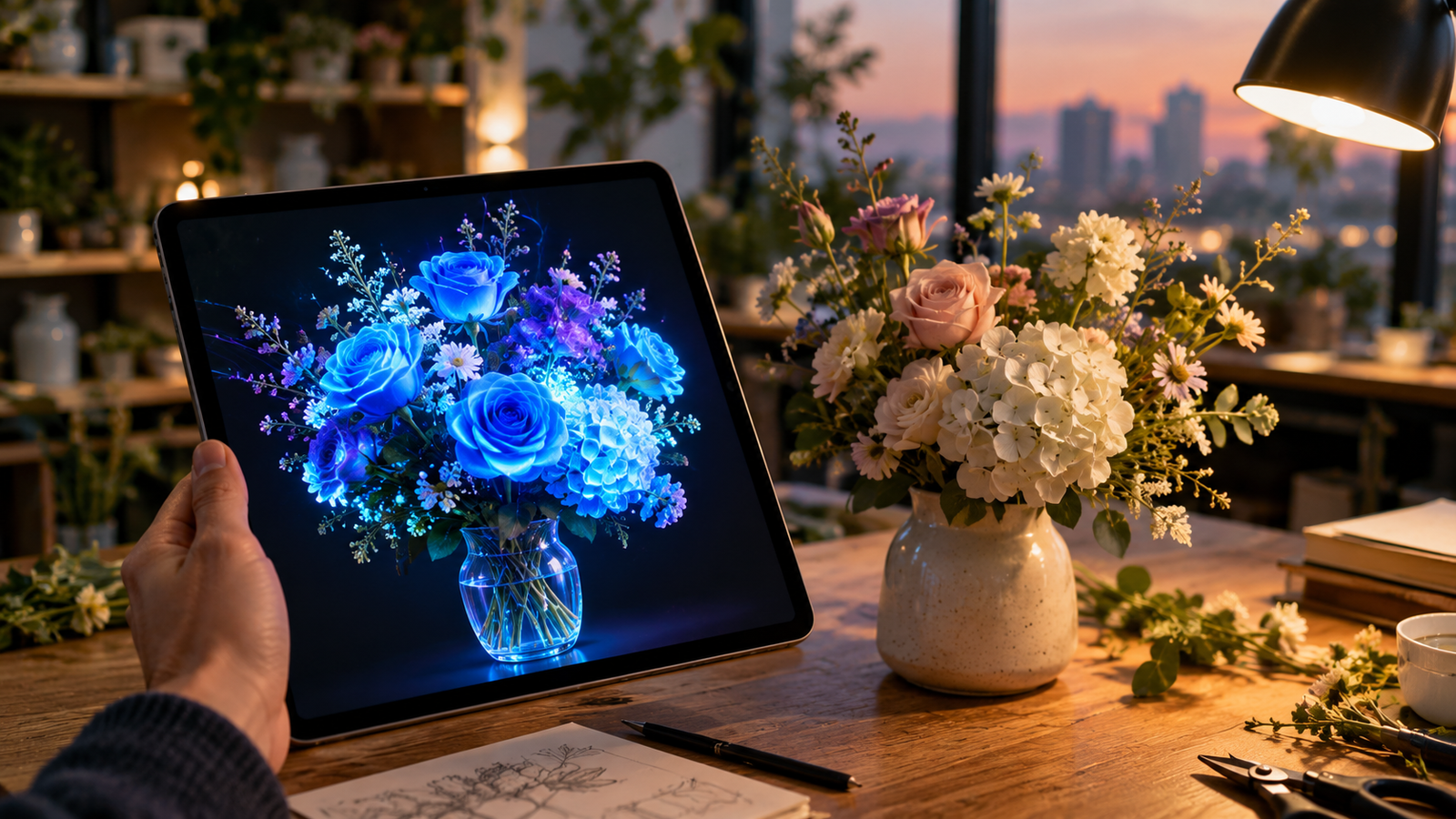
AI-generated floral imagery includes standalone images created from text prompts. A user might request “a bouquet of neon-blue roses arranged in a modern vase” and receive a photorealistic result within seconds.
AI-enhanced floral photography involves modifying real photos. Sellers sometimes alter colors or add impossible features to make ordinary plants appear exotic.
Interactive AI floral experiences represent the newest category. Snapchat’s flower lens, for example, places animated flowers in front of users when they open the camera.
AI floral design tools help professionals conceptualize arrangements. Florists upload product photos and receive styling suggestions or color palette ideas without cutting a single stem.
The common thread is that AI flowers do not exist as physical objects. They exist as digital artifacts, created through algorithms trained on millions of images and text descriptions.
How AI Flowers Work
Understanding the technology behind AI flowers helps separate legitimate uses from deceptive ones.
The Role of Large Language Models and Diffusion Models
Most AI flower generation relies on two types of systems. Large language models (LLMs) interpret text prompts and understand what users are asking for. Diffusion models then generate images by starting with random noise and gradually refining it into a coherent picture.
These models train on massive datasets. They learn patterns in color, shape, texture, and composition by analyzing millions of existing images and their descriptions. When prompted for “a realistic rose bouquet,” the model draws on these patterns to create something new.
Why AI Cannot Truly “Understand” Flowers
A 2025 study published in Nature Human Behaviour revealed a critical limitation. Researchers compared how humans and LLMs represent the concept of “flower” across 4,442 words.
The findings were significant. LLMs performed well with abstract concepts but failed when sensory experience mattered. As lead researcher Qihui Xu explained: “A large language model can’t smell a rose, touch the petals of a daisy or walk through a field of wildflowers. Without those sensory and motor experiences, it can’t truly represent what a flower is in all its richness.”
This gap matters for anyone using AI flowers. The technology can produce visually stunning results. It cannot replicate the emotional and sensory dimensions that make real flowers meaningful.
Technical Considerations for Users
Several practical factors affect AI flower generation:
Prompt specificity determines output quality. Vague prompts produce generic results. Detailed prompts specifying flower type, color palette, lighting, composition, and style yield professional-grade images.
Model selection matters. Different platforms excel at different styles. Some models handle photorealism better. Others produce more artistic or stylized results.
Resolution and format impact usability. Higher-resolution outputs work better for print materials. Lower resolutions suit social media.
Usage rights vary by platform. Commercial use permissions differ significantly between tools. Always verify licensing before using AI images in client work.
Main Use Cases for AI Flowers
AI flowers serve several practical purposes across the floral industry and beyond.
Marketing and Brand Visuals
Floral businesses use AI to create campaign banners, product mockups, and social media graphics without coordinating photo shoots. The New Bloom Solutions team notes that AI tools can design customized floral imagery in seconds, tailored to specific brand guidelines.
Jet Fresh Flowers, a real floral company, has experimented extensively with AI content. Their AI-generated posts have outperformed traditional content in views, engagement, and shares. As Marketing Director Ryan Black explained, “The goal is to experiment, to inspire, and to share our team’s creativity.”
Design Prototyping
Florists and event planners use AI to test arrangements before committing to physical materials. Uploading product photos and requesting variations saves time, money, and waste. A designer can explore dozens of color combinations or structural concepts without cutting a single flower.
E-Commerce and Content Creation
Online sellers use AI flowers to populate listings, especially for digital products. AI writing tools also help draft product descriptions, care instructions, and marketing copy. The human guides the voice while AI accelerates the process.
Social Media and Entertainment
Platforms like TikTok have spawned a vibrant #aiflowers community where creators share digital floral art. These range from photorealistic renders to surreal, impossible compositions featuring rainbow roses or ocean-sized hydrangea fields.
Snapchat’s AI Video Lenses represent a mainstream entry point. Subscribers can use lenses that place animated flowers in their camera view, creating shareable moments with friends.
The Dark Side: AI Flower Scams
The same technology that empowers legitimate creators also enables fraud on a massive scale.
How the Scam Works
Scammers use AI to generate images of impossible plants and sell seeds for these nonexistent varieties. Listings for “cat’s eye dazzle” flowers, which supposedly bloom into feline shapes, have appeared on eBay, Amazon, and Etsy.
The pattern is consistent. Sellers post stunning AI-generated images. They promise rare, organic, non-GMO seeds. Buyers receive either different seeds, no seeds, or seeds that never germinate.
A cybersecurity analysis noted that this represents a shift in low-value e-commerce fraud. Before generative AI, creating convincing fake product photos required real effort. Now, scammers generate hundreds of images in minutes and spin up entire storefronts before disappearing.
Red Flags for Buyers
The National Garden Bureau identifies several warning signs:
- No botanical name in the listing. Legitimate sellers list genus, species, and cultivar.
- Unnatural traits such as impossible colors, perfect symmetry, or features that defy plant biology.
- No seller history or verifiable presence beyond the current listing.
- Reverse image search returns the same photo across unrelated sites.
- No timestamped photos of the actual plant in a real environment.
Why Platforms Struggle
E-commerce platforms have invested heavily in counterfeit detection for branded goods. Fake biological claims do not fit those frameworks. An eBay spokesperson noted that the company uses policy enforcement, seller audits, and AI-supported monitoring. The challenge remains that fabricated plants do not trigger the same filters as knockoff sneakers.
The individual financial damage from each scam remains small. Most victims lose under $100. However, the cumulative effect erodes trust in online plant commerce and can introduce mislabeled species into local ecosystems.
AI Flowers vs. Real Flowers: What Matters
The relationship between AI and real flowers is not purely competitive. In many cases, AI enhances appreciation for the genuine article.
The Sensory Gap
A study from Ohio State University highlighted what AI fundamentally lacks: the ability to smell, touch, or physically interact with plants. Human understanding of flowers integrates scent, texture, visual beauty, and emotional memory into a coherent concept. LLMs work with text and images alone.
This limitation is not necessarily a weakness for marketing applications. An AI-generated image of a rainbow rose can spark curiosity and desire for real floral experiences. It functions as an invitation rather than a replacement.
When AI Flowers Help Real Businesses
For floral professionals, AI offers tangible benefits:
- Cost reduction: No photography studio, models, or physical inventory required for digital campaigns.
- Speed: Generate hundreds of design variations in the time a single photo shoot would take.
- Creativity: Explore impossible combinations that inspire real-world designs.
- Content volume: Maintain an active social media presence without constant photo production.
The New Bloom Solutions team summarized this perspective well: “AI content doesn’t replace flowers. It draws people toward them, and it can create beauty around them.”
When AI Flowers Cause Harm
The harms emerge in specific contexts:
- Consumer deception: Selling seeds for nonexistent plants.
- Industry confusion: Customers requesting arrangements based on impossible AI images.
- Trust erosion: When buyers cannot distinguish real products from fabricated ones.
Floral designer Hana Katoba, who uses AI extensively in her art, emphasizes the importance of intentionality. She describes AI as a “creative partner” rather than a replacement, using it to “amplify what I want to say” and “transform sensations into images.”
Key Platforms and Tools
The AI floral tool landscape spans several categories. Below is a comparison of relevant platforms.
| Platform/Tool | Target User | Key Strength | Pricing Transparency | Core Limitation |
|---|---|---|---|---|
| Snapchat AI Video Lenses | Social media users | Real-time interactive floral effects | Included with Platinum subscription | Limited to Snapchat ecosystem |
| flowers4ai | AI enthusiasts | Novelty gifting for AI politeness | Free; $3 fancy; $99 Doomsday | Digital only, no real flowers |
| General AI image tools | Designers, marketers | Unlimited floral concepts | Varies by tool | Requires prompt expertise |
| AI writing assistants | Content creators | Draft floral copy quickly | Subscription or freemium | Output requires human editing |
For floral businesses, the practical recommendation is to use general-purpose AI tools for content generation while maintaining human oversight for brand voice and accuracy.
Who Should Use AI Flowers?
AI floral technology suits specific users and contexts.
Floral marketers and business owners benefit from cost-effective content creation and design prototyping. The technology reduces production barriers for businesses without large photography budgets.
Content creators and social media managers can maintain higher posting volume and experiment with creative concepts that would be impractical to photograph.
E-commerce sellers can use AI for digital product mockups and listing visuals, provided they clearly label digital content and do not misrepresent physical products.
Consumers should approach AI flower listings with healthy skepticism, especially when buying seeds or plants online.
Developers and researchers exploring multimodal AI will find floral concepts useful for testing sensory grounding limitations.
AI flowers are less suitable for applications requiring genuine botanical accuracy, such as scientific illustration or horticultural education. In those contexts, AI hallucinations can introduce misinformation.
Common Mistakes to Avoid
Several pitfalls trip up new users of AI floral technology.
Assuming photorealism equals authenticity. AI models excel at creating images that look like photographs. This does not mean the subject exists or is accurately represented.
Neglecting prompt engineering. Generic prompts produce generic results. Investing time in detailed, specific prompts dramatically improves output quality.
Ignoring licensing terms. Different platforms have different rules about commercial use, attribution, and derivative works. Verify before publishing.
Over-relying on AI for customer-facing content. AI-generated floral descriptions can contain factual errors about plant care, growth habits, or toxicity. Human review remains essential.
Confusing AI capability with AI understanding. As the Nature Human Behaviour study demonstrated, LLMs process floral concepts differently than humans. They can generate convincing descriptions without grasping what flowers actually mean to people.
Real-World Applications
Several concrete examples illustrate AI flowers in action.
Jet Fresh Flowers created an AI-generated video featuring a mannequin floral installation that appeared to come alive. The content outperformed traditional posts and demonstrated how AI can extend creative reach.
Snapchat’s AI Video Lenses represent a mainstream application. The flower lens places animated blooms in the user’s camera view, creating shareable content with minimal effort.
Hana Katoba’s AI Flower World project blends Japanese Hanakotoba (flower language) with algorithmic generation. Her work treats AI as a creative partner, producing images that are “dense with meaning” rather than generic.
The cat’s eye dazzle scam serves as a cautionary example. AI-generated images of cat-shaped flowers circulated widely on Facebook and Reddit, driving thousands of seed purchases for a plant that does not exist.
Latest Developments
The AI floral space continues evolving rapidly. Several trends are worth monitoring.
Video generation is moving beyond static images. Snapchat’s AI Video Lenses and similar tools enable real-time interactive floral content.
Sensory AI research may eventually address the limitations identified in the Nature Human Behaviour study. Researchers suggest that future models augmented with sensor data and robotics could develop richer understanding of physical concepts like flowers.
Platform enforcement of AI-generated product listings remains an ongoing challenge. E-commerce companies are investing in detection capabilities, but the cat-and-mouse dynamic continues.
Industry adoption is accelerating. The floral sector is moving from skepticism to experimentation, with companies like Jet Fresh demonstrating measurable engagement benefits from AI content.
Frequently Asked Questions
Are AI flowers real?
No, AI flowers are digital images or videos created by artificial intelligence. They do not exist as physical plants. Some AI-generated floral images are used to market real products, while others are used to sell seeds for plants that do not exist.
Can I buy AI flowers?
AI flowers are not products you can purchase in a physical sense. You can use AI tools to generate floral images for personal or commercial purposes. You can also buy digital floral art created by human artists using AI. Be cautious of any seller offering seeds for flowers you have only seen in AI-generated images.
Why can’t AI understand flowers like humans do?
AI systems like ChatGPT process information through text and images only. They lack sensory experience: they cannot smell a rose, touch petals, or walk through a field. A 2025 study found that this sensory gap prevents AI from fully representing concepts like “flower” in the same way humans do.
Is it safe to buy flower seeds online?
Buying seeds online is generally safe when you use reputable sellers. Avoid listings with no botanical name, impossible plant features, or sellers with no verifiable history. Reverse image search the product photo before purchasing. The National Garden Bureau recommends verifying the genus, species, and cultivar before ordering.
How can florists use AI without misleading customers?
Florists can use AI for internal design prototyping, marketing mockups, and content drafts while maintaining transparency. Label AI-generated images as digital concepts rather than photographs of real arrangements. Use AI as a creative tool, not a substitute for accurate product representation.
Conclusion
AI flowers represent a genuine technological shift with both promising applications and real risks. The technology enables floral professionals to create compelling visuals, test designs without waste, and maintain active digital presences at lower cost. It also enables scammers to fabricate products and exploit shoppers who trust what they see.
What matters most is intentionality. AI works best as a creative tool guided by human judgment and expertise. It cannot replicate the sensory richness of real flowers, and it should not be presented as doing so.
For floral businesses, the opportunity lies in using AI to enhance marketing and design workflows while maintaining honest representation of physical products. For consumers, the priority is developing healthy skepticism toward visually stunning listings that lack verifiable botanical information.
Before adopting any AI floral tool, evaluate its licensing terms, output quality, and suitability for your specific use case. Verify seller credentials when buying seeds or plants online. And remember that a beautiful image, however perfect, is not proof that a flower exists.