AI voicemail uses speech recognition and language models to transcribe, summarize, and sometimes respond to missed calls automatically. It ranges from simple on-device transcription to interactive agents that qualify callers and book appointments, with pricing and privacy terms varying widely across providers.
At a Glance
- Core function: Converts spoken voicemail into text, summaries, and structured call data
- Two main types: Passive transcription (cheap, simple) vs. interactive AI receptionists (higher cost, more capability)
- Entry pricing: From free on-device transcription to $25 to $99 per month for business-grade AI answering
- Key limitation: Accuracy drops with background noise, accents, and poor call quality
- Privacy variance: Some providers process in memory with no retention; others do not disclose retention terms
- Best fit: Small businesses, mobile professionals, and teams that miss calls but cannot justify full-time reception staff
What Is AI Voicemail?
AI voicemail describes a category of tools that apply speech-to-text and language processing to missed call messages. At its simplest, it turns a voice recording into a readable transcript. At its most advanced, it holds a conversation with the caller before the message is even left.
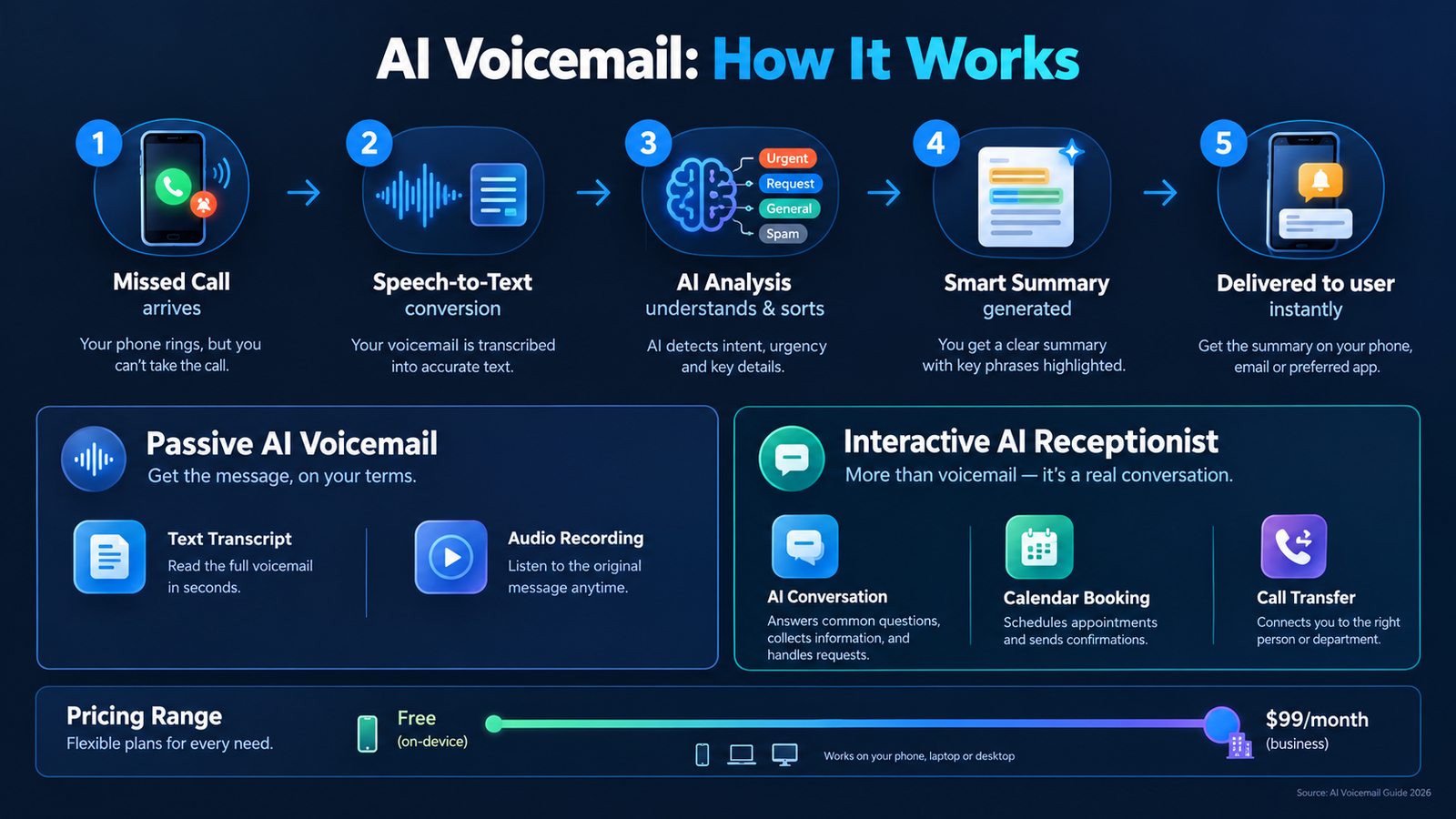
The term covers two distinct product types. Passive AI voicemail transcribes and summarizes recordings after the fact. Interactive AI voicemail, sometimes called an AI receptionist, engages callers in real time, asks structured questions, and routes or books outcomes.
This distinction matters for buyers. A transcription feature built into a phone system solves a different problem than a standalone AI agent that costs $99 per month. Confusing the two leads to mismatched expectations and wasted spend.
How AI Voicemail Works
The technical flow is straightforward, even when the implementation varies.
Step 1: Call capture. An incoming call goes unanswered or is sent to voicemail automatically. The system records the caller’s audio.
Step 2: Speech-to-text processing. A speech recognition model converts the audio into written text. Some systems do this on-device; others send audio to cloud infrastructure.
Step 3: Language model analysis (optional). More advanced systems use a language model to summarize, categorize, or extract action items from the transcript. Microsoft’s Teams Phone, for example, uses a compliant LLM to identify importance and suggested actions.
Step 4: Delivery. The transcript, summary, or structured data reaches the user through email, an app, or a CRM integration.
Step 5: Interaction (interactive systems only). AI receptionists insert a conversational layer before or instead of a recording. They ask questions, capture details, and either transfer the call or produce a structured summary for follow-up.
The gap between Step 2 and Step 3 is where most products differentiate. Basic transcription is cheap and increasingly commoditized. Accurate summarization and reliable categorization are harder, and performance varies significantly.
Key Features to Evaluate
Transcription Accuracy
This is the foundation. If the transcript is wrong, everything built on top of it fails. Accuracy depends on audio quality, speaker clarity, language, and accent.
Samsung’s Direct Voicemail, which runs on-device, produces “spot on” transcripts under good conditions. But Android Authority’s reviewer noted that Samsung’s underlying Text Call technology makes mistakes with mumbling or background noise, while Google’s Pixel handles those conditions better. That gap illustrates why vendor claims deserve scrutiny.
Summarization
Summaries help users triage messages without reading full transcripts. Microsoft’s implementation generates a concise summary and highlights key terms. Samsung offers a summarization button on longer transcripts. The quality of these summaries depends on the underlying model and how well it handles the language and context of the call.
Caller Interaction
Interactive AI voicemail goes beyond recording. It can ask for a name, reason for calling, preferred callback time, and other structured details. NonaCall’s comparison notes that traditional voicemail only collects structured details “if the caller volunteers them,” while an AI receptionist can ask for configured information.
This capability is useful for lead capture and appointment booking. It is overkill for low-volume businesses where a simple callback works fine.
Integrations
The value of AI voicemail increases when it connects to existing workflows. Common integrations include:
- Calendar systems for appointment booking
- CRMs for contact and lead logging
- Slack, Teams, or email for notifications
- Business phone systems for unified call handling
VoiceFleet, for example, lists 16 booking integrations including Google Calendar, Outlook, and Calendly. RingOperator offers only Google Calendar and no public API. Integration depth is a practical differentiator that marketing pages rarely emphasize.
Pricing: What You Actually Pay
AI voicemail pricing spans an enormous range. The table below summarizes publicly listed options as of 2026.
| Tool / Feature | Starting Price | What You Get | Pricing Transparency |
|---|---|---|---|
| Samsung Direct Voicemail | Free (device feature) | On-device transcription, summarization, Audio Eraser | High (no subscription) |
| Microsoft Teams Phone AI triage | Requires M365 Copilot license | Summary, category, importance, suggested actions | Moderate (license cost varies) |
| RingOperator | $25/month | 100 minutes, AI call answering | High (all tiers published) |
| VoiceFleet | $99/month | 24/7 answering, booking, routing, 30+ languages | High (published, prepaid minutes) |
| Voice Mate | $9.99/month or $74.99/year | AI voicemail answering, summaries, transcripts | High (self-serve) |
Hidden Costs to Watch
Published prices rarely tell the full story.
Per-minute overages. Most business-grade tools include a set number of minutes, then charge per minute beyond that. RingOperator publishes its overage rate, which is a positive sign. Many competitors do not.
Prepaid minute caps. VoiceFleet uses prepaid minutes with no automatic overage. When the balance hits zero, new AI calls pause until you buy more or the plan renews. This protects against surprise bills but can silently disable your phone answering.
Add-on features. Some providers charge extra for additional transfer numbers, bilingual answering, or setup. Others bundle everything. Smith.ai lists Spanish-language support and booking as per-call add-ons, while PATLive includes both on every plan.
Spam call billing. Forwarded business lines attract robocalls. Some services bill every call, including spam. Upfirst and Goodcall explicitly exclude spam from billing. Over a year, that difference can be material.
Who Should Use AI Voicemail?
Good fit:
- Small businesses that miss calls during busy periods or after hours
- Solo professionals who cannot answer every call but want structured follow-up
- Teams that need written records of phone inquiries for compliance or CRM hygiene
- Mobile workers who receive calls on a personal device and want transcripts
Poor fit:
- Callers who expect an immediate human response for urgent or sensitive matters
- Businesses with very low call volume where a basic voicemail inbox is sufficient
- Organizations that cannot verify the vendor’s data retention and privacy terms
A practical framing from the telecom industry: AI voicemail works best as “interactive voicemail” rather than a receptionist replacement. It captures structured information when no one is available, without pretending to be human. That positioning sets honest expectations for callers.
Privacy and Security: What to Verify
AI voicemail processes spoken content that may include personal, financial, or health information. The privacy stakes are higher than for most AI tools.
What Some Providers Disclose
NFON’s voicemail transcription technical note is unusually specific. It states that processing occurs in memory, no audio or text is stored permanently on the AI system, data is not used for model training, and infrastructure is hosted in Germany. Those are concrete, verifiable claims.
What Many Providers Do Not Disclose
Many AI voicemail vendors publish no equivalent transparency documentation. Buyers should ask specific questions:
- Is audio or transcript data retained? For how long?
- Is data used for model training?
- Where is processing infrastructure located?
- Are subcontractors (telephony carriers, model providers) covered by the same terms?
- Is a Data Processing Agreement available?
A critical distinction: SOC 2 certification does not mean Zero Data Retention. A vendor can hold SOC 2 and still store recordings indefinitely. These are separate controls. Healthcare buyers also need a signed Business Associate Agreement (BAA) before any patient data flows through the system.
Limitations and Common Mistakes
Accuracy Is Conditional
Vendor accuracy claims often assume ideal conditions. Real-world performance drops with background noise, strong accents, poor phone connections, and complex terminology. NFON explicitly notes that “occasional inaccuracies may occur due to background noise, unclear speech, or complex terminology.” Budget for imperfect transcripts.
Interactive AI Can Frustrate Callers
An AI agent that mishears a name or loops on a question creates a worse experience than a simple recording. NonaCall’s testing checklist recommends evaluating how the AI handles callers who “speak quickly or interrupt,” whether it understands business-specific terms, and what happens when it does not know an answer.
Free Tiers Have Hard Limits
Free plans typically cover testing, not production. A DIY stack using Twilio and OpenAI might cost $5 to $20 per month at low volume, but maintenance time adds up. At 200+ calls per month, the DIY approach often costs more than a turnkey paid plan.
Language Support Varies
Microsoft’s AI voicemail triage is English-only and in preview. VoiceFleet claims 30+ languages. Voice Mate lists English, Spanish, French, German, Italian, and Dutch. If you serve multilingual callers, verify language support before committing.
Alternatives and Competitors
| Platform | Best For | Key Strength | Pricing | Main Limitation |
|---|---|---|---|---|
| Samsung Direct Voicemail | Galaxy S25 owners | Free, on-device, real-time transcripts | Free | Samsung devices only |
| Microsoft Teams Phone | Microsoft 365 organizations | Integrated triage and summarization | Requires Copilot license | English-only preview |
| Voice Mate | Individuals and small teams | Low-cost AI voicemail with summaries | $9.99/month | Limited independent reviews |
| RingOperator | Small service businesses | Published pricing, 30-day trial | $25/month | Google Calendar only, no CRM |
| VoiceFleet | Appointment-based businesses | 16 booking integrations, 30+ languages | $99/month | Prepaid minutes pause at zero balance |
| Traditional voicemail | Low-volume, simple needs | Universal, free with phone service | Included | No transcription, no structure |
For users who only need transcription, the built-in features on modern smartphones may be sufficient. For businesses that need booking, routing, and CRM integration, paid AI receptionists offer more but require careful evaluation of contracts and limits.
Frequently Asked Questions
Is AI voicemail the same as an AI receptionist?
Not exactly. AI voicemail typically records, transcribes, and summarizes a message after the caller speaks. An AI receptionist engages the caller in a two-way conversation, asks questions, and can book appointments or transfer calls. Some products blend both capabilities, so check the specific feature set rather than the label.
How accurate is AI voicemail transcription?
Accuracy varies widely by provider and conditions. Clear speech on a good connection produces strong results, but background noise, accents, and technical terminology reduce accuracy. No provider guarantees perfect transcription, and users should verify important details rather than relying solely on the transcript.
Does AI voicemail work for HIPAA-covered healthcare calls?
It can, but only with proper safeguards. A healthcare provider needs a signed Business Associate Agreement (BAA) with the vendor before patient data is processed. The vendor’s subcontractors, including telephony carriers and speech-to-text processors, must also be covered. Not all AI voicemail providers offer BAAs.
Can I use AI voicemail on a personal phone number?
Yes. Several services forward calls from a personal number to an AI voicemail system. Voice Mate, for example, provides a dedicated number and supports call forwarding from major carriers. Check whether forwarding charges apply from your carrier.
What happens when the AI does not understand the caller?
Well-designed systems have fallback paths. NonaCall recommends testing what happens when the AI does not know an answer and confirming that a clear escalation route exists. Some systems forward to a human or take a standard recording when confidence is low. Others may loop or misroute. Test this before deploying.
Conclusion
AI voicemail solves a real problem: missed calls that contain valuable information but arrive as unstructured audio. Transcription, summarization, and structured capture turn those messages into usable data. For small businesses and mobile professionals, that can mean faster follow-up and fewer lost leads.
The category is broad, and the differences between products matter. A free on-device transcription feature is not the same as a $99 monthly AI receptionist. Buyers should start with their actual call volume, the outcomes they need (just a transcript, or a booked appointment), and the privacy sensitivity of their callers.
Before choosing a tool, test it with real callers and realistic conditions. Read the data retention terms, not just the marketing page. Confirm whether minutes are prepaid or overage-billed. And remember that AI voicemail works best as a bridge to human follow-up, not a replacement for it.