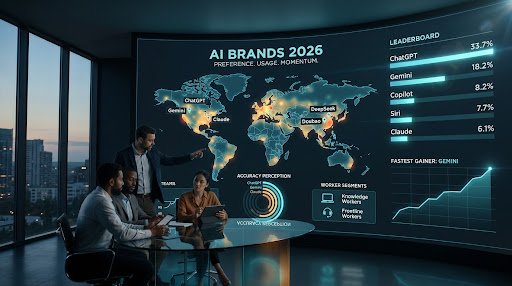
The leading AI brands in 2026 are ChatGPT, Google Gemini, and Anthropic Claude, with ChatGPT holding the largest share of consumer preference and Gemini closing fastest through distribution inside Google products. Chinese AI brands like DeepSeek and Doubao also rank among the most-used AI applications globally, making the market more fragmented than headlines suggest.
At a Glance
- Consumer preference leader: ChatGPT holds 33.7% preference among U.S. generative AI users, well ahead of Gemini at 18.2% and Copilot at 8.2%
- Fastest mover: Gemini gained 6.8 preference points between February and July 2026, the largest shift of any brand tracked
- Global usage share: ChatGPT holds 46.4% of global AI assistant True Audience share, Gemini 27.7%, and Claude 10.3% as of May 2026
- Chinese AI brands: DeepSeek ranks fourth globally in web traffic among generative AI apps, and Doubao leads China’s AIGC brand value rankings
- Perception gap: ChatGPT leads on accuracy perception with a net score of 30.3, followed by Gemini at 25.3 and Claude at 14.4
- Worker split: Siri and Alexa skew toward frontline workers, while ChatGPT and Claude skew toward knowledge workers
What “AI Brands” Actually Means in 2026
The phrase “AI brands” covers several different things, and that ambiguity shapes what people find when they search.
It can mean the consumer-facing assistants people use daily: ChatGPT, Gemini, Claude, Copilot, and Perplexity. It can mean the companies building foundation models, like OpenAI, Anthropic, and Google DeepMind. It can also mean the infrastructure brands underneath the models, like NVIDIA and TSMC. And increasingly, it means AI-native brands competing in specific verticals, from legal tech to audio data.
This article focuses on the brand layer that most searchers care about: the AI products and companies competing for user attention, trust, and spending. The rankings below draw on YouGov BrandIndex tracking, Sensor Tower audience data, and industry coverage, with clear separation between verified metrics and company claims.
The Consumer Preference Ranking
YouGov’s U.S. AI brand rankings track which tools people like or prefer using most among those they already consider. This is a narrower measure than awareness or trial, and it reveals which brand wins when users have options.
| Rank | Brand | Preference Share |
|---|---|---|
| 1 | ChatGPT | 33.7% |
| 2 | Gemini | 18.2% |
| 3 | Microsoft Copilot | 8.2% |
| 4 | Apple Siri | 7.7% |
| 5 | Anthropic Claude | 6.1% |
The rest of the top ten includes Meta AI, Amazon Alexa, xAI’s Grok, Apple Intelligence, and Perplexity AI .
The shape matters. ChatGPT leads by 15.5 percentage points over Gemini, a gap that no other brand comes close to closing. But the momentum story sits beneath the leader. Gemini gained 6.8 preference points from February to July 2026, while ChatGPT lost 5.9 points over the same period . ChatGPT still leads comfortably, but the direction of travel favors Google’s brand.
Global Usage: A Different Picture
Preference measures stated liking. Actual audience share measures behavior. Sensor Tower’s State of AI 2026 report counts unique users across mobile apps and web, and the numbers show a more contested market.
| Assistant | True Audience Share (May 2026) | Estimated Monthly Users |
|---|---|---|
| ChatGPT | 46.4% | 1.1 billion+ |
| Gemini | 27.7% | 662 million |
| Claude | 10.3% | 245 million |
| Grok, Perplexity, DeepSeek, Meta AI | Under 5% each | Not disclosed |
Source: Sensor Tower State of AI 2026 report .
ChatGPT’s share dipped below 50% in March 2026 for the first time since the category began. That is a meaningful milestone. It does not mean ChatGPT is declining in absolute terms. Its user base still grew past one billion monthly actives, the fastest app to reach that mark. But the market is expanding faster than OpenAI’s share can hold.
Gemini’s rise is less about model quality and more about distribution. Google embeds Gemini inside Search, Android, Chrome, Gmail, and Workspace. Hundreds of millions of people encounter it without opening a separate app . That structural advantage compounds with every Android device sold.
Why ChatGPT Still Leads
ChatGPT’s position rests on three advantages that are difficult to replicate quickly.
Brand habit. ChatGPT created the consumer AI assistant category. For many users, “AI” and “ChatGPT” are still interchangeable. That default status carries enormous value in a market where most people do not evaluate models technically.
Accuracy perception. YouGov’s accuracy net score measures whether users associate a brand more with accurate or inaccurate information. ChatGPT scores 30.3, ahead of Gemini at 25.3 and Claude at 14.4 . Perception is not the same as measured benchmark performance, but it drives trust and retention.
Scale of usage. More than 1.1 billion monthly users generate more feedback, more training signal, and more network effects through sharing and collaboration . Scale reinforces itself.
The vulnerability is equally clear. ChatGPT’s preference share is slipping, and Gemini’s distribution advantage is structural, not temporary. OpenAI’s challenge is to convert its brand lead into durable habit before Google’s embedding strategy erodes it further.
The Chinese AI Brands Reshaping the List
Western coverage often treats the AI brand race as a three-way contest between OpenAI, Google, and Anthropic. The global picture is broader.
DeepSeek ranks fourth globally in web traffic among generative AI applications, according to a16z’s 2026 ranking. Its user base is genuinely global: 33.5% from China, 7.1% from Russia, and 6.6% from the United States . It achieved this with a free, low-cost offering that soaks up engagement time, even where its share of unique users remains under 5%.
Doubao, ByteDance’s AI assistant, topped the Hurun Most Valuable China Brands 2026 AIGC sector with a brand value of 8.5 billion yuan . It crossed 100 million daily active users during Chinese New Year and holds over 155 million weekly actives .
Alibaba’s Qwen model family has surpassed one billion downloads and is described by TIME as the most popular open-source model series globally . That open-source strategy builds brand recognition among developers even without a dominant consumer app.
For anyone evaluating AI brands beyond the Western defaults, these names belong in the consideration set. They compete on different terms: lower cost, open weights, and regional ecosystem integration.
What Separates Strong AI Brands from Weak Ones
Brand strength in AI does not track model benchmark scores cleanly. Several other factors matter more for user retention and trust.
Distribution Beats Model Quality
Gemini’s momentum illustrates this most clearly. Its preference gains came during a period when Google made the brand more visible across its ecosystem, including model and product announcements around Google I/O . Users did not necessarily switch because Gemini got better. They switched because it became easier to use.
Accuracy Perception Compounds
A brand associated with accurate answers earns repeat usage. A brand associated with hallucinations loses trust that is hard to rebuild. YouGov’s accuracy scores show ChatGPT and Gemini well ahead of the field, and those perceptions likely reinforce their preference positions .
Worker Context Shapes Brand Choice
The AI brand landscape looks different depending on who you ask. ChatGPT is 10.9 points higher among knowledge workers than frontline workers. Claude shows a similar tilt. Siri and Alexa reverse the pattern, skewing toward frontline and operational workers .
This split suggests that “which AI brand is leading” depends on the audience. For desk-based research and writing, ChatGPT and Claude dominate. For voice-first, device-embedded assistance, Apple and Amazon remain relevant.
Transparency Is Uneven
Pricing transparency varies widely across AI brands. Consumer assistants publish clear subscription tiers. Enterprise AI brands often require sales conversations. The brands that make evaluation easy tend to earn goodwill from buyers who are comparing options.
AI Brand Visibility: A New Measurement Problem
A growing category of tools now measures how AI brands appear inside AI-generated answers. Platforms like ReachLLM, Citable, and GetMentions AI track brand mentions in ChatGPT, Gemini, Perplexity, and Claude responses .
This matters because AI assistants increasingly act as discovery layers. If a user asks “what is the best CRM for small teams,” the brands mentioned in the answer shape purchasing decisions. A Korean study of 715 brands across four generative AI platforms found that market leaders did not always rank first in AI answers. In 20 of 30 categories, different AIs named different brand leaders .
The implication is uncomfortable for brand managers. Visibility inside AI answers is not guaranteed by market position. It depends on how models retrieve, synthesize, and cite information.
Who Should Care About AI Brand Rankings?
Consumers benefit from understanding that “most popular” and “best for my needs” are different questions. A brand that leads on preference may not lead on the task you care about.
Businesses evaluating AI vendors should look beyond brand recognition. Distribution strength, accuracy perception, and worker-type fit all predict whether a tool will stick inside an organization.
Investors tracking the AI sector need to distinguish between brand momentum and durable advantage. Gemini’s preference gains are real, but they rest on Google’s distribution, not on a decisive product lead.
Marketers should recognize that AI answer visibility is becoming a brand channel. Monitoring how models describe your brand is no longer optional.
Common Mistakes When Comparing AI Brands
Treating preference as quality. YouGov’s preference measure reflects stated liking, not measured performance. A brand can lead on preference while trailing on specific tasks.
Ignoring distribution effects. Gemini’s gains are partly a distribution story. Comparing models in isolation misses the structural advantage that comes from being embedded in products people already use.
Assuming global uniformity. DeepSeek’s user base spans China, Russia, and the US. Western-centric rankings miss a significant share of global AI usage.
Confusing brand value with market share. Hurun’s brand value rankings measure financial brand equity, not user counts or revenue. Doubao’s 8.5 billion yuan valuation does not directly translate to global market position.
Overlooking worker context. Siri and Alexa remain relevant for frontline workers even as ChatGPT dominates knowledge work. The “leader” depends on the audience.
Frequently Asked Questions
Which AI brand is most popular in 2026?
ChatGPT leads consumer preference at 33.7% among U.S. generative AI users, according to YouGov. It also holds 46.4% of global AI assistant audience share, though that figure has slipped below 50% for the first time .
Is Gemini catching up to ChatGPT?
Gemini gained 6.8 preference points between February and July 2026, the largest increase of any AI brand tracked. It holds 27.7% global audience share. ChatGPT still leads by a wide margin, but Gemini’s distribution inside Google products gives it structural momentum .
What are the leading Chinese AI brands?
DeepSeek ranks fourth globally in web traffic among generative AI apps. Doubao, ByteDance’s assistant, leads China’s AIGC brand value rankings at 8.5 billion yuan. Alibaba’s Qwen is the most-downloaded open-source model family .
How do AI brands differ by worker type?
ChatGPT and Claude skew toward knowledge workers. Siri and Alexa skew toward frontline and operational workers. The most relevant AI brand depends on whether the user is desk-based or device-first .
What is AI brand visibility tracking?
Tools like ReachLLM and Citable measure how often a brand appears in AI-generated answers across ChatGPT, Gemini, Perplexity, and Claude. Research shows AI answer rankings do not always match market rankings, making this an emerging brand channel .
Conclusion
The AI brand landscape in 2026 has a clear leader, a fast-closing challenger, and a widening field of specialists and regional players. ChatGPT remains the most preferred and most-used AI brand, but its share has slipped below half of global assistant users for the first time. Gemini is the momentum story, powered less by model quality than by Google’s unmatched distribution across search, mobile, and productivity software. Claude holds a smaller but loyal base, particularly among enterprise and developer users.
Beyond the Western trio, Chinese AI brands like DeepSeek, Doubao, and Qwen have built significant global usage and brand value. Ignoring them produces an incomplete picture.
For consumers, the practical question is not which brand leads overall, but which fits the task. For businesses, brand recognition is a starting point, not a procurement decision. Evaluate distribution fit, accuracy perception, and worker-type alignment before committing.
The AI brand race is not settled. The leaders have structural advantages, but distribution, trust, and habit are still shifting. Anyone making decisions based on brand rankings should check the underlying metric: preference, usage, accuracy perception, or brand value all tell different stories.

Alex Carter is a technology writer at AI SpaceZ.com, who covers AI tools, software reviews, practical tutorials and emerging artificial intelligence trends. He aims to make AI easier to understand and help readers discover useful tools and technologies for everyday productivity.