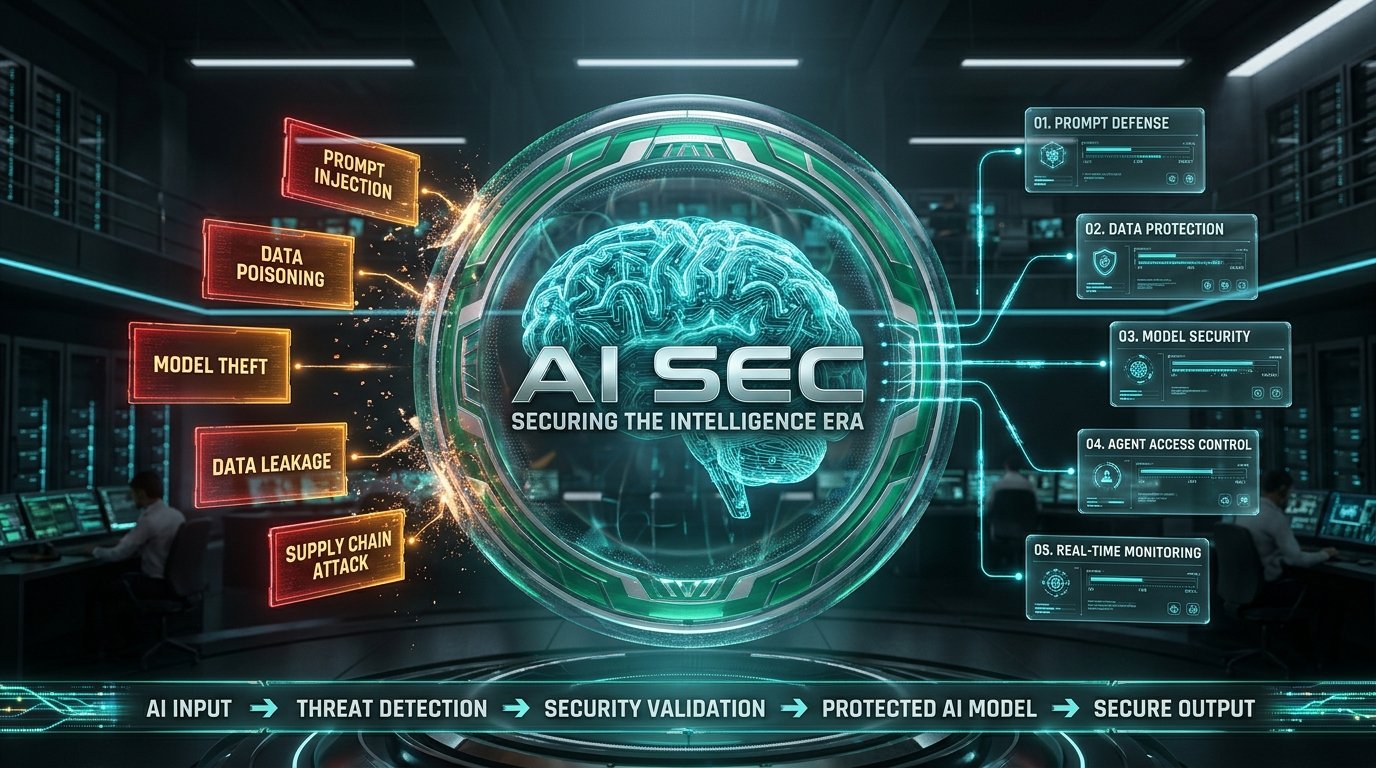
AI Sec, commonly understood as AI security, refers to the technologies, policies, and practices used to protect artificial intelligence systems, models, applications, and data from cyber threats. It addresses risks such as prompt injection, data leakage, model manipulation, unauthorized access, and unsafe AI agent behavior.
AI Sec at a Glance
- Meaning: AI Sec is the protection of AI systems throughout their development and deployment.
- Major threats: Prompt injection, data poisoning, model theft, sensitive information disclosure, and excessive AI autonomy.
- Main technologies: AI firewalls, runtime guardrails, model scanning, red teaming, and security monitoring.
- Leading platforms: Palo Alto Networks Prisma AIRS, Cisco AI Defense, Check Point AI Security, HiddenLayer, and Microsoft security products.
- Important frameworks: OWASP Top 10 for LLM Applications and the NIST AI Risk Management Framework.
- Best approach: Combine traditional cybersecurity controls with AI-specific testing, monitoring, and governance.
What Is AI Sec?
AI Sec is a broad term for securing artificial intelligence technologies against digital threats, unauthorized access, misuse, and operational vulnerabilities.
It includes protecting machine learning models, large language models (LLMs), generative AI applications, training datasets, APIs, and autonomous AI agents.
Traditional cybersecurity focuses primarily on protecting networks, applications, devices, and information systems. AI security extends those protections to the unique ways artificial intelligence processes information and makes decisions.
For example, a company might use an AI assistant to analyze customer documents, retrieve internal information, and generate business recommendations.
Without appropriate security controls, an attacker could manipulate its instructions, expose confidential information, or exploit its connections to other business systems.
This makes AI Sec an important consideration for organizations building, purchasing, or deploying artificial intelligence.
AI Security vs. AI-Powered Cybersecurity
These terms are related, but they describe different activities.
| Category | Meaning | Example |
|---|---|---|
| AI security | Protecting AI systems against attacks | Preventing prompt injection |
| AI-powered cybersecurity | Using AI to improve conventional security | AI-assisted threat detection |
| AI safety | Reducing harmful or unintended AI behavior | Preventing dangerous recommendations |
| AI governance | Managing AI accountability and organizational risks | Establishing access and usage policies |
A complete security strategy may involve all four areas.
However, protecting an AI application and using AI to detect network attacks require different technologies and security controls.
Why Is AI Security Important in 2026?
Artificial intelligence is becoming part of everyday business operations.
Organizations increasingly use AI for customer support, software development, financial analysis, document processing, healthcare administration, and internal knowledge management.
These applications introduce additional security considerations.
An AI application might connect to confidential databases, external APIs, cloud storage, and third-party services. An autonomous agent may also have permission to send emails, modify records, or execute workflows.
Consequently, a vulnerability in an AI application can affect more than its generated responses.
It can potentially expose business information or trigger unauthorized actions.
Three developments make AI security particularly important:
1. Growing AI adoption: More organizations are integrating AI into applications and internal processes, increasing the number of systems that need protection.
2. Autonomous AI agents: Agents can interact with external tools and perform actions. Excessive permissions can turn a manipulated response into an operational security incident.
3. Complex AI supply chains: AI applications depend on models, datasets, libraries, APIs, plugins, and cloud infrastructure. Vulnerabilities in any component can affect the complete application.
The NIST AI Risk Management Framework and its Generative AI Profile provide useful guidance for identifying and managing these risks.
How Does AI Security Work?
AI security uses multiple protective layers rather than depending on a single security product.
These layers monitor how information enters an AI system, how models process requests, and how applications use generated outputs.
A typical AI security architecture includes the following stages.
1. AI Asset Discovery
Organizations first need to identify which AI systems operate within their environments.
This includes:
- Public generative AI applications.
- Internally developed LLM applications.
- Machine learning models.
- AI agents and assistants.
- Third-party AI APIs.
- Model repositories and external datasets.
Asset discovery helps security teams identify unauthorized or unmanaged AI usage, sometimes called shadow AI.
2. Data Protection
AI systems frequently process sensitive information.
Security controls must prevent confidential documents, customer records, financial information, and personal data from reaching unauthorized destinations.
Common techniques include:
- Data loss prevention (DLP).
- Encryption.
- Access restrictions.
- Data classification.
- Sensitive information redaction.
- Secure storage and retention policies.
Organizations should also evaluate how AI providers process submitted information.
3. Model and Application Security
AI models and their surrounding applications require different security checks.
Model security examines model files, dependencies, training data, and potential manipulation.
Application security focuses on authentication, authorization, API protection, input validation, and output handling.
This distinction matters because a secure model does not automatically make its application secure.
4. Runtime Protection
Runtime security monitors AI applications while users interact with them.
Security controls can inspect prompts, detect suspicious instructions, identify sensitive information, and restrict unsafe responses.
Some platforms provide AI guardrails that operate between an application and its underlying model.
These controls help reduce risks without requiring organizations to replace their existing AI models.
5. Continuous Monitoring
AI threats and application behavior can change over time.
Security teams should monitor:
- Unusual API requests.
- Unexpected model behavior.
- Unauthorized tool calls.
- Suspicious access patterns.
- Data exposure.
- Abnormal usage and inference costs.
Continuous monitoring helps organizations identify problems before they become larger incidents.
Major AI Security Threats You Should Understand
AI systems introduce security risks that traditional application security alone may not adequately address.
The OWASP Top 10 for LLM Applications 2025 provides an important reference for understanding these vulnerabilities.
1. Prompt Injection
Prompt injection occurs when malicious instructions manipulate an AI model into ignoring its intended behavior.
For example, an attacker might hide instructions inside a document that an AI assistant is asked to summarize.
If the application treats that document as trusted instructions, the model could expose information or perform an unintended action.
Defenses include instruction separation, restricted tool permissions, trusted-source validation, and human approval for sensitive operations.
Prompt injection cannot be reliably eliminated through simple keyword filtering alone.
2. Sensitive Information Disclosure
AI applications may accidentally reveal confidential information through generated responses.
This can happen when applications provide excessive access to internal documents or fail to enforce user-specific permissions.
Organizations should implement data access controls, sensitive information detection, and appropriate output filtering.
3. Data and Model Poisoning
Data poisoning involves manipulating information used to train or fine-tune an AI model.
An attacker might introduce misleading examples that influence model behavior.
Model poisoning can also involve malicious modifications to model files or other components.
Organizations should verify data provenance, protect training pipelines, and scan external model artifacts.
4. Excessive AI Agent Permissions
AI agents can use external tools to complete tasks.
However, granting an agent unnecessary permissions increases the potential damage caused by manipulated instructions or incorrect decisions.
For example, an AI assistant that only needs to read customer records should not automatically receive permission to delete them.
The principle of least privilege is essential here.
5. Supply Chain Vulnerabilities
AI applications rely on third-party models, libraries, plugins, datasets, and infrastructure.
A compromised dependency can introduce vulnerabilities into an otherwise well-designed system.
Organizations should maintain dependency inventories, verify model sources, and review third-party security practices.
6. Model Theft
Proprietary AI models can represent significant intellectual property.
Unauthorized access to model weights, training information, or inference endpoints can create financial and competitive risks.
Access restrictions, encryption, monitoring, and infrastructure security help reduce these threats.
7. Unbounded Consumption
AI services can become expensive or unavailable when attackers exploit unrestricted requests.
Repeated or resource-intensive prompts may increase inference costs and consume available computing capacity.
Rate limits, request quotas, usage monitoring, and resource controls help mitigate this risk.
Best AI Security Tools and Platforms in 2026
AI security platforms address different parts of the AI development and deployment lifecycle.
Some focus on prompt protection, while others specialize in cloud discovery, model scanning, red teaming, or enterprise data governance.
There is no universal solution for every organization.
The following comparison highlights established platforms and open-source projects worth evaluating.
| Platform or Tool | Target User | Key Strength | Pricing Transparency | Core Limitation |
|---|---|---|---|---|
| Palo Alto Networks Prisma AIRS | Large enterprises | AI application, model, and agent security | Contact vendor | Enterprise deployment complexity |
| Cisco AI Defense | Enterprise security teams | AI application validation and runtime protection | Contact vendor | Requires evaluation of deployment and integration fit |
| Check Point AI Security (Lakera) | AI developers and enterprises | LLM runtime protection and prompt security | Contact vendor | Specialized controls may require additional security layers |
| HiddenLayer | AI development and security teams | Model and AI supply chain security | Contact vendor | Not a complete replacement for general cybersecurity |
| Microsoft Purview | Microsoft-centric organizations | Data governance and protection | Plan-dependent | Coverage depends on Microsoft licensing and configuration |
| NVIDIA garak | Developers and researchers | Open-source LLM vulnerability testing | Free, open-source | Requires technical knowledge and does not provide complete runtime protection |
Pricing transparency describes publicly available pricing information, not the actual cost of implementation.
1. Palo Alto Networks Prisma AIRS
Prisma AIRS is an AI security offering from Palo Alto Networks.
It addresses security risks across AI applications, models, and agent-based systems.
Its capabilities make it relevant to enterprises that need visibility and protection across different stages of AI deployment.
Suitable for: Organizations managing complex AI environments and enterprise security infrastructure.
Official website: https://www.paloaltonetworks.com/
2. Cisco AI Defense
Cisco AI Defense focuses on protecting AI applications through security assessment, validation, and runtime controls.
It is relevant to organizations that want to integrate AI security into an established enterprise security environment.
Suitable for: Enterprise IT departments, developers, and security operations teams.
Official website: https://www.cisco.com/
3. Check Point AI Security (Lakera)
Lakera became part of Check Point’s AI security portfolio.
Its technology is associated with protecting generative AI applications against prompt-based attacks and other LLM-specific threats.
This makes it particularly relevant to teams developing customer-facing AI assistants and internal LLM applications.
Suitable for: AI developers and organizations deploying generative AI applications.
Official website: https://www.checkpoint.com/
4. HiddenLayer
HiddenLayer specializes in AI and machine learning security.
Its focus includes model security, AI supply chain protection, and identifying vulnerabilities affecting machine learning systems.
It is particularly relevant when organizations develop, train, or deploy proprietary AI models.
Suitable for: AI researchers, ML engineers, and enterprise AI security teams.
Official website: https://hiddenlayer.com/
5. Microsoft Purview
Microsoft Purview provides data governance and information protection capabilities.
For organizations using Microsoft 365 and enterprise AI applications, its data security capabilities can help manage sensitive information and organizational policies.
It should not be confused with a dedicated prompt-injection firewall.
Suitable for: Organizations using Microsoft cloud and productivity environments.
Official website: https://www.microsoft.com/en-us/security/business/microsoft-purview
6. NVIDIA garak
Garak is an open-source vulnerability scanner for large language models.
It helps developers test models for weaknesses through automated probes.
It can support security testing during development, although it does not replace a complete enterprise security platform.
Suitable for: Developers, AI researchers, and technical security teams.
Official repository: https://github.com/NVIDIA/garak
Open-Source vs. Commercial AI Security Solutions
Organizations do not always need an expensive commercial platform to begin securing AI applications.
Open-source projects can provide valuable testing and development capabilities.
However, commercial platforms may offer additional centralized monitoring, enterprise integrations, deployment support, and managed security capabilities.
| Consideration | Open-Source Tools | Commercial Platforms |
|---|---|---|
| Initial cost | Often free | Usually vendor-dependent |
| Customization | Generally flexible | Depends on product |
| Deployment | Often requires technical expertise | May offer managed deployment |
| Support | Community or paid support | Vendor support options |
| Integration | Varies by project | Often includes enterprise integrations |
| Maintenance | Organization-managed | Depends on vendor agreement |
Useful open-source resources include:
- NVIDIA garak: Automated LLM vulnerability testing.
- Microsoft PyRIT: Framework for automating generative AI red teaming.
- OWASP GenAI Security Project: Security research, risk guidance, and educational resources.
- NVIDIA NeMo Guardrails: Framework for implementing programmable guardrails in LLM applications.
- promptfoo: Testing and evaluation workflows for AI applications.
The right choice depends on technical capabilities, deployment requirements, and the organization’s threat model.
Benefits of Implementing AI Security
AI security is not simply another compliance requirement.
It helps organizations maintain control over systems that increasingly influence business decisions and operations.
Better Data Protection
Security controls help prevent sensitive business information from being exposed through AI applications.
This is especially important when employees use external AI services or connect models to internal databases.
Reduced Cybersecurity Risks
AI-specific monitoring and testing help identify vulnerabilities that conventional security tools may overlook.
Organizations can detect suspicious prompts, insecure integrations, and potentially dangerous agent behavior.
Improved Business Trust
Customers and business partners expect organizations to handle their information responsibly.
A well-designed AI security program supports transparency, accountability, and responsible deployment.
Safer AI Automation
AI agents can perform useful tasks, but their permissions must remain controlled.
Approval mechanisms and restricted access help prevent unintended operations.
Better Regulatory and Risk Management
Security documentation, access policies, and incident response procedures help organizations demonstrate responsible AI management.
However, implementing an AI security platform alone does not guarantee regulatory compliance.
Challenges and Limitations of AI Sec
Although AI security technologies are improving, several challenges remain.
Prompt injection is difficult to eliminate completely. Natural-language instructions and untrusted content can enter the same model context, making reliable separation difficult.
Security tools have different coverage. A prompt firewall may not detect malicious model files or cloud misconfigurations.
False positives can disrupt workflows. Overly aggressive filtering may block legitimate requests and reduce application usability.
AI systems change frequently. Model updates, new integrations, and additional agent permissions can introduce new vulnerabilities.
Deployment costs can increase. Runtime inspection, logging, testing, and additional infrastructure may add operational expenses.
Security depends on implementation. Even advanced platforms cannot compensate for unrestricted permissions, poor access controls, or insecure application architecture.
These limitations make layered security and continuous testing important.
How to Secure an AI System: Practical Best Practices
Organizations should approach AI security as an ongoing process rather than a one-time software installation.
The following practices provide a useful starting point.
1. Identify Every AI Application
Create an inventory of AI applications, models, APIs, agents, and external integrations.
Include systems purchased by departments as well as applications developed internally.
2. Apply Least-Privilege Access
Give AI applications only the permissions they need.
Separate read and write permissions, restrict access to sensitive databases, and require approval for high-impact operations.
3. Protect Sensitive Information
Use encryption, access controls, data classification, and DLP policies.
Avoid sending confidential information to external AI providers without reviewing their contractual and data-handling terms.
4. Test for Prompt Injection
Perform security testing using malicious and unexpected inputs.
Test both direct prompt injection and indirect attacks hidden in documents, web pages, and retrieved content.
5. Validate AI Outputs
Never automatically trust generated content.
Validate outputs before passing them into databases, code execution environments, payment systems, or other sensitive applications.
6. Secure APIs and Integrations
Use authentication, authorization, rate limiting, secure secrets management, and appropriate network controls.
Review third-party plugins and tools before connecting them to AI agents.
7. Monitor AI Activity
Maintain appropriate audit logs for model requests, tool calls, access events, and security alerts.
Protect logs from unauthorized access and avoid unnecessarily storing sensitive prompt content.
8. Conduct Regular Red-Team Assessments
Use adversarial testing to identify weaknesses before attackers exploit them.
Repeat assessments after major model changes, new integrations, and significant application updates.
AI Security Frameworks and Standards
Organizations need structured approaches to identify, assess, and manage AI-related security risks.
Two important resources are particularly useful.
OWASP Top 10 for LLM Applications
OWASP provides security guidance specifically for applications built using large language models.
Its 2025 framework highlights risks such as:
- Prompt injection.
- Sensitive information disclosure.
- Supply chain vulnerabilities.
- Data and model poisoning.
- Improper output handling.
- Excessive agency.
- System prompt leakage.
- Vector and embedding weaknesses.
- Misinformation.
- Unbounded consumption.
It is particularly useful for developers, application security teams, and organizations deploying generative AI.
NIST AI Risk Management Framework
The National Institute of Standards and Technology developed the AI Risk Management Framework to help organizations manage risks associated with artificial intelligence.
Its four core functions are:
- Govern: Establish policies, responsibilities, and accountability.
- Map: Understand the AI system, its context, and potential risks.
- Measure: Assess and monitor identified risks.
- Manage: Prioritize and address risks throughout the AI lifecycle.
NIST also published its Generative AI Profile, NIST AI 600-1, in July 2024.
These frameworks complement each other. OWASP provides application-focused security guidance, while NIST offers a broader risk-management approach.
AI Security vs. Traditional Cybersecurity
Traditional cybersecurity remains essential, but AI introduces additional attack surfaces.
| Security Area | Traditional Cybersecurity | AI Security |
|---|---|---|
| Primary target | Networks, devices, and applications | Models, data, prompts, and AI applications |
| Common attacks | Malware, phishing, and network intrusion | Prompt injection, poisoning, and model manipulation |
| Data protection | Encryption and access control | Encryption, access control, and AI-specific data safeguards |
| Testing | Penetration testing and vulnerability scanning | Red teaming, adversarial testing, and model scanning |
| Monitoring | Network and endpoint activity | Model behavior, prompts, tool calls, and AI activity |
| Governance | IT and cybersecurity policies | AI-specific accountability and risk management |
The two disciplines should work together.
AI security does not replace conventional cybersecurity. It extends security practices to systems with additional risks and behaviors.
Who Should Use AI Security Solutions?
AI security matters to almost every organization using artificial intelligence, although the required level of protection varies.
Businesses: Organizations using AI for customer service, document processing, or internal operations need data protection and access controls.
Developers: Teams building LLM applications should implement secure APIs, output validation, prompt testing, and runtime safeguards.
Enterprise security teams: Large organizations need AI discovery, governance, monitoring, and incident response capabilities.
AI researchers: Researchers working with models and training datasets should consider data provenance, model integrity, and adversarial testing.
Cloud and IT administrators: Teams managing AI infrastructure need visibility into external services, model dependencies, permissions, and configurations.
Smaller organizations can begin with secure development practices and open-source testing tools. Larger environments may require centralized commercial platforms.
What to Consider Before Choosing an AI Security Platform
Choosing an AI security solution requires more than comparing feature lists.
Evaluate these factors before purchasing:
| Evaluation Factor | What to Check |
|---|---|
| AI coverage | Does it protect LLMs, traditional ML models, or autonomous agents? |
| Deployment | SaaS, self-hosted, cloud, or hybrid? |
| Integrations | Does it support your existing AI infrastructure? |
| Data privacy | How are prompts, logs, and customer information processed? |
| Retention | Are retention periods configurable? Is Zero Data Retention available? |
| Access control | Can it enforce user permissions and restrict tool access? |
| Testing | Does it support automated security assessments and red teaming? |
| Monitoring | Can security teams investigate incidents and review audit logs? |
| Pricing | Are usage limits, API charges, and enterprise fees transparent? |
| Support | Does the vendor provide documentation and technical assistance? |
One important distinction concerns security certifications and data retention.
A SOC 2 report provides information about controls within a defined audit scope. It does not automatically establish that a provider offers Zero Data Retention.
Organizations should review the actual security documentation, contractual terms, retention settings, and service-specific policies before sharing sensitive information.
Frequently Asked Questions
1. What does AI Sec mean?
AI Sec generally refers to artificial intelligence security. It includes technologies and practices that protect AI models, applications, datasets, APIs, and agents against cyberattacks, unauthorized access, data leakage, and manipulation.
2. What are the biggest AI security threats in 2026?
Major threats include prompt injection, sensitive information disclosure, data and model poisoning, supply chain vulnerabilities, excessive AI agent permissions, and model theft. Organizations should also monitor unbounded resource consumption and insecure integrations.
3. What are the best AI security tools?
Suitable platforms include Palo Alto Networks Prisma AIRS, Cisco AI Defense, Check Point AI Security, HiddenLayer, and Microsoft Purview. Developers can also evaluate open-source tools such as NVIDIA garak and Microsoft PyRIT. The right choice depends on the security requirements and existing infrastructure.
4. Is AI security different from traditional cybersecurity?
Yes. Traditional cybersecurity protects networks, devices, applications, and information systems. AI security adds protections for models, prompts, training data, AI integrations, and autonomous agents. Both disciplines are necessary for organizations deploying artificial intelligence.
5. How can businesses improve AI security?
Businesses should inventory their AI systems, restrict permissions, protect sensitive information, test for prompt injection, validate model outputs, secure API integrations, and monitor AI activity. Regular red-team assessments also help identify weaknesses before production deployment.
Conclusion
AI Sec is becoming an essential part of modern cybersecurity as organizations increasingly depend on artificial intelligence.
Protecting AI requires more than securing the underlying model. Businesses must also protect training data, APIs, integrations, user permissions, and autonomous agents.
Platforms such as Prisma AIRS, Cisco AI Defense, Check Point AI Security, and HiddenLayer offer different approaches to addressing these challenges.
However, no single product eliminates every AI security risk.
Organizations should combine established cybersecurity practices with AI-specific testing, continuous monitoring, and responsible governance.
The most effective strategy starts with understanding how AI systems operate, what information they access, and what actions they can perform. That foundation makes it easier to choose appropriate security technologies and deploy AI with greater confidence.