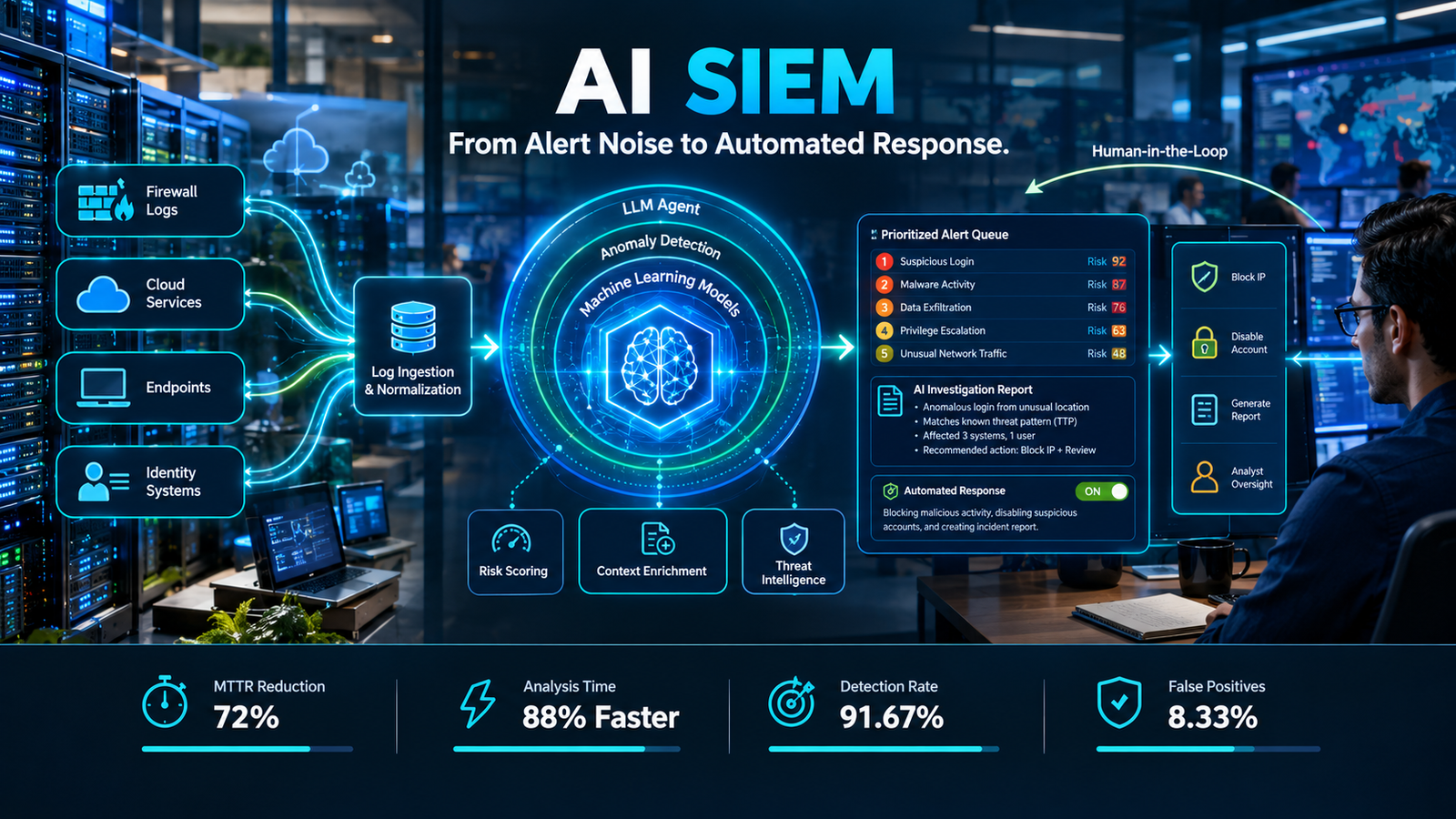
AI SIEM is a security information and event management platform that embeds machine learning and AI agents to automate alert triage, threat investigation, and incident response. It moves beyond static rule-based detection to help security teams handle high alert volumes with fewer analysts and faster response times.
At a Glance
- Core shift: AI agents are moving from preview features to general availability in major SIEM platforms, handling triage, investigation, and detection engineering
- Measured impact: An IEEE study on Wazuh SIEM found AI-assisted workflows cut mean time to respond by 72%, and fully automated response by 98% compared to manual triage
- Market direction: IDC reports 73% of enterprises ingest less than 75% of needed data due to cost constraints, driving adoption of decoupled storage and AI-driven efficiency
- Key limitation: AI models still require quality training data and human oversight for high-stakes decisions; explainability remains a challenge
- Pricing reality: AI features often come as separate metered units (e.g., Google Security Tokens), adding cost complexity beyond base ingestion fees
What Is AI SIEM?
Security Information and Event Management (SIEM) has traditionally been a log aggregation and correlation tool. Analysts query data, write detection rules, and manually investigate alerts. The model worked when data volumes were manageable and threats were slower.
AI SIEM changes that model by embedding machine learning and AI agents directly into the detection and response pipeline. Instead of waiting for an analyst to query a dashboard, the system actively triages alerts, gathers context, and in some configurations, executes containment actions .
IDC describes the shift clearly: SIEM is moving from a data platform analysts query to one that actively works alongside them . The technology is not a separate product category. It is an evolution of existing SIEM platforms adding AI capabilities at multiple stages.
How AI SIEM Works
The architecture layers AI across the traditional SIEM workflow.
Data Ingestion and Normalization
Logs from firewalls, endpoints, cloud services, and applications flow into the platform. AI can help normalize diverse formats and identify which sources carry the most detection value. This matters because data ingestion costs dominate SIEM budgets .
Anomaly Detection and Scoring
Machine learning models establish baselines of normal behavior and flag deviations. Supervised models catch known threat patterns. Unsupervised models surface unknown anomalies. The system scores incidents by risk, asset value, and potential impact to prioritize analyst attention .
Agentic Triage and Investigation
This is the newest layer. AI agents, powered by large language models, can autonomously query the SIEM, enrich alerts with threat intelligence, and generate structured incident reports. A 2026 IEEE study on Wazuh SIEM documented the impact directly .
In the study, manual triage took an average of 10.04 minutes per alert. With an AI assistant using Model Context Protocol tools to query the Wazuh manager, analysis time dropped to 1.23 minutes. Mean time to respond fell from 804 minutes to 222 minutes .
Automated Response
The final layer adds active response capabilities. The system can block IPs, disable accounts, and trigger containment playbooks without waiting for human approval. In the IEEE study’s Phase 2, fully automated response achieved 0.15 minutes average analysis time and 15.2 minutes MTTR .
The trade-off is precision. The automated phase achieved 87.50% precision with an 8.33% false-positive rate. Higher than manual, but still requiring monitoring.
Key Capabilities in 2026
Autonomous Alert Triage
Vendors including CrowdStrike, Google, and Rapid7 now ship AI agents that ingest alerts, correlate related events, and present analysts with a prioritized queue. IDC notes these agents move from preview to general availability across major platforms .
Natural Language Investigation
Analysts can ask questions in plain language rather than writing complex query syntax. NLP processes unstructured data including threat intelligence feeds and analyst notes, building richer context around events .
Detection Rule Generation
AI can draft new detection rules based on observed attack patterns. This addresses a persistent bottleneck: detection engineering requires specialized skills that many SOCs lack.
Decoupled Data Economics
Traditional SIEM pricing penalized visibility. IDC found 73% of enterprises deliberately limit ingestion due to cost . Next-gen platforms separate storage costs from compute costs, allowing organizations to retain more data without proportional spending increases.
Benefits: What the Evidence Shows
Faster Response Times
The IEEE study provides the most concrete evidence available. AI-assisted triage reduced analysis time by 88%. Automated response reduced it by 98.5%. MTTR dropped from 804 minutes to 15.2 minutes in the automated configuration .
These results come from a controlled experiment, not a production enterprise environment. Real-world performance will vary with rule quality, data completeness, and incident complexity.
Reduced Analyst Cognitive Load
Rapid7’s positioning in the 2026 IDC MarketScape emphasizes cognitive load reduction as a core strength . AI handling repetitive triage frees analysts for threat hunting and strategic work. The IEEE study supports this: the AI assistant acted as a senior responder, handling context gathering while the human retained final decision authority .
Better Detection Coverage
The same study showed detection rate improved from 83.33% manually to 91.67% with AI assistance. Attacker dwell time fell from 846 minutes to 222 minutes .
Cost Pressure Relief
AI does not make SIEM cheap. But decoupled data architectures and automated triage can reduce the analyst hours required per incident, which is often the larger operational cost.
Limitations and Risks
Training Data Quality
Machine learning models require representative, clean data. Incomplete or biased datasets produce poor detection and erroneous automated responses . Organizations with messy log sources will see degraded AI performance.
Explainability and Compliance
Deep learning models operate as black boxes. When an AI agent blocks an IP or disables an account, auditors and regulators may ask why. Explainable AI frameworks are emerging but not universal . Regulated industries should verify audit trails before enabling automated response.
Adversarial Attacks
Attackers can manipulate input data to deceive ML models, causing false negatives or positives. Robust training and continuous monitoring are required, but no system is immune .
Integration Complexity
AI SIEM features rarely work in isolation. They depend on clean integrations with endpoints, identity systems, and cloud platforms. Legacy infrastructure and hybrid environments create friction that reduces AI effectiveness.
Pricing Opacity
AI features often come as separate metered units. Google SecOps uses “Security Tokens” for agentic features, with daily allotments that do not roll over. Enterprise tier customers may not receive complimentary tokens at all . Microsoft Sentinel bills AI and automation features separately from core ingestion .
AI SIEM vs. Traditional SIEM
| Dimension | Traditional SIEM | AI SIEM |
|---|---|---|
| Detection | Static rules and correlation | ML anomaly detection plus rules |
| Triage | Manual analyst review | AI-prioritized queue, autonomous enrichment |
| Investigation | Analyst writes queries | Natural language, agent-driven context gathering |
| Response | Manual playbook execution | Automated containment with human oversight |
| Cost driver | Ingestion volume | Ingestion plus AI metering units |
| Skill requirement | Query language expertise | Oversight and validation skills |
The distinction is not absolute. Most “AI SIEM” platforms still require traditional rule authoring and analyst judgment. The AI augments rather than replaces the core workflow.
Who Should Consider AI SIEM?
AI SIEM fits well for:
- SOCs handling high alert volumes with limited analyst headcount
- Organizations struggling with MTTR targets and alert fatigue
- Enterprises with mature log pipelines and clean data sources
- Teams already using a major SIEM vendor adding AI features (CrowdStrike, Google, Microsoft, Rapid7)
AI SIEM may not fit for:
- Small teams without dedicated security staff to oversee AI decisions
- Organizations with poor data quality or incomplete log coverage
- Regulated industries requiring full explainability for automated actions
- Budget-constrained teams unable to absorb additional AI metering costs
Common Mistakes When Adopting AI SIEM
Enabling automated response too early. Start with AI-assisted triage and human-approved actions. Move to full automation only after validating precision in your environment.
Ignoring data quality. AI amplifies existing problems. If your logs are noisy or incomplete, AI will produce noisy, incomplete results.
Underestimating AI metering costs. Security Tokens, AI credits, and automation units add to base ingestion fees. Model your expected usage before committing.
Treating AI as a replacement for analysts. The IEEE study kept humans in the loop for final decisions in Phase 1. The technology works best as augmentation, not replacement .
Skipping explainability requirements. Verify that your vendor provides audit trails for AI decisions. This matters for compliance and incident post-mortems.
Frequently Asked Questions
What is AI SIEM?
AI SIEM is a security information and event management platform that uses machine learning and AI agents to automate alert triage, investigation, and response. It augments traditional rule-based detection with anomaly detection and natural language processing.
Is AI SIEM accurate?
Accuracy depends on data quality and configuration. An IEEE study on Wazuh SIEM found AI-assisted detection achieved 91.67% detection rate and 8.33% false-positive rate in automated response mode. Production results will vary based on rule coverage and log completeness .
Does AI SIEM replace security analysts?
No. Current implementations keep humans in oversight roles. AI handles repetitive triage and context gathering. Analysts focus on threat hunting, validation, and strategic decisions. The technology reduces workload but does not eliminate the need for skilled staff.
How much does AI SIEM cost?
Costs vary widely. Base SIEM ingestion ranges from hundreds to hundreds of thousands of dollars monthly depending on volume. AI features often add separate metered costs. Google SecOps uses Security Tokens for agentic features, and Microsoft Sentinel bills automation separately from ingestion .
Which vendors offer AI SIEM?
Major platforms include CrowdStrike Falcon Next-Gen SIEM, Google Chronicle/SecOps, Microsoft Sentinel, Rapid7 Insight, and Exabeam. IDC’s 2026 MarketScape evaluates these vendors on AI capabilities, data architecture, and workflow integration .
Conclusion
AI SIEM represents a meaningful evolution in security operations. The technology moves beyond passive log retention to active, intelligent assistance. The evidence from controlled studies shows substantial improvements in response times and detection rates.
The limitations are equally real. Data quality determines outcomes. Explainability remains incomplete. Costs extend beyond base ingestion. And fully automated response still carries risk that demands human oversight.
AI SIEM suits organizations with established SOC operations, clean data pipelines, and the budget to absorb additional metering costs. It offers the most value to teams drowning in alerts who need intelligent prioritization.
It may not suit small teams without dedicated security staff or organizations with immature logging infrastructure. The technology amplifies both good and bad data practices.
Before committing, evaluate your data quality first. Test AI triage features in assisted mode before enabling automation. Model the full cost including AI metering units. And verify that your vendor provides audit trails for AI-driven decisions. AI SIEM is a tool for reducing operational friction, not a substitute for security fundamentals.