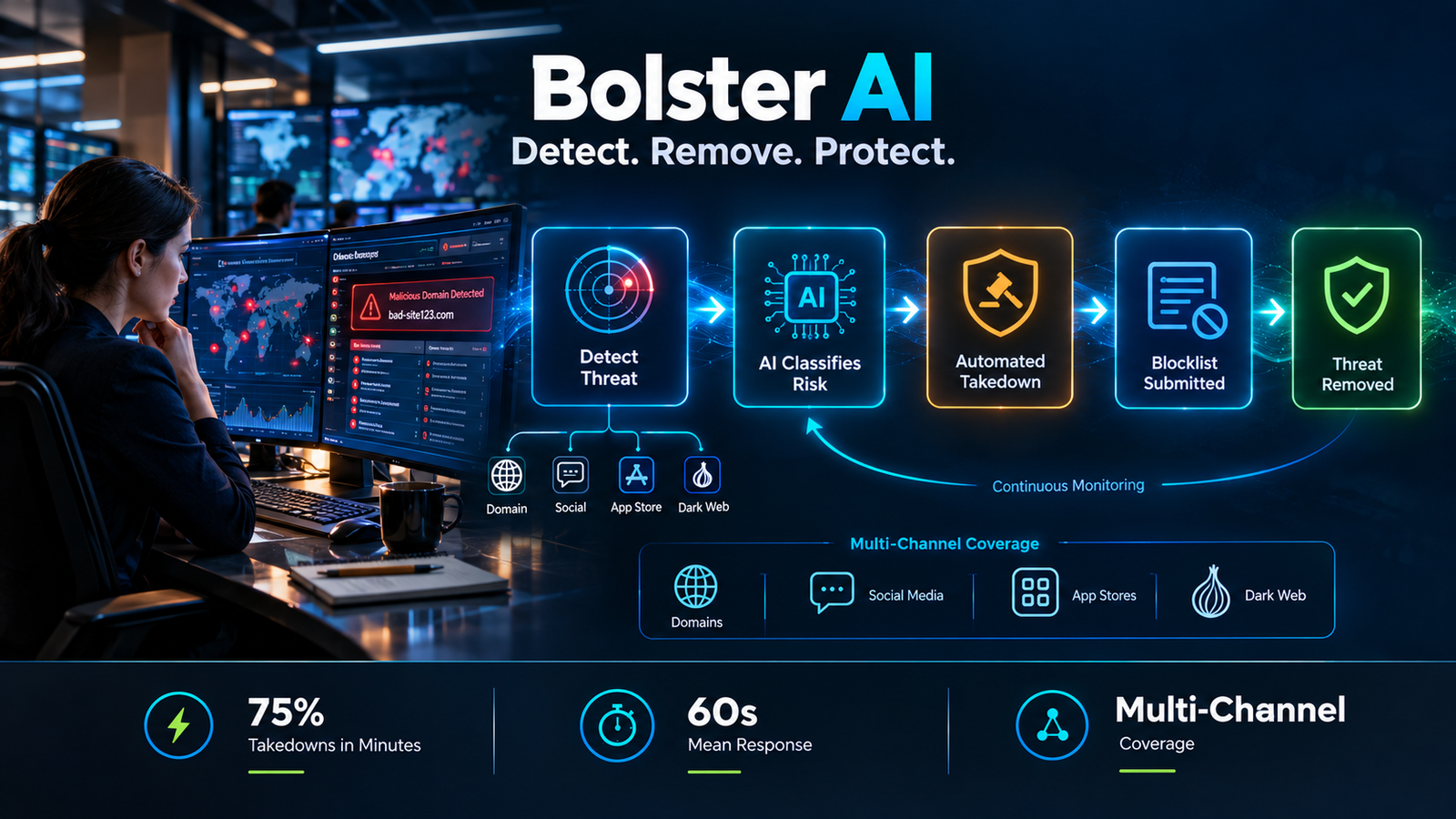
Bolster AI is an AI-powered cybersecurity platform that detects and removes phishing sites, fake social profiles, and brand impersonation across domains, app stores, and the dark web. It is best known for fast automated takedowns, though its sales-led pricing and reliance on third-party platforms for actual removals define its practical limits.
At a Glance
- Core function: AI-driven detection and automated takedown of phishing, scam sites, and brand impersonation
- Key differentiator: Automated removal of confirmed threats, with the company reporting most takedowns complete within minutes through registrar connections
- User sentiment: 4.6 out of 5 on Gartner Peer Insights across 17 to 19 verified reviews
- Pricing: Not published. Sales-quoted only, scoped to brand and domain volume
- Free tool: CheckPhish, a standalone URL scanner that serves as a low-friction entry point to the platform
- Core limitation: Bolster cannot control how fast a registrar or platform acts on a takedown request. Speed depends on third parties
What Is Bolster AI?
Bolster AI is a brand protection and digital risk platform built around one promise: find threats fast, then remove them automatically. The company monitors domains, social media, app stores, and the dark web for signs of impersonation, phishing, and scam activity .
The platform emerged from the broader shift in cybersecurity toward automated remediation. Detection alone has limited value if a fake login page stays live for days while a security team files manual complaints. Bolster bets that speed of removal matters more than breadth of alerts.
The company is headquartered in Santa Clara, California, and was founded in 2017, according to its verified LinkedIn presence . It operates CheckPhish, a free URL scanning tool that has been publicly available since 2019 and serves as a lightweight entry point to the paid platform .
How Bolster AI Works
The workflow centers on continuous monitoring and automated action.
Step 1: Detection. Bolster scans domains, social platforms, app stores, and dark web sources for assets that mimic or reference your brand. The system uses proprietary deep learning models to classify threats, with the company claiming 95% AI accuracy .
Step 2: Triage and confirmation. Confirmed threats are routed for takedown. Bolster reports that 95% of takedowns require no manual intervention, meaning the system acts without an analyst touching the case .
Step 3: Automated takedown. For registrars and hosting providers with automated connections, Bolster submits removal requests directly. For providers without those connections, the system generates evidence-based takedown emails .
Step 4: Blocklist submission. While removal is pending, Bolster submits confirmed URLs to global blocklists. This stops the page from converting visitors even before the hosting provider acts .
The critical nuance here is control. Bolster controls its own response time, not the removal time. The company publishes a 60-second mean time to response, which measures how fast Bolster acts. The actual removal still happens on the registrar’s schedule .
Key Features
Automated Takedowns
This is Bolster’s defining capability. The company reports that 75% of takedowns happen within minutes through automated registrar and hosting provider connections . Unlimited takedowns are included in plans, according to G2 reviewers .
A financial services reviewer on G2 noted: “The dashboards offer excellent visibility into potential threats… What really stands out is the speed at which Bolster acts on identified items. Their removal speed was impressive” .
Multi-Channel Coverage
Bolster monitors more than just domains. The platform covers:
- Social media: Fake profiles and impersonation accounts on major platforms
- App stores: Unauthorized or malicious apps using your brand
- Dark web: Credential leaks and threat intelligence
- Domains: Typosquatting and lookalike domains
This breadth matters because brand attacks rarely stay on one channel. A phishing domain often pairs with a fake social profile and a scam ad. Bolster files related assets under the same campaign record, so removing one does not leave siblings running .
CheckPhish (Free Tool)
CheckPhish is Bolster’s free URL scanner. Users can submit suspicious links for analysis and receive a verdict. It also offers typosquat monitoring for a single domain .
CheckPhish is genuinely useful as a standalone tool. It is also a natural funnel into the paid platform. Teams that find value in CheckPhish’s scanning capabilities may eventually want the multi-channel coverage and automated takedowns that the full platform provides.
Important note: Gridinsoft flags checkphish.bolster.ai as a “phishing” domain, but this appears to be a false positive tied to the tool’s function as a URL scanner. The domain has been registered since 2019, and ownership verification confirms it is controlled by Bolster AI . The flag reflects the nature of a phishing-checking service, not evidence of malicious intent.
API and Integrations
Bolster connects with existing security stacks through an API. Security teams can pull Bolster data into their broader threat intelligence and SIEM workflows . This matters for organizations that do not want another standalone dashboard.
Who Should Use Bolster AI?
Bolster fits well for:
- Enterprise security teams managing brand protection at scale
- Financial services and fintech companies facing phishing attacks
- Organizations with dedicated fraud or abuse teams
- Teams that prioritize takedown speed over detailed analyst transparency
Bolster may not fit for:
- Small businesses with limited security budgets
- Teams that need transparent, self-serve pricing before evaluation
- Organizations that require detailed reasoning behind every flagged or dismissed item
- Users seeking a pure monitoring tool without remediation
A Gartner reviewer in financial services highlighted the platform’s value for executive protection and dark web monitoring, while noting that communication about dismissed items could be clearer . That tension between speed and transparency runs through most user feedback.
Pricing: What You Actually Pay
Bolster does not publish list prices. The company directs all pricing inquiries to its sales team, with quotes scoped to the number of brands and domains you need protected .
This is standard for enterprise security software, but it creates evaluation friction. Buyers cannot estimate cost without a sales conversation. Competitors like VigilDNS publish starting prices, which makes budget comparison easier before committing to a demo cycle .
What is known:
- No public pricing tiers
- Quotes are customized based on brand and domain volume
- The free CheckPhish tool is separate from the paid platform
- Enterprise buyers should expect a sales-led evaluation process
What is not known:
- Minimum contract value
- Whether annual commitments are required
- How pricing scales with additional brands or channels
- Whether add-on modules exist for specific features
For organizations that require budget approval before technical evaluation, the lack of published pricing is a real obstacle. It is worth asking for a ballpark range during the first sales call, before investing time in a full demo.
Privacy and Security
Bolster AI operates in a sensitive space. It processes threat intelligence, brand data, and potentially personal information from social profiles and dark web sources.
Verified facts:
- The company publishes no SOC 2 certification or Zero Data Retention policy on its public pages
- CheckPhish has been active since 2019, suggesting operational stability
- Bolster’s LinkedIn presence confirms a team size of 51 to 200 employees
What this means for buyers: GDPR compliance or a long domain history does not guarantee specific technical safeguards. Organizations with strict data handling requirements should ask Bolster directly about:
- Data retention periods for threat intelligence
- Whether customer data is used for model training
- SOC 2 Type II status
- Subprocessors involved in takedown submissions
The absence of public certification details is common for enterprise security vendors, but it should be addressed during procurement.
Bolster AI vs. Alternatives
| Platform | Target User | Key Strength | Pricing Transparency | Core Limitation |
|---|---|---|---|---|
| Bolster AI | Enterprise security teams | Automated takedowns, multi-channel coverage | Low (sales-quoted) | No control over registrar removal speed |
| ZeroFox | Large enterprises | Broad threat intelligence | Low (sales-led) | Slower manual takedown process |
| Red Points | Consumer brands | Counterfeit and IP enforcement | Moderate | Less focused on phishing |
| Allure Security | Mid-market to enterprise | Strong typosquat intelligence | Low | Smaller social coverage |
| VigilDNS | Budget-conscious teams | Published pricing from $79/month | High | No automated takedowns |
Competitive positioning: Bolster differentiates on takedown automation speed and breadth of channel coverage. ZeroFox offers more mature threat intelligence but relies more on manual processes . Red Points leans toward intellectual property enforcement rather than phishing remediation. VigilDNS undercuts on price but deliberately does not automate removals, leaving that step to the customer .
The choice depends on what you value. If automated removal is the priority, Bolster is a strong option. If budget predictability matters more, VigilDNS or a self-managed approach may fit better.
Common Mistakes When Evaluating Bolster AI
Assuming takedowns are instant. Bolster moves fast, but registrars and platforms control the final clock. A phishing site may stay live even after Bolster submits the removal request. The blocklist submission helps in the interim, but it is not a guarantee of immediate removal .
Skipping the CheckPhish test. The free URL scanner gives you a sense of detection quality before you commit to a sales cycle. Submit a few known-bad links and a few legitimate ones to gauge false positive rates.
Ignoring the transparency gap. A G2 reviewer noted that communication about items flagged and then dismissed could be better. If your team needs to understand why a threat was deprioritized, ask about analyst visibility during the demo .
Underestimating social platform delays. One G2 reviewer reported that social media takedowns sometimes took months, despite the platform’s general speed on domain-based threats . Social platforms have their own review queues that Bolster cannot bypass.
Overlooking the sales-led evaluation burden. Without published pricing, you cannot shortlist Bolster against competitors without first engaging sales. Budget time for a longer procurement cycle.
Frequently Asked Questions
Is Bolster AI free?
No. Bolster AI is a paid enterprise platform with sales-quoted pricing. The company does offer a free tool called CheckPhish, which scans URLs for phishing indicators. CheckPhish is useful for quick checks but does not include automated takedowns or multi-channel monitoring.
How fast does Bolster AI remove phishing sites?
Bolster reports that 75% of takedowns happen within minutes through automated registrar connections. However, the company cannot control how quickly a registrar or hosting provider acts. Bolster publishes a 60-second mean time to response, which measures its own action speed, not the final removal time .
Does Bolster AI have SOC 2 certification?
Bolster has not publicly disclosed SOC 2 certification or Zero Data Retention policies on its website. Organizations with strict security requirements should request certification details directly during procurement. GDPR compliance and a long domain history are not substitutes for technical security audits.
What channels does Bolster AI monitor?
Bolster monitors domains, social media platforms, app stores, and the dark web for brand impersonation and phishing threats. The platform files related assets under the same campaign record, so a fake social profile and a phishing domain tied to the same operation are handled together .
How does Bolster AI compare to ZeroFox?
Bolster emphasizes automated takedowns and faster implementation, while ZeroFox offers broader threat intelligence but relies more on manual removal processes. Bolster claims implementation within days versus weeks or months for ZeroFox, though these are company claims that should be verified during evaluation .
Conclusion
Bolster AI is a focused tool for a specific problem: brand impersonation that spreads across domains, social media, and app stores faster than a manual security team can respond. Its automated takedown engine is the core value, and user reviews consistently highlight speed as its strongest attribute.
The limitations are structural. Bolster cannot force a registrar to act. Social platform removals can lag. Pricing is opaque until you engage sales. And the platform’s communication around dismissed threats could be more transparent, according to at least one verified reviewer.
Bolster suits enterprise security teams with the budget and volume to justify a sales-led procurement process. It may not suit smaller organizations that need published pricing or teams that want full visibility into every analyst decision.
Before committing, test CheckPhish to gauge detection quality. Ask for a live demo focused on your specific threat profile. Request clarity on takedown timelines for social platforms, not just domains. And confirm whether the contract includes unlimited takedowns or caps them. Bolster delivers real value for the right buyer, but the evaluation process requires more diligence than a self-serve tool would demand.