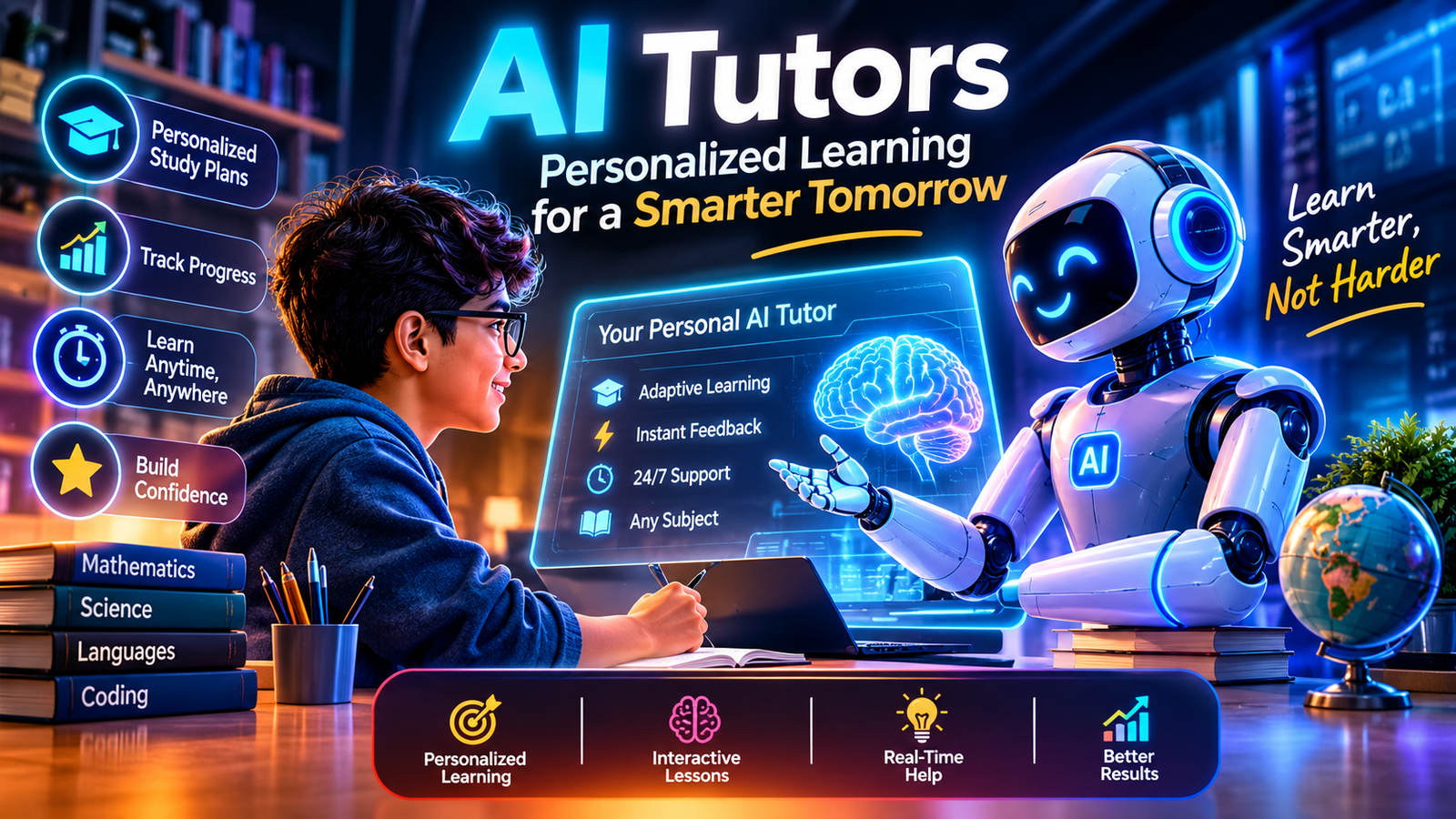
AI tutors are artificial intelligence-powered learning assistants that help students understand subjects, practice skills, solve problems, and receive personalized feedback. They use technologies such as large language models and adaptive learning systems to adjust explanations and exercises to individual needs, but they work best alongside human teachers rather than replacing them.
AI Tutors at a Glance
- Personalized learning: AI tutors adjust explanations and practice questions to a learner’s needs.
- 24/7 availability: Students can access learning assistance whenever a supported platform is available.
- Interactive teaching: Many tools support conversational questions, guided problem-solving, and immediate feedback.
- Multiple subjects: Applications range from mathematics and science to languages, writing, and programming.
- Important limitations: AI-generated answers can contain errors, and some systems struggle with complex reasoning.
- Human involvement matters: Teachers and parents remain essential for motivation, assessment, and educational guidance.
What Are AI Tutors?
AI tutors are digital learning assistants that use artificial intelligence to teach, explain, and reinforce educational concepts. Unlike traditional search engines, they can engage in conversations, respond to follow-up questions, and adjust explanations based on a student’s understanding.
Their main purpose is to make learning more interactive and accessible.
A student struggling with algebra, for example, can ask an AI tutor to explain equations using simpler examples. The system can then provide practice questions, identify mistakes, and explain the reasoning behind each solution.
AI tutoring is not limited to school subjects. These systems can also support:
- University coursework and research preparation.
- Foreign language learning and conversation practice.
- Programming and software development.
- Professional certifications and technical training.
- Writing, grammar, and communication skills.
- Exam preparation and independent study.
The important distinction is that an AI tutor should help learners develop knowledge, not simply complete assignments for them.
How Do AI Tutors Work?
Most modern AI tutors combine conversational AI, machine learning, educational content, and sometimes adaptive learning algorithms.
Their underlying technology varies. Some use general-purpose language models, while others rely on subject-specific content and structured educational systems.
1. Understanding Student Questions
The process usually begins when a student submits a question through text, voice, an uploaded document, or an image.
Natural language processing (NLP) helps the system interpret the request, identify relevant concepts, and understand the surrounding context.
For example, a student might ask:
“Why does dividing a negative number by another negative number produce a positive result?”
The tutor interprets the mathematical question and generates an explanation suited to the learner’s level.
2. Generating Personalized Explanations
Many AI tutors use large language models (LLMs) to generate conversational responses.
These models can explain the same concept in different ways. A beginner might receive a simple analogy, while an advanced student might receive a technical explanation.
Some platforms also use structured lesson content to keep explanations aligned with a particular curriculum.
3. Evaluating Student Understanding
More advanced tutoring systems do more than answer questions.
They may provide:
- Short quizzes.
- Step-by-step exercises.
- Knowledge checks.
- Personalized feedback.
- Hints for incorrect answers.
- Recommendations for additional practice.
This helps students identify knowledge gaps instead of repeatedly studying material they already understand.
4. Adapting Future Lessons
Adaptive learning systems use information about student performance to recommend appropriate learning activities.
For instance, if a student repeatedly struggles with fractions, the system might recommend additional fraction exercises before introducing more complicated algebra.
However, not every AI tutor has sophisticated adaptive learning capabilities. Some simply adjust their conversational responses based on the current interaction.
5. Tracking Learning Progress
Depending on the platform, students, teachers, or parents may access progress summaries and learning histories.
These insights can help identify recurring mistakes, completed lessons, and topics requiring additional attention.
The quality of this functionality varies considerably between platforms.
Key Features of Modern AI Tutors
Not all AI tutoring platforms offer the same capabilities. Some specialize in conversational assistance, while others provide structured lessons and classroom management.
The following features are particularly useful.
Personalized Learning Paths
Personalization allows students to learn at a comfortable pace.
Instead of following identical explanations, learners can request easier examples, advanced exercises, or alternative teaching methods.
Real-Time Feedback
Students can receive immediate explanations when they make mistakes.
This is particularly useful for mathematics, programming, grammar, and language learning.
However, immediate feedback is only valuable when it is accurate.
Interactive Conversations
Conversational interfaces allow students to ask follow-up questions without restarting the learning process.
For example, they can request a simpler explanation, challenge an answer, or ask the tutor to demonstrate another example.
Multimodal Learning
Some AI tutors support more than text.
Depending on the platform, students may interact through:
- Voice conversations.
- Images and diagrams.
- Uploaded PDFs and documents.
- Screenshots of questions.
- Interactive exercises.
Multimodal capabilities can make difficult concepts easier to understand, particularly in science and mathematics.
Practice Tests and Quizzes
AI-generated assessments can help students prepare for examinations.
Some systems generate questions from uploaded study materials, while others provide exercises based on specific subjects or learning objectives.
Students should still compare generated questions with their official syllabus and examination requirements.
24/7 Learning Assistance
Traditional tutoring usually requires scheduling and availability.
AI tutors can provide assistance whenever their services are accessible. This makes them useful for independent study, particularly when students cannot immediately contact a teacher.
Best AI Tutor Platforms to Consider in 2026
The AI tutoring market includes dedicated educational platforms and general-purpose AI assistants with specialized learning experiences.
Choosing between them depends on the subject, learner’s age, teaching style, available budget, and privacy requirements.
Here are four relevant platforms worth evaluating.
1. Khanmigo by Khan Academy
Dedicated educational tutor
Khanmigo is an AI-powered learning assistant developed by Khan Academy.
Its approach emphasizes guided learning rather than simply providing completed answers. Students can receive assistance with mathematics, writing, coding, and other learning activities.
Its educational approach makes it particularly relevant for students who want structured explanations and guided practice.
Key strengths:
- Guided problem-solving.
- Personalized learning assistance.
- Integration with Khan Academy educational content.
- Parent-facing access to children’s interaction histories and moderation alerts.
- Teacher tools for lesson planning and assessment support.
Pricing: Khan Academy’s published pricing lists free teacher tools and a $4 monthly or $44 annual subscription for individual learners and families. Individual subscriptions have U.S. eligibility and billing restrictions, so international availability must be checked. khanmigo.ai+1
Limitation: Its individual subscription is geographically restricted, and institutional access follows separate arrangements.
Website: Official Khanmigo website.
2. ChatGPT Study Mode by OpenAI
Flexible conversational learning
ChatGPT Study Mode provides a learning-focused experience that emphasizes understanding rather than immediately presenting final answers.
It can use Socratic-style questions, step-by-step explanations, knowledge checks, and feedback to help students work through difficult concepts.
Students can also use uploaded materials, including supported PDFs and images, to study specific course topics.
Key strengths:
- Interactive questioning.
- Step-by-step explanations.
- Practice questions and quizzes.
- Assistance with uploaded study materials.
- Support for a wide range of subjects.
Pricing: Study Mode is available across ChatGPT plans globally. It does not require a separate Study Mode subscription, although normal plan limits still apply. OpenAI Help Center+1
Limitation: It can still make mistakes or provide direct answers when students need guided reasoning. It is not a replacement for a teacher or official course material.
Website: ChatGPT Study Mode.
3. Google Gemini Guided Learning by Google
Multimodal learning
Google Gemini’s Guided Learning experience helps students explore difficult subjects through interactive questions and structured explanations.
Its learning ecosystem also includes study notebooks, quizzes, study guides, and connections with Google educational products.
In November 2026, Google announced the global rollout of Guided Learning into Google Classroom, alongside additional education-focused updates. blog.google+1
Key strengths:
- Step-by-step explanations.
- Interactive learning conversations.
- Study guides and quizzes.
- Connections with Google’s education ecosystem.
- Support for visual learning experiences.
Pricing: Availability and pricing depend on the Gemini product, account type, and educational deployment. There is no single universal AI tutor subscription price.
Limitation: Features and administrative controls vary by account and institution. Students should verify which tools are available in their region.
Website: Google Gemini.
4. Google Classroom with Gemini
Google Classroom is an educational platform that supports communication, assignments, and classroom organization.
Its expanding AI capabilities bring learning assistance closer to teachers’ existing classroom workflows.
This approach is particularly relevant to educational institutions that want to integrate AI into organized teaching environments.
Key strengths:
- Classroom-centered workflows.
- Teacher oversight.
- Educational assignment management.
- Integration with Google’s education ecosystem.
- Guided learning capabilities.
Pricing: Depends on the Google Workspace for Education edition and institutional arrangement.
Limitation: Its educational features are not identical to a standalone personal tutoring service. Availability can also depend on school administration and account eligibility.
Website: Google for Education.
AI Tutor Platform Comparison
| Platform | Target user | Key strength | Pricing transparency | Core limitation |
|---|---|---|---|---|
| Khanmigo | Students, parents, teachers | Guided academic tutoring | Published individual pricing | Geographic restrictions |
| ChatGPT Study Mode | Independent learners | Flexible conversational learning | Uses existing plan limits | Requires answer verification |
| Gemini Guided Learning | Students and independent learners | Interactive and multimodal learning | Depends on account | Feature availability varies |
| Google Classroom with Gemini | Schools and teachers | Classroom integration | Institution-dependent | Requires compatible deployment |
Editorial recommendation: Students seeking curriculum-oriented tutoring should examine Khanmigo. Those wanting flexible assistance across different subjects can compare ChatGPT Study Mode and Gemini Guided Learning. Schools should prioritize administrative controls, curriculum alignment, and student privacy.
Benefits of AI Tutors for Students and Educators
AI tutoring offers several practical advantages, particularly when learners use it to strengthen their understanding rather than avoid challenging work.
1. Learning at an Individual Pace
Traditional classrooms often require teachers to manage students with different learning speeds.
An AI tutor can provide additional explanations to students who need more time. Advanced learners can also request more challenging exercises.
This flexibility makes personalized learning more accessible.
2. Affordable Access to Learning Support
Private tutoring can be expensive, particularly when students need regular assistance across multiple subjects.
Some AI learning tools offer free access or relatively inexpensive subscriptions. This can reduce the cost of supplementary educational support.
However, advanced features, institutional subscriptions, and usage limits can affect the overall cost.
3. Immediate Assistance With Difficult Topics
Students do not always understand a lesson during its first explanation.
AI tutors allow them to revisit difficult concepts, request alternative examples, and ask follow-up questions without feeling uncomfortable.
This can be particularly helpful for students who hesitate to ask questions in traditional classrooms.
4. Better Exam Preparation
AI tutoring tools can support examination preparation through:
- Practice questions.
- Subject summaries.
- Flashcards.
- Mock quizzes.
- Explanations of incorrect answers.
- Revision schedules.
Students can also upload relevant course materials to create more focused revision sessions, where supported.
5. Support for Teachers
AI tutors can complement teachers by helping with repetitive educational tasks.
Depending on the platform, teachers may use AI to:
- Develop lesson plans.
- Create assessment questions.
- Prepare differentiated learning activities.
- Generate explanations for difficult topics.
- Review common student misunderstandings.
- Identify areas requiring additional classroom attention.
These capabilities can support teaching, but educators should review generated material before using it.
6. Greater Learning Accessibility
Conversational interfaces can help students who prefer alternative explanations or more flexible learning experiences.
Voice interaction, adjustable explanations, and visual learning materials may also improve accessibility for some learners.
Nevertheless, AI accessibility is not automatic. Students may still face language, device, connectivity, or disability-related barriers.
Do AI Tutors Actually Improve Learning Outcomes?
This is one of the most important questions when evaluating AI tutoring technology.
A sophisticated interface does not automatically produce better academic results. The real measure is whether students understand and retain more information.
Research published in 2025 and 2026 provides encouraging but mixed evidence.
Research Showing Positive Results
A 2025 randomized controlled trial published in Scientific Reports compared a research-informed AI tutor with active-learning classroom instruction.
The researchers reported that students using the AI tutor learned significantly more in less time within the study setting. Participants also reported higher engagement and motivation. Nature+1
A separate August 2026 working paper from the National Bureau of Economic Research examined Khanmigo in 18 Tennessee middle schools.
The two-year randomized study reported approximately 1.3 national percentile ranks of additional mathematics achievement per term. However, the gains were modest and similar to those associated with Khan Academy practice without AI assistance. Student engagement with the tutor was also relatively limited. National Bureau of Economic Research+1
Research Also Highlights Important Risks
An October 2026 IZA working paper examined course-integrated AI tutoring across 2,379 undergraduate students and 30 instructors.
The researchers reported lower final grades and reduced learning management system participation in sections receiving access to the AI tutor.
This finding suggests that poorly integrated AI assistance can displace existing learning activities rather than improve them. IZA@LISER Network+1
Another 2026 study found that human support increased engagement with an AI literacy platform among elementary students, although the intervention did not improve reading achievement. SCALE Initiative+1
What Does the Evidence Mean?
The findings do not establish that every AI tutor improves education.
Instead, they suggest that outcomes depend on several factors:
- Whether the tutor follows effective teaching methods.
- Whether students actively participate.
- Whether lessons match the curriculum.
- Whether learners practice independently.
- Whether teachers provide appropriate guidance.
- Whether the system encourages understanding instead of answer copying.
The important distinction is between access to AI and effective AI-supported teaching. Simply giving students a chatbot does not guarantee meaningful learning.
Limitations and Risks of AI Tutors
Despite their advantages, AI tutors have technical and educational limitations that students, parents, and schools should understand.
1. Incorrect or Misleading Answers
Generative AI systems can produce convincing explanations containing factual errors.
This behavior is sometimes called an AI hallucination.
For example, an AI tutor might explain a mathematical concept incorrectly, cite a nonexistent academic source, or provide outdated scientific information.
Students should verify important answers against textbooks, official educational resources, and teacher guidance.
2. Overdependence on AI
One major educational concern is cognitive offloading.
This occurs when students rely on external tools to perform mental tasks they should practice themselves.
If a student repeatedly asks an AI tutor to solve homework problems, they may complete assignments without developing independent problem-solving skills.
A better approach is to request hints, attempt the problem independently, and ask for feedback afterward.
3. Limited Understanding of Student Emotions
Human teachers can recognize frustration, confusion, motivation problems, and other emotional signals.
AI tutors can respond to language patterns, but they do not possess human empathy or reliably understand a student’s emotional condition.
They may therefore provide technically correct explanations that fail to address the learner’s actual difficulty.
4. Curriculum and Context Mismatches
An AI tutor may explain a concept using a different curriculum, notation system, or examination format.
This can create confusion for students following specific educational requirements.
For example, a mathematics student preparing for a particular examination board may need explanations aligned with its prescribed methods.
Students should provide their syllabus, grade level, and relevant study materials when supported.
5. Internet and Device Requirements
Many cloud-based AI tutors require an internet connection and a compatible device.
Students with limited connectivity, older devices, or restricted access to digital services may experience difficulties.
This remains an important consideration in regions where affordable internet access is inconsistent.
AI Tutor Privacy and Security: What Should Parents and Schools Check?
AI tutors may process information that students share during learning sessions.
This can include names, school details, uploaded assignments, personal questions, voice recordings, and educational performance information.
For younger learners, these concerns deserve particular attention.
UNESCO’s guidance on generative AI in education emphasizes human-centered implementation, age-appropriate use, and the protection of personal data. UNESCO+1
Before selecting a platform, examine the following areas.
| Privacy consideration | What to verify |
|---|---|
| Data collection | What student information does the platform collect? |
| Data retention | How long are conversations and uploaded files stored? |
| Model training | Can student information be used to improve AI models? |
| Parental controls | Can parents review or manage children’s access? |
| Account security | Does the service offer appropriate authentication and access controls? |
| School administration | Can institutions manage accounts, permissions, and student data? |
| Data deletion | Can users request deletion of stored information? |
Important Security Distinction
A company’s SOC 2 report does not automatically establish Zero Data Retention (ZDR).
SOC 2 concerns controls relevant to security and other trust-service criteria. ZDR concerns how submitted data is retained or handled.
They are different things.
Schools should review the actual privacy policy, applicable data-processing agreements, retention settings, and contractual protections rather than relying on general security marketing.
Parents should also avoid allowing children to upload sensitive personal documents unless the platform’s data practices have been properly reviewed.
How to Choose the Right AI Tutor
The right AI tutoring platform depends on the student’s educational goals.
A tool designed for language practice may not be suitable for advanced mathematics. Similarly, a general-purpose chatbot may not offer the classroom management features required by a school.
Consider these factors before choosing.
Subject Coverage
Check whether the platform supports the subjects you need.
Some systems provide broad conversational support, while others focus on particular curricula or academic areas.
Teaching Method
Look for tools that encourage students to think.
Useful features include:
- Step-by-step explanations.
- Guided questions.
- Hints before complete answers.
- Practice exercises.
- Feedback on mistakes.
Accuracy and Curriculum Alignment
Test the platform using questions from the student’s actual syllabus.
Compare its explanations with trusted textbooks and official course materials.
Pricing and Usage Restrictions
Do not evaluate a platform using its advertised starting price alone.
Check:
- Monthly and annual subscription costs.
- Free-plan message limits.
- Advanced model restrictions.
- File upload limits.
- Voice usage restrictions.
- Family or classroom subscription requirements.
- Regional availability.
A free tool may be sufficient for occasional questions, while frequent users may need a paid subscription.
Ease of Use
The interface should make learning straightforward.
Students should be able to ask questions, review previous explanations, and access exercises without navigating complicated menus.
Parental and Teacher Controls
For younger learners and schools, consider moderation features, account permissions, interaction histories, and administrative oversight.
Practical Ways to Use AI Tutors Effectively
The quality of AI-assisted learning depends partly on how students interact with the technology.
Instead of treating an AI tutor as an answer generator, use it as an interactive learning partner.
Use the Tutor to Understand Difficult Concepts
Start with a specific question.
For example:
“Explain photosynthesis to a beginner using a simple real-world example. Then explain the scientific process in more detail.”
This encourages the system to build understanding gradually.
Request Hints Instead of Complete Answers
When working on mathematics or science problems, ask for hints first.
A useful instruction is:
“Do not solve the problem immediately. Give me one hint at a time and let me attempt each step.”
This preserves the student’s opportunity to think independently.
Practice Through Active Recall
Active recall involves retrieving information from memory instead of simply rereading it.
Ask the AI tutor to:
- Explain a topic briefly.
- Create five practice questions.
- Ask one question at a time.
- Wait for your answer.
- Explain mistakes.
- Repeat difficult questions later.
This approach makes the interaction more educational.
Upload Relevant Study Materials
Where supported, provide class notes, textbooks, worksheets, or syllabus documents.
Ask the AI tutor to base its explanations on those materials.
However, always check whether uploaded content is processed, stored, or used for model improvement.
Verify Important Information
Use official educational sources to confirm important facts, formulas, definitions, and examination requirements.
Never assume that a fluent AI-generated explanation is necessarily correct.
The Future of AI Tutors in Education
AI tutoring is moving beyond simple question-and-answer chatbots.
Several developments are shaping the next generation of educational technology.
More Interactive and Adaptive Learning
AI systems are increasingly designed to provide guided lessons rather than isolated responses.
They can break complex topics into smaller steps, ask questions, and adjust explanations during a conversation.
Google’s November 2026 education announcements illustrate this direction, with Guided Learning expanding into Google Classroom and additional student-focused learning experiences. blog.google+1
Voice-Based Tutoring
Voice interaction can make AI tutoring feel more conversational.
Students may use spoken questions to practice languages, discuss concepts, or receive explanations without typing.
However, voice interaction does not automatically produce better learning outcomes. A September 2026 randomized field experiment involving graduate business students found statistically equivalent learning outcomes between structured voice and text tutoring, despite higher conversational engagement with voice. SCALE Initiative+1
Integration With Educational Platforms
AI tutoring is increasingly being incorporated into existing learning environments.
This can connect educational assistance with assignments, course materials, classroom activities, and teacher workflows.
Such integration may make tutoring more relevant to actual coursework, provided that schools maintain appropriate oversight.
More Subject-Specific AI Systems
General-purpose language models can explain many topics, but specialized educational systems may offer better curriculum alignment.
Future development is likely to emphasize structured subject knowledge, reliable assessments, and learning systems designed around specific educational objectives.
The central challenge will remain the same: improving actual learning rather than simply making AI conversations more impressive.
Who Should Use AI Tutors?
AI tutoring is useful for different types of learners, but its value depends on their goals and learning habits.
| User group | Potential benefit | Recommended approach |
|---|---|---|
| School students | Understand difficult subjects | Use guided explanations and practice |
| University students | Review complex academic topics | Combine AI assistance with course materials |
| Exam candidates | Prepare for assessments | Generate quizzes and revision plans |
| Language learners | Practice vocabulary and conversation | Use interactive dialogue and corrections |
| Programming beginners | Understand code and debugging | Request explanations before code solutions |
| Teachers | Prepare learning activities | Review and adapt AI-generated materials |
| Parents | Supplement children’s education | Choose age-appropriate tools with oversight |
Are AI Tutors Suitable for Children?
They can be useful, but children need additional safeguards.
Parents should prioritize age-appropriate platforms, suitable parental controls, transparent data policies, and teacher involvement.
Children should also understand that AI-generated information can be incorrect. An adult should remain involved when educational decisions or sensitive information are involved.
For younger students, a structured educational platform may be more appropriate than unrestricted access to a general-purpose chatbot.
Common Mistakes to Avoid When Using AI Tutors
Even capable AI tutoring systems can become ineffective when students use them incorrectly.
Avoid these common mistakes:
- Copying answers: Copying completed solutions without understanding them weakens independent learning.
- Trusting every explanation: AI systems can generate incorrect information with confidence.
- Ignoring textbooks: Official course materials should remain the foundation of examination preparation.
- Using vague prompts: Specific questions produce more useful educational interactions.
- Skipping practice: Reading explanations is not the same as demonstrating knowledge.
- Ignoring privacy: Uploading personal information without checking platform policies creates unnecessary risks.
- Replacing human instruction: AI tutoring should complement teachers, not eliminate meaningful human interaction.
The most effective approach combines independent thinking, guided AI assistance, and human feedback.
Frequently Asked Questions
1. What is an AI tutor?
An AI tutor is an artificial intelligence-powered learning assistant that helps students understand subjects, practice skills, and receive personalized feedback. It uses technologies such as natural language processing, machine learning, and generative AI to provide interactive educational support.
2. Are AI tutors better than human tutors?
AI tutors offer convenient access, flexible explanations, and immediate practice assistance. Human tutors provide personal mentorship, emotional understanding, and professional judgment. Neither is universally better, and combining both can provide a more balanced learning experience.
3. Can AI tutors help students prepare for exams?
Yes. AI tutors can generate practice questions, explain difficult concepts, create revision schedules, and test student knowledge. Students should verify generated material against their official syllabus and examination requirements.
4. Are there free AI tutors available?
Yes. Some AI tutoring experiences offer free access or free educational features. Examples include ChatGPT Study Mode, Google’s available Gemini learning features, and Khan Academy’s free educational resources. Access, account eligibility, and usage limits vary by platform.
5. Are AI tutors safe for children?
AI tutors can support children’s learning, but safety depends on the platform and its settings. Parents should review age restrictions, privacy policies, content controls, data retention practices, and parental supervision features before allowing children to use them.
Conclusion
AI tutors represent an important development in personalized education. They make it easier for students to explore difficult subjects, practice independently, and receive explanations whenever support is needed.
However, their effectiveness depends on more than the underlying AI model. Teaching methods, curriculum alignment, answer accuracy, student engagement, and data protection all matter.
For students, Khanmigo, ChatGPT Study Mode, and Gemini Guided Learning offer different approaches to AI-assisted learning. Teachers and educational institutions should additionally evaluate administrative controls and classroom integration.
The most practical strategy is to use AI as a learning partner, not an answer machine. Students who question explanations, practice independently, and verify important information are better positioned to benefit from this technology.

Alex Carter is a technology writer at AI SpaceZ.com, who covers AI tools, software reviews, practical tutorials and emerging artificial intelligence trends. He aims to make AI easier to understand and help readers discover useful tools and technologies for everyday productivity.