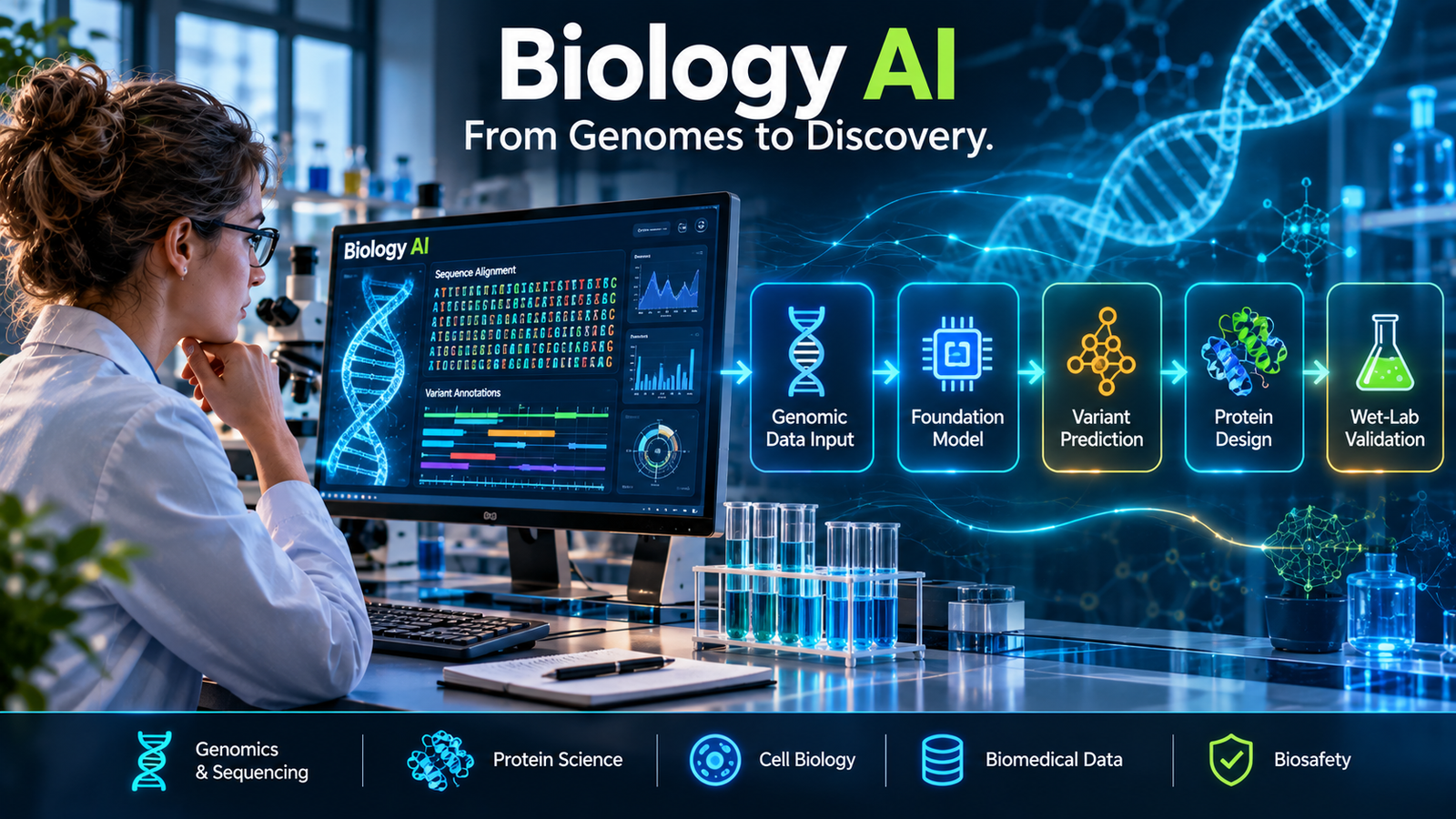
Biology AI refers to artificial intelligence systems built to analyze, generate, and reason about biological data, from DNA sequences to protein structures to cellular systems. The field spans open-source foundation models like Evo 2, autonomous research agents like Biomni, and consumer homework apps, each serving very different users with very different limitations.
At a Glance
- Dominant research model: Evo 2, a fully open-source DNA foundation model trained on 9.3 trillion nucleotides across 128,000+ genomes
- Key capability: Evo 2 predicts disease-causing mutations with over 90% accuracy on BRCA1 variants and can design genome-length sequences
- Agentic shift: Biomni autonomously plans and executes biomedical workflows, used by 15,000+ scientists for 100,000+ tasks in its first nine months
- Persistent gap: Generated genomes still require extensive wet-lab validation, and agents struggle with nuanced biological reasoning
- Consumer confusion: Multiple “Biology AI” homework apps exist with no connection to research-grade tools, charging $5.99 to $49.99 for subscription tiers
What Is Biology AI?
Biology AI is not a single product. It is a category of tools that apply machine learning to biological problems, and the category splits sharply by audience and purpose.
Research-grade biology AI includes DNA foundation models like Evo 2, protein structure predictors, and autonomous research agents. These tools operate at the frontier of computational biology and are built by institutions like the Arc Institute, Stanford, and NVIDIA .
Consumer biology AI includes homework helper apps that use the “Biology AI” name for photo-based problem solving. These are unrelated to research tools and serve students seeking quick answers .
The distinction matters because search queries for “biology AI” surface both categories, and users often conflate them. A student looking for homework help and a researcher evaluating foundation models need entirely different information.
This analysis focuses primarily on research-grade biology AI, where the technical substance and genuine information gain lie, while clarifying the consumer app landscape where relevant.
The Research Frontier: DNA Foundation Models
What Evo 2 Does
Evo 2 is the largest and most significant biology AI model released to date. Developed by the Arc Institute, Stanford University, UC Berkeley, UC San Francisco, and NVIDIA, it was published in Nature after an initial preprint release in February 2025 .
The model was trained on over 9.3 trillion nucleotides from more than 128,000 whole genomes, spanning bacteria, archaea, eukaryotes, and metagenomic data . Its context window processes up to 1 million nucleotides at once, enabling it to identify relationships between distant regions of a genome that shorter-context models miss .
Verified Capabilities
Evo 2’s performance claims are peer-reviewed and independently documented.
Variant effect prediction: In tests with BRCA1 variants, Evo 2 achieved over 90% accuracy in distinguishing benign from pathogenic mutations, without task-specific fine-tuning . This matters because BRCA1 mutations carry significant cancer risk implications.
Genome generation: The model generated sequences resembling mitochondrial genomes, bacterial genomes, and large regions of yeast chromosomes. Researchers also used it to design DNA sequences with predetermined chromatin accessibility patterns, successfully reproduced in mouse and human cells .
Interpretability: Arc collaborated with Goodfire to build a mechanistic interpretability visualizer that shows which biological features the model learns to recognize, addressing the “black box” concern that plagues many AI systems .
Openness and Access
Evo 2 is fully open source. The training data, training and inference code, and model weights are publicly available, making it the largest-scale fully open AI model in biology . It is integrated into NVIDIA’s BioNeMo framework for researchers who prefer that environment.
The developers excluded viruses that infect eukaryotic organisms from the training data as a biosafety measure .
Autonomous Research Agents
Biomni: A General-Purpose Biomedical Agent
If Evo 2 is a specialized tool for reading and writing DNA, Biomni is a generalist agent designed to execute entire research workflows.
Developed at Stanford with contributions from Genentech and the Arc Institute, Biomni combines large language model reasoning with over 150 specialized bioinformatics tools, 59 curated databases, and 100+ software packages . The agent mines tools and protocols from thousands of publications across 25 domains, building a unified action space without task-specific retraining .
Real-world usage: In its first nine months as an open-source project, more than 15,000 scientists used Biomni to automate 100,000 different workflows .
Documented case study: A researcher gave Biomni 458 Excel files from 30 participants wearing continuous glucose monitors and asked an open-ended question about thermogenic patterns. Biomni autonomously generated and executed a 10-step analysis plan, inferred meal events from glucose spikes, and produced a structured report with population-level trends .
Honest limitations: Stanford’s own assessment notes that Biomni “still struggles in areas that require nuanced clinical judgment, novel experimental reasons, or deep biological thinking and synthesis” . It approaches human-level performance on database querying and sequence analysis, but not on scientific creativity.
The Agentic Landscape
A systematic review of over 50 LLM-based biological agents identified consistent challenges across the field: unstable reasoning, limited biological grounding, retrieval misalignment, and barriers to reproducibility and biosafety . These are not isolated problems with one agent. They are structural limitations of applying general-purpose language models to domain-specific scientific work.
Technical Considerations
Context Window Constraints
Evo 2’s 1-million-nucleotide context is impressive but insufficient for full human chromosomes. A review of generalist biological AI notes that current models remain “limited by ease of use, context length (for example, to the scale of human chromosomes)” . For cell-type-specific tasks, Evo 2 still depends on fine-tuning or other models.
Computational Cost
Training Evo 2 required months on over 2,000 NVIDIA H100 GPUs via NVIDIA DGX Cloud . Inference and generation of long DNA sequences remain computationally expensive, and the published literature acknowledges that “the computational cost of designing long DNA sequences is high” .
Validation Bottleneck
Generated genomes and designed sequences must be synthesized and tested in wet labs. This experimental validation is slow, expensive, and not automated. No AI model has closed this loop, and claims about “designing new life” should be read with that constraint in mind.
Consumer “Biology AI” Apps: A Separate Market
Search queries for “biology ai” frequently surface homework helper apps that share the name but nothing else.
These apps are consumer products with subscription billing. They are not connected to Evo 2, Biomni, or any research-grade biology AI infrastructure. Users seeking homework help will find them useful. Users seeking to understand biology AI as a field should not confuse them with the research tools.
No independent accuracy benchmarks exist for these consumer apps in the search results reviewed. Pricing is transparent in the App Store listings, but users should check renewal terms before subscribing.
Who Should Use Biology AI?
Research-grade tools fit:
- Computational biologists working with genomic data at scale
- Bioinformatics teams needing variant effect prediction or sequence design
- Research institutions evaluating foundation models for drug discovery or synthetic biology
- Scientists who want to automate repetitive analysis workflows through agents like Biomni
Research-grade tools may not fit:
- Labs without computational infrastructure or GPU access
- Researchers needing guaranteed biological validity without wet-lab validation capacity
- Teams requiring full chromosome-scale modeling, which remains beyond current context windows
- Anyone seeking a turnkey solution, as these are research tools requiring expertise
Consumer apps fit:
- Students needing quick homework assistance
- Learners who want photo-based problem solving on mobile devices
Limitations and Open Challenges
Biological grounding. A survey of 50+ biological agents found “limited biological grounding” as a consistent weakness . Models generate plausible-sounding outputs that may not reflect biological reality.
Reproducibility. The same survey flagged barriers to reproducibility. Agent workflows that depend on external tools and databases can fail silently when APIs change or data sources update.
Benchmark reliability. Current benchmarks may not capture real-world biological complexity. A model that scores well on variant prediction may still fail on novel protein families or poorly characterized organisms.
The validation gap. Every generated sequence, designed protein, or predicted mutation effect requires experimental confirmation. AI accelerates hypothesis generation but does not replace the wet lab.
Frequently Asked Questions
What is the most advanced biology AI model?
Evo 2 is the largest and most capable open-source DNA foundation model currently published, trained on 9.3 trillion nucleotides and capable of processing 1 million nucleotides at once . It is fully open source with weights and code available.
Can biology AI design new organisms?
Evo 2 can generate DNA sequences resembling simple bacterial genomes and design regulatory elements, but these outputs require extensive wet-lab validation before they can be considered functional . Claims about designing new life overstate current capabilities.
Is there a free biology AI tool?
Evo 2 is free and open source for researchers with computational resources to run it . Biomni is open source as well . Consumer homework apps offer free tiers with limited daily usage, but unlimited access requires paid subscriptions .
What is the difference between Evo 2 and ChatGPT for biology?
Evo 2 is trained specifically on DNA sequences and understands genomic patterns, while ChatGPT is a general language model trained on text. Evo 2 can predict mutation effects and generate DNA, tasks that general-purpose chatbots cannot perform reliably .
Are biology AI homework apps accurate?
No independent accuracy benchmarks for consumer biology homework apps appear in the search results reviewed. These apps are useful for quick assistance but should not be trusted for high-stakes assignments without verification.
Conclusion
Biology AI means different things to different people, and that ambiguity shapes the search landscape.
For researchers, the field is defined by foundation models like Evo 2 and agents like Biomni. Evo 2 offers genuine scientific utility: open weights, peer-reviewed performance, and capabilities that accelerate genomic analysis. Biomni demonstrates that autonomous research agents can execute complex workflows, even as they struggle with nuanced biological reasoning.
For students, “biology AI” is a homework app with a subscription fee. These tools serve a real need, but they share nothing with research-grade systems beyond a name.
What matters most: The research tools are open, validated, and genuinely advancing the field. They are also computationally demanding and require expertise to use well. The consumer apps are accessible but unverified.
Who should evaluate biology AI: Researchers with computational resources and genomic data challenges should explore Evo 2 and Biomni. Students should use homework apps with the understanding that they are aids, not authorities.
Before adopting any biology AI tool, verify whether it is a research system or a consumer product. Check the licensing, the training data, and the published validation. The name overlap creates confusion that careful evaluation can resolve.