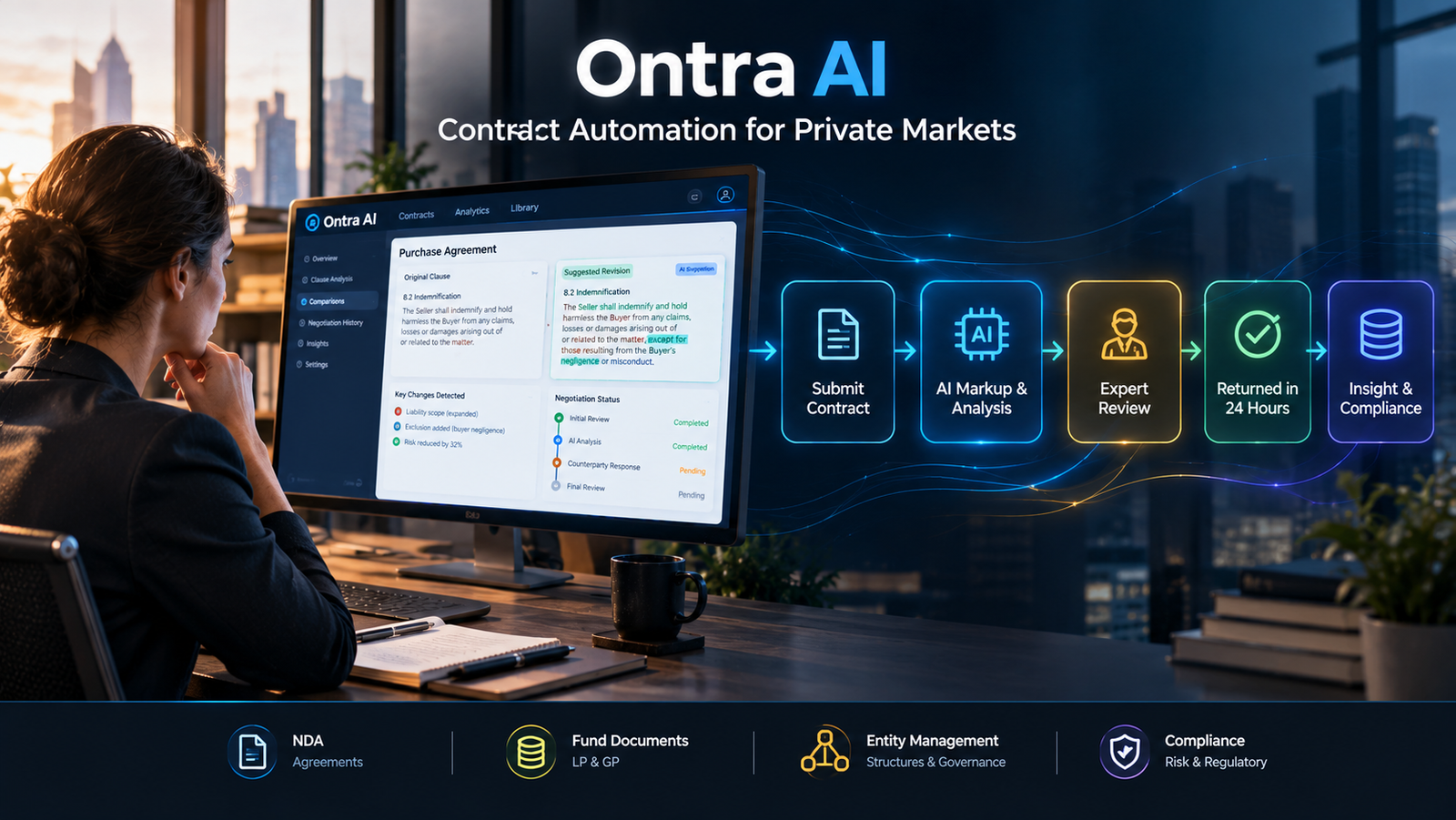
Ontra AI is a legal technology platform that combines AI-powered contract automation with a global network of legal professionals, designed specifically for private equity and private market firms. It handles high-volume routine agreements like NDAs, automates fund compliance workflows, and counts nine of the top ten PEI-ranked firms as customers.
At a Glance
- Core focus: Contract automation and legal workflow management for private markets, not general corporate legal departments
- Key differentiator: Hybrid model combining AI software with managed legal review services from qualified lawyers
- Customer base: Over 1,000 private market firms, including nine of the top ten PEI-ranked firms globally
- Certifications: SOC 2 Type 2, ISO 27001:2022, and stated Zero Data Retention for third-party LLM processing
- Pricing: Custom enterprise quotes only, with third-party estimates suggesting first-year costs starting around $64,000
- Best fit: Private equity firms, fund managers, and investment banks with high volumes of routine legal agreements
What Is Ontra AI?
Ontra AI is not a general-purpose contract review tool. It is a specialized platform built around the workflows of private capital markets.
The company, formerly known as InCloudCounsel, was founded in 2014 and has raised $252 million in funding . Its core proposition is unusual in legal tech: Ontra pairs proprietary AI software with a managed network of lawyers who handle the actual contract negotiation work.
This hybrid model matters. Most legal AI tools sell software and leave implementation and review to the customer. Ontra sells an outcome. You send routine contracts, and Ontra returns them negotiated according to your playbook, within a defined turnaround window .
The platform serves more than 1,000 global GPs, investment banks, law firms, and advisors . Its customer roster includes nine of the top ten PEI-ranked firms worldwide, according to company statements .
How Ontra AI Works
Ontra’s workflow depends on which product tier and service level a firm selects. The core pattern is consistent.
Step 1: Define your playbook. Ontra captures your firm’s standard positions, preferred clauses, and fallback language. The platform offers an “Ontra Market Playbook” for firms without a fully documented set of positions .
Step 2: Submit contracts. Routine agreements, NDAs, and other high-volume documents enter the Ontra system. The AI processes and categorizes them.
Step 3: AI-assisted negotiation. Ontra’s AI generates markup suggestions and contract summaries. The system tracks how clauses evolve across thousands of real agreements, grounding suggestions in precedent rather than generic model output .
Step 4: Human review and return. Depending on the service tier, qualified lawyers from Ontra’s network review and finalize the negotiation. Standard turnaround is stated as 24 hours for return to counterparty .
Step 5: Ongoing intelligence. Contracts become part of Ontra’s data layer. Firms can search across agreements, track obligations, and surface compliance insights through the Insight product line .
Key Products and Features
Contract Automation
This is Ontra’s flagship offering. It targets recurring, high-volume agreements that consume legal team capacity without requiring deep strategic judgment. NDAs are the canonical example.
The platform standardizes markups, automates clause suggestions, and provides real-time status tracking. A case study cited by Ontra describes Bain Capital Credit completing four times more NDAs annually, offloading 73 percent of NDA management to Ontra’s network .
Insight for Funds
Insight focuses on fund documents, including Limited Partnership Agreements, side letters, and credit agreements. The AI categorizes clauses and creates a searchable digital source of truth for fund operations .
Features include AI-powered conversational search across agreements, side letter compliance checks, and automated MFN election processes . For firms managing dozens of side letters with varying terms, this replaces manual tracking with structured data.
Atlas for Entity Management
Atlas automates entity management workflows, including data extraction from formation documents and dynamic structure chart generation. It includes compliance support for the Corporate Transparency Act .
This product competes with specialized entity management tools, but its integration with Ontra’s contract data gives it a contextual advantage for firms already using the platform.
Synapse AI Engine
Ontra’s underlying AI, branded Synapse, powers all products. The company describes it as a hybrid system combining rule-based precision with LLM intelligence . The rule-based layer handles structured legal logic where precision matters. The LLM layer handles language understanding and generation.
Human-in-the-loop review is a deliberate design choice, not a fallback. Subject matter experts review AI outputs for accuracy and flag potential hallucinations . This addresses a persistent concern in legal AI: models that sound confident while being wrong.
Pricing: What Ontra AI Actually Costs
Ontra does not publish pricing. The company sells through custom enterprise contracts, often bundling software with managed legal services .
Important context: Ontra’s model is not comparable to self-serve legal AI tools. The managed service component, where Ontra lawyers actually negotiate contracts, drives much of the cost. Firms evaluating Ontra should clarify whether they are buying software alone, managed services, or both.
A SaaSworthy listing notes “flat-fee pricing” that the company claims saves over 70 percent on average compared to alternative staffing models . This claim is not independently verified and depends entirely on the baseline being compared.
Privacy and Security
Ontra’s security posture is stronger than many legal AI vendors, with specific disclosures that matter for enterprise procurement.
Verified certifications: Ontra holds SOC 2 Type 2 across all five trust criteria and ISO 27001:2022 certification . The company states it conducts annual penetration testing.
Zero Data Retention: Ontra explicitly states that data provided to third-party LLMs is processed only for service delivery and deleted afterward. Customer data is not used for model training and is not shared with other customers . This is a meaningful commitment, though it applies specifically to third-party LLM interactions.
Encryption: Data in transit uses TLS 1.2+, and data at rest uses AES-256 with rotating keys .
RAG security architecture: Ontra describes a sandboxed environment where access controls are enforced outside the GenAI system. This prevents third-party LLMs from bypassing permission restrictions or leaking data across customer accounts .
What to verify: SOC 2 and ISO 27001 cover the software platform. The managed legal services component involves human lawyers accessing customer documents. Firms should ask specifically about access controls, confidentiality agreements, and data handling for the human review layer.
Who Should Use Ontra AI?
Ontra fits well for:
- Private equity firms with high volumes of NDAs, side letters, and routine fund agreements
- Fund managers needing structured search and compliance tracking across credit agreements and LPAs
- Legal operations teams at private market firms that want to offload routine negotiation work
- Investment banks and advisors handling repetitive deal documents
Ontra may not fit for:
- Corporate legal departments outside private markets
- Firms with low contract volume where managed service costs outweigh benefits
- Organizations seeking a self-serve, low-cost AI contract review tool
- Teams that need extensive customization or integration with non-standard systems
A TriVista analysis notes that Ontra is “built around fund and deal work” and that “a company outside private markets may not need its specific feature set” . This is not a limitation of the product’s quality. It is a deliberate specialization that makes Ontra excellent for its target market and less relevant elsewhere.
Ontra AI vs. Alternatives
| Platform | Target User | Key Strength | Pricing Transparency | Core Limitation |
|---|---|---|---|---|
| Ontra AI | Private markets | Managed legal network + AI, deep PE workflow fit | Low (custom quotes, high entry point) | Narrow market focus |
| Ironclad | General legal teams | Broad CLM, self-serve implementation | Moderate | Less specialized for PE fund workflows |
| Sirion | Enterprise CLM | Obligation management depth | Low (enterprise sales) | Complex implementation |
| Agiloft | Legal and procurement | No-code customization | Moderate | Less AI-native than newer tools |
| Luminance | Legal AI review | Document analysis at scale | Moderate | Not a managed service model |
CB Insights lists Sirion, Agiloft, and Ironclad among Ontra’s primary competitors . These platforms compete on contract lifecycle management features. Ontra competes on a different axis: replacing the need to staff routine negotiation internally.
For firms that want software they implement and run themselves, Ironclad or Sirion may fit better. For firms that want the negotiation work handled, Ontra’s model is distinct.
Common Mistakes When Evaluating Ontra AI
Assuming it is a self-serve tool. Ontra is an enterprise platform with implementation requirements and managed service components. The buying process is consultative, not transactional.
Ignoring the service layer. The AI is part of the value, but the lawyer network is what makes Ontra’s model work for high-volume routine contracts. Firms that only want software may overpay for capabilities they do not use.
Underestimating implementation time. Third-party cost estimates include $10,800 to $30,600 for implementation alone . Playbook definition and integration take real effort.
Comparing headline costs to self-serve tools. A $25,000 annual software subscription and a $100,000 managed service engagement solve different problems. The comparison should be against internal staffing costs, not against other software licenses.
Overlooking the narrow use case. Ontra’s specialization is a strength for private markets and a limitation everywhere else. Firms outside PE should verify that their specific document types are supported before engaging.
Frequently Asked Questions
Is Ontra AI free?
No. Ontra AI does not offer a free tier or free trial. It sells through custom enterprise contracts, typically bundled with managed legal services. Third-party estimates suggest first-year costs starting around $64,000 .
What is Ontra AI best used for?
Ontra AI is best for high-volume routine contract work in private markets, especially NDAs, side letters, and credit agreements. It combines AI markup suggestions with human lawyer review to handle negotiation at scale .
Does Ontra AI use customer data to train its models?
No, according to Ontra’s published security documentation. The company states that data provided to third-party LLMs is processed only for service delivery and deleted afterward, with no use in model training .
Who are Ontra AI’s main competitors?
Ontra competes with contract lifecycle management platforms like Ironclad, Sirion, and Agiloft, as well as legal AI review tools like Luminance . Its managed service model is less common than pure software competitors.
Is Ontra AI suitable for small businesses?
Generally no. Ontra’s pricing and service model target firms with significant contract volume and budget. Small businesses or corporate legal teams outside private markets will likely find the cost and specialization mismatch prohibitive.
Conclusion
Ontra AI occupies a specific and defensible position in legal technology. It does not try to be a universal contract tool. It targets private market firms with high volumes of routine legal work and solves that problem through a combination of AI and human lawyers.
The strengths are clear. The customer roster includes the top tier of private equity. The security certifications and Zero Data Retention commitment address enterprise procurement concerns. The managed service model directly reduces the staffing burden that drives legal operations costs.
The limitations are equally real. Pricing is opaque and expensive. The platform is not designed for general corporate use. Implementation requires effort, and the value depends on actually using the managed service component.
Ontra suits private equity firms and fund managers who want to offload routine contract negotiation and gain structured intelligence from their agreement data. It may not suit corporate legal departments, small teams, or firms seeking a low-cost self-serve tool.
Before engaging, request a scoped quote based on your actual contract volume. Clarify whether you are buying software alone or software plus managed services. Ask for references from firms of similar size and fund structure. The fit is strong for the right buyer, but the buyer must fit Ontra’s model.