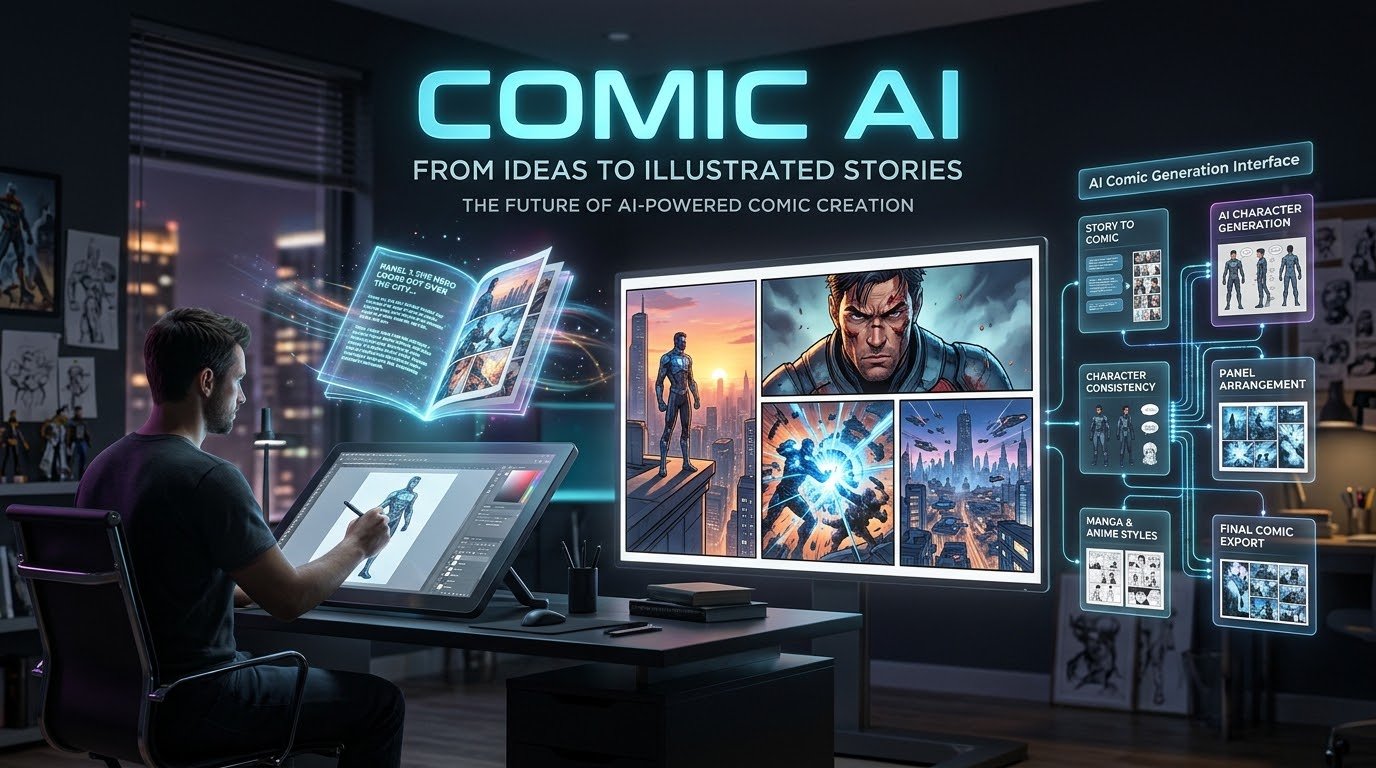
Comic AI is a generative AI technology that transforms written stories, prompts, and reference photos into illustrated comic panels and pages. Tools such as ComicAI.com make comic creation easier through automated artwork, multiple visual styles, character references, and customizable layouts.
Comic AI at a Glance
- What it does: Converts story ideas, text prompts, and reference photos into comic artwork.
- Who it helps: Writers, manga enthusiasts, educators, marketers, and independent creators.
- Popular styles: Manga, anime, superhero, cartoon, noir, sketch, fantasy, and science fiction.
- Main advantage: Reduces the time and drawing skills needed to produce illustrated stories.
- Biggest challenge: Maintaining consistent characters, accurate dialogue, and visual continuity.
- Important consideration: Copyright, image permissions, privacy, and commercial-use terms vary between platforms.
What Is Comic AI?
Comic AI refers to artificial intelligence technology that creates comic-style illustrations from text descriptions, images, or story instructions.
Instead of drawing every character and background manually, creators can describe a scene and let an AI image-generation system produce the artwork.
A typical comic contains several connected elements:
- Characters with recognizable appearances.
- Backgrounds that establish the setting.
- Different camera angles and character poses.
- Speech bubbles and dialogue.
- Multiple panels arranged into a readable sequence.
Traditional comic production requires illustration, coloring, lettering, and page composition. AI comic generators can automate parts of this process.
However, they do not eliminate every creative task. Writers and artists still need to review storytelling, correct mistakes, and maintain continuity.
Comic AI Technology vs. ComicAI.com
It is important to distinguish the general technology from individual products.
Comic AI technology describes the broader category of AI-powered comic creation tools.
ComicAI.com is a particular web-based service. Its website advertises two creation methods: uploading character photos or describing a story using text.
The platform also advertises 12 comic art styles, different panel arrangements, and downloadable artwork. These are vendor-published capabilities rather than independently benchmarked results. Create Comics Online
How Does Comic AI Work?
Most AI comic generators combine language understanding, image generation, and layout tools.
The exact technology varies between platforms, but the overall process follows a similar workflow.
1. Story and Prompt Understanding
The creator enters a story, dialogue, or scene description.
For example:
* A young inventor discovers a mysterious machine inside an abandoned laboratory. The machine activates, revealing a hidden futuristic city.*
The AI interprets the description and identifies relevant characters, actions, settings, and visual details.
Some platforms accept a complete story, while others work better with individual scene descriptions.
2. Character Generation
The system creates characters based on the supplied descriptions or reference images.
A character might have:
- Specific hair and clothing.
- Distinctive facial features.
- A particular age and appearance.
- Recognizable accessories.
- A defined artistic style.
Character references help the generator reproduce these details across multiple scenes.
However, reference images do not guarantee perfect consistency. Facial proportions, clothing, and small visual details can still change.
3. AI Image Generation
The image-generation model creates illustrations based on the prompt and available references.
Depending on the platform, it may generate individual panels or an entire comic page.
The output can include characters, backgrounds, objects, lighting, and visual effects.
4. Panel Arrangement and Dialogue
The generated illustrations are arranged into comic panels.
Some tools provide editing features for:
- Panel sizes and positioning.
- Speech bubbles.
- Dialogue placement.
- Background adjustments.
- Page layouts.
- Visual effects.
This stage matters because a collection of attractive images does not automatically become a readable comic.
5. Export and Sharing
After reviewing the pages, creators can export or share their finished work.
Available formats depend on the tool. Common possibilities include image files, PDFs, and web-friendly layouts.
Always check export resolution and file-format restrictions before choosing a platform.
What Can You Create With Comic AI?
AI comic generators support different creative projects.
| Comic Type | Typical Application |
|---|---|
| Manga | Japanese-inspired illustrated stories |
| Superhero comics | Action scenes and fictional characters |
| Webtoons | Vertical digital storytelling |
| Comic strips | Short stories and social media content |
| Educational comics | Lessons and classroom explanations |
| Marketing comics | Brand storytelling and product campaigns |
| Personalized comics | Stories featuring people or custom characters |
| Fantasy comics | Fictional worlds, creatures, and adventures |
Manga and Anime Stories
Manga creators can experiment with character designs, dramatic expressions, action sequences, and different visual compositions.
However, Japanese manga conventions involve more than an anime-inspired appearance. Panel direction, pacing, lettering, and visual storytelling also matter.
Educational Comics
Teachers can turn complicated topics into illustrated explanations.
For example, a science teacher might create a short comic showing how the water cycle works.
Visual storytelling can make abstract concepts easier to follow, especially for younger learners.
Social Media Content
Content creators can use short comic strips to communicate ideas on Instagram, Facebook, Pinterest, and other platforms.
A four-panel story can explain a problem, introduce a solution, and finish with a memorable message.
Personalized Comic Books
Reference-photo functionality makes personalized storytelling possible.
A creator could develop a birthday comic featuring a friend or create a fictional adventure using an authorized photograph.
Always obtain permission before uploading identifiable photographs of other people.
Key Features to Evaluate in an AI Comic Generator
Not every tool offers the same level of creative control. The following features deserve attention before selecting a platform.
Character Consistency
Character consistency is one of the most important requirements for long-form comics.
Imagine creating a six-page manga featuring one protagonist. The character should retain the same face, hairstyle, clothing, and physical proportions throughout the story.
Some generators use reference images or saved character profiles to guide image generation.
Before paying, test the same character in several situations:
- A full-body standing pose.
- A close-up facial expression.
- An action scene.
- A different camera angle.
- A scene with multiple characters.
Compare the results rather than relying on promotional examples.
Multiple Art Styles
Different stories require different visual approaches.
Useful styles include:
- Manga: Expressive characters and manga-inspired compositions.
- Superhero: Dramatic poses, action, and powerful visual effects.
- Noir: Dark environments and high-contrast lighting.
- Cartoon: Simplified characters and accessible storytelling.
- Chibi: Small characters with exaggerated proportions.
- Pixel Art: Retro video-game-inspired illustrations.
- Fantasy: Magical environments and fictional creatures.
- Science Fiction: Futuristic technology and space adventures.
ComicAI.com currently advertises 12 styles, including these categories. Create Comics Online
Reference Image Support
Reference images help creators guide the appearance of characters.
This is especially useful when developing recurring protagonists or adapting an existing character concept.
However, check whether a platform supports multiple references, reusable character profiles, and consistent character generation across separate projects.
Panel and Page Layouts
A comic’s layout affects its storytelling.
A large panel can emphasize an important moment. Smaller panels can communicate rapid action or conversation.
Look for tools that allow you to:
- Change panel dimensions.
- Rearrange scenes.
- Control page composition.
- Add speech bubbles.
- Adjust dialogue placement.
- Export complete pages.
Editing and Regeneration
AI-generated artwork often needs corrections.
A useful editor should make it possible to revise individual scenes without unnecessarily rebuilding the entire comic.
Check whether edits consume additional credits. Also determine whether the platform supports image replacement, background changes, character adjustments, and text editing.
How to Create a Comic Using Comic AI
Creating a comic does not require advanced illustration skills. However, good preparation makes a significant difference.
Here is a practical workflow using the features advertised by ComicAI.com.
Step 1: Prepare Your Story
Start with a simple idea.
For example:
An ordinary student discovers a mysterious notebook that can predict events before they happen.
Develop the story into a beginning, middle, and ending.
Avoid writing a long, complicated narrative before testing the generator.
Step 2: Define Your Characters
Create a short character description.
Include:
- Character name.
- Physical appearance.
- Clothing.
- Personality.
- Distinctive features.
- Role in the story.
A clear description helps establish a recognizable visual identity.
Step 3: Choose an Art Style
Select a style that matches your target audience.
A fantasy adventure might benefit from detailed illustrations, while a humorous social media comic may work better with simple cartoon artwork.
Keep the visual direction consistent throughout the project.
Step 4: Generate Comic Panels
Enter your story or scene descriptions.
If the platform supports reference photographs, upload images you own or have permission to use.
Select the available panel arrangement and generate the artwork.
Step 5: Review the Results
Do not immediately publish the first generation.
Check the following:
- Are the characters recognizable?
- Does the story follow the correct sequence?
- Are the backgrounds appropriate?
- Are the character poses believable?
- Are the speech bubbles readable?
- Does the artwork contain unwanted visual artifacts?
Correct any important problems before exporting.
Step 6: Download and Share
Export your finished comic using the available download options.
Check the resolution, watermark conditions, and intended usage rights.
For professional publishing, keep editable source files and original reference materials wherever possible.
Comic AI Pricing: Is It Free?
Pricing is an important consideration because AI comic generation can involve repeated image-generation requests.
Some platforms provide free credits or limited free generations. Others operate through subscriptions, credit packages, or pay-as-you-go systems.
ComicAI.com Pricing
Free credits advertised
ComicAI.com advertises free credits without requiring a credit card to begin. However, its public homepage does not provide a fixed, clearly itemized subscription price or a complete credit-cost schedule.
The website says users can purchase additional credits after exhausting their initial allocation. Create Comics Online
This means users should check the actual checkout screen before purchasing.
| Pricing consideration | What to verify |
|---|---|
| Free credits | Initial allocation and restrictions |
| Generation cost | Credits required per image or comic |
| Image quality | Whether higher resolutions cost more |
| Character references | Additional credit requirements |
| Editing | Whether regeneration consumes credits |
| Subscriptions | Billing frequency and renewal |
| Refunds | Conditions for unused or consumed credits |
Important: ComicAI.com’s terms say credit costs and plan benefits can change. They also state that credits consumed by moderation-rejected generations are not necessarily refunded. Subscription credits are forfeited at the end of a billing cycle, while purchased credit packs currently do not expire under the published terms. AI Comic Generator
These conditions make it particularly important to understand the credit system before committing to a paid plan.
Comic AI Privacy, Copyright, and Commercial Rights
This is an area many introductory AI comic guides overlook.
A comic generator may process personal photographs, original characters, story manuscripts, and other creative material. Understanding the platform’s legal terms is therefore essential.
Photo and Input Privacy
ComicAI.com’s privacy policy says it collects personal information, usage data, uploaded images, and text inputs.
It also describes sharing information with service providers and retaining information while an account is active or as needed for specified purposes.
The policy does not establish a specific Zero Data Retention guarantee. It also does not provide a detailed retention period for every category of uploaded content. AI Comic Generator
For that reason, avoid uploading confidential documents, sensitive photographs, or unpublished commercial material unless you are comfortable with the applicable data practices.
Copyright and Ownership
ComicAI.com’s terms state that users retain ownership of generated content to the maximum extent permitted by law.
However, the same terms grant ComicAI a perpetual, worldwide, royalty-free, sublicensable license covering submitted prompts, images, and generated outputs.
That is a significant contractual consideration.
The homepage’s ownership statement should not be interpreted independently of the full terms. Review the license before uploading valuable intellectual property or creating commercial work. Create Comics Online+1
There is another important distinction: owning an output under a service contract does not automatically establish copyright protection.
Copyright treatment of AI-generated material differs between jurisdictions and depends on the level of human creative contribution.
Can You Sell AI-Generated Comics?
Potentially, but the answer depends on several factors:
- The platform’s commercial-use terms.
- The rights associated with uploaded reference material.
- Applicable copyright law.
- Any third-party characters, trademarks, or artwork.
- The amount of human creative contribution.
Do not assume that a generated image is automatically free from copyright restrictions.
Creators planning to sell books, merchandise, or licensed comic content should review the applicable legal terms carefully.
Best Comic AI Alternatives and Competitors
The AI comic market includes specialized comic generators, manga tools, and general-purpose image platforms.
The right choice depends on whether you need complete comic pages, individual illustrations, character consistency, or a professional editing workflow.
Here are several relevant alternatives.
| Platform | Target User | Key Strength | Pricing Transparency | Main Consideration |
|---|---|---|---|---|
| ComicAI | Beginners and casual creators | Text and photo-based comic creation | Limited public pricing details | Review credit and licensing terms |
| LlamaGen.ai | Comic writers and creators | Story-to-comic and storyboard workflows | Public plans available | Check generation limits |
| Anifusion | Manga creators | Manga-focused page creation | Public plan information varies | Evaluate character continuity |
| Komiko | Digital storytellers | Comic and animation-oriented workflows | Check current plans | Confirm export and usage limits |
| Canva | Educators and marketers | Templates and page design | Public pricing information | Less specialized comic generation |
These are alternatives, not a performance ranking. Feature availability and pricing can change, so verify the current vendor documentation before subscribing.
Comic AI vs. General AI Image Generators
A general-purpose image generator can create impressive comic illustrations.
However, generating a complete story requires more than producing attractive images.
| Requirement | Specialized Comic Generator | General AI Image Generator |
|---|---|---|
| Story-to-panel workflow | Often built in | Usually requires manual work |
| Speech bubbles | May be integrated | Often needs separate editing |
| Character references | Platform-dependent | Model-dependent |
| Page composition | Often available | Usually assembled separately |
| Creative flexibility | Depends on editor | Often broad |
| Long-form storytelling | Requires continuity testing | Requires more manual control |
A specialized comic generator is worth considering when you want an integrated workflow. General image generators may suit creators who prefer greater control over individual illustrations.
Benefits of Using Comic AI
AI comic generation offers practical advantages for people who want to experiment with visual storytelling.
Faster Creative Production
Traditional comic creation involves several stages, including sketching, coloring, inking, and lettering.
AI tools can automate parts of these tasks. This allows creators to spend more time developing their stories and reviewing the final artwork.
Lower Entry Barrier
Beginners can experiment without mastering professional illustration software.
A written description can become the starting point for a visual story.
More Creative Experiments
Creators can test different character designs, backgrounds, and artistic styles.
This makes it easier to explore ideas before committing to a complete comic.
Useful for Small Businesses
Businesses can use comic-style visuals for:
- Social media campaigns.
- Product explanations.
- Brand storytelling.
- Promotional materials.
- Educational marketing.
- Internal training documents.
However, professional campaigns still need human review for brand consistency and factual accuracy.
Limitations of AI Comic Generators
Despite their advantages, AI comic tools have several weaknesses.
Inconsistent Characters
A character may look different between panels.
Hair, clothing, facial features, and body proportions can change unexpectedly.
This becomes particularly noticeable in longer stories.
Incorrect Text and Speech Bubbles
AI-generated images can contain distorted letters, misspelled words, or unreadable dialogue.
For publication-quality comics, adding dialogue through a dedicated editor is often more reliable than generating text directly inside the artwork.
Limited Storytelling Control
A generator may understand individual scenes but struggle with complex narrative relationships.
For example, it might produce an impressive action scene while overlooking an important detail established earlier.
Human editing remains necessary.
Credit Consumption
Multiple generations may be needed to achieve a satisfactory result.
This can increase costs, especially when creators repeatedly regenerate characters or entire pages.
Copyright Uncertainty
AI-generated artwork can involve questions about training data, reference images, human authorship, and third-party intellectual property.
Creators should understand these issues before commercial publication.
Who Should Use Comic AI?
Comic AI can serve several audiences, but its value depends on their creative requirements.
| Audience | Potential Benefit | Important Consideration |
|---|---|---|
| Beginners | Create comics without drawing experience | Learn prompt writing and editing |
| Writers | Visualize stories and characters | Review narrative continuity |
| Manga enthusiasts | Experiment with manga-style artwork | Check panel and character controls |
| Teachers | Create educational illustrations | Verify educational accuracy |
| Marketers | Develop visual campaign content | Maintain brand consistency |
| Independent creators | Produce early comic prototypes | Check commercial rights |
| Professional artists | Explore concepts and compositions | Preserve creative control |
For professional comic artists, AI is generally more useful as an additional production tool than as a complete replacement for illustration and storytelling skills.
Practical Tips for Better Comic AI Results
The quality of your prompt directly influences the quality of your initial output.
A vague instruction such as “create a superhero comic” leaves too many creative decisions to the model.
A structured prompt provides better direction.
Example: A Four-Panel Comic Prompt
Example AI comic prompt
Ready to copy
Create a four-panel cinematic superhero comic featuring one consistent original character named Alex.
Character appearance: Young inventor, short black hair, blue futuristic jacket, silver wrist device, and expressive brown eyes.
Scene: Alex discovers a mysterious energy source inside an abandoned underground laboratory.
Panel 1: Wide shot showing Alex entering the dark laboratory.
Panel 2: Close-up of a glowing energy device on a metal table.
Panel 3: Alex activates the device, creating a bright blue energy explosion.
Panel 4: A mysterious holographic message appears, revealing an unknown futuristic city.
Art direction: Premium graphic novel illustration, dramatic cinematic lighting, detailed backgrounds, dynamic camera angles, consistent facial features, identical clothing, clean comic composition.
Dialogue: Keep speech bubbles separate from the artwork and use the exact supplied text. Copy comic prompt
Five Ways to Improve Your Results
- Describe characters precisely. Give each character a recognizable appearance and clothing.
- Separate scenes. Explain what happens in each panel instead of combining everything into one instruction.
- Specify camera angles. Use close-ups, wide shots, and over-the-shoulder compositions where appropriate.
- Maintain a consistent art direction. Avoid switching between unrelated visual styles.
- Edit before publishing. Correct dialogue, character details, visual errors, and panel sequencing.
Common Mistakes to Avoid
Even powerful comic generators can produce disappointing results when used without planning.
Avoid these common mistakes:
- Writing overly complicated prompts with conflicting instructions.
- Expecting perfect character consistency from one generation.
- Generating long stories without a scene-by-scene outline.
- Ignoring speech-bubble readability.
- Uploading photographs without permission.
- Assuming free credits cover unlimited revisions.
- Publishing generated artwork without reviewing its licensing conditions.
A structured workflow usually produces more useful results than repeatedly entering random prompts.
Frequently Asked Questions
1. What is the best free comic AI generator?
There is no universally best free comic generator. ComicAI.com advertises free starting credits, while other platforms offer different free allowances and editing features. Compare character consistency, export options, usage limits, and licensing before choosing.
2. Can AI create a complete comic book from text?
Yes, some AI comic platforms can turn written stories into multiple illustrated panels and pages. However, the level of automation varies. Longer projects usually require manual corrections to dialogue, character appearance, and story continuity.
3. Can I use AI-generated comics commercially?
Commercial use depends on the platform’s terms, the rights associated with reference materials, and applicable copyright law. Check the licensing agreement before selling or distributing generated comics.
4. Does Comic AI require drawing skills?
No advanced drawing skills are necessary for basic AI comic generation. Users can describe scenes in text or upload permitted reference photographs. However, editing and storytelling skills remain valuable for producing professional results.
5. Are AI comic generators suitable for manga creation?
Yes. Some platforms offer manga-specific styles, character references, panel layouts, and page-generation workflows. However, creators should test Japanese-style lettering, reading direction, character consistency, and page composition before producing a full manga chapter.
Conclusion
Comic AI is changing how people approach illustrated storytelling. It allows beginners, writers, educators, and independent creators to turn ideas into visual narratives without drawing every scene manually.
Platforms such as ComicAI.com provide accessible text-to-comic and photo-to-comic workflows. However, character consistency, editing flexibility, credit costs, privacy, and copyright terms deserve careful attention.
For casual projects, start with free credits and test a short comic. For professional publishing, evaluate the platform’s licensing, export quality, and ability to maintain visual continuity across complete stories.
The strongest results still come from combining AI-generated artwork with thoughtful human storytelling and creative direction.