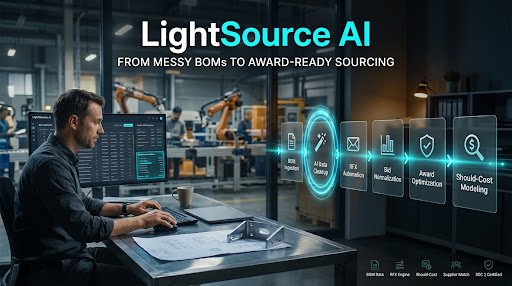
LightSource AI is an AI-native procurement platform designed specifically for direct materials sourcing in manufacturing, covering the full lifecycle from new product introduction to end-of-life. It ingests bills of materials, automates RFX workflows, and performs should-cost modeling, differentiating itself from legacy suites like Coupa and SAP Ariba that focus on indirect spend.
At a Glance
- Core focus: Direct materials sourcing, not general procurement or indirect spend management
- Founded: 2020, emerged from stealth in April 2025 with $33 million in seed and Series A funding at a $130 million valuation
- Key customers: Yum! Brands, Bombardier Recreational Products, Serta Simmons Bedding, Hello Fresh, and Shure
- Deployment: Approximately 30 days, with no rip-and-replace of existing ERP systems
- Security: SOC 2 certified, according to the company’s website
- Pricing: Not publicly disclosed; enterprise sales only
What Is LightSource AI?
LightSource AI is not a general-purpose procurement suite. It is a specialized platform built for one of the most underserved functions in enterprise spending: direct materials sourcing.
Direct materials are the physical components and raw materials that go into a finished product. They are tracked at the bill of materials level and represent a major share of cost of goods sold for manufacturers . Despite this, approximately 70% of procurement teams do not use any software tools for sourcing, relying instead on spreadsheets, email, and manual tracking .
LightSource targets that gap. Its platform is built around the direct materials workflow, from new product introduction through volume production to end-of-life. The company calls this lifecycle “Spec to Scale” .
The distinction matters. Coupa and SAP Ariba, the dominant procurement platforms, were architected around indirect spend: office supplies, facilities, services. LightSource was built from the ground up for BOM-level component sourcing, should-cost modeling, and supplier award optimization .
How LightSource AI Works
The workflow is designed to compress the manual effort that dominates direct materials sourcing.
Step 1: BOM ingestion. Users upload bills of materials, often in messy formats. LightSource’s AI cleans and structures the data automatically, mapping items and components without manual preparation .
Step 2: RFX setup. The system generates RFX templates based on past projects and category context. What typically takes two weeks of scoping and bid sheet design can be completed in roughly 15 minutes, according to the company .
Step 3: Supplier activation. LightSource sends packages to suppliers, tracks responses, and flags gaps. The system handles follow-up automatically rather than relying on procurement staff to chase quotes .
Step 4: Bid normalization and comparison. The AI standardizes supplier quotes into a comparable format, accounting for unit-of-measure differences and pricing structures. This enables apples-to-apples comparison .
Step 5: Award optimization. The system models award scenarios against constraints like cost, location, lead time, and supplier concentration. Buyers see tradeoffs before making a decision .
Key Feature
AI Workforce
Launched in July 2026, AI Workforce is the company’s name for its agentic execution layer. It runs across five stages of the sourcing cycle: item ingestion, RFX setup, supplier activation, real-time analytics, and award optimization .
The distinction from earlier AI features is execution. The system does not just suggest actions. It performs them, from cleaning BOM data to chasing suppliers for quotes.
Should-Cost Modeling
LightSource includes clean-sheet costing, an analytical method for independently calculating what a component should cost based on materials, labor, overhead, and margin. This is used to validate supplier pricing and identify negotiation leverage .
For manufacturers, this capability directly addresses the problem of cost creep, where prices rise gradually after initial supplier selection.
BOM-Level Data Handling
The platform ingests unstructured BOMs and engineering drawings. It tracks components at the part level, not just the category level. This granularity is unusual among procurement tools, most of which operate at a higher level of abstraction .
Real-Time Analytics
The “Ask LightSource” feature provides conversational analytics on any RFQ or program. A global automotive supplier cited by the company reduced program management time spent on data mining from 20 to 30 percent of capacity to minutes per status report .
Pricing: What LightSource AI Costs
LightSource does not publish pricing. The company sells through enterprise contracts negotiated by company size and scope.
What to expect in evaluation: Enterprise procurement software typically involves annual licensing, implementation fees, and potentially usage-based components. LightSource’s 30-day deployment claim suggests lower implementation overhead than legacy suites, but buyers should request a detailed quote covering licensing, onboarding, and any add-on modules.
Important context: LightSource is not a self-serve tool. The buying process is consultative, and pricing reflects enterprise procurement budgets. Small or mid-sized manufacturers may find the cost structure prohibitive compared to simpler sourcing tools.
Verified Performance Claims
LightSource makes specific performance claims based on customer deployments. These are company-reported figures, not independently audited benchmarks.
Automotive case study: A Big Three auto manufacturer that adopted LightSource halfway through a vehicle program provided a natural A/B test. Components sourced through LightSource showed a 25% acceleration in sourcing cycle time and a 47% reduction in cost creep compared to components sourced through traditional methods .
Platform-wide metrics: The company reports 65% faster sourcing cycles, 3 to 5 percent savings uplift on average, and one customer taking $10 million out of BOM costs in nine months .
Scale indicators: Since 2024, over $1 billion in spend has been processed through the platform, facilitating more than 1,100 sourcing events .
Editorial interpretation: These figures are directionally credible given the customer roster and funding. However, they come from company interviews and press materials. Buyers should ask for references from customers with similar volume and complexity before relying on these numbers for their own business case.
Who Should Use LightSource AI?
LightSource fits well for:
- Manufacturers with complex bills of materials and high direct materials spend
- Procurement teams currently managing sourcing through spreadsheets and email
- Automotive, aerospace, electronics, and consumer goods companies with multi-tier supplier bases
- Organizations that need should-cost modeling and bid normalization without replacing their ERP
LightSource may not fit for:
- Companies seeking a full source-to-pay suite covering indirect spend and invoicing
- Small manufacturers with low sourcing volume
- Organizations deeply standardized on SAP Ariba or Coupa for all procurement functions
- Teams without the data maturity to benefit from BOM-level automation
The company’s own competitive positioning concedes breadth. LightSource does not compete on indirect spend, procure-to-pay transactions, or broad supplier network management . It wins when direct materials sourcing is the primary pain point.
LightSource AI vs. Competitors
| Platform | Target User | Key Strength | Pricing Transparency | Core Limitation |
|---|---|---|---|---|
| LightSource AI | Manufacturers with direct materials focus | BOM ingestion, should-cost, 30-day deployment | Low (enterprise quotes) | Narrow focus, no indirect spend |
| Coupa | Enterprises seeking broad spend management | Breadth, indirect procurement, user adoption | Low (enterprise) | Weak direct materials depth |
| SAP Ariba | SAP-anchored enterprises | ERP integration, supplier network | Low (enterprise) | Not built for BOM-level sourcing |
| Keelvar | Teams optimizing sourcing events | Autonomous sourcing bots | Moderate | Not a full direct materials platform |
| JAGGAER | Direct and indirect procurement | Manufacturing depth | Low (enterprise) | Less AI-native than LightSource |
LightSource’s differentiation is architectural. Coupa and Ariba added AI features to platforms built for indirect spend. LightSource was built as an AI-native system for direct materials data structures .
For manufacturers whose primary challenge is component cost reduction and NPI sourcing, that architectural difference may matter more than the breadth of legacy suites.
Limitations and Open Questions
No Public Pricing
The absence of published pricing creates evaluation friction. Buyers cannot compare LightSource against alternatives without engaging sales. This is common in enterprise software but still a barrier.
Narrow Market Focus
LightSource’s specialization is a strength for manufacturers and a limitation everywhere else. Companies seeking a unified procurement platform for all spend categories will need to integrate LightSource with other tools.
Limited Independent Review Footprint
G2 lists a 4.9 out of 5 rating, but based on a small number of reviews . The company’s customer roster is strong, but independent user feedback at scale is limited compared to legacy platforms.
Employee Sentiment
A single Blind review from a rejected interview candidate criticized the company’s technical interview process and described the website as “generic” . One review from a non-employee is not a reliable signal of company culture or product quality, but it is the only public employee-adjacent feedback available.
Security Disclosure Gaps
LightSource states SOC 2 certification on its website . SOC 2 covers security, availability, and confidentiality controls. However, SOC 2 certification does not automatically mean Zero Data Retention or specific data handling practices. Buyers handling sensitive supplier pricing and BOM data should request details on data retention, encryption, and access controls.
Frequently Asked Questions
What is LightSource AI used for?
LightSource AI is used for direct materials sourcing in manufacturing. It ingests bills of materials, automates RFX workflows, normalizes supplier bids, and performs should-cost modeling to help manufacturers reduce component costs and accelerate sourcing cycles.
How much does LightSource AI cost?
LightSource does not publish pricing. It sells through custom enterprise contracts negotiated by company size and scope. Buyers should request a detailed quote covering licensing, implementation, and any add-on modules.
Who are LightSource AI’s main competitors?
LightSource competes with Coupa and SAP Ariba for procurement budgets, but differentiates by focusing exclusively on direct materials rather than indirect spend. It also competes with Keelvar and JAGGAER in sourcing optimization.
Is LightSource AI secure?
LightSource states SOC 2 certification on its website. SOC 2 covers security and confidentiality controls. However, the company has not publicly disclosed Zero Data Retention policies or detailed data handling practices. Enterprise buyers should request specifics during procurement.
Does LightSource AI replace my ERP?
No. LightSource is designed to layer onto existing ERP systems without rip-and-replace. It handles sourcing workflows and connects to ERP for transactional records.
Conclusion
LightSource AI addresses a genuine gap in enterprise software. Direct materials sourcing, despite representing the majority of cost of goods sold for manufacturers, has been largely ignored by procurement software vendors focused on indirect spend. LightSource’s BOM-level ingestion, should-cost modeling, and rapid deployment offer a credible alternative to spreadsheets and email for manufacturers with complex sourcing needs.
The strengths are real. The customer roster includes recognizable brands. The funding and investor backing suggest market confidence. The company’s claims about deployment speed and sourcing cycle acceleration align with the pain points its target buyers face.
The limitations are those of a young, specialized vendor. Pricing is opaque. Independent user reviews are limited. The platform does not replace a full procurement suite, and companies seeking unified spend management will need to integrate LightSource with other tools.
LightSource suits manufacturers with high direct materials volume and a sourcing process still reliant on manual workflows. It may not suit companies seeking a broad source-to-pay platform or those without the data maturity to benefit from BOM-level automation.
Before engaging, request references from customers with similar BOM complexity and spend volume. Ask for written security documentation covering data retention and access controls. Confirm the total cost of ownership beyond the initial license, including any implementation or integration fees. The platform’s technical approach is differentiated; the procurement due diligence should match.