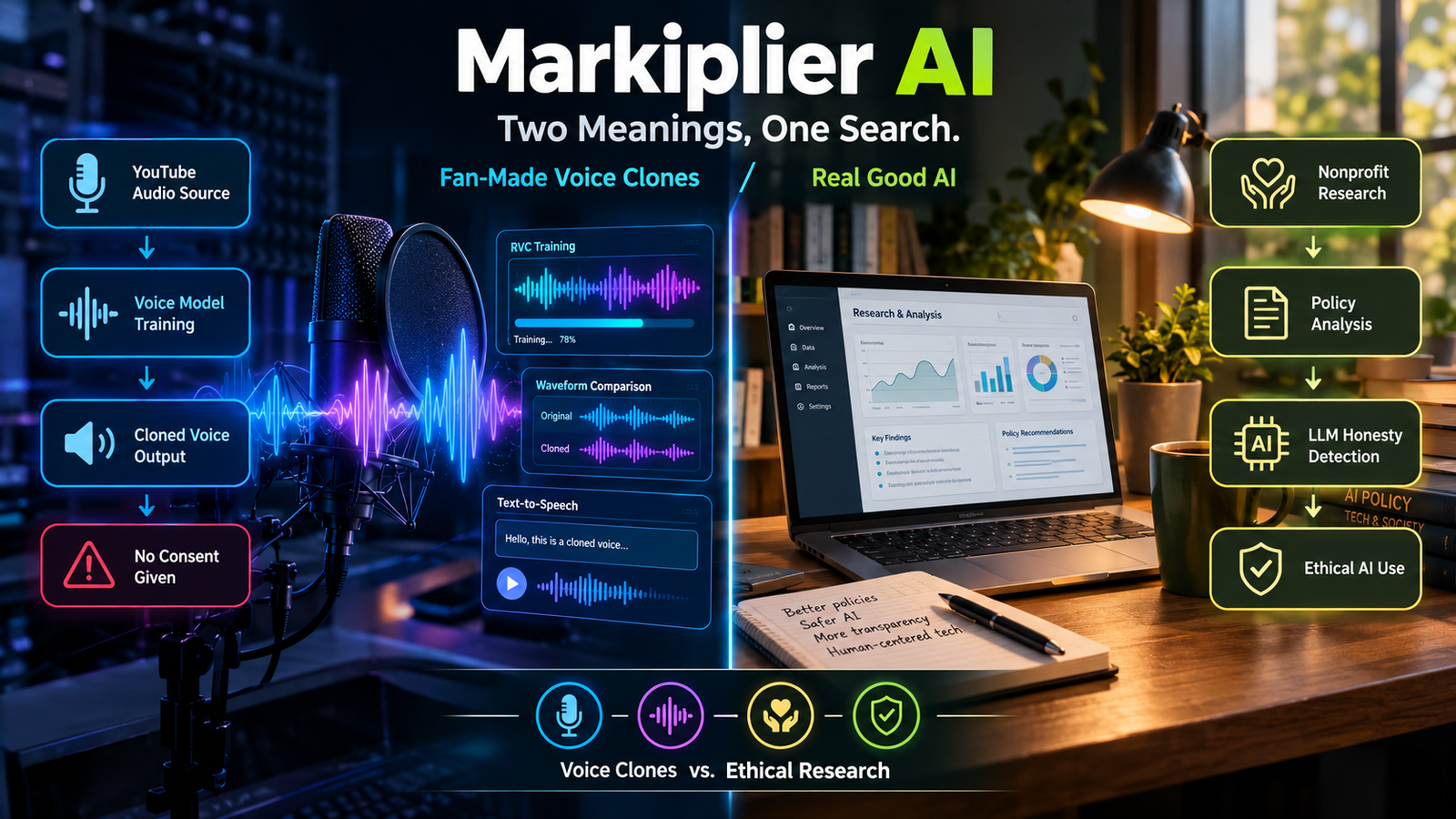
Markiplier AI refers to two very different things: fan-made voice cloning tools trained on his YouTube audio, and Real Good AI, a nonprofit he personally funds to study ethical AI applications. He has publicly criticized generative AI misuse while supporting research into AI that benefits humanity.
At a Glance
- Fan-made voice models: Multiple RVC and So-VITS models trained on Markiplier’s voice exist on Hugging Face and voice-model sites
- Commercial voice generators: Fish Audio and ModelsLab offer paid Markiplier voice synthesis without his endorsement
- His actual AI project: Real Good AI, a 501(c)(3) nonprofit he founded and fully funds
- His public stance: Critical of generative AI misuse, opposed to AI-generated content in his community, but not anti-AI research
- Key incident: August 2025 livestream addressing AI backlash over a podcast ChatGPT joke and an AI-generated thumbnail
- Important distinction: He does not endorse or profit from fan-made voice clones
What Is Markiplier AI?
The phrase “Markiplier AI” covers a messy landscape. Search for it and you will find voice generators, Hugging Face model repositories, TikTok tutorials, and news about a nonprofit. These are not connected in the way most people assume.
On one side, independent developers have trained AI voice models on Markiplier’s YouTube audio. These models can generate speech that sounds like him. Some are free downloads. Others sit behind paid API subscriptions. None of them involve Markiplier’s permission or participation.
On the other side, Markiplier (Mark Fischbach) has his own AI project. It is not a voice tool or a content generator. It is a nonprofit research organization called Real Good AI, which he founded with data scientist Dr. Amanda Muyskens and funds entirely himself .
Understanding which “Markiplier AI” you are looking for matters. The fan tools raise ethical and legal questions. His nonprofit operates in a completely different space.
The Fan-Made Voice Clones
Markiplier’s voice is distinctive: a warm baritone with theatrical projection and sudden shifts into horror-game screaming . That distinctiveness makes it a popular target for voice cloning.
What Exists
Several voice models are publicly available:
- Hugging Face (FearedSlug7/so-vits-svc-Markiplier): A So-VITS-SVC model trained on samples from his YouTube channel .
- Hugging Face (JayTbh/Markiplier-SpaceIsCool): An RVC v2 model trained on a 98-second clip from his song “Space Is Cool,” using 161 epochs and a HiFi-GAN vocoder .
- Hugging Face (V-Mikey-V/Markiplier): Another RVC v2 model with a 20-minute dataset and 250 epochs of training .
- Fish Audio: A commercial text-to-speech generator listed under Markiplier’s name, claiming 3,413+ creators have used it .
- ModelsLab: An API-based voice model charging $0.001 per second of output, with plans starting at $21 per month .
These tools produce audio that mimics his voice. They do not involve him. They do not pay him. And they exist in a legal gray zone.
How Voice Cloning Works Technically
RVC (Retrieval-based Voice Conversion) and So-VITS-SVC are open-source architectures for voice conversion. Developers feed the model audio samples of a target speaker. The model learns the speaker’s timbre, pitch patterns, and vocal characteristics. Once trained, it can convert any input audio into the target voice.
The quality depends on the training data. A 98-second clip produces a rougher approximation than a 20-minute dataset. But even small datasets can produce recognizable results with modern architectures.
This is not unique to Markiplier. Voice models exist for countless public figures. The technology is accessible, the barriers are low, and the ethical frameworks are still catching up.
Markiplier’s Actual Stance on AI
Markiplier is not anti-AI. He is also not a supporter of generative AI misuse. His position is more nuanced than headlines suggest.
The August 2025 Livestream
In August 2025, Markiplier addressed backlash over AI use in his content during a livestream titled “Markiplier vs AI: FIGHT NIGHT” . The controversy had three parts.
First, a ChatGPT joke. His Distractible podcast had used ChatGPT for a comedic segment. Critics interpreted this as endorsement. He clarified it was mockery of AI dependence, not advocacy .
Second, an AI-generated thumbnail. An editor had unknowingly used a stock image that turned out to be AI-generated. Markiplier explained this was not intentional and noted that AI images are increasingly common on stock photo sites .
Third, subreddit moderation. His subreddit had restricted AI discussions. He stated this was due to escalating hostility and threats toward him and his moderators, not an attempt to suppress criticism .
His summary position: “There are reasons to be critical of [AI] the way that it currently is. It’s a problem when used without safeguards or proper oversight” .
The Iron Lung Accusation
When fans accused him of using AI in his film Iron Lung, he pushed back firmly. He praised the set designers, makeup artists, and practical effects crew who built the film’s physical world. He was prepared to release behind-the-scenes material before the movie’s debut rather than let their work be dismissed as machine output .
The suspicion partly came from an unusual detail: he had converted a bathroom into a render farm using secondhand servers for blood simulations. The machines handled conventional VFX, not generative AI .
Real Good AI: What He Actually Built
Real Good AI is the concrete expression of Markiplier’s interest in the technology. It is a 501(c)(3) nonprofit focused on “trying to ethically pursue ways to improve and new methods to make these tools work for humanity” .
Structure and Funding
Markiplier funds the organization entirely himself. Dr. Amanda Muyskens leads the research without taking a paycheck, assisted by summer research fellows. The board includes Markiplier, Mr. and Mrs. Muyskens, and music teacher David Bell .
Current Projects
Real Good AI’s initial work has three tracks:
- Nonprofit data analysis: Helping nonprofits learn from peers in their area by examining best practices and funding histories to project budgets .
- Homelessness policy research: Analyzing the impacts of public policy on homelessness among the elderly to identify which policies actually work .
- LLM honesty detection: Figuring out how to identify when large language models are lying, and getting those models to communicate accuracy concerns to users .
The third project is particularly relevant to the “Markiplier AI” search intent. While fan tools clone his voice, his nonprofit is researching how to make AI systems more honest about their own limitations.
Privacy and Legal Concerns
Fan-made voice clones raise questions that have no settled answers.
Consent: Markiplier has not authorized any of the voice models listed on Hugging Face or commercial platforms. His audio was scraped from public YouTube videos. Whether this constitutes fair use or infringement is legally unresolved.
Commercial use: Fish Audio and ModelsLab charge money for access to Markiplier voice synthesis. He receives no compensation. Users who generate content with these tools may face takedown requests or legal action if the output is used commercially.
Deepfake risks: Voice cloning enables impersonation. A convincing Markiplier voice could be used for scams, misinformation, or harassment. The technology does not distinguish between parody and fraud.
Platform policies: Hugging Face hosts the models but does not vet consent. Commercial platforms like Fish Audio and ModelsLab operate with minimal oversight. The regulatory environment is fragmented and evolving.
If you use these tools, understand the risks. You are generating audio in the voice of a real person who has explicitly criticized generative AI misuse. That does not make the tools illegal, but it makes their use ethically questionable and potentially actionable.
Who Should Care About Markiplier AI?
This topic matters for:
- Creators curious about voice cloning and its ethical boundaries
- Fans who encountered “Markiplier AI” content and want to understand what is real
- Researchers studying AI voice synthesis and consent frameworks
- Anyone considering using a celebrity voice model for content
It probably does not matter for:
- People looking for an official Markiplier AI product (none exists)
- Anyone hoping to use his voice commercially with permission (he has not granted any)
- General AI users seeking practical tools
Common Mistakes When Searching for Markiplier AI
Assuming he endorsed the voice tools. He did not. The models exist independently of him.
Confusing Real Good AI with a voice product. His nonprofit researches AI ethics and policy. It does not generate content.
Ignoring the consent problem. Using a cloned voice without permission carries legal and ethical risks, especially for commercial content.
Expecting quality consistency. Fan models vary widely based on training data. A 98-second dataset produces different results than a 20-minute one.
Missing his actual position. He is critical of generative AI misuse but supports ethical AI research. He is not a blanket opponent of the technology.
Frequently Asked Questions
Is there an official Markiplier AI voice generator?
No. Markiplier has not released or endorsed any AI voice model. The generators on Fish Audio, ModelsLab, and Hugging Face are fan-made or third-party creations that use his voice without permission.
Did Markiplier use AI in his videos?
He used ChatGPT for a comedy segment on his Distractible podcast but stated he no longer does. An AI-generated thumbnail appeared on one video due to an editor’s mistake with a stock image. He has denied using generative AI in his film Iron Lung .
What is Real Good AI?
Real Good AI is a nonprofit Markiplier founded and funds himself. It researches ethical AI applications, including nonprofit data analysis, homelessness policy evaluation, and detecting when language models lie .
Can I use a Markiplier AI voice for my own content?
Legally, this is unclear. Ethically, it is problematic. Markiplier has criticized generative AI misuse and restricted AI-generated content in his community. Commercial use of his cloned voice could invite legal action.
Is Markiplier anti-AI?
No. He is critical of generative AI misuse and its impact on artists. But he funds AI research through Real Good AI and has described his interest as wanting to understand both the risks and potential benefits .
Conclusion
“Markiplier AI” is two stories tangled together. One is a sprawling ecosystem of fan-made voice clones and commercial generators that use his voice without permission. The other is a quiet nonprofit he funds himself to research whether AI can actually help people.
The voice tools are technically impressive and ethically fraught. They exist because the technology is accessible and the legal frameworks are not. Using them carries risks that most tutorials do not mention.
Real Good AI represents a different approach. Instead of generating content in someone else’s voice, it asks harder questions about honesty, policy, and whether AI can be directed toward genuine social benefit. That work is slower, less viral, and more substantive.
If you came here looking for a Markiplier voice generator, understand what you are getting into. If you came curious about what he actually thinks about AI, the answer is more interesting than a cloned baritone.

Alex Carter is a technology writer at AI SpaceZ.com, who covers AI tools, software reviews, practical tutorials and emerging artificial intelligence trends. He aims to make AI easier to understand and help readers discover useful tools and technologies for everyday productivity.