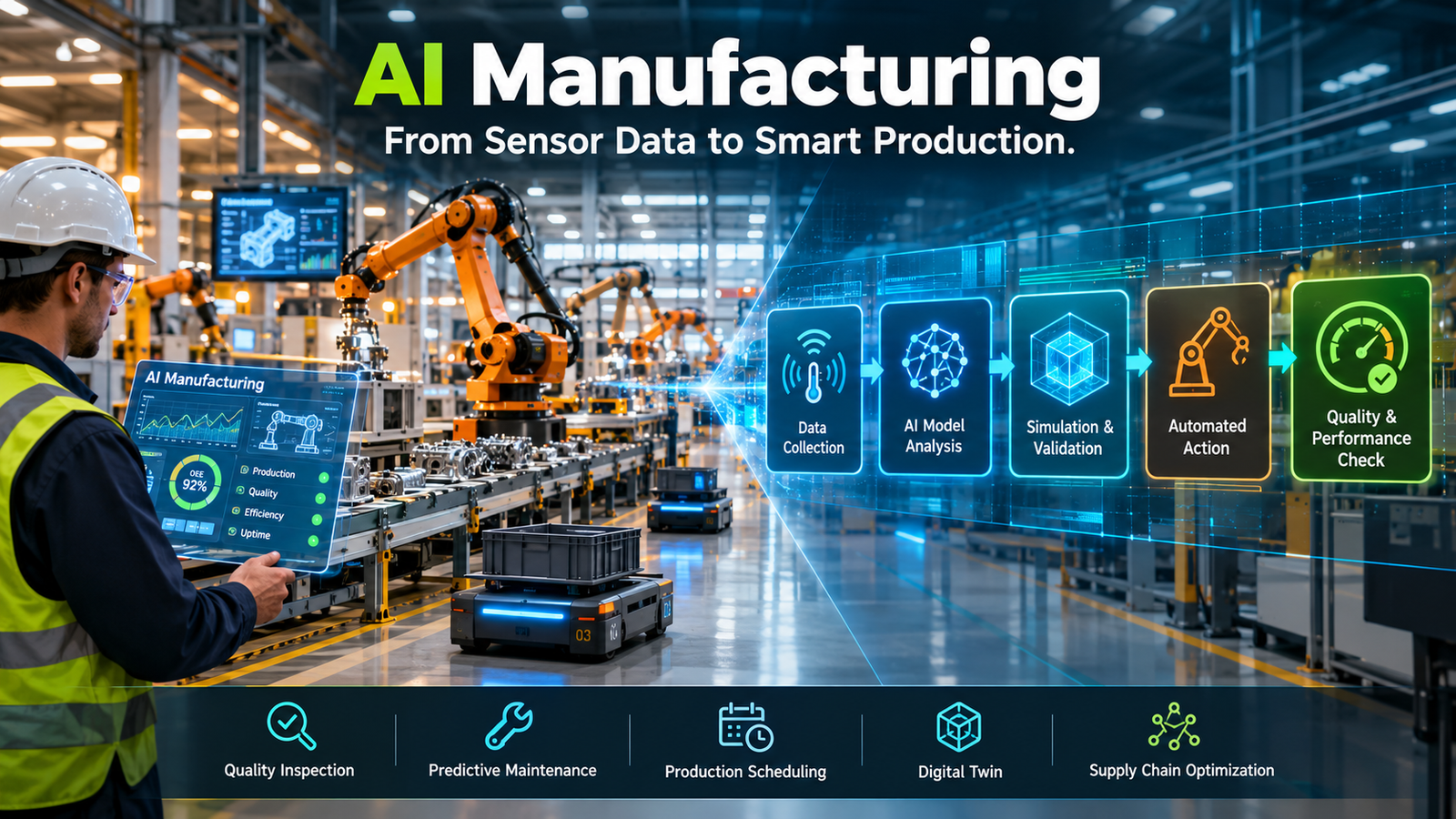
AI in manufacturing refers to the use of machine learning, computer vision, digital twins, and AI agents to optimize production, quality, maintenance, and supply chains. Most manufacturers now report measurable value from these tools, but only about one in five use cases reaches enterprise-wide scale.
At a Glance
- Value is proven: 84% of manufacturers report measurable value from AI, with average KPI improvement potential around 20%
- Scale is the bottleneck: Only 20% of use cases are scaled consistently across sites or the enterprise
- Highest adoption: Quality (62%), production (57%), and logistics/supply chain (49%) lead deployment
- Biggest barriers: Implementation costs (43%), skills gaps (35%), and change resistance (35%)
- Leading example: Siemens’ Nanjing facility pairs digital twins with operational discipline, not technology alone
- Market trajectory: The AI in manufacturing market is projected to grow from $8.36B to $34.1B by 2030
What Is AI in Manufacturing?
AI in manufacturing is not a single product or platform. It is a set of technologies applied across the production lifecycle to improve throughput, quality, cost, and resilience.
The core technologies include machine learning for predictive maintenance and process optimization, computer vision for defect detection, digital twins for simulation and validation, and increasingly, generative AI and AI agents for planning and decision support .
What separates manufacturing AI from general enterprise AI is the physical stakes. A bad recommendation in a marketing tool wastes time. A bad recommendation on a production line stops a factory.
That distinction shapes everything about how AI is adopted, governed, and scaled in manufacturing environments.
How AI Manufacturing Works in Practice
The workflow varies by use case, but the pattern is consistent across successful deployments.
Step 1: Identify a high-variability, high-value process. AI creates the most value where processes have many interacting parameters and material consequences for failure. Deloitte’s survey found the strongest improvement potential in complex areas like chemical transformation (32%) and assembly (22%) .
Step 2: Ensure data infrastructure exists. AI models need clean, labeled, accessible data from machines, sensors, and process control systems. Data quality issues block 30% of implementations .
Step 3: Deploy into a defined workflow, not around it. The most common failure mode is bolting AI onto existing processes without redesigning the work. Companies that embed AI across functions generate nearly double the profit margins of those using it in isolated departments .
Step 4: Validate and govern. In production-critical environments, AI outputs need human confirmation or simulation-based validation. Siemens’ Nanjing site defines clear decision rights for when humans must approve AI-generated changes .
Step 5: Scale what works. Only one in five use cases reaches consistent multi-site deployment. The gap between pilot success and enterprise scale is the defining challenge of the current market .
Key Use Cases Delivering Value
Quality and Defect Detection
Quality leads AI adoption at 62% of manufacturers . Computer vision systems inspect products at speeds and accuracies beyond human visual inspection.
FAW-Volkswagen’s Tianjin factory uses AI visual inspection to identify gluing defects in welding and perform millimeter-level checks in stamping. The factory reports a 20% reduction in quality-related issues .
Beko’s sheet metal forming operations use a decision tree model to prevent clinching failures from thickness variations, cutting defect rates by 66% .
Predictive Maintenance
Unplanned downtime is expensive. AI models trained on equipment sensor data can predict failures before they occur.
Jubilant Ingrevia reports reducing downtime by more than 50% using IoT-based monitoring and predictive analytics . FAW-Volkswagen’s Tianjin factory uses predictive maintenance to identify equipment abnormalities before breakdowns, saving over 3,000 person-hours in stamping alone .
Production Planning and Scheduling
AI agents are beginning to handle the complex trade-offs in production scheduling. At Siemens’ Erlangen electronics factory, an AI agent generates production options when new orders arrive and validates them against the factory’s digital twin before execution. The company reports up to 20% cost savings from this approach .
Process Optimization
Machine learning models optimize parameters in real time for complex processes. Beko uses a closed-loop valve gate control system with convolutional neural networks to optimize plastic injection, analyzing over 150,000 data points and improving cycle time by 18% .
Digital Twins
Digital twins create virtual replicas of production lines or entire factories. They allow engineers to test changes, train AI models, and validate AI-generated plans before touching physical equipment.
At Siemens’ Nanjing site, digital twin capabilities combined with operational improvements significantly increased throughput . The Erlangen factory uses NVIDIA Cosmos world models to generate realistic training images for visual inspection systems, eliminating the need to wait for physical prototypes .
The Scale Gap: Why Most AI Manufacturing Pilots Fail to Expand
The data tells a consistent story. AI works in manufacturing. Scaling it does not.
Deloitte found that 84% of manufacturers generate measurable value from AI, but only 20% of use cases are scaled . McKinsey’s research shows a similar pattern: nearly 90% of organizations are experimenting with AI, but just 7% report scaling it across the enterprise .
The reasons are operational, not technical.
High implementation costs are the most cited barrier at 43% . Integrating AI into legacy systems, upgrading data infrastructure, and training staff require sustained investment.
Lack of technical expertise affects 35% of manufacturers. The intelligence gap matters here. Manufacturing processes are often undocumented outside the minds of experienced operators. Unlike back-office functions where public data is abundant, factory knowledge is proprietary and tacit .
Resistance to change also sits at 35%. AI changes how work gets done. Operators who have run a line for twenty years may understand its quirks better than any model. Winning adoption requires involving them, not bypassing them.
Regulatory and compliance concerns affect 34%. As AI moves closer to production-critical decisions, traceability and accountability requirements increase .
A peer-reviewed case study of an Austrian manufacturer with 800 employees found an implementation rate of roughly 12%: 25 use cases submitted, three productive. The researchers concluded that organization is the lever that moves everything else, and the element companies invest in least .
Technical Considerations
Data Infrastructure Comes First
AI models are only as good as the data feeding them. Manufacturing environments often have data trapped in proprietary systems, stored in inconsistent formats, or lacking labels.
The Austrian case study describes a four-level protection-class model that enforces data access rights, roles, and logging. It also uses an LLM router that distributes requests by task, cost, and confidentiality, keeping models exchangeable rather than locked to one vendor .
The Deterministic Gap
Manufacturing processes require deterministic outcomes. An LLM that produces a plausible but wrong answer is a liability on a production floor.
This explains why agent adoption in manufacturing lags other functions. McKinsey’s 2026 report found manufacturing dead last among eleven business functions for agent adoption, at just 3% . The probabilistic nature of language models clashes with the precision requirements of physical production.
Successful deployments work around this. Rule-based systems handle structured logic where precision matters. LLMs handle language understanding and generation. Human confirmation is required for consequential actions .
Physical AI Is Emerging
Physical AI, where AI directly controls robots or automated systems, remains early. Only 18% of manufacturers report using it . But the trajectory is clear.
At Siemens’ Erlangen factory, AI agents coordinate production planning and validate plans against digital twins. In Nanjing, AI agents manage warehouse logistics and drive robots to handle the “last half meter” of material replenishment, a task previously too variable for conventional automation .
Humanoid robots may eventually suit smaller manufacturers because they work in environments built for people. But the Austrian case study notes that the question is not when robots become affordable, but whether companies are prepared when they are .
Who Benefits Most from AI Manufacturing?
AI manufacturing delivers the strongest returns for:
- Large manufacturers with high data density and existing digital infrastructure
- Operations with complex, variable processes where manual optimization has hit limits
- Quality-critical industries like automotive, electronics, and pharmaceuticals
- Firms willing to redesign workflows, not just add tools
It delivers less for:
- Small and medium manufacturers with limited data infrastructure and AI skills
- Operations with highly stable, repetitive processes already well-optimized
- Companies expecting AI to fix fundamentally broken processes without operational changes
The adoption gap between large and small enterprises is widening. In the EU, 55% of large enterprises used AI in 2025, compared to 17% of small enterprises .
Common Mistakes in AI Manufacturing Adoption
Treating AI as a tool, not a transformation. McKinsey’s analysis is blunt: companies that bolt AI onto existing processes see far more modest results than those that redesign workflows around AI capabilities .
Skipping the data foundation. AI cannot compensate for missing, dirty, or inaccessible data. The Austrian case study found that without data, no physical-AI application carries. Data readiness must precede model deployment .
Underinvesting in people. The implementation rate of 12% in the Austrian case study reflects a demand-supply mismatch. Explorers identified use cases, but there were not enough AI engineers to build them. Companies that train operators and create hybrid roles scale faster .
Chasing the wrong use cases. AI should target processes where complexity, variability, and business value intersect. Spreading AI evenly across the enterprise dilutes impact .
Ignoring operational excellence. Siemens’ Nanjing facility succeeded because it tightened its operating backbone before scaling digital twins. Technology amplified good processes. It did not replace them .
Frequently Asked Questions
What is AI manufacturing?
AI manufacturing is the application of machine learning, computer vision, digital twins, and related technologies to production processes. It covers quality inspection, predictive maintenance, production scheduling, and process optimization.
What percentage of manufacturers use AI?
Around 84% of manufacturers report generating measurable value from AI, according to Deloitte’s 2026 survey. However, only about 20% of use cases are scaled across sites or the enterprise .
Why does AI in manufacturing fail to scale?
The main barriers are high implementation costs, lack of technical expertise, resistance to change, and data quality issues. Organizational factors, not technology limitations, are the primary constraint .
What is the difference between AI and physical AI in manufacturing?
AI in manufacturing often refers to software analyzing data and making recommendations. Physical AI refers to AI that directly controls robots or automated systems in the physical world. Only 18% of manufacturers currently use physical AI .
How long does it take to see ROI from AI manufacturing?
It depends on the use case and the starting point. Quality inspection and predictive maintenance often show faster returns because they link directly to measurable KPIs like defect rates and downtime. Enterprise-wide transformation takes years, not months.
Conclusion
AI in manufacturing has moved past the question of whether it works. Most manufacturers can point to a pilot that delivered measurable value. Quality inspection catches defects faster. Predictive maintenance prevents downtime. Digital twins reduce commissioning time.
What remains unresolved is the gap between pilot and scale. Only one in five use cases reaches consistent deployment. The barriers are operational: cost, skills, change resistance, and data infrastructure. The companies that close this gap do not just deploy better models. They redesign how work gets done.
AI manufacturing suits large operations with data density and process complexity, especially in automotive, electronics, and process industries. It fits less well for small manufacturers without data infrastructure or AI talent.
Before investing, assess data readiness honestly. Identify one high-variability process where AI can prove value. Train operators to work with the system, not around it. Plan for scale from the first pilot. And measure outcomes in KPIs that matter on the P&L, not in slide decks. The technology is ready. The operating model is the work.