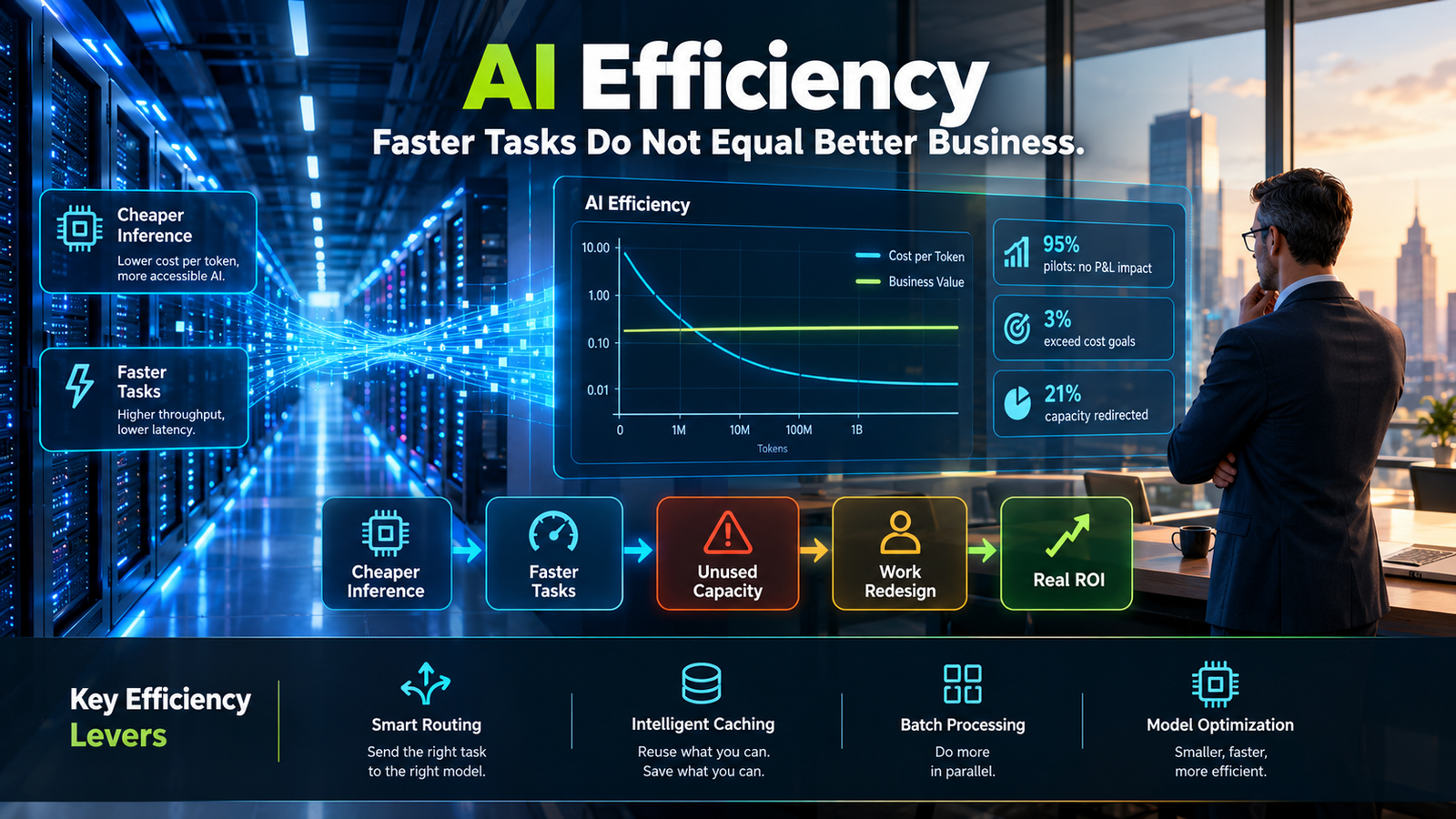
AI efficiency refers to the ability of AI systems to produce useful output with less compute, time, and cost, measured increasingly as cost per completed task rather than cost per token. Yet faster task completion and lower inference prices do not automatically translate into financial returns, because organizations rarely redesign work to capture the capacity AI creates.
At a Glance
- The paradox: Power consumption per AI task is falling by an order of magnitude annually, yet total data center electricity demand rose 26% in 2026
- The ROI gap: 77% of board members expect AI to deliver productivity and cost savings, but only 3% of organizations exceed cost savings goals through productivity alone
- The adoption failure: Roughly 95% of enterprise generative AI pilots produce no measurable P&L impact, largely because workflows are not redesigned
- The cost reality: Advanced reasoning models consume 5 to 30 times more tokens than basic chatbots, and inference costs per agentic workflow are projected to rise more than fivefold through 2028
- The lever: Model routing, prompt caching, and batch processing can cut inference bills by 40% to 85% without changing application logic
- The missing piece: Only 21% of time freed by AI is redirected into more innovative work, which is where efficiency becomes actual value
What Is AI Efficiency?
AI efficiency is a broad term that covers several distinct measurements, and confusing them creates bad decisions.
At the infrastructure level, efficiency means producing AI output with less energy and compute. Google reports that a median Gemini text prompt now uses about 0.24 watt-hours, following a 33-fold reduction in one year . Token prices have fallen roughly 600-fold since 2020, driven mostly by software and architectural innovation rather than cheaper hardware .
At the application level, efficiency means lower cost per query or per task. Prompt caching, model routing, and output limits can reduce a typical inference bill by 40% to 70% with minimal engineering effort .
At the business level, efficiency means something harder to measure: capacity created, cost avoided, or revenue unlocked. This is where most organizations struggle. A process can become faster while the cost base, staffing structure, and complexity remain unchanged .
The distinction matters because the first two forms of efficiency are improving dramatically. The third is not.
The Efficiency Paradox: Cheaper Tasks, Higher Bills
Two curves are moving in opposite directions.
Per-task cost is collapsing. Power consumption per AI task declines by at least an order of magnitude annually, an unprecedented rate in energy history . Economy-tier token prices follow a half-life of roughly 1.1 years, faster than Moore’s Law .
Total consumption is exploding. Data center electricity consumption reached 565 TWh in 2026, up 26% from the prior year. AI-optimized servers alone account for 31% of that power draw, and by 2027 they will surpass conventional servers in total consumption .
The mechanism is straightforward. AI is becoming cheaper per action, but the number and complexity of actions are growing faster. Long reasoning queries already consume roughly 13 times more energy than standard prompts . Agentic workflows, which chain multiple reasoning steps together, multiply token usage further.
Gartner predicts that inference costs per agentic workflow will increase by more than five times through 2028, even as per-token prices continue to fall . The efficiency of each token is improving. The volume of tokens required to complete real work is rising faster.
Why AI Efficiency Rarely Reaches the Bottom Line
The most important number in enterprise AI right now is not a benchmark score or a price per million tokens. It is 95%.
MIT’s NANDA research found that roughly 95% of generative AI pilots at large companies produce no measurable P&L impact . The pilots that succeeded shared one trait: they changed how work actually happened. The ones that failed added a step and asked employees to trust that it would pay off later .
Gartner’s data reinforces the pattern. Seventy-seven percent of board members expect AI to deliver productivity and cost savings. Yet 97% of organizations are unable to achieve desired cost savings through productivity alone. Only 3% exceed their cost savings goals .
The World Economic Forum describes this as the AI productivity trap. Twenty-seven percent of organizations report productivity gains with no measurable impact on the bottom line. Only 13% have scaled AI initiatives fully in line with the original business plan .
The gap is not a technology failure. It is a work-design failure. Faster resolution times in customer service do not reduce costs unless the organization serves more customers, improves retention, redeploys staff, or reduces hiring. Without that connection, time saved is simply time that disappears .
The Real Cost Drivers Behind AI Efficiency
Understanding where AI costs actually accumulate helps separate meaningful efficiency from cosmetic savings.
Reasoning Is Expensive
Basic chatbots answer questions. Reasoning models think through problems, and that thinking consumes tokens. Advanced reasoning models typically use five to 30 times more tokens than standard completions. In agentic settings, where models plan, execute, observe results, and adjust, the multiplier grows further .
Token Depth Matters More Than Token Price
A lower per-token price means little if each task requires vastly more tokens. Total inference cost breaks down into volume, tokens per call, model price, and infrastructure overhead . Optimizing only the price column while ignoring token depth produces misleading savings.
Output Tokens Cost More Than Input
Models generate output tokens sequentially during the decode phase, while input processing happens in parallel. Many frontier providers charge four to five times more for output than input. Reasoning tokens are typically billed as output, which makes output length limits a direct cost lever .
Small Models Win on Narrow Tasks
A fine-tuned 7B model can match or beat GPT-4 on specific classification or extraction tasks at a fraction of the cost. In one documented scenario, a high-volume document classification workload cost roughly $500,000 over three years with GPT-4o versus $75,000 with a self-hosted fine-tuned model, an 85% reduction. The same small model would fail on open-ended reasoning, which is why matching model capability to task complexity matters more than buying the largest model available .
How to Improve AI Efficiency Where It Counts
The techniques that reduce inference costs are well documented. The harder work is connecting those savings to business outcomes.
Technical Levers
Model routing sends simple tasks to cheaper models and reserves frontier models for complex reasoning. Routing 70% of traffic to a model five times cheaper cuts that portion of the bill by 56% .
Prompt caching stores repeated prompt prefixes and charges a reduced rate for cached tokens. Anthropic bills cache reads at 0.1x the base input price. OpenAI discounts cached input by up to 95% .
Batch processing handles non-urgent workloads at roughly 50% of standard prices. Nightly reports, bulk classification, and document tagging are natural candidates .
Semantic caching stores answers to semantically similar questions and serves them without invoking the model at all. Enterprise deployments report hit rates of 25% to 60% on high-volume query streams .
Combined, these levers often reduce a typical bill by 80% or more . But a lower bill is not the same as higher value.
Organizational Levers
Gartner recommends establishing transparent value measurement frameworks that link AI spending to business outcomes, not just token consumption . The FinOps Foundation’s AI working group has reframed the core metric from cost per token to cost per useful outcome .
That reframing matters because it forces a question that technical optimization avoids: what outcome are we actually buying?
Gartner’s research on capacity is instructive. Only 21% of time freed by AI is redirected into more innovative work. The capacity exists. Organizations are struggling to make it usable .
The implication is uncomfortable but clear. Technical efficiency improvements create headroom. Without deliberate work redesign, that headroom becomes overcapacity or idle time, not savings.
AI Efficiency vs. Business Efficiency
| Dimension | Technical Efficiency | Business Efficiency |
|---|---|---|
| Primary metric | Cost per token, latency, throughput | Cost per outcome, revenue per employee, margin |
| Who owns it | Engineering, platform teams | Executive leadership, operations, finance |
| Typical failure | Optimizing the wrong workload | Automating a process that should be redesigned |
| Evidence of success | Lower inference bill | Redeployed capacity, measurable cost avoidance, new revenue |
| Risk if ignored | Higher cloud bills | Pilot graveyard, board skepticism |
Both dimensions matter. A firm that ignores technical efficiency wastes money on inference. A firm that pursues only technical efficiency saves money on a process that delivers no strategic value.
Common Mistakes When Pursuing AI Efficiency
Measuring cost per token instead of cost per outcome. A cheaper model that produces unusable output is not efficient. It is a refund request waiting to happen.
Assuming speed equals savings. Faster task completion without work redesign produces unused capacity, not lower costs .
Routing everything to frontier models. The “big model fallacy” is the most expensive architectural mistake in enterprise AI. Most production tasks do not require frontier reasoning .
Ignoring reasoning token consumption. Agentic workflows can multiply token usage by 20 to 30 times compared to standard completions. Budgeting for agent pilots using chatbot cost assumptions produces unpleasant surprises .
Skipping the measurement layer. Without transparent value measurement, organizations cannot distinguish genuine efficiency from activity that looks productive.
Frequently Asked Questions
What is AI efficiency?
AI efficiency describes how well AI systems convert compute, time, and cost into useful output. It spans technical metrics like tokens per second and cost per query, as well as business metrics like cost per completed task and revenue per employee.
Why doesn’t AI efficiency always lead to cost savings?
Faster tasks and cheaper tokens create capacity, but organizations often fail to redirect that capacity toward revenue-generating or cost-reducing work. Only 21% of time freed by AI is redirected into more innovative work, according to Gartner .
How much can model routing reduce AI costs?
Routing simple queries to cheaper models can cut costs by more than half on the routed portion of traffic. The exact savings depend on task mix. Organizations that route 70% of traffic to a model five times cheaper reduce that portion of the bill by 56% .
What is the difference between prompt caching and semantic caching?
Prompt caching reduces the price of repeated prompt prefixes at the provider level. Semantic caching stores past answers and serves them without any model call when a new question is close in meaning. Prompt caching suits long shared instructions. Semantic caching suits repeated questions like support FAQs .
Why do advanced reasoning models cost so much more?
Reasoning models generate intermediate thinking tokens before producing a final answer. These tokens are billed as output, and reasoning models can consume five to 30 times more tokens than basic chatbots. In agentic workflows, the multiplier grows further .
Conclusion
AI efficiency is improving on every technical measure that matters. Token prices are falling. Per-task energy consumption is declining. Caching, routing, and batching can cut inference bills by 80% or more.
What is not improving at the same rate is the translation of those gains into business value. The 95% pilot failure rate, the 3% cost-savings success rate, and the 21% capacity redirection rate all point to the same problem. Technology is creating capacity that organizations are not structured to use .
AI efficiency suits organizations that pair technical optimization with deliberate work redesign. Firms that can measure cost per outcome, route workloads intelligently, and redeploy freed capacity toward higher-value activities capture real returns.
It does not suit teams that treat AI as a drop-in tool, measure success by tokens consumed, or automate processes without asking whether those processes should exist in their current form.
Before chasing a lower inference bill, ask what the freed capacity will actually do. The answer to that question determines whether efficiency becomes savings or just a faster path to the same cost base.