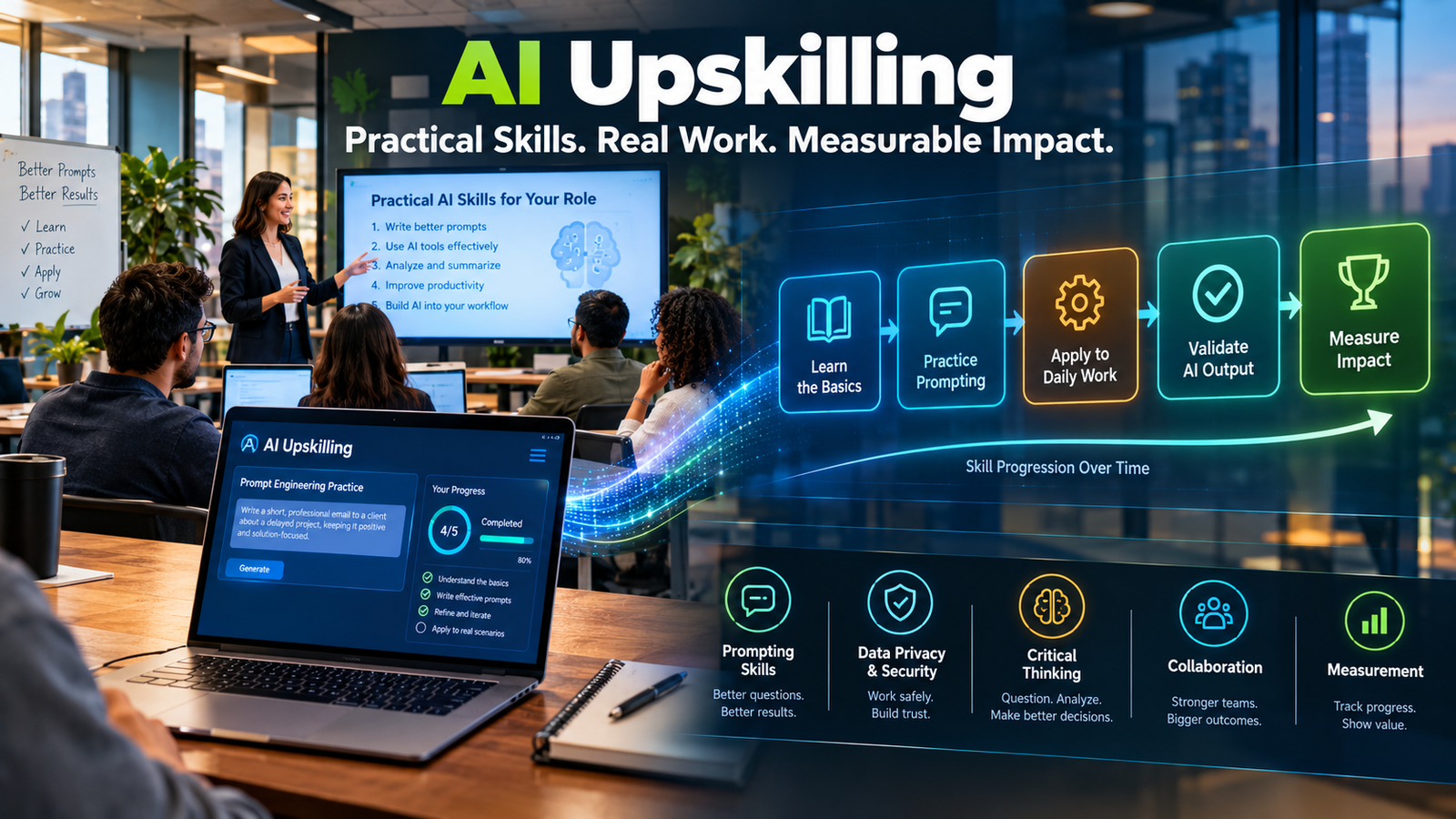
AI upskilling is the process of equipping employees with the skills to work alongside artificial intelligence tools, from basic prompting to workflow redesign. Evidence from government programs and enterprise surveys shows that effective training is practical, role-based, and embedded in daily work, not delivered through generic courses.
At a Glance
- The gap is real: 94% of executives report AI-critical skill shortages, with one in three facing gaps of 40% or more
- Training demand is surging: AI course enrollments grew 234% year over year, with GenAI content leading the market
- Most training fails on delivery: Employers cite lack of protected time, cost, and staff capacity as the top barriers, not awareness
- What works: Short, job-embedded modules tied to real tasks outperform generic AI literacy courses
- Government action: The UK aims to train 10 million workers by 2030, with over 1 million courses already completed
- The overlooked skill: Critical thinking enrollment grew 107%, reflecting demand for human judgment alongside AI fluency
What Is AI Upskilling?
AI upskilling means teaching people to use artificial intelligence tools effectively in their specific roles. It is not about turning everyone into a machine learning engineer. It is about helping a marketer use generative AI for campaign drafts, a finance analyst validate AI-generated forecasts, or a customer support agent supervise an AI agent.
The distinction matters because most organizations approach upskilling wrong. They buy enterprise licenses for ChatGPT or Copilot, send a generic training link, and assume adoption will follow. It rarely does.
A Skills England report published in June 2026 found that while 44% of UK workplaces use AI daily, adoption remains uneven and often limited in impact . The report’s conclusion was direct: successful adoption depends not just on technology, but on people having the right skills, confidence, and support.
The Skills Gap in Numbers
The data paints a stark picture of the mismatch between AI investment and workforce readiness.
Executive survey findings: In a global survey of 1,010 C-suite executives, 94% reported facing AI-critical skill shortages today, with one in three citing gaps of 40% or more . By 2028, 44% of leaders still expect gaps of 20 to 40% in critical roles.
Worker training deficit: Research from Ipsos and Google found that 70% of managers believe an AI-trained workforce is vital, but only 14% of workers have actually been offered AI training .
LinkedIn data: Job postings requiring AI literacy in the US grew 70% year over year. Meanwhile, 53% of American employees say they plan to learn new AI skills within six months, and AI course viewing time on LinkedIn increased 92% .
This is not a demand problem. Workers want training. Employers say they need it. The failure lies in delivery.
What Effective AI Upskilling Looks Like
The evidence on what works is surprisingly consistent across government research, enterprise surveys, and academic analysis.
The PRIMES Framework
Skills England developed the PRIMES framework based on insights from over 150 employers. It sets out six principles for effective AI training :
- Practical: Linked to real job tasks, not abstract concepts
- Reachable: Accessible in format, timing, and cost
- Integrated: Embedded into existing workflows and tools
- Modular: Broken into short, completable units
- Expandable: Designed to grow as AI capabilities evolve
- Sustainable: Supported by leadership and protected time
The framework’s emphasis on modularity and integration reflects a hard truth. Employees cannot leave their core work for week-long training programs. AI learning competes with daily tasks, especially in smaller firms and frontline roles .
What Employers Actually Request
When surveyed about what would increase participation, employers cited three factors above all others :
- Flexibility in format, timing, or delivery (50%)
- Cost (46%)
- Staff capacity (44%)
Awareness and perceived value ranked lower. The barrier is not skepticism. It is time and money.
The Case for Role-Based Training
Generic “AI literacy” courses produce limited behavior change. Training tied to specific job functions produces more. A procurement specialist learning to use AI for supplier contract analysis will adopt faster than the same person sitting through a general prompting tutorial.
This aligns with findings from the World Economic Forum’s workforce research. The new demand is concentrated in roles like AI governance, prompt engineering, agentic workflow design, and human-AI collaboration specialists . These are not entry-level skills. They require context.
Common Mistakes in AI Upskilling Programs
Most failed upskilling initiatives share recognizable patterns.
Treating Training as an Event, Not a Journey
One workshop does not create capability. The Skills England report emphasizes that upskilling is a journey, not a one-off intervention, because AI tools and workplace uses continue to change . Programs that allocate a fixed budget for a single training session and move on will see minimal return.
Ignoring the Human Skills Layer
Coursera’s Global Skills Report 2026 found that critical thinking enrollment grew 107% year over year . This is not a coincidence. As AI generates more content and makes more recommendations, humans need the judgment to evaluate outputs, catch errors, and decide when not to trust the machine.
The report explicitly notes: “Recognizing that AI output is not as trustworthy as it sounds, and knowing how to check it, is now a core skill for anyone who relies on these tools” .
Overlooking Middle Management
Executives support AI training. Frontline workers want it. Middle managers often block it, sometimes unintentionally. When a team lead is measured on output volume, releasing staff for training feels like a cost. Without leadership alignment and clear rules around AI use, training participation suffers .
Assuming Technical Staff Don’t Need It
AI upskilling is not only for non-technical employees. Developers need training on new frameworks, security practices for LLM integration, and responsible AI patterns. The content differs, but the principle is the same: skills must evolve with the tools.
Who Needs AI Upskilling Most?
The answer is broader than most organizations assume.
Priority groups include:
- Knowledge workers whose roles involve writing, analysis, or communication, where generative AI tools offer immediate productivity gains
- Customer-facing teams who will supervise or collaborate with AI agents
- Managers and team leads who need to model effective AI use and create psychological safety for experimentation
- Compliance and risk staff who must understand AI outputs well enough to govern them
- HR and L&D professionals responsible for designing and delivering training programs
The World Economic Forum’s research adds a critical insight: the workforce challenge is dual. Companies face overcapacity in legacy roles due to automation while simultaneously struggling to fill AI-critical positions . Upskilling serves both problems. It helps displaced workers transition into new roles and fills gaps that external hiring cannot close fast enough.
The Market Response: Training Providers and Platforms
The AI courses market reflects surging demand. Valued at $7.35 billion in 2025, it is projected to reach $16.57 billion by 2031 . Generative AI and LLM content led revenue share at 26.91% in 2025, while agentic AI training is growing fastest.
Notable provider movements:
- Coursera merged with Udemy in a $2.5 billion deal completed in 2026, creating a platform with 290 million learners and 18,000 enterprise clients
- Multiverse raised $70 million at a $2.1 billion valuation to expand AI workforce training in Europe
- Pluralsight launched AI Academy and AI Sandbox for structured enterprise learning
Government programs are also scaling. The UK’s AI Skills Boost aims to train 10 million workers by 2030, with over 1 million course completions recorded by January 2026 . Google launched an AI Professional Certificate with hands-on training in Gemini tools, available in markets including Pakistan .
| Provider | Target User | Key Strength | Pricing Transparency | Core Limitation |
|---|---|---|---|---|
| Coursera | Broad workforce | University and corporate certificates | Moderate (subscription plus per-course) | Generic content, limited role specificity |
| DataCamp | Data and technical staff | Hands-on coding exercises | High ($35/month) | Narrow subject focus |
| Google AI Certificate | General professionals | Practical, tool-based, short duration | High (free via some programs) | Google ecosystem dependency |
| NVIDIA DLI | Technical AI developers | GPU labs, deep learning depth | Moderate | Expensive, technical prerequisite |
| Skills England (PRIMES) | UK employers | Government-backed framework | N/A (framework, not courses) | UK-specific |
Technical Considerations for Enterprise Programs
Organizations designing AI upskilling at scale face decisions that generic courses do not address.
Data Privacy and Tool Selection
Training employees on AI tools means exposing them to data handling practices. Before rolling out generative AI training, organizations should clarify which tools are approved, what data can be entered, and how vendor retention policies work. Zero Data Retention agreements and SOC 2 certification are relevant procurement criteria, though neither guarantees complete privacy.
API Dependency and Vendor Lock-In
If training focuses on a single vendor’s ecosystem, such as Google Gemini or Microsoft Copilot, employees develop skills tied to that platform. This creates efficiency in the short term and lock-in in the long term. Balanced programs teach transferable concepts: how to structure prompts, evaluate outputs, and integrate AI into workflows, regardless of the underlying model.
Context Window and Output Limitations
Effective training includes realistic expectations. LLMs have context window limits, can hallucinate confidently, and degrade in quality with certain task types. Employees who understand these limitations are less likely to over-rely on AI and more likely to verify outputs. This is not a technical detail. It is a core competency.
Real-World Example: What Scaled Upskilling Looks Like
FPT Software, a global technology services firm, embedded continuous learning into career progression. The company aligned AI training with business priorities and employee growth goals. The result: over 108,000 learning hours and 22,500 course completions, according to Coursera’s report .
The key design choices were integration and recognition. Training was not a separate activity. It was part of how employees advanced. Completion was visible and valued.
BMW offers another example. Its AIconic system, launched in late 2024, uses multi-agent AI in procurement. Today it supports 1,800 active users and has handled over 10,000 searches . The system required not just deployment but training: teaching procurement staff to work alongside agents, interpret outputs, and know when to intervene. The technology was necessary but not sufficient.
Frequently Asked Questions
What is AI upskilling?
AI upskilling is the process of training employees to use artificial intelligence tools effectively in their roles. It covers a range of skills, from basic prompting and output validation to workflow redesign and AI governance.
Why do most AI training programs fail?
Most programs fail because they are generic, poorly timed, and disconnected from daily work. Employers cite lack of protected time, cost, and staff capacity as the top barriers to participation, not lack of interest .
How long does effective AI upskilling take?
There is no single timeline. Evidence suggests short, modular sessions tied to specific tasks produce better results than long courses. The UK’s Google AI certificate, for example, can be completed in under 10 hours and focuses on practical tool use . Ongoing reinforcement matters more than initial duration.
What skills should AI upskilling prioritize?
Prioritize the skills employees need for their specific roles, plus critical thinking and output validation. Coursera’s 2026 report found critical thinking enrollment grew 107%, reflecting demand for human judgment alongside AI fluency .
Is AI upskilling only for technical employees?
No. While developers need technical training on model integration and security, non-technical employees need training on using AI tools in their workflows, evaluating outputs, and understanding limitations. The content differs, but the need is universal.
Conclusion
AI upskilling is not a training problem. It is a design problem. The demand exists. The tools exist. The market for courses is growing rapidly. What fails is delivery.
Effective programs share common features. They are practical, tied to real tasks, delivered in short modules, and supported by leadership. They teach not just how to use AI, but when to trust it and when to override it. They treat upskilling as an ongoing practice, not a one-time event.
AI upskilling suits organizations that are willing to invest time and structure, not just licenses. It works best when managers create space for learning and when training connects directly to how people do their jobs.
It does not work when it is outsourced to a generic course catalog, when employees are expected to learn on their own time, or when leadership treats training as a checkbox.
Before selecting a program or building one internally, assess three things: what specific tasks your employees need to perform with AI, how much protected time you can realistically allocate, and how you will measure whether behavior actually changed. The answers will determine whether your investment produces capability or just completion certificates.

Alex Carter is a technology writer at AI SpaceZ.com, who covers AI tools, software reviews, practical tutorials and emerging artificial intelligence trends. He aims to make AI easier to understand and help readers discover useful tools and technologies for everyday productivity.