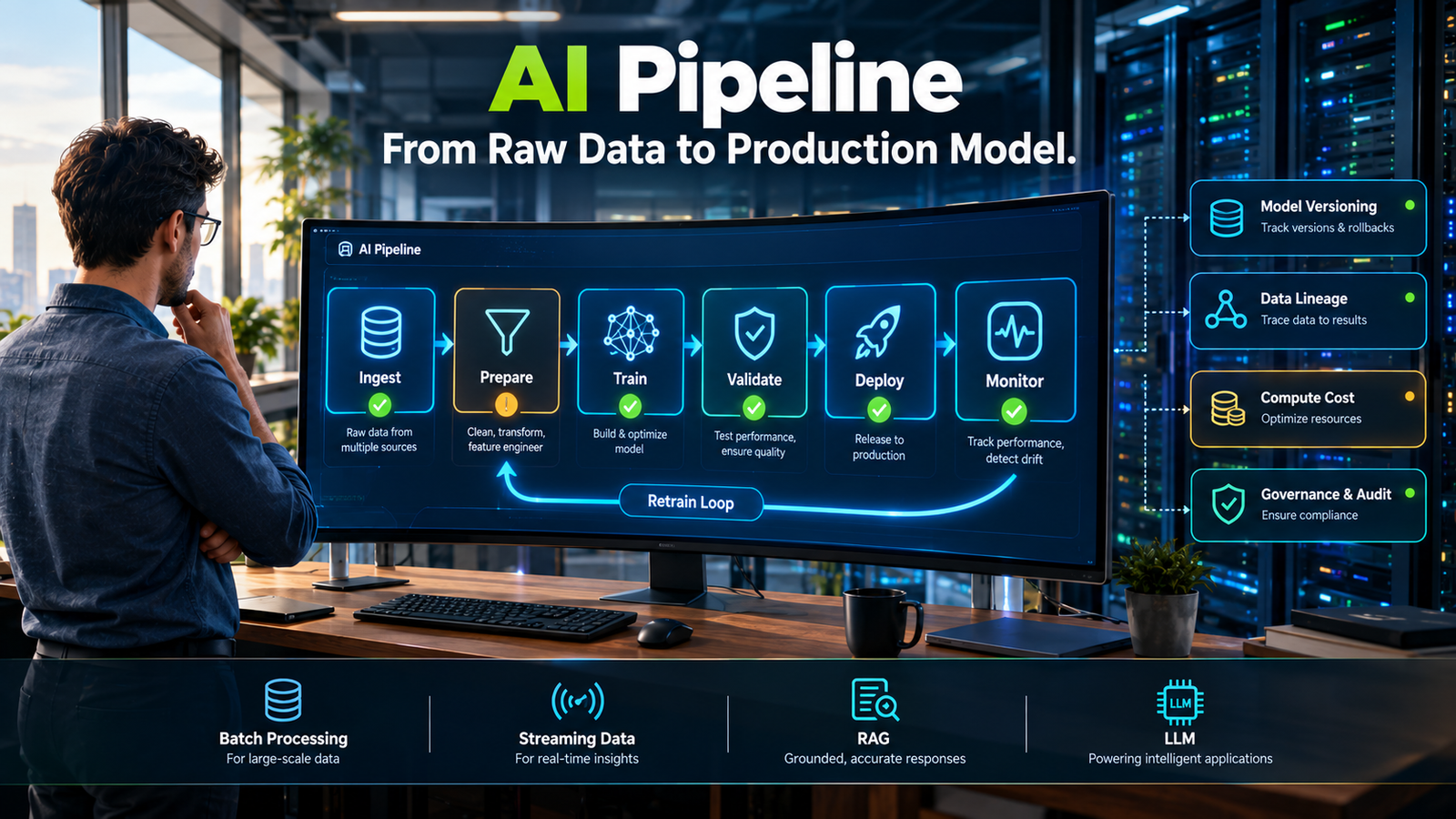
An AI pipeline is an automated, end-to-end workflow that manages the full lifecycle of an AI model, from data ingestion through training, deployment, and monitoring. It replaces manual, error-prone handoffs with a repeatable system that produces reliable models and keeps them accurate in production.
At a Glance
- Core definition: A repeatable workflow connecting data preparation, model training, evaluation, deployment, and monitoring
- Key distinction: An AI pipeline is broader than a data pipeline or ML pipeline; it is the superset that includes both
- Dominant architecture: Most production systems use hybrid batch and streaming patterns rather than one pure approach
- Biggest failure point: Governance, lineage, and data quality, not model selection
- Common cost trap: Retraining cadence is the largest cost lever most teams control, yet many treat it as an afterthought
- Who owns it: ML engineers, data engineers, and platform teams working together, not data scientists alone
What Is an AI Pipeline?
An AI pipeline is the assembly line for artificial intelligence. Raw data enters one end. A trained, validated, deployed model comes out the other. Every step in between is automated, versioned, and monitored.
The term overlaps with related concepts, which causes confusion. A data pipeline moves and transforms data without necessarily involving a model. An ML pipeline focuses on the machine learning lifecycle: feature engineering, training, and deployment. An AI pipeline is the broader category that includes the data pipeline, the model layer, and increasingly the inference and agent layers that consume model outputs .
The distinction matters for planning. Teams that treat an AI pipeline as just a training script miss the operational pieces that determine whether the system survives contact with production.
The Core Stages of an AI Pipeline
Most production pipelines follow a consistent lifecycle. The specifics vary by workload, but the stages are predictable.
Data Ingestion and Preparation
Raw data arrives from databases, APIs, streaming platforms, and files. This stage consolidates it, cleans it, handles missing values, and engineers features that give the model predictive signal .
Data quality checks belong inside the pipeline, not after it. For AI workloads, quality extends beyond completeness and accuracy. It includes bias checks, representativeness, and recency, meaning the data reflects the world the model will operate in .
Data Storage and Dataset Management
Processed data lands in object storage, a data warehouse, a lakehouse, or a feature store. The feature store matters for consistency: the same features must be available during training and inference .
Dataset versioning is non-negotiable for reproducibility. Without it, you cannot answer the question “which data produced this model?” when something breaks six months later.
Model Training and Validation
The model learns from prepared data. This stage includes algorithm selection, hyperparameter tuning, and validation against held-out data to confirm the model generalizes rather than memorizes.
Training introduces non-determinism that ordinary data pipelines do not face. Model lineage must tie a specific model version to the specific data version and pipeline run that produced it .
Model Deployment and Inference
A validated model moves to production. Deployment can take several forms: a real-time API, batch scoring on new data, or edge deployment. The choice depends on latency requirements and infrastructure constraints.
Generative AI workloads add complexity here. Serving may mix CPU inference, GPU inference, and retrieval-augmented generation calls to external foundation models .
Monitoring and Feedback
Deployed models degrade. Data distributions shift. User behavior changes. Monitoring tracks performance and data drift, then triggers retraining or corrective updates when thresholds are crossed .
This feedback loop is what separates a production pipeline from a demonstration. A model without monitoring is a model waiting to fail silently.
Batch, Streaming, and Hybrid Architectures
There is no single correct pipeline architecture. The right design depends on the workload.
Batch pipelines move large data volumes on a schedule. They suit model training, where consistency matters more than freshness .
Streaming pipelines move data continuously. They suit inference features, where a live application needs the latest signal available .
Hybrid pipelines combine both, often using a streaming path for real-time requirements and a batch path for historical aggregations. Most enterprise AI systems land here, because neither pure batch nor pure streaming covers the full workload .
The trade-off is operational complexity. Hybrid pipelines are harder to build and monitor. Teams should adopt them when the workload genuinely requires both paths, not because hybrid sounds more sophisticated.
Key Architectural Components
A production pipeline rests on several supporting systems.
Orchestration layer. The control plane that schedules tasks, manages dependencies, handles errors, and ensures data flows between stages. Apache Airflow, Prefect, and cloud-native tools fill this role .
Model registry. A versioned catalog of trained models, parameters, and artifacts. MLflow and Weights & Biases are common choices .
Compute infrastructure. CPUs for data processing, GPUs or accelerators for training and heavy inference, often managed by Kubernetes .
Vector store. For generative AI workloads, embeddings are indexed for retrieval. This is the backbone of RAG pipelines .
Governance and lineage tools. These track which data was used, which transforms were applied, and who authorized access. In regulated industries, this is mandatory. Everywhere else, it is the difference between a trustworthy pipeline and one that cannot be audited .
Who Should Care About AI Pipelines?
ML engineers and data scientists build and maintain them. Understanding pipeline architecture prevents the “works on my laptop” problem from reaching production.
Data engineers supply the data layer. They need to know how AI pipelines differ from traditional analytics pipelines, especially around versioning and feature consistency.
Platform and DevOps teams run the infrastructure. GPU scheduling, cost control, and fault isolation fall to them.
Business and product leaders sponsor the work. They need to understand that model accuracy is a pipeline property, not a model property. A perfect model fed by a broken pipeline produces unreliable results.
Common Mistakes When Building AI Pipelines
Treating It as a One-Time Build
A pipeline is not a script you write once. It runs on schedules, responds to new data, and adapts as requirements change. Teams that build and walk away find themselves debugging broken workflows months later.
Skipping Model Lineage
When a model underperforms, the first question is “what changed?” Without lineage linking model versions to data versions to pipeline runs, that question has no answer. Reproducibility is what separates production systems from experiments .
Ignoring Cost Predictability
AI pipeline costs are harder to forecast than traditional pipeline costs. GPU usage varies. Inference volume spikes. External foundation model calls add variable expense. Retraining cadence is the single largest cost lever most teams control, yet many set it by habit rather than intention .
Over-Automating Without Human Oversight
Full automation sounds appealing until a pipeline silently passes low-quality data to a model that silently underperforms. Human-in-the-loop checkpoints at critical stages, such as data validation and model approval, catch problems that automated checks miss .
Neglecting Failure Isolation
In distributed AI systems, failures cascade. A degraded LLM endpoint, a slow vector database, and a stalled queue can look like separate minor issues while together signaling a developing outage. Circuit breakers, fallback mechanisms, and bulkhead patterns prevent one component failure from taking down the entire pipeline .
Real-World Examples
Enterprise Vision AI
ClearML describes deploying NVIDIA Cosmos and Nemotron models through orchestrated pipelines that handle ingestion, preprocessing, inference, and downstream reasoning. The pipeline manages GPU allocation across heterogeneous hardware and tracks artifacts for reproducibility .
Structured Development Workflows
The A.I.N. Pipeline, a local multi-agent orchestrator, runs planning stages before touching code. It coordinates Gemini, Codex, and Claude through deterministic stages, pausing for human approval before implementation begins . This is an AI pipeline applied to software development itself.
LLM Application Pipelines
Production LLM systems separate an offline knowledge path (parsing, chunking, embedding, indexing) from an online inference path (retrieval, reranking, prompt assembly, output validation). A control plane manages versions, evaluation sets, budgets, and rollback .
AI Pipeline vs. Related Concepts
The terms are not interchangeable. Precision matters when planning infrastructure and assigning ownership.
Frequently Asked Questions
What is an AI pipeline in simple terms?
An AI pipeline is an automated workflow that takes raw data, prepares it, trains a model, deploys that model, and monitors its performance. It replaces manual steps with a repeatable system.
What is the difference between an AI pipeline and an ML pipeline?
An ML pipeline focuses on the machine learning lifecycle, especially training and deployment. An AI pipeline is broader: it includes the data pipeline that feeds the ML pipeline plus the inference and monitoring layers that operate the model in production .
Do I need an AI pipeline for a simple project?
Not always. A one-off analysis or prototype may only need a script. Pipelines become necessary when you need reproducibility, scheduled retraining, or production reliability. If you cannot afford for the system to fail silently, you need pipeline discipline.
What is the biggest mistake teams make with AI pipelines?
Neglecting governance and lineage. Model accuracy gets the attention, but production failures often trace back to data quality issues, untracked changes, or the inability to reproduce a model that worked last month .
How much does an AI pipeline cost to build?
Costs vary widely based on infrastructure, tooling, and team size. The biggest variable is often compute, especially GPU usage for training and inference. Retraining cadence is the largest controllable cost lever, and it should be a deliberate design decision rather than an operational habit .
Conclusion
An AI pipeline is the infrastructure that turns a model from an experiment into a reliable system. It handles the unglamorous work: moving data, tracking versions, catching failures, and keeping models accurate as the world changes.
The technical choices matter. Batch versus streaming versus hybrid depends on the workload. Orchestration tools, model registries, and feature stores are not interchangeable. Governance and lineage are design properties, not add-ons.
But the bigger lesson is organizational. An AI pipeline forces teams to be explicit about data quality, retraining schedules, cost trade-offs, and failure handling. Those are not engineering details. They are the difference between an AI system that earns trust and one that quietly erodes it.
Before building or buying pipeline infrastructure, map your actual workflow. Identify where manual handoffs create risk. Decide how often you will retrain and who approves deployments. Then choose tools that fit that plan, not the other way around.