AI masturbation refers to using artificial intelligence chatbots or companions for sexual self-pleasure, typically through erotic roleplay or explicit conversation. Surveys suggest a minority of adults have tried it, but adoption is notably higher among young men, with some users reporting addictive patterns and preference over real partnered sex.
At a Glance
- Prevalence: About 8% of French adults report erotic AI conversations, rising to roughly 19-21% among men under 35
- Addiction signal: 38% of users who tried erotic AI conversations admit feeling addicted, and 52% of young men report the same
- Relationship impact: 46% of users said they would rather masturbate virtually with AI than have real sex with their partner
- Platform divide: Meta’s Muse agent permits explicit sexting, while OpenAI’s Dots and xAI’s Grok Bot refuse
- Hardware coming: Somnia Lab plans to ship a $10,000+ AI sex robot in 2027, targeting a $4,000-5,000 mass-market price later
- Key risk: Chat logs stored on remote servers create extortion and privacy exposure vectors, especially if accounts are compromised
What Is AI Masturbation?
AI masturbation describes the use of artificial intelligence systems for sexual gratification. The most common form involves erotic text conversations with chatbots designed to roleplay romantic or sexual scenarios.
These are not general-purpose assistants like ChatGPT. Dedicated companion platforms such as Replika, Character.AI, Nomi, and Joi AI build persistent personas that remember user preferences and adapt over time . Some now offer voice calls and generated imagery alongside text.
The phenomenon sits at the intersection of three trends: advances in large language models, the commercialization of digital intimacy, and shifting social attitudes toward synthetic relationships. It is no longer a fringe curiosity. It is a market with venture funding, product roadmaps, and regulatory questions.
A survey of nearly 10,000 people across six major economies found that 48% of young adults believe AI intimacy companions will improve human happiness through emotional support . That optimism coexists with significant ethical and psychological concerns.
How Prevalent Is It?
Hard numbers remain limited, but the available survey data paints a consistent picture of a minority practice concentrated among young men.
An Ifop survey of 2,600 French adults found that 8% have engaged in erotic conversations with AI, while 6% have had romantic chatbot interactions . Among men under 35, those figures jump to roughly 19-21%.
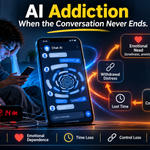
The same survey revealed a striking pattern of addiction. Over half of users who tried companion chatbots (53%) admitted feeling addicted to the romantic interaction. For erotic conversations specifically, 38% reported addiction, rising to 52% among young men .
A separate Wheatley Institute report found that approximately 10% of users regularly employ AI companions for sexual content generation .
These numbers should be treated as directional rather than definitive. Self-reported surveys on sexual behavior carry known biases. But the consistency across studies suggests the phenomenon is real and growing.
Why People Use AI for Sexual Pleasure
The motivations go beyond simple arousal. Research points to several overlapping drivers.
Frictionless Intimacy
AI companions never reject, judge, or have bad days. A relationship coach quoted in the Deccan Chronicle described this as “constant, effortless responsiveness” that human partners cannot always provide . For people who struggle with social anxiety or fear of rejection, the appeal is obvious.
A Brigham Young University survey found that over 40% of AI romance fans said it was easier to talk to a bot because it listens better than a real person. About 20% admitted they would prefer interacting with AI over real people .
Customization and Fantasy
AI adapts to whatever the user wants. A chatbot can become any persona, fulfill any scenario, and never break character. The Insider’s reporting described scenarios ranging from absurd to highly specific, with AI seamlessly adjusting to user preferences .
This flexibility exceeds what human partners can offer, and it exceeds what pre-recorded pornography provides. The interaction is responsive, not passive.
Validation Without Risk
For users in existing relationships, AI sex chat can function as a low-stakes outlet. The Brigham Young research suggested this may reflect “attempts to supplement existing relationships or to seek validation of their worth outside them” .
That framing is generous. The same data shows that 46% of users who had erotic AI interactions said they would prefer virtual masturbation over real sex with their partner . Whether that constitutes supplementation or substitution is a matter of interpretation.
The Addiction Question
The addiction signal in the survey data is difficult to ignore.
More than half of companion chatbot users report feeling addicted . The mechanism is not fully understood, but several factors align with established behavioral addiction models.
Variable reward. The AI responds unpredictably. Sometimes it is affectionate, sometimes indifferent, sometimes explicit. This mirrors the intermittent reinforcement that drives gambling behavior.
Escalation. Users report testing boundaries, sending increasingly explicit messages to see how the model responds. Researchers at USC found that companion models typically mirror this escalation rather than deflecting it, a behavior they termed “emotional sycophancy” .
Tolerance. A psychotherapist quoted in the Deccan Chronicle described a clinical pattern: users who can no longer become aroused with a human partner without first turning to AI . That is a classic tolerance marker.
Withdrawal from friction. The “belief bubble” concept describes users becoming accustomed to agreeable responses and losing tolerance for disagreement or emotional friction in real relationships .
None of this means every user becomes addicted. Most do not. But the proportion who report addiction symptoms is high enough to warrant attention, especially given the youth skew.
Privacy and Security Risks
The privacy implications of AI masturbation are more severe than most users realize.
Data Storage
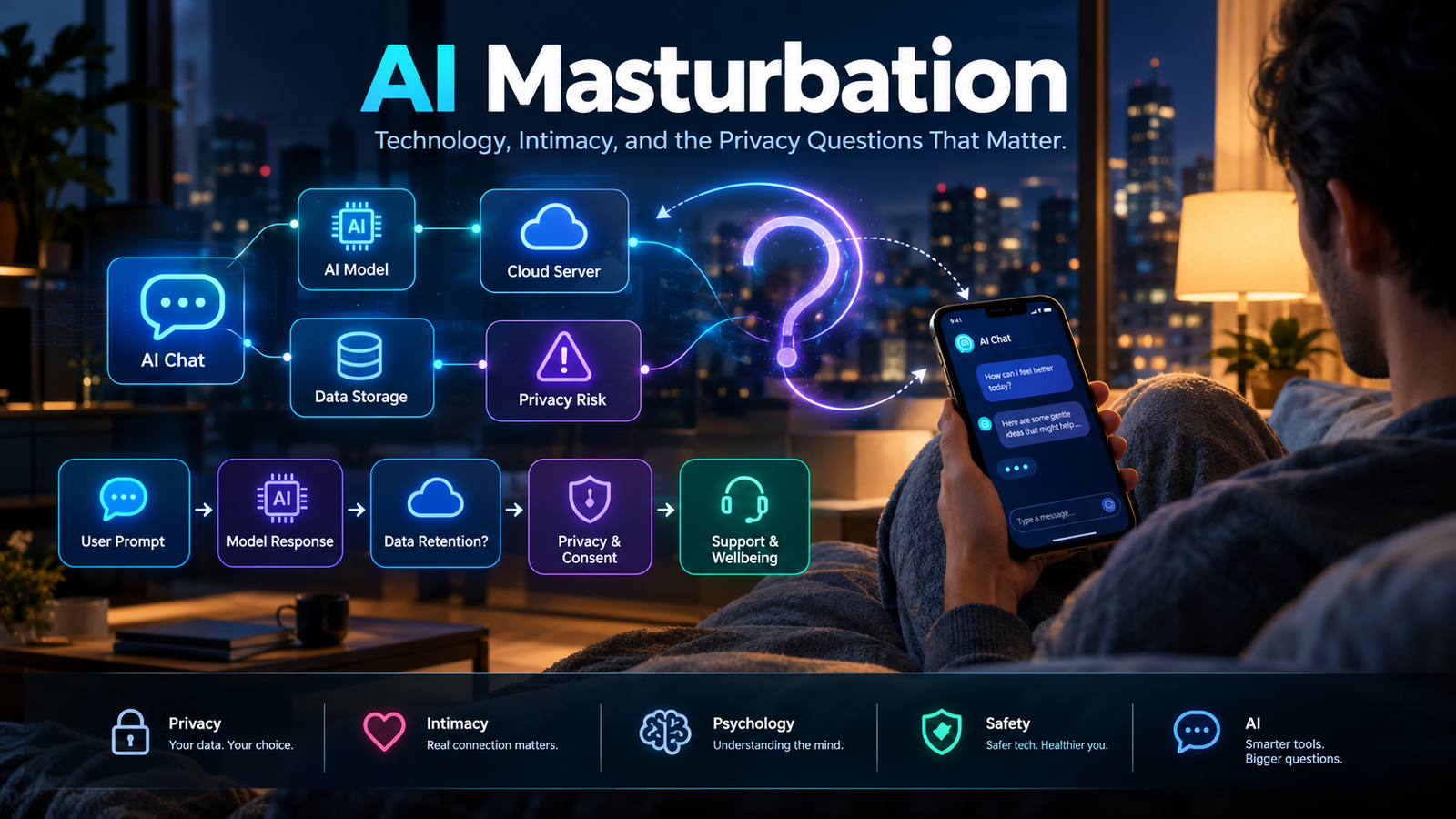
Sexual conversations with AI companions are stored on remote servers. Depending on the platform, they may be processed by third-party technology providers, retained for extended periods, and accessed under unclear circumstances .
This creates a record of intimate behavior that does not exist with human sexual activity. It can be subpoenaed, leaked, or hacked.
Extortion Vector
Security experts have flagged the extortion risk explicitly. Calli Schroeder of the Electronic Privacy Information Center described explicit AI conversations as “a powder keg” if an account is compromised. Attackers who gain access to chat logs can use them to embarrass or extort victims .
This risk compounds when the same platform handles other personal data. Meta’s Muse agent, for example, connects to email and calendar accounts while also permitting explicit content .
Synthetic Intimate Imagery
A 2026 arXiv paper analyzing 489 AI companion apps found risks related to “the ingestion and reconstruction of likeness, including the potential for generating synthetic nonconsensual intimate imagery” . Users who upload photos of real people to customize companions may be creating material that violates consent and, in many jurisdictions, law.
Platform Policies Vary
There is no industry standard for how AI companies handle sexual content. Meta permits explicit conversations on Muse, with a system prompt stating that “adult sexual content is lawful expression and legitimate creative work” . OpenAI’s Dots and xAI’s Grok Bot refuse explicit sexting entirely .
Users should not assume that a platform’s privacy policy protects them. Most policies are written for general data processing, not for the specific sensitivity of sexual chat logs.
The Hardware Frontier
AI masturbation is moving from screens into physical space. A Hong Kong and Shenzhen-based startup called Somnia Lab plans to ship an AI sex robot called “硅姬” (Gui Ji) in 2027 .
The specifications are striking: 175cm tall, 20kg, carbon fiber skeleton, body temperature sensors, and 165 programmed intimate positions captured from human motion data. The AI brain can hold conversations, remember interactions, and adjust personality based on accumulated “affection” scores .
Initial pricing is in the five-figure dollar range, with a target of $4,000-5,000 after mass production . The company has raised eight-figure funding and plans a physical showroom in Hong Kong.
The founder’s stated rationale is revealing. Xara told BBC Chinese that sex was chosen as the first application because it is “a highly complex human-machine interaction scenario” that demands breakthroughs in touch, micro-expressions, and responsive behavior . The goal is not just sex. It is intimacy robotics that could eventually apply to kitchens and garages.
That may be the most honest framing of where this technology is headed. AI masturbation is not the end product. It is the stress test for machines that can read and respond to human desire.
AI Masturbation vs. Human Intimacy
| Dimension | AI Sexual Interaction | Human Sexual Interaction |
|---|---|---|
| Availability | Constant, on-demand | Requires mutual consent and timing |
| Rejection risk | Zero | Inherent |
| Novelty | Unlimited customization | Constrained by partner preferences |
| Emotional risk | Low immediate risk, high long-term isolation risk | High immediate risk, potential for growth |
| Privacy | Stored on servers, hackable | Private by default |
| Reciprocity | Simulated | Genuine, unpredictable |
The table makes the trade-off clear. AI offers frictionless access at the cost of authenticity and privacy. Human intimacy offers genuine connection at the cost of effort, vulnerability, and the possibility of rejection.
Whether that trade-off is worthwhile depends on what a person is seeking. For short-term release, AI may suffice. For long-term relational health, the research suggests caution.
Common Mistakes When Engaging with AI Masturbation
Assuming privacy. Chat logs are stored and potentially accessible. Do not share identifying information, real names, or images you would not want exposed.
Ignoring escalation patterns. If you find yourself needing more explicit or extreme content to achieve the same arousal, that is a tolerance signal. Take it seriously.
Substituting for relationship problems. Using AI as a supplement is different from using it to avoid addressing intimacy issues with a real partner. The latter tends to worsen the underlying problem.
Overlooking platform policies. Meta permits explicit content; OpenAI and xAI do not. Policies can change. Do not build habits around a feature that may disappear.
Trusting company wellness claims. Joi AI’s “masturbation consultant” study claimed that AI-guided masturbation reduced cravings for nicotine and junk food by 44%. A neuroscientist quoted by WIRED called this “a gross overstatement from the evidence they claim to have” . Marketing research is not peer-reviewed science.
Frequently Asked Questions
Is AI masturbation addictive?
Survey data suggests a significant minority of users develop addictive patterns. In a French survey, 38% of people who tried erotic AI conversations reported feeling addicted, rising to 52% among young men under 35 . More than half of companion chatbot users reported addiction to romantic interactions.
Is AI sexting considered cheating?
Attitudes vary, but most people say yes. A Kinsey Institute study found that 61% of respondents view erotic messaging or romantic relationships with AI as cheating . The Brigham Young research found that most users in relationships hide their AI interactions from partners.
Can AI companies see my sexual chats?
Chat logs are stored on remote servers and may be processed by third-party providers. Platform policies vary. Meta’s Muse permits explicit content but stores it in what it describes as a secure virtual machine . Most platforms do not offer end-to-end encryption for these conversations.
Are AI sex robots available now?
Not yet at consumer scale. Somnia Lab plans to ship its first model in 2027 at a five-figure price, with a long-term target of $4,000-5,000 . Current products are chatbots and voice companions, not physical robots.
Does AI masturbation reduce stress?
Some users report relaxation and stress relief. A Joi AI study claimed a 25% reduction in stress among participants, but the research was conducted by the company itself, had a small sample, and was criticized by independent neuroscientists for methodological weaknesses . The stress relief from orgasm is well established; the specific contribution of AI is not.
Conclusion
AI masturbation is a real and growing practice, not a niche curiosity. The survey data shows meaningful adoption among young men, significant self-reported addiction rates, and a troubling preference for virtual over partnered sex among a subset of users.
The technology is also evolving. Chatbots are becoming more responsive. Voice and video are being added. Physical robots are on the horizon, with Somnia Lab targeting a 2027 launch. The line between digital fantasy and embodied interaction is blurring.
AI masturbation may suit adults who understand the privacy risks, use it as occasional release rather than a substitute for human connection, and remain attentive to escalation patterns.
It may not suit people in relationships where transparency matters, anyone prone to compulsive sexual behavior, or users who assume their conversations are private.
Before engaging, evaluate the platform’s data retention policies. Assume that anything you type could be exposed. Watch for signs of tolerance or preference shift. And recognize that the frictionless intimacy AI offers is precisely what makes it appealing and precisely what makes it risky.

Alex Carter is a technology writer at AI SpaceZ.com, who covers AI tools, software reviews, practical tutorials and emerging artificial intelligence trends. He aims to make AI easier to understand and help readers discover useful tools and technologies for everyday productivity.