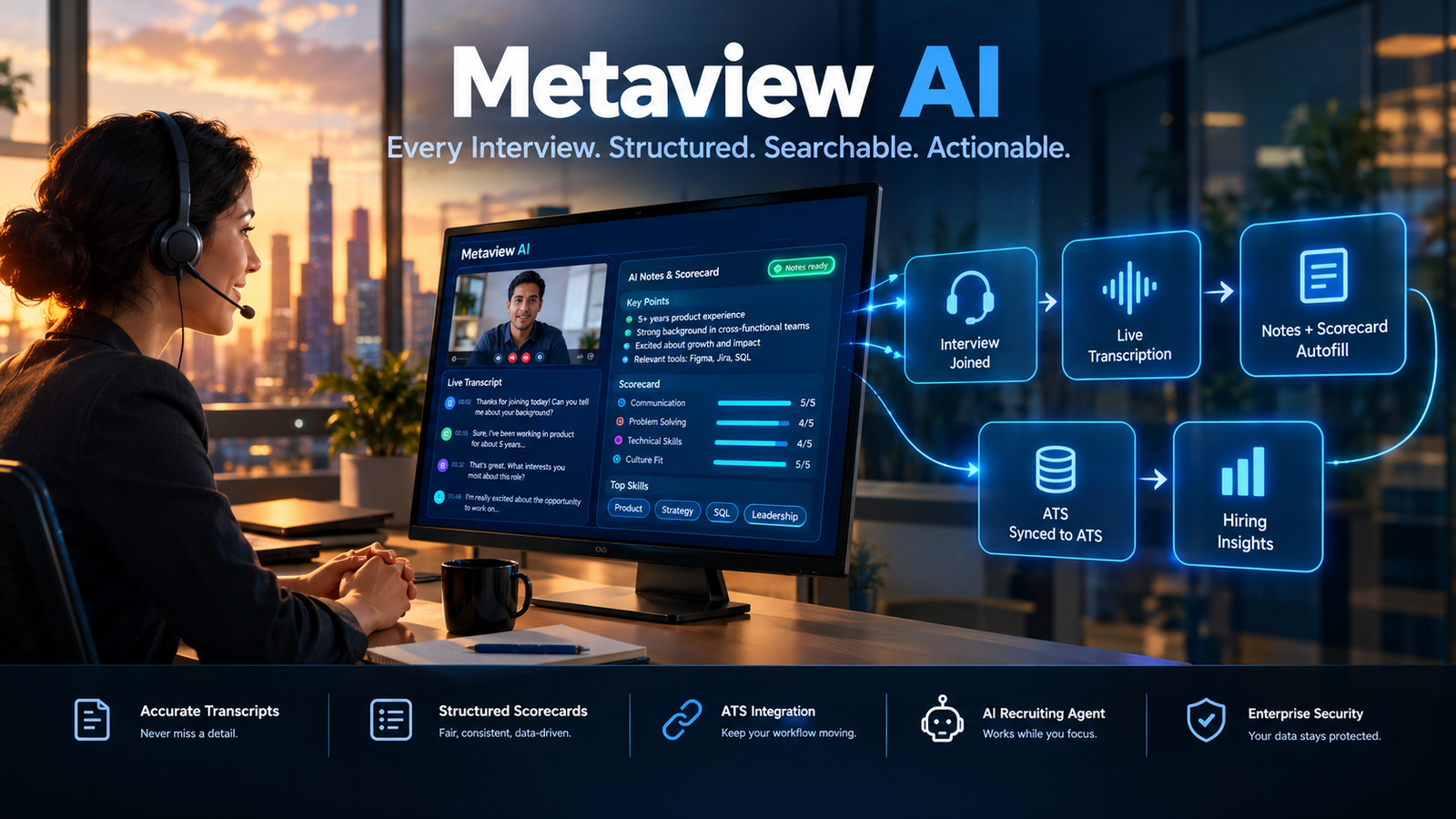
Metaview AI is a recruiting platform that began as an AI interview notetaker and has expanded into an agentic hiring suite for sourcing, application review, and screening. It serves over 7,000 companies, publishes per-user pricing for its core notetaker, and holds SOC 2 Type II certification.
At a Glance
- Origin: Founded in 2018 by former Uber and Palantir engineers, initially focused on interview capture
- Core product: AI notetaker that joins interviews, transcribes, and produces structured notes with scorecard autofill
- Expansion: Agentic recruiting platform with sourcing, application review, and screening agents, including the fillmore coworker
- Pricing transparency: Strong for notetaker tiers; weaker for the full agent suite, which requires custom quotes
- Security: SOC 2 Type II certified, GDPR and CCPA compliant, with regular external penetration testing
- Best fit: Talent acquisition teams drowning in interview admin and feedback inconsistency, not teams primarily seeking sourcing depth
What Is Metaview AI?
Metaview AI is not a general meeting assistant. It is a recruiting-specific intelligence layer built around the hiring conversation.
The company started by solving a narrow problem: interviewers forget what candidates said, write thin feedback, and disagree on what they observed. Metaview joins the call, captures the conversation, and produces structured notes mapped to the team’s scorecard or interview guide .
That original product earned Metaview its reputation. The company says it has processed more than 6 million interviews . In 2026, it raised a $60 million Series C led by Insight Partners and began positioning itself as an “agentic recruiting platform,” with AI agents that source candidates, review applications, and run screening conversations .
The tension in evaluating Metaview today is that its two identities do not carry equal weight. The notetaker is mature, widely adopted, and transparently priced. The agent suite is newer, strategically important to the company, and sold through custom enterprise conversations.
How Metaview AI Works
The workflow depends on which product you are evaluating.
The Notetaker Workflow
Step 1: Connect your stack. Metaview integrates with calendar tools, video conferencing platforms, and over 100 ATS and HR systems, including Greenhouse, Workday, Lever, and Ashby .
Step 2: Join the interview. The Metaview bot joins scheduled calls automatically or is invited manually. It records, transcribes, and identifies speakers.
Step 3: Generate structured notes. After the call, Metaview produces summaries mapped to your templates, scorecards, or feedback forms. Note sections link back to the relevant transcript and recording .
Step 4: Review and sync. Recruiters or interviewers edit the notes for accuracy, then push the output to the ATS. The system supports scorecard autofill and one-click completion .
The Agent Workflow
For teams using the broader platform, agents handle sourcing, application review, and outreach. You brief the agent on a role, and it returns candidate profiles and drafts outreach . The fillmore agent goes further, managing follow-ups and booking screening calls .
A critical distinction: Metaview’s sourcing agent is autonomous, not interactive. You cannot sit inside the search query and adjust criteria mid-run. You brief it and wait for output . That suits teams that want to delegate the task. It frustrates recruiters who want hands-on control.
Key Features
Recruiting-Specific AI Notes
This remains Metaview’s strongest and most proven capability. The notetaker understands recruiting language and context. It identifies skills, experiences, and red flags mentioned in conversation, then organizes them into structured output .
A reviewer on G2, cited by TechReviewer, described recovering at least 20 percent of their working week through note automation . That claim aligns with the core value proposition: interviewers stay present instead of typing.
Scorecard Autofill and ATS Sync
Metaview does not just produce a generic summary. It maps notes to your evaluation framework and writes them into the candidate record. This closes a gap that plagues most hiring teams, where feedback sits in email threads or never gets written at all .
Agentic Sourcing and Application Review
The platform’s newer agents source candidates, review inbound applications against role criteria, and draft outreach. Metaview claims some customers have cut time-to-hire by more than 75 percent, though the company does not publish a methodology for that figure .
Reports and Analytics
Metaview offers a reporting layer that surfaces interview load, decision lag, and question coverage. It is sold as a flat-fee add-on rather than bundled into core notetaking tiers .
Free Tier for Evaluation
Every Metaview product carries a free tier, which is unusual in recruiting software. The notetaker free plan includes 25 calls per user per month, capped at 60 calls organization-wide, with 14-day access to older conversations . That is enough for a real trial, not just a demo.
Pricing: What You Actually Pay
Metaview’s pricing is unusually transparent for the notetaker, and unusually opaque for the agent suite.
The profile meter matters. Sourcing Pro’s 200 profiles per month is roughly one active search for many recruiters. Running two or three searches hits the cap quickly, pushing serious users toward Max at three times the price . There is no middle tier between 200 profiles and unlimited.
The notetaker is the affordable entry point. At $60 per user per month, Pro is competitive with dedicated notetakers. The full platform, which bundles sourcing, screening, and reporting, moves into enterprise sales territory.
Third-party estimates are unreliable for the full suite. One listing mentions a $49 per seat team plan, but that likely reflects a legacy or component price rather than the current platform . Buyers should request a scoped quote based on actual seat count and agent usage.
Privacy and Security
Metaview’s security disclosures are stronger than most recruiting AI vendors.
Verified certifications: Metaview is SOC 2 Type II certified and states it conducts regular external penetration testing . It complies with GDPR and CCPA .
Data handling: The company describes encrypted AWS infrastructure with configurable retention . Specific retention periods and data residency options are available in the DPA .
What to verify: SOC 2 covers the software platform. Interview recordings and transcripts contain sensitive personal data. Buyers should ask specifically about:
- Default retention periods for recordings and transcripts
- Whether data is used for model training
- Access controls for the human review layer, if using managed services
- Data residency options for European or other regulated jurisdictions
Metaview does not publicly claim Zero Data Retention for third-party LLM processing. That distinction matters for firms with strict data minimization requirements.
Who Should Use Metaview AI?
Metaview fits well for:
- Talent acquisition teams with high interview volume and inconsistent feedback
- Recruiters who spend hours writing up notes after screens and debriefs
- Organizations that want structured, searchable interview records tied to ATS data
- Teams evaluating agentic sourcing as a supplement to their existing process
Metaview may not fit for:
- Teams whose primary pain is sourcing depth, not interview admin
- Recruiters who need hands-on control over search queries
- Organizations requiring published pricing for the full agent suite
- Teams with heavy technical or coding interview needs, where accuracy reportedly drops
A SitePoint comparison captured the distinction well: Metaview is an “interview-intelligence product” that expanded into sourcing, not a sourcing engine that added interviews . Teams should buy it for the problem it solves best.
Metaview AI vs. Alternatives
| Platform | Target User | Key Strength | Pricing Transparency | Core Limitation |
|---|---|---|---|---|
| Metaview AI | Interview-heavy TA teams | Mature notetaker, scorecard autofill, growing agent suite | High for notetaker, low for agents | Sourcing agent lacks manual control |
| BrightHire | Distributed hiring visibility | Native Zoom capture, compliance posture | Low (demo-gated) | No public pricing, narrower capture methods |
| Juicebox | Sourcing-first teams | Hands-on search control | Moderate | No interview intelligence capability |
| Noon AI | Autonomous sourcing | Web-wide candidate search | Moderate | Younger interview layer |
BrightHire competes directly on interview intelligence. It offers native Zoom capture without a bot participant, which is a candidate-experience advantage. It also publishes a stronger compliance posture, including SOC 2 Type II, CCPA, and an annual bias audit . However, BrightHire does not publish pricing, while Metaview does.
Juicebox and Metaview are complementary rather than competitive. Juicebox handles sourcing with hands-on control; Metaview handles the interview and evaluation stage. Some teams run both .
Common Mistakes When Evaluating Metaview AI
Assuming the notetaker and agent suite cost the same. The $60 notetaker tier is affordable. The full agentic platform is an enterprise purchase. Clarify which products you are evaluating before comparing prices.
Expecting manual sourcing control. Metaview’s sourcing agent is autonomous. If your recruiters want to adjust queries mid-search, this is not the tool for that job .
Skipping the free tier. Metaview’s free notetaker plan includes real call volume. Run it against actual interviews before buying. Do not rely on a sales demo.
Ignoring the 14-day history limit on free plans. Free users lose access to calls older than 14 days . If your team reviews past interviews, this is a functional limitation, not just a pricing detail.
Overlooking technical interview accuracy. Multiple reviewers note that accuracy drops in coding or highly technical interviews . If your hiring is engineering-heavy, test this specifically.
Frequently Asked Questions
Is Metaview AI free?
Metaview AI offers a free notetaker tier with 25 calls per user per month, capped at 60 calls organization-wide, with 14-day access to older conversations. Paid notetaker plans start at $60 per user per month for unlimited calls. The full agentic recruiting platform requires a custom quote.
What is Metaview AI best used for?
Metaview AI is best for automating interview notes, scorecard autofill, and feedback consistency. Its newer agents handle sourcing and application review, but the notetaker remains its most mature and widely adopted product.
Does Metaview AI replace recruiters?
No. Metaview positions its agents as tools that handle repetitive work while humans set criteria and make final hiring decisions. The company explicitly states that people remain responsible for final calls .
Is Metaview AI secure?
Metaview is SOC 2 Type II certified and GDPR and CCPA compliant. It conducts regular external penetration testing and uses encrypted AWS infrastructure. Buyers should request specific retention and data residency details before signing.
How does Metaview AI compare to BrightHire?
Metaview publishes pricing and offers a free tier; BrightHire does not. Metaview has a broader agent suite; BrightHire offers native Zoom capture and a stronger published compliance posture. The choice depends on whether you value transparent evaluation or native capture experience.
Conclusion
Metaview AI is a recruiting platform in transition. Its notetaker is a proven, well-priced product that solves a real problem for interview-heavy teams. Its agent suite is a strategic bet on where recruiting is heading, backed by significant funding and a growing customer base.
The notetaker earns its place. Published pricing, a usable free tier, broad ATS integrations, and strong security certifications make it easy to evaluate. Teams that struggle with interview documentation and feedback consistency will find immediate value.
The agent suite requires more scrutiny. Sourcing is autonomous, not interactive. Pricing is custom. The platform is newer than the notetaker that built Metaview’s reputation. Buyers should test the specific agents they need against their actual workflow before committing to an enterprise contract.
Metaview suits talent acquisition teams that want to eliminate note-taking admin, standardize interview feedback, and experiment with agentic sourcing as a supplement to their process. It may not suit teams that need hands-on sourcing control, published pricing for the full platform, or guaranteed accuracy in highly technical interviews.
Before choosing Metaview, run a real trial on live interviews. Test note accuracy in your specific roles. Ask for a scoped quote that separates notetaker costs from agent costs. And clarify retention and data handling terms in writing. The notetaker is a low-risk starting point. The full platform is a larger commitment that deserves proportional diligence.