Artificial intelligence is changing how organizations create courses, deliver training, and measure learning progress. Traditional learning management systems provide the infrastructure, but AI introduces personalization, automation, and intelligent assistance.
An AI LMS takes this experience further by helping administrators build learning materials, supporting students with AI-powered assistance, and adapting educational experiences to individual needs.
What Is an AI LMS?
An AI LMS (Artificial Intelligence Learning Management System) is a digital learning platform that combines traditional learning management capabilities with artificial intelligence. It uses technologies such as machine learning, natural language processing, predictive analytics, and generative AI to improve course creation, learner engagement, and educational administration.
A traditional LMS primarily manages courses, enrollments, assessments, and completion records. An AI-powered LMS can also generate learning materials, recommend relevant courses, answer questions, and identify potential learning difficulties.
For example, imagine a company onboarding 200 employees. A conventional LMS might assign everyone the same training program. An AI LMS could recommend different learning paths based on job responsibilities, previous experience, assessment results, and individual progress.
The goal is not simply to automate education. It is to make learning more relevant, accessible, measurable, and responsive.
How Does an AI LMS Work?
An AI learning management system combines several technologies to understand learning requirements and improve educational workflows.
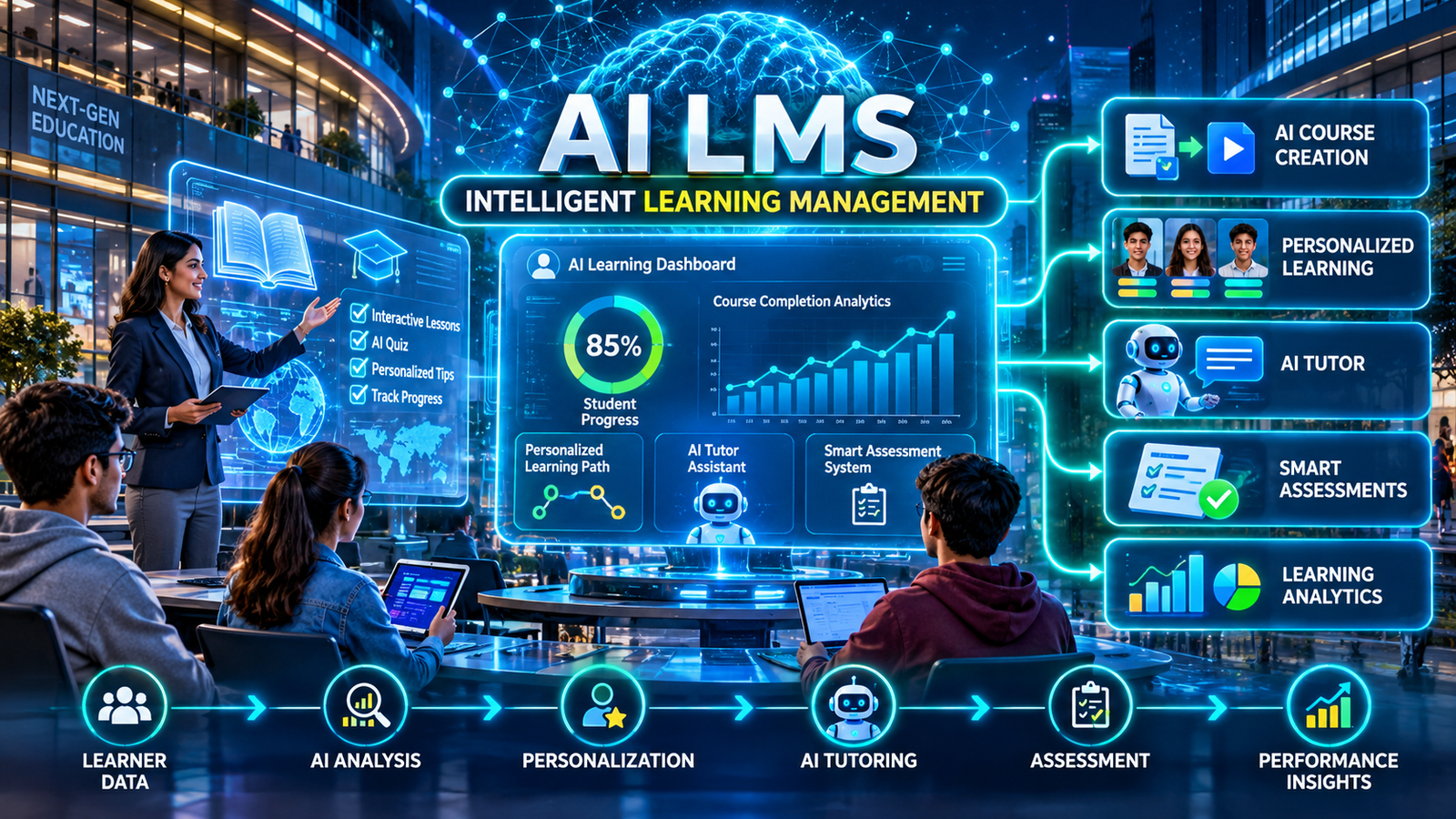
Most platforms follow a process involving data collection, AI analysis, personalized recommendations, and continuous evaluation.
1. Learner Data Collection
The platform collects relevant information about learners, including:
- Course enrollment and completion history.
- Assessment scores and quiz results.
- Learning preferences and activity.
- Subject knowledge and skill levels.
- Course engagement and participation.
This information helps the system understand how individuals interact with educational content.
However, organizations should collect only the information necessary for their learning objectives.
2. AI-Powered Analysis
Machine learning algorithms analyze learner activity to identify patterns.
For example, the system might detect that several employees struggle with a particular technical topic. It can highlight the knowledge gap and recommend additional learning materials.
Natural language processing also helps AI systems understand written questions and provide conversational responses.
3. Personalized Learning Recommendations
After analyzing available information, the platform can recommend courses, lessons, quizzes, or additional resources.
A beginner might receive introductory lessons, while an experienced learner could move directly to advanced material.
This creates a more flexible learning experience than assigning identical content to every participant.
4. Automated Content Creation
Generative AI can help instructors create course outlines, lesson summaries, quiz questions, explanations, and training materials.
Some platforms also support translation, content tagging, and AI-assisted course development.
However, generated educational content should always receive human review. AI can produce incorrect explanations, outdated information, or misleading assessment questions.
5. Continuous Performance Monitoring
The LMS tracks learning activity and provides reports for administrators and instructors.
Depending on the platform, AI-supported analytics can identify engagement patterns, highlight potential learning difficulties, and recommend interventions.
The quality of these recommendations depends on the available data, model design, and evaluation methods.
Key Features of an AI LMS
Not every platform offers the same AI capabilities. Some focus on course creation, while others emphasize adaptive learning, analytics, or conversational assistance.
The following features are particularly valuable when evaluating an AI-powered LMS.
AI-Powered Course Creation
Creating educational content manually can require substantial time and resources.
AI-assisted course authoring helps instructors turn existing documents, presentations, and training materials into structured learning experiences.
Common capabilities include:
- Automatic course outlines.
- AI-generated lesson drafts.
- Quiz and assessment generation.
- Learning objective suggestions.
- Content summaries.
- Translation assistance.
These features can accelerate development, but they do not eliminate the need for instructional design expertise.
Personalized Learning Paths
Personalized learning is one of the most important potential advantages of an AI LMS.
Instead of presenting identical courses to every learner, an intelligent system can recommend content based on previous performance, skill levels, and learning activity.
For example, a student struggling with mathematics might receive additional practice exercises before moving to more advanced lessons.
The important distinction is between genuine adaptive learning and basic role-based recommendations. A platform that assigns identical courses to everyone with the same job title is not necessarily delivering meaningful personalization.
Intelligent AI Tutors and Chatbots
Some AI LMS platforms include conversational assistants that answer questions about educational materials.
Learners can ask questions naturally rather than searching through multiple course pages.
A well-designed AI tutor can:
- Explain difficult concepts.
- Summarize lessons.
- Provide additional examples.
- Guide learners through exercises.
- Recommend relevant course materials.
For organizations using these systems, answers should ideally be grounded in approved educational resources.
Automated Assessments and Feedback
AI can help generate questions, evaluate certain types of responses, and provide preliminary feedback.
For example, an instructor might use AI to generate multiple-choice questions from an existing lesson.
More advanced systems may support rubric-based assessment assistance.
However, automated grading requires careful evaluation, particularly for subjective assignments, complex writing, and high-stakes examinations.
Human instructors should retain responsibility for important academic decisions.
Learning Analytics and Predictive Insights
AI-powered analytics can help organizations understand how learning programs perform.
Useful measurements include:
- Course completion rates.
- Assessment performance.
- Learner engagement.
- Knowledge gaps.
- Training participation.
- Learning progression.
Some systems also use predictive models to identify learners who may need additional support.
Predictions should be treated as indicators rather than definitive judgments about an individual’s ability or future performance.
Multilingual Learning Support
Translation and language assistance can make educational materials accessible to wider audiences.
This is especially useful for international companies, universities, and organizations with geographically distributed teams.
However, automated translation should be reviewed for technical accuracy, cultural context, and terminology.
AI LMS vs. Traditional LMS: What Is the Difference?
Both systems help organizations manage digital education, but their capabilities differ.
| Feature | Traditional LMS | AI LMS |
|---|---|---|
| Course management | Yes | Yes |
| Student enrollment | Yes | Yes |
| Progress tracking | Yes | Yes |
| Automated reports | Often | Often, with AI-assisted insights |
| Course creation | Usually manual or template-based | Can include generative AI |
| Personalized learning | Limited or rule-based | Can use learner data and AI |
| AI tutoring | Usually requires integration | May be built in |
| Intelligent recommendations | Basic or predefined | Can be behavior-based |
| Predictive analytics | Limited or separate tools | Available on some platforms |
| Automated content translation | Often requires additional tools | Available on some platforms |
The distinction is not always clear-cut.
Modern traditional LMS products increasingly include AI capabilities. Therefore, buyers should evaluate individual features rather than relying on product labels.
Benefits of Using an AI LMS
An AI-powered learning management system can improve several areas of education and workforce development.
1. Saves Time for Educators and Administrators
AI can reduce repetitive work associated with course creation, content organization, assessment preparation, and reporting.
This gives instructors more time to focus on teaching and learner support.
2. Improves Learning Personalization
Learners have different backgrounds, abilities, and educational goals.
AI-supported recommendations can help organizations deliver more relevant learning materials instead of relying exclusively on standardized training paths.
3. Supports Scalable Education
Managing 50 learners is different from managing 5,000.
AI-assisted administration can help organizations handle content preparation, recommendations, and learner support across larger populations.
The actual scalability depends on infrastructure, licensing, integrations, and administrative controls.
4. Identifies Knowledge Gaps
Learning analytics can reveal areas where learners consistently struggle.
Instructors can use these insights to improve lessons, provide additional resources, and redesign ineffective assessments.
5. Makes Learning More Accessible
Features such as translation, summaries, conversational assistance, and accessibility support can improve the learning experience for different audiences.
These capabilities are particularly valuable in multilingual and remote learning environments.
Limitations and Challenges of AI LMS Platforms
Despite their advantages, AI learning systems introduce important challenges.
Organizations should understand these limitations before adopting a platform.
AI-Generated Content Can Be Incorrect
Generative AI sometimes produces inaccurate explanations, fabricated references, or poorly structured educational materials.
This creates risks when learners depend on AI-generated information.
Human review remains essential, especially for healthcare, finance, engineering, and other specialized subjects.
Data Privacy and Security Concerns
AI LMS platforms may process sensitive information, including student records, employee training histories, assessment results, and personal details.
Before implementation, organizations should investigate:
- What information the platform collects.
- Whether data is used to train external AI models.
- How long information is retained.
- Whether administrators can delete learner data.
- Which third-party AI providers receive information.
- Whether the provider supports suitable contractual and regulatory requirements.
A security certification alone does not establish that a platform offers zero data retention.
Implementation Costs
Some AI LMS platforms require additional licensing, implementation services, integrations, or premium AI features.
The advertised subscription may not represent the complete cost.
Organizations should calculate the total cost of ownership, including setup, migration, content development, support, and AI usage.
Algorithmic Bias
AI recommendations and predictive analytics depend on training data and system design.
If the underlying data contains bias, the system may produce unfair recommendations or inaccurate risk assessments.
Regular monitoring and human oversight are necessary.
Dependence on Internet Connectivity
Cloud-based AI functionality generally requires reliable internet access.
API-dependent features may also become unavailable when external services experience outages or rate limits.
Organizations operating in regions with inconsistent connectivity should examine offline learning options carefully.
Best AI LMS Platforms to Consider in 2026
Several established learning management platforms now offer AI-assisted capabilities.
The following options serve different audiences. They should not be treated as interchangeable products.
| Platform | Target User | Main Strength | Pricing Transparency | Important Consideration |
|---|---|---|---|---|
| Docebo | Large businesses | Enterprise learning and AI-assisted workflows | Custom quote | Evaluate implementation and licensing costs |
| 360Learning | Corporate L&D teams | Collaborative learning and AI assistance | Published entry pricing | Check advanced feature packaging |
| Moodle | Universities and technical teams | Open-source flexibility and extensibility | Free self-hosted software; hosting may cost extra | AI capabilities depend on configuration and integrations |
| D2L Brightspace | Universities and large organizations | AI-supported educational workflows | Custom quote | Confirm which AI capabilities require add-ons |
| TalentLMS | Small and medium businesses | Accessible employee training administration | Public pricing | Verify the availability and limits of AI authoring features |
Docebo
Docebo is an enterprise learning platform designed for employee, customer, and partner education.
Its AI-related capabilities include learning assistance, content creation, automated tagging, and roleplay-based learning experiences.
It is worth evaluating for organizations that need structured training across multiple audiences.
However, enterprise buyers should request a detailed proposal covering implementation, integrations, licensing, and AI feature availability.
360Learning
360Learning focuses on collaborative learning and knowledge sharing.
Its platform supports collaborative course creation and AI-assisted learning workflows.
This approach can be useful for organizations that rely on internal experts to create and maintain training materials.
Its published Team pricing provides a starting reference, but buyers should verify the current plan limits and feature packaging.
Moodle
Moodle is an open-source learning management system widely used in educational environments.
Its flexibility makes it attractive to universities, schools, and organizations that want greater control over their learning infrastructure.
Moodle’s AI subsystem supports connections to different AI providers, depending on the installed version and configuration.
Organizations can explore integrations with external AI services and locally hosted models.
However, meaningful AI implementation may require technical expertise, plugin management, hosting resources, and ongoing maintenance.
D2L Brightspace
D2L Brightspace serves higher education institutions, schools, and corporate training programs.
Its D2L Lumi offering provides AI-related capabilities for educational content creation and learning workflows.
Depending on the product configuration, capabilities include quiz generation, content assistance, and learning analytics.
Institutions should confirm which features are included in their licensing agreement.
TalentLMS
TalentLMS is designed for organizations that need a straightforward way to manage employee and customer training.
Its ecosystem includes AI-assisted course authoring through TalentCraft.
It can be worth considering for smaller training teams that want to reduce manual content development.
Before purchasing, compare its AI authoring capabilities, usage allowances, learner limits, and reporting options.
Important: AI features, licensing, and product packaging change frequently. Request a current demonstration and written pricing breakdown before making a purchasing decision.
How to Choose the Right AI LMS
Selecting an AI LMS requires more than comparing marketing pages.
The right platform should match your learning objectives, technical environment, budget, and administrative requirements.
Identify Your Primary Learning Requirements
Start by defining what you want the system to accomplish.
For example:
- Universities may prioritize student engagement, assessments, and academic integrations.
- Businesses may prioritize employee onboarding, compliance, and professional development.
- Training providers may need course authoring, learner management, and certification.
- Customer education teams may prioritize product tutorials and personalized learning resources.
Your primary use case should determine the platform shortlist.
Evaluate Actual AI Capabilities
Ask vendors to demonstrate their AI features using your own educational materials.
Check whether the platform genuinely supports:
- Personalized learning recommendations.
- AI-assisted course authoring.
- Conversational learner support.
- Automated assessment assistance.
- Learning analytics.
- Multilingual content support.
Do not assume that a chatbot automatically makes a platform an advanced AI LMS.
Check Integrations and Compatibility
Your LMS may need to connect with existing business or educational software.
Important integration requirements include:
- Single sign-on (SSO).
- Human resource management systems.
- Student information systems.
- Video conferencing software.
- Content authoring tools.
- CRM platforms.
- Learning content standards such as SCORM and xAPI.
Also examine API documentation, integration costs, and data synchronization requirements.
Review Privacy and Administrative Controls
Ask how learner information is stored, processed, and shared.
Check access controls, data retention, encryption, audit logs, and AI provider arrangements.
For regulated organizations, legal and security teams should review the vendor’s contractual commitments.
Calculate the Complete Cost
Compare more than the monthly subscription.
Consider:
- Per-user or per-active-learner charges.
- AI usage allowances and additional credits.
- Premium AI modules.
- Implementation and migration.
- Integrations and support.
- Content development.
- Future scaling requirements.
A platform with a lower entry price may become more expensive when additional modules and services are included.
Common Mistakes When Adopting an AI LMS
Organizations sometimes invest in AI learning technology without establishing clear implementation goals.
Avoid these common mistakes:
- Choosing features over learning outcomes: More AI functionality does not automatically produce better education.
- Ignoring content quality: AI cannot reliably correct every weakness in outdated educational materials.
- Overlooking data governance: Learner information requires clear access and retention policies.
- Assuming every AI feature is included: Some capabilities require premium subscriptions or external integrations.
- Removing human oversight: Instructors and administrators should retain control over important educational decisions.
- Skipping pilot testing: Test the platform with a small group before organization-wide deployment.
A structured pilot helps identify technical problems and usability issues before they affect the entire learning program.
Who Should Use an AI LMS?
An AI-powered learning management system can benefit several types of organizations.
Universities and colleges: Institutions can explore AI-assisted teaching, learning support, content preparation, and student engagement.
Schools and educators: Teachers can use AI-assisted resources to support lesson preparation and provide additional explanations.
Corporate training departments: HR and L&D teams can streamline onboarding, compliance training, and employee development.
Online course creators: Training providers can explore automated content creation, course organization, and learner support.
Customer education teams: Businesses can use personalized learning resources to help customers understand products and services.
However, organizations with simple training requirements may not need advanced AI capabilities. A conventional LMS could remain sufficient.
The Future of AI LMS Technology
AI learning management systems are moving beyond automated course creation and basic recommendation engines.
Several developments are shaping the next generation of educational platforms.
More Advanced AI Tutors
Conversational AI assistants are becoming more capable of explaining concepts and supporting interactive learning.
Future implementations may provide more context-aware tutoring based on approved educational materials and individual learning progress.
AI Agents for Learning Administration
AI agents could help administrators perform multi-step tasks, such as organizing course materials, identifying missing learning resources, preparing reports, and managing routine workflows.
However, actions involving enrollment, grading, certifications, and learner records should remain subject to appropriate permissions and review.
Skills-Based Learning
Organizations increasingly need to identify employee capabilities and training requirements.
AI-assisted skills analysis may help connect learning activities with professional development goals.
The usefulness of these systems will depend on accurate skills data and transparent assessment methods.
Better Learning Analytics
Future LMS platforms may combine learning records with additional operational information to provide more useful insights.
For example, businesses could examine whether training participation corresponds with improvements in workplace performance.
These relationships require careful measurement. A correlation between course completion and performance does not automatically establish that training caused the improvement.
Greater AI Integration
LMS platforms will likely continue integrating third-party AI models and specialized educational tools.
This could improve flexibility, but it also creates questions about API dependencies, model costs, data transfers, and long-term vendor relationships.
Organizations should prioritize platforms that provide clear integration documentation and meaningful administrative control.
Frequently Asked Questions
1. What does AI LMS stand for?
AI LMS stands for Artificial Intelligence Learning Management System. It describes a learning management platform that uses artificial intelligence to improve course creation, learner support, personalized learning, assessments, and educational administration.
2. How is an AI LMS different from a traditional LMS?
A traditional LMS primarily manages courses, enrollments, assessments, and learning records. An AI LMS adds capabilities such as AI-assisted content creation, personalized recommendations, conversational tutoring, and intelligent learning analytics.
3. What are the main benefits of an AI LMS?
The main benefits include faster course development, personalized learning experiences, automated administrative tasks, improved learning analytics, and scalable learner support. Actual results depend on implementation and content quality.
4. Are there free AI LMS platforms?
Yes. Moodle offers free open-source LMS software that organizations can host and customize. However, AI functionality may require additional configuration, plugins, external AI providers, or hosting resources. Free software does not necessarily mean a completely free AI-powered learning environment.
5. Can AI LMS platforms replace teachers and instructors?
No. AI LMS platforms can assist with educational content, explanations, assessments, and administration, but they cannot fully replace human teaching expertise. Instructors remain important for mentoring, complex feedback, academic judgment, and responsible educational decisions.
Conclusion
An AI LMS combines traditional learning management with artificial intelligence to improve course development, learner support, personalization, and educational analytics.
Its value depends on more than the number of AI features available. Content quality, data privacy, integrations, pricing, and human oversight are equally important.
Docebo, 360Learning, Moodle, D2L Brightspace, and TalentLMS offer different approaches to AI-assisted learning. The right choice depends on organizational requirements and technical capabilities.
Before investing, test the actual AI workflows, review data policies, compare total costs, and measure learning outcomes through a pilot program.
Ultimately, an effective AI LMS should make learning more useful and accessible, not simply make existing educational processes more automated.