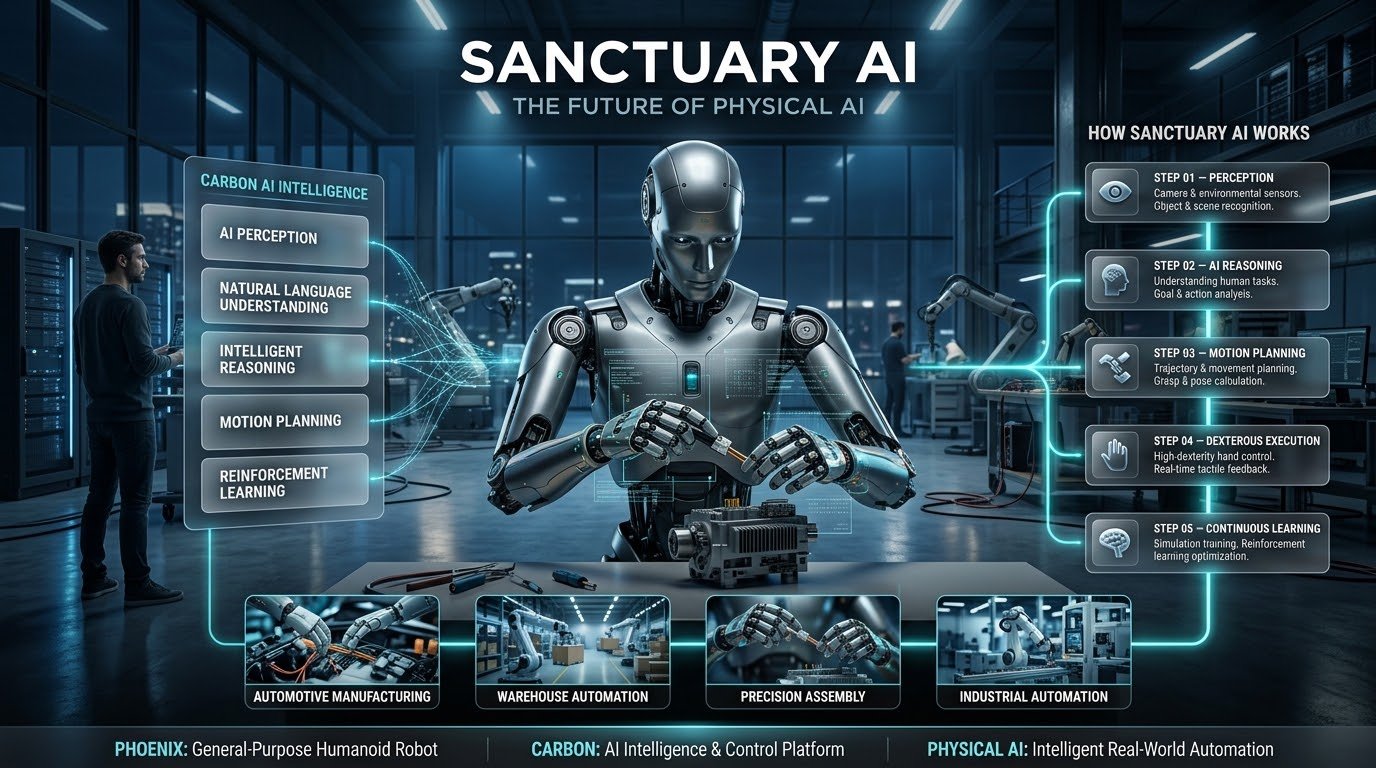
Sanctuary AI is an important name in the emerging humanoid robotics industry. Unlike companies focused primarily on robotic movement, Sanctuary AI emphasizes human-like intelligence, dexterous manipulation, and the ability to perform practical work in human environments.
Sanctuary AI is a Canadian robotics company developing Physical AI systems that enable robots to perform complex tasks in real-world environments. Its Phoenix humanoid robot and Carbon AI control platform focus on human-like dexterity, intelligent manipulation, and industrial automation.
Sanctuary AI at a Glance
Yeni nesil insansı robot Phoenix, görevleri 24 saatte öğreniyor | DonanımHaber
Sanctuary AI
Canadian Physical AI and robotics company
2018
Founded in Vancouver, Canada
Official website
- Main robot: Phoenix, a general-purpose humanoid robotics platform.
- AI platform: Carbon, its proprietary robotic intelligence and control system.
- Core technology: Machine learning, reinforcement learning, tactile sensing, and dexterous manipulation.
- Primary market: Industrial automation and complex physical work.
- Business direction: Deploying Physical AI across existing and future robotic hardware.
- Headquarters: Vancouver, British Columbia, Canada.
What Is Sanctuary AI?
Robotics Startup Sanctuary Signs Deal for Factory Tests, Funds – Bloomberg
Sanctuary AI Demonstrates In-Hand Manipulation Capabilities for Improved General Purpose Robot Dexterity — Sanctuary AI
Physical AI for Industrial Automation | Sanctuary AI
9
Sanctuary AI is a Canadian technology company specializing in general-purpose robotics and Physical AI.
Founded in 2018, the company aims to develop intelligent machines that can perform work traditionally requiring human dexterity and decision-making.
Its approach goes beyond conventional industrial automation. Traditional industrial robots usually repeat predefined movements within controlled environments. Sanctuary AI wants its robots to understand tasks, respond to changing conditions, and manipulate different objects.
Two technologies define its original approach:
- Phoenix: A humanoid robot designed to perform physical work.
- Carbon: An AI control system that translates intelligence into real-world robotic actions.
However, the company’s strategy has evolved. In 2026, Sanctuary AI expanded its focus toward deploying Physical AI on commercially available industrial robots.
This shift is important because it allows the company to pursue practical industrial applications without waiting for fully commercial humanoid robots.
The company now describes its mission as delivering production-ready Physical AI to industry. Sanctuary AI+1
Who Founded Sanctuary AI?
Sanctuary AI was founded in 2018 in Vancouver, Canada.
Its founding team included entrepreneurs and robotics specialists with experience in artificial intelligence, machine learning, and advanced engineering.
Geordie Rose, one of its co-founders, previously helped establish D-Wave, a quantum computing company. His background helped shape Sanctuary AI’s ambitious approach to machine intelligence and robotics.
The company’s leadership has evolved as its commercial strategy has developed.
In 2026, Daniel Friedmann was appointed CEO, succeeding James Wells. Friedmann previously led MDA, an aerospace technology company, and Carbon Engineering. Sanctuary AI+1
This leadership transition reflects the importance of industrial execution, commercialization, and scaling technology beyond laboratory demonstrations.
What Is the Phoenix Humanoid Robot?
Sanctuary rolls out Phoenix, a Carbon-based humanoid AI labor robot
newatlas.com
Phoenix is Sanctuary AI’s general-purpose humanoid robot.
It was introduced as a machine capable of performing different types of work through human-like movement, intelligent control, and advanced manipulation.
Rather than designing a robot for just one repetitive task, Sanctuary AI developed Phoenix around a broader objective: creating a physical platform capable of learning and performing multiple activities.
Phoenix’s Key Characteristics
The original sixth-generation Phoenix announcement included these specifications:
| Specification | Announced figure |
|---|---|
| Height | 5 feet 7 inches |
| Weight | 155 pounds |
| Maximum payload | 55 pounds |
| Maximum speed | 3 mph |
| Robotic hand degrees of freedom | 20 total |
| AI control platform | Carbon |
These figures describe the sixth-generation version, not necessarily the latest Phoenix configuration. The company has since introduced newer generations. Sanctuary AI
Why Phoenix’s Hands Matter
Sanctuary AI Demonstrates In-Hand Manipulation Capabilities for Improved General Purpose Robot Dexterity
newswire.ca
One of Phoenix’s most interesting components is its robotic hand.
Human hands perform complicated movements that conventional industrial grippers cannot easily reproduce.
Consider picking up a small connector, rotating a screwdriver, holding flexible wiring, or adjusting an object without dropping it.
These activities require precise control over finger movement, pressure, and contact.
Sanctuary AI has invested heavily in:
- Multiple independently controlled finger movements.
- Hydraulic actuation.
- Integrated tactile sensing.
- Fine object manipulation.
- Finger-level force control.
- In-hand object rotation.
Its later demonstrations have included manipulating a cube between the fingertips without dropping it.
In one company-reported demonstration, the robotic hand achieved its target orientation ten consecutive times using a policy trained in simulation. Sanctuary AI
This matters because industrial work often involves objects that are flexible, irregular, slippery, or difficult to grasp.
What Is Carbon AI?
Sanctuary AI Expands General Purpose Robot Footprint in Automotive Manufacturing Industry
prnewswire.com
Carbon is Sanctuary AI’s proprietary AI control system.
It acts as the intelligence layer connecting a robot’s sensors, decision-making capabilities, and physical movements.
A robot needs more than motors and cameras to perform useful work. It must understand instructions, recognize objects, determine appropriate actions, and respond when something changes.
Carbon is designed to coordinate these processes.
How Carbon Works
The original Carbon architecture combines several AI and robotics techniques.
1. Natural language understanding
The system can interpret human instructions and translate them into actionable tasks.
2. Perception and sensing
Robotic sensors provide information about objects, surroundings, and physical interactions.
3. Planning and reasoning
The software determines how to approach a task and organize the required movements.
4. Physical execution
The robot performs the planned actions using its motors, actuators, and robotic hands.
5. Learning and improvement
Machine learning and reinforcement learning help improve performance through training, feedback, and simulation.
The original Carbon description also included symbolic reasoning, logical reasoning, large language models, and human-in-the-loop supervision. Sanctuary AI
Carbon and Reinforcement Learning
Reinforcement learning is particularly relevant to Sanctuary AI.
It is a machine learning technique in which a system learns through actions, feedback, and rewards.
For example, a robotic hand can learn to rotate an object while maintaining a stable grip.
Instead of programming every possible finger movement manually, engineers train the system to discover effective strategies.
This approach is valuable for dexterous manipulation because objects and contact conditions can vary.
Simulation and Real-World Learning
Training a physical robot through repeated real-world experiments can be expensive and time-consuming.
Simulation provides a more controlled environment.
Sanctuary AI has demonstrated transferring manipulation policies from simulation to physical hardware.
This is commonly called sim-to-real transfer.
The technique allows developers to train robotic behaviors in virtual environments before validating them on real machines. Sanctuary AI+1
How Sanctuary AI Is Expanding Beyond Humanoid Robots
One of the most important developments in Sanctuary AI’s business strategy occurred in June 2026.
The company announced an expanded Physical AI strategy focused on existing industrial robotics platforms.
This means Sanctuary AI is no longer relying exclusively on Phoenix to commercialize its technology.
Instead, its AI systems can be deployed on commercially available industrial robotic hardware.
The company identifies compatibility with existing and future robotic configurations as a central part of its strategy. Sanctuary AI+1
Why This Strategy Matters
Building a humanoid robot involves several difficult engineering challenges:
- Walking and maintaining balance.
- Managing battery life.
- Developing reliable actuators.
- Controlling complex hands.
- Meeting workplace safety requirements.
- Manufacturing hardware at commercial scale.
An existing industrial robot already solves many mechanical and operational problems.
Sanctuary AI can therefore focus more resources on perception, manipulation, learning, and intelligent control.
This approach could also reduce the need for manufacturers to replace their existing automation equipment.
The 99.5% Task Success Demonstration
In June 2026, Sanctuary AI announced a major industrial milestone.
The company reported achieving:
- 99.5%+ task success rate
- 2.54-second cycle time
- A complex wire-plugging operation.
- Validation against a customer’s live production benchmarks.
The task involved inserting a flexible wire connector into a moving target on a conveyor.
This is significantly more challenging than moving an object along a fixed, predetermined path.
Importantly, these are company-reported results from a proof-of-concept with a global Tier 1 automotive supplier. They should not be interpreted as an independently audited performance benchmark across all applications. Sanctuary AI
Main Applications and Use Cases of Sanctuary AI
Sanctuary AI targets industries where conventional automation struggles with complex physical tasks.
Its technology could be particularly useful when machines must manipulate different objects, respond to changing conditions, or perform tasks requiring fine motor control.
Wire Harness Automation Trends: Robot-ready Pre-assembly, Zonal Architectures and AI Quality for EV Manufacturing
1. Automotive Manufacturing
Flexible wire insertion, connector assembly, component handling, and precision manufacturing tasks.
Automatisation logistique : définition, enjeux, technologies et bénéfices pour 2026
2. Warehousing and Logistics
Object handling, sorting, picking, and manipulation of items with different shapes and sizes.
Ferninspektion mit Roboter «Spot» von Boston Dynamics
3. Energy and Utilities
Potential applications include equipment handling, inspection support, and repetitive operational tasks.
통신선로기능사 필기 실기 시험일정 합격률 난이도 취업 연봉 전망 :: 트렌디네스트
4. Telecommunications
Cable handling, connector insertion, and other delicate physical operations.
Walmart: cómo serán los almacenes tecnológicos de próxima generación en EE.UU. que mejorarán los tiempos de entrega a domicilio – El Diario NY
5. Retail and Distribution
Repetitive product handling, sorting, and inventory-related physical operations.
These represent target applications and potential use cases, not proof that every task is already commercially deployed.
The company’s industrial strategy prioritizes tasks that require more flexibility than traditional fixed automation. Sanctuary AI+1
Key Features of Sanctuary AI Technology
Sanctuary AI combines hardware, software, and learning systems. Several capabilities distinguish its approach.
| Feature | What it does | Why it matters |
|---|---|---|
| Carbon AI | Controls robotic intelligence and actions | Connects instructions with physical work |
| Phoenix | Provides a humanoid robotics platform | Supports general-purpose robotics research |
| Hydraulic hands | Control complex finger movements | Improve manipulation capabilities |
| Tactile sensing | Detects physical contact and pressure | Helps prevent slipping and excessive force |
| Reinforcement learning | Trains robotic behaviors | Improves task execution |
| Simulation | Supports virtual training | Reduces dependence on physical experiments |
| Human supervision | Allows human guidance and teleoperation | Supports training and oversight |
| Multi-embodiment strategy | Supports different robotic hardware | Expands potential deployment options |
The Importance of Tactile Sensors
Vision alone cannot provide complete information about physical interactions.
A camera may identify an object, but it cannot always determine whether the object is slipping or whether a robot is applying excessive force.
Tactile sensors help address this problem.
Sanctuary AI has highlighted several applications:
- Detecting when an object begins slipping.
- Improving grip stability.
- Manipulating objects without relying entirely on visual feedback.
- Performing delicate tasks when cameras cannot see the contact point.
- Collecting richer data for robotic learning.
This combination of vision and touch is particularly relevant to manufacturing operations. Sanctuary AI
Benefits of Sanctuary AI
Sanctuary AI’s technology offers several potential advantages for industrial organizations.
1. More Flexible Automation
Traditional robots often require extensive programming for individual tasks.
Physical AI aims to make machines more adaptable to changing objects and working conditions.
2. Human-Like Dexterity
Advanced robotic hands can potentially perform tasks that conventional grippers struggle with.
This includes handling flexible cables, small connectors, and irregular objects.
3. Reduced Dependence on Custom Hardware
The company’s multi-embodiment direction could allow customers to use AI capabilities with existing industrial robots.
This may reduce equipment replacement costs.
4. Improved Task Adaptability
Machine learning allows robots to learn movements through demonstrations, simulation, and feedback.
This can make automation more flexible than strictly predefined motion sequences.
5. Potential Labor Support
Manufacturers face difficulties filling certain repetitive, physically demanding, and specialized roles.
Robotic automation could help address some of these operational challenges.
However, the actual economic benefits depend on reliability, maintenance, integration costs, and the complexity of individual tasks.
Limitations and Challenges of Sanctuary AI
Despite its technical progress, Sanctuary AI faces challenges that affect the entire humanoid robotics industry.
1. Commercial Scalability
A successful demonstration does not automatically translate into a reliable production system.
Industrial customers require consistent performance across thousands of operating cycles.
2. Hardware Complexity
Hydraulic hands, tactile sensors, actuators, and robotic control systems introduce additional engineering requirements.
Maintenance and component reliability become particularly important in demanding environments.
3. Deployment Costs
Sanctuary AI does not publish a standard public purchase price for Phoenix or a universal Carbon subscription.
Customers must consider hardware, installation, integration, support, and ongoing operating costs.
4. General-Purpose Intelligence Remains Difficult
Performing one task successfully does not prove that a robot can perform hundreds of unrelated tasks.
Robots still need extensive training and validation to operate reliably in unfamiliar environments.
5. Safety and Human Interaction
Industrial robots must operate within appropriate safety systems.
Manufacturers need to evaluate emergency stops, physical separation, collision risks, force limits, and supervision requirements.
6. Competition
Sanctuary AI competes against companies with significant funding, manufacturing resources, research capabilities, and commercial relationships.
Its success will depend on measurable industrial performance rather than demonstrations alone.
Sanctuary AI Pricing: How Much Does Phoenix Cost?
No verified public list price
Sanctuary AI does not provide a publicly confirmed standard retail price for its Phoenix humanoid robot.
It is primarily an enterprise-focused robotics company, not a consumer robot retailer.
Its commercial offering involves industrial automation, AI technology, robotics integration, and deployment services.
Potential customer costs may include:
- Robotic hardware and components.
- AI software and deployment.
- Custom robotic end effectors.
- Engineering and integration.
- Maintenance and technical support.
- Training and operational validation.
The company has also expanded toward deploying Physical AI on existing industrial robotic platforms.
This makes a single Phoenix purchase price an incomplete way to evaluate the business.
How can businesses obtain pricing?
Organizations interested in commercial applications should contact Sanctuary AI through its official website:
Sanctuary AI official website and commercial inquiries.
Sanctuary AI Competitors: How Does It Compare?
The humanoid robotics market includes several companies pursuing different approaches to physical intelligence.
Some focus on industrial humanoids, while others prioritize warehouse automation, general-purpose robotics, or autonomous manipulation.
Figure – Parkway VC
Elon Musk pone fecha a Optimus: Tesla podría empezar a vender su robot humanoide a finales de 2027
Non, ce robot ne s’est pas désactivé lui-même pour échapper à son travail
4
Leading Sanctuary AI Alternatives
| Company | Robot / Platform | Main Focus | Important Difference |
|---|---|---|---|
| Figure AI | Figure 02 / Figure 03 | Industrial humanoids | Combines humanoid hardware with its Helix AI system |
| Tesla | Optimus | General-purpose humanoids | Benefits from Tesla’s manufacturing ecosystem |
| Agility Robotics | Digit | Warehouse automation | Focuses on logistics and material handling |
| Apptronik | Apollo | Industrial humanoids | Emphasizes modular industrial robotics |
| 1X Technologies | NEO / EVE | Home and service robotics | Targets both consumer and industrial environments |
| Boston Dynamics | Atlas | Advanced humanoid robotics | Known for dynamic mobility and robotics research |
These companies are not interchangeable. Their hardware, intended environments, commercial availability, and autonomy strategies differ. DEPLOY+2
Sanctuary AI vs. Figure AI
Figure AI is a direct competitor in general-purpose humanoid robotics.
Its Figure robots are designed for manufacturing and logistics applications.
Sanctuary AI places particular emphasis on dexterous manipulation, tactile sensing, and Carbon’s control architecture.
The main distinction is not simply robot appearance. It is how each company combines perception, intelligence, manipulation, and commercial deployment.
Sanctuary AI vs. Tesla Optimus
Tesla’s Optimus program benefits from its existing manufacturing facilities, engineering resources, and experience with automation.
Sanctuary AI takes a more specialized route, emphasizing physical intelligence and dexterous manipulation.
Tesla’s manufacturing scale is a potential advantage, while Sanctuary AI’s focus on robotic hands and multi-embodiment AI provides a different competitive position.
Sanctuary AI vs. Agility Robotics
Agility Robotics develops Digit, a bipedal robot focused on warehouse and logistics applications.
Digit’s design emphasizes practical material handling.
Sanctuary AI has historically focused more heavily on general-purpose manipulation and human-like dexterity.
This illustrates an important distinction: a successful warehouse robot does not necessarily need the same capabilities as a general-purpose humanoid.
Is Sanctuary AI Better Than Other Humanoid Robot Companies?
There is no universal answer.
The right platform depends on the task, operating environment, reliability requirements, and cost structure.
| Evaluation factor | What to examine |
|---|---|
| Dexterity | Can the robot manipulate small or flexible objects? |
| Autonomy | How much human supervision does it require? |
| Reliability | What is its verified task success rate? |
| Speed | Can it meet production cycle times? |
| Integration | Does it work with existing industrial equipment? |
| Safety | Can it meet workplace safety requirements? |
| Economics | Does it provide measurable savings? |
| Scalability | Can performance transfer across multiple facilities? |
For companies evaluating Sanctuary AI, its industrial results and hardware-agnostic strategy deserve particular attention.
A robot that performs one complicated task reliably may offer more immediate business value than a more impressive general-purpose demonstration.
Who Should Pay Attention to Sanctuary AI?
Sanctuary AI is particularly relevant to several audiences.
Manufacturers: Businesses looking to automate complicated physical operations.
Robotics researchers: Professionals interested in reinforcement learning, robotic manipulation, and embodied intelligence.
AI developers: Engineers exploring how software intelligence can control physical systems.
Investors and industry analysts: People monitoring the development of humanoid robotics and Physical AI.
Technology enthusiasts: Readers following the evolution of intelligent machines and human-robot collaboration.
It is less relevant to ordinary consumers looking for an affordable home robot today. Phoenix is not presented as a conventional consumer product.
Latest Sanctuary AI Developments in 2026
The company’s recent direction is particularly important because its strategy has moved beyond the original humanoid-only narrative.
Here are notable developments to understand.
June 2026
Physical AI expands into industrial robotics
Sanctuary AI announced a 99.5%+ task success rate at a 2.54-second cycle time for a complex wire-plugging proof-of-concept with an automotive supplier. Sanctuary AI
2026
Leadership transition
Daniel Friedmann was appointed CEO, bringing experience from aerospace and climate technology businesses. Sanctuary AI
2026
Eighth-generation Phoenix development
Sanctuary AI’s official news page identifies its eighth-generation Phoenix as a platform for improved robotic data capture. Sanctuary AI
Ongoing development
Advanced tactile sensing and manipulation
The company continues developing robotic touch sensors and dexterous manipulation capabilities. Sanctuary AI+1
For the latest announcements, consult the official Sanctuary AI website rather than relying on older Phoenix specifications.
What Makes Sanctuary AI Different in the Future of Robotics?
The most interesting part of Sanctuary AI is its focus on physical intelligence.
Many AI systems operate entirely within digital environments. They generate text, analyze documents, write code, or process images.
Physical AI takes intelligence into the real world.
It requires machines to understand objects, control movement, respond to physical feedback, and complete tasks safely.
Sanctuary AI’s strategy combines three important elements:
- Intelligence: Carbon provides the software and AI control layer.
- Dexterity: Advanced hands and tactile sensors enable complex manipulation.
- Embodiment: Phoenix and compatible industrial robots provide the physical platform.
The company’s move toward existing industrial hardware could prove strategically important.
It creates an opportunity to commercialize AI capabilities before general-purpose humanoids become widely available.
However, long-term success will depend on reliable deployments, repeatable performance, operating economics, and the ability to scale beyond individual customer projects.
Frequently Asked Questions
1. What does Sanctuary AI do?
Sanctuary AI develops Physical AI technology and robotic systems designed to perform complex real-world tasks. Its technology includes the Phoenix humanoid platform, Carbon AI control system, and industrial robotics solutions.
2. Is Sanctuary AI a Canadian company?
Yes. Sanctuary AI was founded in 2018 and is headquartered in Vancouver, British Columbia, Canada.
3. What is the Phoenix robot?
Phoenix is Sanctuary AI’s general-purpose humanoid robot. It was developed to perform physical work using advanced robotic hands, sensors, and Carbon AI technology.
4. What is Carbon AI in Sanctuary AI?
Carbon is Sanctuary AI’s proprietary robotic intelligence and control platform. It combines AI techniques, perception, planning, and machine learning to translate instructions into physical robotic actions.
5. How much does the Sanctuary AI Phoenix robot cost?
Sanctuary AI has not published a verified standard retail price for Phoenix. Interested businesses should contact the company directly for commercial pricing and deployment information.
Conclusion: Is Sanctuary AI Worth Watching?
Sanctuary AI represents an interesting direction in the development of intelligent robotics.
Its Phoenix robot demonstrates the company’s ambitions in general-purpose humanoid machines, while Carbon provides the intelligence behind its approach to physical work.
However, its 2026 expansion into existing industrial robotics may be even more important than the humanoid hardware itself.
For manufacturers, the key question is whether Sanctuary AI can deliver reliable performance, practical integration, and measurable economic benefits.
For researchers and technology enthusiasts, its work on tactile sensing, reinforcement learning, and dexterous manipulation makes it a company worth following.
The future of Sanctuary AI will depend not only on how capable its robots become, but also on how effectively that capability translates into real industrial value.
Internal Linking Opportunities for aispacez.com
These are suggested contextual links. Add them only if the corresponding articles exist on your website.
| Suggested anchor text | Recommended placement |
|---|---|
| AI-powered humanoid robots | Within the introduction or Phoenix section |
| How reinforcement learning works | Within the Carbon AI section |
| The future of AI in manufacturing | Within the industrial applications section |
SEO recommendation: Link to relevant existing articles rather than creating unnecessary pages just to accommodate these anchors.
Featured Image Prompt (16:9)
Recommended featured image
Sanctuary AI Unveils 7th Generation Phoenix Robot with Advanced AI and Hardware Upgrades
maginative.com
Copy-ready image generation prompt:
Create an ultra-premium, cinematic 16:9 landscape featured image for an authoritative technology article titled “Sanctuary AI: The Future of Humanoid Robotics and Physical AI.”
Visual Style: Premium technology editorial photography, photorealistic hybrid, cinematic 3D environment, hyper-detailed robotics engineering, dramatic industrial lighting, sophisticated futuristic atmosphere, luxury technology magazine aesthetic, exceptional realism, professional visual storytelling.
Main Visual Concept
Create a spectacular futuristic AI-powered industrial robotics laboratory at night, featuring the Sanctuary AI Phoenix humanoid robot as the dominant central subject.
Center: Show a highly realistic Phoenix-inspired humanoid robot standing inside an advanced industrial automation facility. Its human-like proportions, sophisticated mechanical construction, articulated fingers, realistic joints, and advanced robotic hands should be exceptionally detailed.
The robot should be actively manipulating a delicate electrical connector with its dexterous fingers, demonstrating precision and human-like physical intelligence.
Its robotic hand should be the most visually impressive technical detail.
Left Side: Carbon AI Intelligence
Show a photorealistic robotics engineer observing the robot through a large transparent digital control interface.
Display sophisticated floating UI elements representing:
- Carbon AI Control System
- Neural Processing Visualization
- Real-Time Motion Planning
- Reinforcement Learning
- Robotic Perception
- Task Execution Monitoring
Use elegant cyan and electric-blue digital graphics, with subtle neural-network connections linking the interface to the robot.
Center: Phoenix Humanoid Robot
Make the Phoenix-inspired humanoid robot the visual centerpiece.
Include:
- Highly realistic mechanical fingers.
- Detailed hydraulic actuation.
- Integrated tactile sensor visualization.
- Sophisticated metallic body construction.
- Realistic industrial-grade mechanical joints.
- Natural human-like posture.
- A precision manipulation demonstration.
Add a subtle illuminated title above the robot:
SANCTUARY AI
Below it, display:
PHOENIX + CARBON
Right Side: Physical AI Workflow
Create a cinematic translucent digital workflow with five connected floating technology cards:
- VISION & PERCEPTION
- AI REASONING
- DEXTEROUS MANIPULATION
- PHYSICAL EXECUTION
- LEARNING & IMPROVEMENT
Connect these cards with glowing cyan lines and sophisticated animated-looking data streams.
In the background, show robotic arms, conveyor belts, electrical components, industrial machinery, and engineers monitoring automated production.
Environment and Lighting
Use a premium futuristic manufacturing laboratory with:
- Floor-to-ceiling glass walls.
- Dark graphite metallic architecture.
- Realistic industrial equipment.
- Reflective polished flooring.
- Subtle blue ambient illumination.
- Cyan and amber accent lighting.
- Cinematic volumetric light beams.
- Sophisticated depth of field.
Composition
Use a balanced cinematic split-layout.
The Phoenix humanoid robot must dominate the center. The left side communicates Carbon AI intelligence, while the right side communicates industrial applications and intelligent automation.
Ensure excellent visual hierarchy, realistic proportions, accurate mechanical details, sophisticated lighting, and premium editorial composition.
Color Palette: Deep charcoal, metallic silver, electric cyan, subtle teal, and controlled amber highlights.
Image Quality: Ultra-realistic, 8K-quality appearance, sharp mechanical details, professional photography, cinematic contrast, premium magazine cover aesthetic.
Important: Avoid cartoon robots, generic AI brains, exaggerated science-fiction elements, cluttered interfaces, incorrect text, watermarks, and unrelated company logos.
The final image should communicate one powerful idea: Sanctuary AI is developing intelligent robotic systems that combine human-like dexterity with artificial intelligence to perform real-world industrial work.
FAQs
The following schema uses the same five questions and answers displayed in the article. Add it through your website’s schema integration or appropriate HTML insertion point.
SEO note: Google does not guarantee FAQ rich results, and currently limits their regular display primarily to authoritative government and health websites. The markup should accurately reflect visible content.
Final SEO Quality Checklist
| SEO requirement | Status |
|---|---|
| Focus keyword in title and H1 | Done |
| Direct answer near beginning | Done |
| One H1 and logical heading hierarchy | Done |
| Semantic keywords and related entities | Done |
| Phoenix and Carbon explanations | Done |
| Competitor comparison | Done |
| Current company developments | Done |
| Pricing transparency | Done |
| Limitations and realistic evaluation | Done |
| Five visible FAQs | Done |
| FAQPage JSON-LD | Done |
| Internal linking suggestions | Done |
| 16:9 featured image prompt | Done |
Editorial recommendation: The most important SEO differentiator is the distinction between Sanctuary AI’s original Phoenix-focused humanoid strategy and its newer industrial Physical AI strategy. Many generic company profiles overlook this development. Make that distinction prominent in the article and featured image.
To keep this article current, I can also monitor Sanctuary AI’s announcements and provide a verified monthly update.
Conclusion
Sanctuary AI is helping shape the future of Physical AI by combining advanced robotics, artificial intelligence, and human-like dexterity. Its Phoenix humanoid robot and Carbon AI platform demonstrate how intelligent machines can move beyond repetitive automation and perform increasingly complex real-world tasks.
What makes the company particularly interesting is its expanding focus on industrial applications and compatibility with existing robotic hardware. This strategy could create new opportunities for manufacturers seeking more flexible automation solutions.
However, challenges involving deployment costs, reliability, safety, and commercial scalability remain important. Sanctuary AI has made promising technical progress, but its long-term success will depend on delivering consistent results in real production environments.
For manufacturers, robotics researchers, and AI enthusiasts, Sanctuary AI is a company worth watching as Physical AI continues to evolve.

Alex Carter is a technology writer at AI SpaceZ.com, who covers AI tools, software reviews, practical tutorials and emerging artificial intelligence trends. He aims to make AI easier to understand and help readers discover useful tools and technologies for everyday productivity.