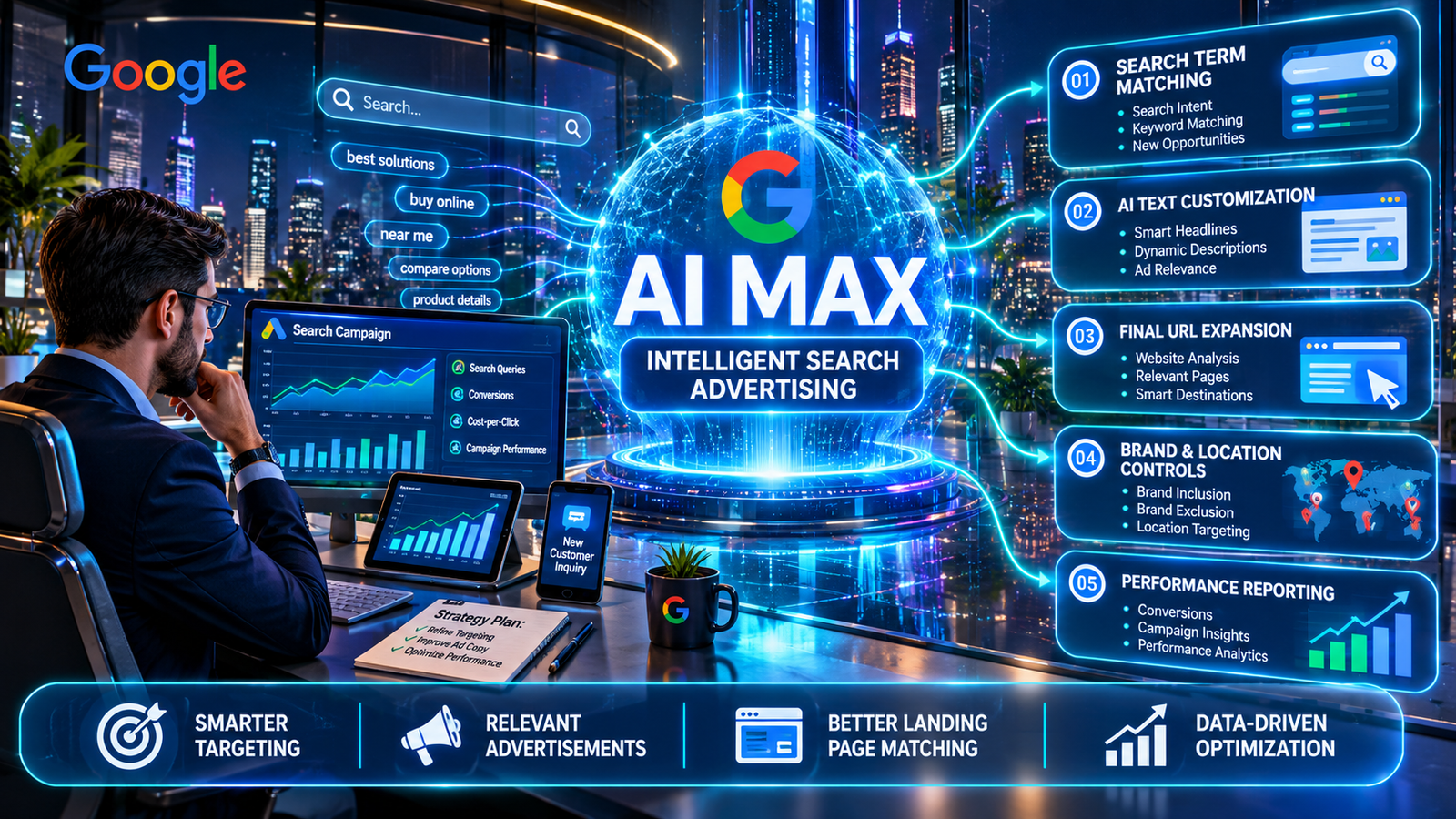
AI Max is Google’s suite of AI-powered targeting and creative optimization features designed to improve existing Google Search campaigns. It expands keyword matching, generates search-relevant ad text, and selects relevant landing pages while giving advertisers additional controls over targeting, brands, and URLs.
Google Ads is changing how businesses reach potential customers through search advertising. Traditional keyword targeting remains important, but understanding search intent is becoming increasingly valuable.
This is where AI Max enters the picture.
Rather than requiring advertisers to manage every keyword, headline, and landing page manually, Google uses artificial intelligence to make additional optimization decisions.
However, automation does not automatically guarantee better advertising results. Advertisers still need accurate conversion tracking, relevant landing pages, suitable budgets, and effective campaign management.
This guide explains how AI Max works, what makes it different, how to use its features, and what businesses should consider before enabling it.
At a Glance: What You Should Know About AI Max
- Platform: Google Ads.
- Purpose: Improve targeting, ad relevance, and performance in Search campaigns.
- Campaign type: An optimization layer, not a separate campaign type.
- Main features: Search term matching, text customization, and Final URL expansion.
- Advertiser controls: Brand settings, URL controls, and location-of-interest targeting.
- Best suited for: Advertisers seeking additional search reach and more automated campaign optimization.
What Is AI Max?
AI Max for Search: The Complete 2026 Guide (Features, Performance Data & When to Use It) | Soku
soku.ai
AI Max is an artificial intelligence-powered feature suite within Google Ads. It helps advertisers expand their Search campaign reach and improve how advertisements respond to individual search queries.
Google introduced AI Max as a way to bring more of its AI capabilities into traditional Search advertising.
Its primary objective is to understand the relationship between a user’s search, an advertiser’s products or services, existing advertisements, and website content.
For example, imagine a company advertising professional accounting software.
Its existing keyword list might include:
- Accounting software for businesses
- Small business bookkeeping software
- Online accounting platform
- Business financial management tools
However, potential customers might search for something different, such as:
- Software to organize business expenses
- How to manage company invoices
- Accounting tools for growing startups
Traditional keyword strategies may not capture every relevant search opportunity.
AI Max can use additional contextual signals to identify relevant searches beyond the advertiser’s original keyword list.
It can also customize advertising messages and select appropriate landing pages based on predicted user intent.
Importantly, AI Max is not an independent advertising platform. It operates within Google Ads Search campaigns.
Google’s documentation describes it as a continuous optimization layer rather than a new campaign type. Google Ads Help+2
How Does AI Max Work?
AI Max combines search targeting and creative optimization into a connected advertising process.
Instead of relying exclusively on manually selected keywords and fixed advertising messages, it evaluates multiple campaign signals.
These include:
- Existing keywords and their themes.
- Advertiser-provided headlines and descriptions.
- Website content and landing pages.
- Search query context.
- Available campaign settings.
- Relevant targeting and performance signals.
The system uses these signals to determine which searches may be relevant and how an advertisement should respond.
1. Understanding Search Intent
The first important component is understanding what users actually want.
Two people might search for different phrases while looking for the same product.
For example:
- Best CRM for a small company.
- Affordable customer relationship management software.
- Tools for organizing customer information.
These searches have different wording but share a commercial purpose.
AI Max uses AI-powered matching technology to identify additional relevant searches.
This can help advertisers discover opportunities that their original keyword lists did not cover.
2. Matching Relevant Search Queries
AI Max expands search reach through broad match and keywordless matching technology.
It evaluates existing keywords, advertising assets, and website information to identify potentially relevant searches.
This gives campaigns additional flexibility beyond conventional keyword matching.
However, broader matching also requires careful monitoring.
An advertisement appearing for a search does not necessarily mean that the searcher is a valuable potential customer.
3. Creating Relevant Advertising Messages
AI Max includes text customization, previously known as automatically created assets.
This feature uses existing advertising content and relevant website information to generate additional headlines and descriptions.
For example, a business advertising project management software might have an original headline:
“Project Management Software for Teams.”
Depending on the search context, Google AI may generate a more specific variation highlighting team collaboration or project organization.
Advertisers should review generated assets to ensure that their messaging accurately represents the business.
4. Selecting Relevant Landing Pages
The final stage involves Final URL expansion.
Rather than always sending visitors to one predetermined landing page, AI Max can select another relevant page from the advertiser’s website.
For example, a company might advertise several services:
- Website development.
- Mobile application development.
- E-commerce solutions.
- Software consulting.
A user searching for e-commerce development may receive an advertisement directing them to the corresponding service page.
This can create a more relevant journey from search to website.
The advertiser can also apply URL inclusion and exclusion controls to guide destination selection. Google Ads Help+2
Key Features of Google AI Max
AI Max brings several advertising capabilities together. Understanding each feature helps marketers decide how much automation their campaigns need.
1. Search Term Matching
Google Ads Search Term Reports: What You Need To Know Now
learn.jyll.ca
Search term matching helps campaigns discover relevant searches beyond their existing keyword lists.
It combines broad match and keywordless technology to identify potential customer queries.
Its main advantages include:
- Discovering additional search opportunities.
- Reaching customers using unexpected wording.
- Expanding existing keyword coverage.
- Identifying relevant searches with conversion potential.
Advertisers can also control search term matching at the ad group level.
This is useful when certain ad groups need broader targeting while others require more focused search coverage.
2. Text Customization
Text customization uses generative AI to produce additional advertising messages.
It considers existing advertisements, website content, and the user’s search context.
The objective is to make headlines and descriptions more relevant to individual searches.
Potential advantages include:
- Additional headline variations.
- Search-specific advertising messages.
- Less manual copywriting work.
- More flexibility when testing different messages.
However, generated advertising copy should not be treated as automatically approved marketing content.
Businesses should review factual statements, promotional offers, product descriptions, and legal language.
3. Final URL Expansion
Final URL expansion helps Google select relevant landing pages from an advertiser’s website.
This feature is particularly useful for businesses offering multiple products or services.
Instead of sending every visitor to the homepage, advertisements can direct users toward more specific pages.
Advertisers should pay attention to an important detail: when Final URL expansion selects a different destination, pinned responsive search ad assets may not be respected.
This matters for businesses that require specific headlines or descriptions to appear consistently.
4. Brand Controls
Brand controls allow advertisers to manage which brands their advertisements can be associated with.
Google provides:
- Brand inclusions.
- Brand exclusions.
These settings help businesses guide their campaign targeting and brand associations.
They are particularly relevant for advertisers operating in competitive industries.
5. Locations of Interest
Locations of interest help advertisers reach customers based on geographical intent.
This functionality operates at the ad group level.
For example, a company providing services in London may want to reach people specifically interested in London, even when their physical location differs.
This adds another layer of targeting flexibility.
6. URL Inclusion and Exclusion Controls
Advertisers can guide landing-page selection through URL rules.
- URL inclusions: Help identify specific website pages that should be considered.
- URL exclusions: Prevent selected URLs from being used as landing pages.
These controls are important for websites containing outdated content, irrelevant pages, or sections that should not receive advertising traffic.
7. Improved Reporting
AI Max also introduces reporting improvements that help advertisers understand automated campaign activity.
These include:
- AI Max match-type reporting.
- Search-term source information.
- Search term, headline, and URL combinations.
- Landing-page selection reporting.
- Asset performance information.
This reporting is important because automation needs measurement.
Advertisers should understand where their budget goes and which searches generate valuable outcomes.Google Ads Help+2
AI Max vs. Performance Max: What’s the Difference?
Phrase Match & Exact Match Keywords: Should They Mix?
P-MAX の可視性と管理性を向上 – Google 広告 ヘルプ
AI Max and Performance Max both use Google’s artificial intelligence, but they serve different advertising purposes.
The most important distinction is campaign structure.
AI Max enhances existing Search campaigns. Performance Max is a separate campaign type designed to distribute advertisements across Google’s eligible advertising channels.
| Comparison | AI Max | Performance Max |
|---|---|---|
| Campaign structure | Search campaign optimization layer | Separate campaign type |
| Main purpose | Improve Search advertising | Reach customers across multiple Google channels |
| Search targeting | Keyword and keywordless matching | Search themes and other AI signals |
| Creative optimization | Text customization | Multiple creative asset formats |
| Landing pages | Final URL expansion | Final URL expansion options |
| Advertiser control | Search-specific controls | Asset groups and campaign-level controls |
| Primary environment | Google Search | Google’s advertising inventory |
When Should You Choose AI Max?
Consider AI Max when:
- Your business already receives valuable Search traffic.
- You want to discover additional search queries.
- Your website has multiple relevant service pages.
- You want to improve advertising message relevance.
- You prefer maintaining a Search campaign structure.
When Is Performance Max More Appropriate?
Performance Max may be more appropriate when you want to combine different advertising formats and reach customers across Google’s broader advertising inventory.
For example, an online retailer may want to combine Shopping, YouTube, Display, and Search opportunities.
These campaign types are not necessarily competitors. Depending on your marketing strategy, they can complement each other.
Google explains that eligible queries may match both AI Max and Performance Max campaigns. In such situations, Ad Rank determines which eligible advertisement serves. Google Ads Help+1
Benefits of Using AI Max for Search Advertising
AI Max offers several potential advantages, particularly for businesses with established Search campaigns.
1. Discover Additional Customers
Traditional keyword lists cannot always represent every way people search for products and services.
AI Max helps advertisers reach relevant queries that might otherwise remain undiscovered.
This can create additional opportunities to attract customers.
2. Reduce Manual Campaign Management
Managing thousands of search terms and advertising variations requires considerable time.
AI Max automates parts of this process through search matching and creative optimization.
Marketing teams can spend more time evaluating strategy and business outcomes.
3. Improve Advertising Relevance
Search intent changes depending on the user’s needs.
A generic advertisement may not address every search effectively.
Text customization helps generate messages that better reflect different search contexts.
4. Send Visitors to Relevant Website Pages
Final URL expansion can improve the connection between advertisements and landing pages.
A visitor searching for a particular service may reach the relevant service page instead of a general homepage.
This can make the customer journey more direct.
5. Discover New Marketing Opportunities
Search-term reporting provides additional information about how users discover advertisements.
Advertisers can use these insights to identify:
- New keyword opportunities.
- Unexpected customer needs.
- Relevant website content gaps.
- Potential new advertising groups.
- Search queries that deserve separate campaigns.
6. Maintain Important Campaign Controls
Automation does not mean advertisers lose every targeting decision.
AI Max includes controls for brands, URLs, and geographical intent.
These options help marketers balance automation with business requirements.
How to Set Up AI Max in Google Ads
Google Ads AI Max explained: Key insights for marketers
lunio.ai
Setting up AI Max does not require creating an entirely new campaign type.
You can configure it within an existing Search campaign or during the creation of a new Search campaign.
Follow these steps.
Step 1: Open Google Ads
Sign in to your Google Ads account.
Navigate to the Campaigns section and identify the Search campaign you want to optimize.
Before making changes, review its existing performance.
Pay particular attention to conversions, cost per acquisition, and return on advertising spend.
Step 2: Open Campaign Settings
Select the relevant Search campaign.
Navigate to its settings and locate the AI Max section.
Google’s setup documentation also supports bulk editing for advertisers managing multiple campaigns.
Step 3: Enable AI Max
Activate the AI Max setting.
New Search campaigns currently have AI Max selected by default, although advertisers can choose which individual features to use.
For existing campaigns, review the available settings before activation.
Step 4: Configure Search Term Matching
Review the search term matching setting.
Decide whether broader matching is appropriate for each ad group.
Consider the following:
- Product relevance.
- Search intent.
- Existing keyword performance.
- Negative keyword coverage.
- Available conversion data.
Avoid expanding every campaign without considering its purpose.
Step 5: Review Text Customization
Enable or disable text customization according to your advertising requirements.
Review your existing headlines and descriptions.
Make sure your website contains accurate information about products, services, prices, and promotional offers.
Step 6: Configure Final URL Expansion
Decide whether Google should select additional landing pages.
Review URL inclusion and exclusion rules.
Exclude pages that contain outdated information, irrelevant content, or destinations unsuitable for paid traffic.
Step 7: Review Brand and Location Settings
Configure brand inclusions and exclusions where necessary.
Check locations of interest for ad groups with specific geographical requirements.
These controls are particularly useful for businesses with restricted service areas or brand-related advertising requirements.
Step 8: Save and Monitor Performance
Save your campaign settings.
Monitor the campaign regularly after activation.
Compare its performance against an appropriate baseline rather than judging success through impressions or clicks alone.
Google provides detailed instructions for enabling, modifying, and disabling AI Max settings in its official setup guide. Google Ads Help+1
Does AI Max Improve Google Ads Performance?
AI Max is designed to improve campaign performance, but actual results depend on the advertiser, industry, campaign structure, and quality of conversion data.
Google has published internal performance figures supporting its product.
Its 2025 data reported that advertisers activating AI Max typically saw 14% more conversions or conversion value at a similar CPA or ROAS.
Google also reported in 2026 that advertisers already using search term matching saw an average 7% improvement in conversions or conversion value at a similar CPA or ROAS after enabling text customization and Final URL expansion.
These figures are Google’s internal results for non-retail advertisers, not independently verified guarantees for every account. Google Ads Help+1
Which Metrics Should Advertisers Track?
| Metric | What It Measures |
|---|---|
| Conversions | Completed business actions |
| Conversion value | Financial value generated by conversions |
| CPA | Average cost per acquisition |
| ROAS | Revenue or conversion value relative to advertising spend |
| Search impression share | Share of eligible search impressions received |
| Search terms | Actual queries triggering advertisements |
| Landing-page performance | Results generated by selected website destinations |
The most useful measurement depends on your business model.
A lead-generation company may prioritize qualified leads and cost per acquisition.
An e-commerce business may focus on conversion value and return on advertising spend.
The important point is to measure business outcomes rather than simply celebrating increased traffic.
AI Max Limitations and Risks Advertisers Should Understand
AI Max offers useful automation, but it also introduces decisions that require human oversight.
Understanding its limitations can prevent wasted advertising budgets.
1. Broader Targeting Can Produce Irrelevant Traffic
Expanded search matching may identify searches that appear contextually relevant but have limited commercial value.
For example, an enterprise software company may want customers searching for business management platforms.
However, some searches may come from students researching software concepts.
These visitors might generate clicks without producing valuable leads.
What to do: Review search-term reports and maintain appropriate negative keyword strategies.
2. Generated Advertising Copy Needs Review
AI-generated headlines and descriptions may not always reflect the exact messaging a business wants.
Potential problems include:
- Inaccurate product descriptions.
- Outdated promotional information.
- Unintended messaging.
- Claims that require legal approval.
- Brand voice inconsistencies.
What to do: Review generated assets and maintain accurate website content.
3. Landing-Page Selection Can Affect Brand Experience
Final URL expansion may direct visitors to pages that advertisers did not originally intend to promote.
For example, a business may prefer sending all paid traffic to dedicated conversion pages.
Automatic destination selection can create challenges if certain pages contain outdated pricing or incomplete information.
What to do: Configure URL exclusions and review the landing-page report.
4. Pinned Headlines May Not Always Be Respected
This is an important consideration for advertisers who require fixed advertising messages.
When Final URL expansion or URL inclusions are enabled, certain pinned responsive search ad assets may not be respected if Google selects a different destination.
Businesses with strict messaging requirements should review these settings carefully.
Google documents this behavior in its AI Max FAQ. Google Ads Help
5. Limited Budget Can Restrict Results
Google specifically warns that AI Max may not be effective when campaigns are limited by budget.
Enabling additional targeting does not automatically provide the resources needed to capture every new opportunity.
What to do: Review campaign budget limitations before expanding targeting.
6. Manual CPC Can Limit AI Max Capabilities
AI Max’s search term matching depends on automated bidding signals.
Google states that Manual CPC bidding limits the full capabilities of AI Max, including its search term matching functionality.
Advertisers should evaluate compatible automated bidding strategies before expecting the complete feature set to work.
7. Automation Makes Monitoring More Important
Automated optimization can reduce manual campaign work, but it does not eliminate the need for performance analysis.
Advertisers should regularly inspect search queries, generated assets, destination URLs, and conversion quality.
The best approach is controlled automation rather than unrestricted automation.Google Ads Help+1
AI Max Pricing: Does Google Charge Extra?
AI Max does not have a separately listed subscription price.
It is included as an optimization feature within Google Ads Search campaigns.
However, advertisers still pay for their advertising activity through Google’s advertising auction and applicable billing model.
Your actual advertising expenses depend on factors such as:
- Keyword competition.
- Industry and audience.
- Campaign bidding strategy.
- Advertising budget.
- Search demand.
- Conversion objectives.
| Cost Component | Explanation |
|---|---|
| AI Max activation | No separately listed activation fee |
| Google Ads spend | Advertiser-funded |
| Click costs | Depend on auction conditions and bidding |
| Campaign management | Depends on whether management is handled internally or externally |
| Additional tools | May involve separate third-party costs |
Important: AI Max should not be confused with a free advertising service. The optimization features do not remove the underlying costs of running Google Ads.
AI Max vs. Other Advertising Platforms
AI Max operates within Google’s advertising ecosystem, but marketers have other options for automated search advertising.
The following comparison highlights relevant alternatives.
| Platform | Target User | Key Strength | Pricing Transparency | Main Limitation |
|---|---|---|---|---|
| Google AI Max | Search advertisers | AI-powered search matching and creative optimization | No separate AI Max fee; ad spend applies | Requires Google Ads campaigns and monitoring |
| Google Performance Max | Businesses seeking multi-channel reach | Automated advertising across Google inventory | Auction-based advertising costs | Less traditional Search campaign control |
| Microsoft Advertising | Search advertisers | Advertising across Microsoft’s search network | Auction-based advertising costs | Different audience reach and inventory |
| Google Ads Smart Bidding | Performance marketers | Automated bid optimization | Included in applicable Google Ads campaigns | Does not independently provide all AI Max features |
These options are not identical products.
AI Max is an integrated Search optimization suite, while the other entries represent different campaign types, advertising platforms, or optimization capabilities.
For businesses evaluating alternatives, the important question is not which platform uses the most AI.
It is which platform can reach the right audience and generate profitable business outcomes.
Latest AI Max Developments in 2026
AI Max has continued evolving beyond its original Search campaign capabilities.
Several developments are particularly relevant to advertisers.
AI Max Moves Beyond Beta
Google announced that AI Max for Search campaigns moved out of beta in 2026.
The company also introduced improvements to targeting quality, creative capabilities, reporting, and advertiser controls.
This represents an important transition from an experimental feature suite toward broader campaign adoption. Accelerate with Google US+1
Dynamic Search Ads Transition
Google announced changes to its legacy Dynamic Search Ads infrastructure.
Its updated timeline states that automatic upgrades for eligible campaigns using Automatically Created Assets and campaign-level broad match settings began in September 2026.
The company also extended the beginning of the Dynamic Search Ads sunset and automatic upgrade process to February 2027.
Advertisers using legacy campaigns should review Google’s migration documentation and account notifications before making changes. blog.google+1
AI Brief and Text Disclaimers
Google announced additional improvements in May 2026.
These included AI Brief and text disclaimers.
Text disclaimers are particularly relevant to regulated industries where certain legally required language must appear in advertisements.
This development addresses an important concern: automated advertising must still accommodate business and compliance requirements. Accelerate with Google US
Who Should Use AI Max?
AI Max may be useful for several types of advertisers, although its suitability depends on campaign objectives and operational requirements.
Small Business Owners
Small businesses can use AI Max to explore additional search opportunities without manually creating extensive keyword lists.
However, smaller advertisers should monitor spending carefully.
Broader targeting is not automatically beneficial when budgets are limited.
Digital Marketing Agencies
Agencies managing multiple client accounts may find its automated targeting and creative capabilities useful.
The reporting improvements can also help specialists investigate how advertisements reach potential customers.
E-commerce Businesses
Online retailers can benefit from more relevant search matching and landing-page selection.
However, retailers should evaluate the relationship between AI Max and their existing Shopping or Performance Max strategies.
Lead Generation Companies
Businesses generating leads through Search advertising may benefit from reaching additional high-intent searches.
They should prioritize qualified leads rather than treating every form submission as an equally valuable conversion.
Enterprise Marketing Teams
Larger organizations may appreciate brand controls, URL restrictions, and reporting capabilities.
Companies operating in regulated industries should also review advertising copy and destination-page requirements.
Best Practices for Getting Better Results With AI Max
Activating AI Max is only the beginning.
A successful campaign requires good data, clear objectives, and ongoing optimization.
Here are practical recommendations.
- Use accurate conversion tracking: Make sure Google Ads measures meaningful business outcomes.
- Improve landing-page quality: Keep website content accurate, relevant, and conversion-focused.
- Review search terms: Identify irrelevant queries and apply negative keywords where appropriate.
- Check generated assets: Review advertising messages for accuracy and brand consistency.
- Configure URL controls: Prevent unsuitable website pages from receiving paid traffic.
- Monitor conversion quality: Evaluate actual customer value instead of relying exclusively on clicks.
- Test before expanding: Use controlled experiments where appropriate.
- Review budgets: Ensure your campaigns have sufficient funding for their objectives.
Should You Enable AI Max Immediately?
Not necessarily.
Start by evaluating your existing Search campaign performance.
If your campaign already generates valuable conversions and has reliable tracking, it may be a suitable candidate for testing.
If your conversion tracking is inaccurate or your website contains weak landing pages, address those issues first.
AI Max can optimize available signals, but it cannot replace a sound marketing strategy.
Frequently Asked Questions
1. What is AI Max in Google Ads?
AI Max is a collection of AI-powered targeting and creative optimization features for Google Ads Search campaigns. It includes search term matching, text customization, Final URL expansion, brand controls, and improved reporting.
2. Is AI Max a new Google Ads campaign type?
No. AI Max is an optimization layer within existing Google Ads Search campaigns. It enhances their targeting and creative capabilities without creating a separate campaign type.
3. Is AI Max free to use?
Google does not list a separate subscription or activation fee for AI Max. Advertisers still pay their normal Google Ads advertising costs, which depend on campaign activity and auction conditions.
4. What is the difference between AI Max and Performance Max?
AI Max enhances existing Search campaigns through AI-powered targeting and creative optimization. Performance Max is a separate campaign type that uses Google’s advertising inventory across multiple channels.
5. Can I turn off AI Max in Google Ads?
Yes. Advertisers can disable AI Max through campaign settings and adjust individual features. Turning it off also disables associated AI Max features, including relevant brand and URL controls.
Conclusion
AI Max represents an important development in Google’s approach to Search advertising.
It combines AI-powered search matching, automated advertising messages, landing-page selection, and improved reporting within existing Search campaigns.
Its biggest advantage is the ability to discover additional relevant searches while reducing some manual campaign management.
However, automation comes with responsibilities. Advertisers must monitor search relevance, generated content, landing pages, conversion quality, and advertising expenses.
For businesses with reliable conversion tracking and well-structured Search campaigns, AI Max is worth testing.
The smartest approach is to evaluate actual campaign results instead of assuming that more automation automatically produces better returns.
Ultimately, successful AI-powered advertising still depends on understanding customers, maintaining relevant messaging, and making decisions based on measurable business outcomes.

Alex Carter is a technology writer at AI SpaceZ.com, who covers AI tools, software reviews, practical tutorials and emerging artificial intelligence trends. He aims to make AI easier to understand and help readers discover useful tools and technologies for everyday productivity.