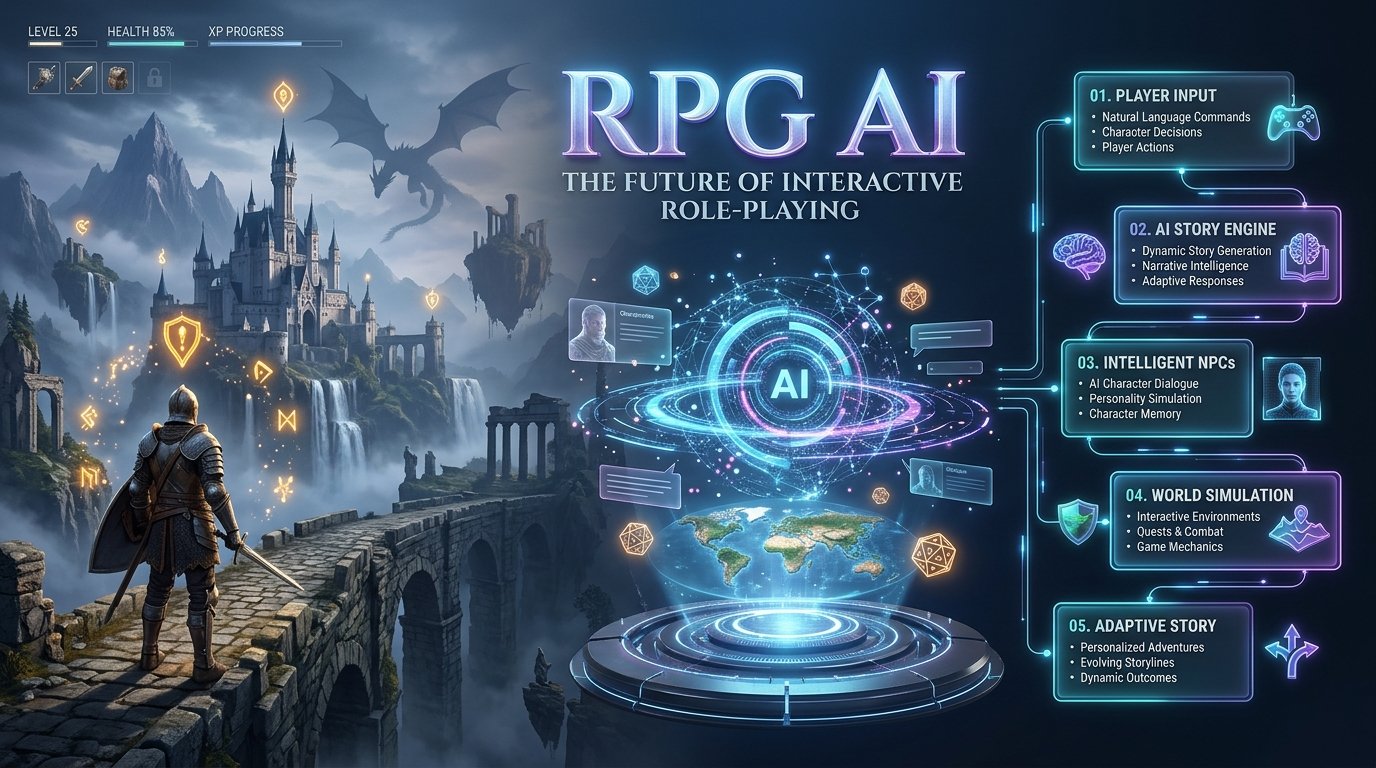
RPG AI uses artificial intelligence to create interactive role-playing experiences where players influence stories, communicate with intelligent characters, and explore evolving game worlds. Modern AI RPG platforms use language models, persistent memory, and game mechanics to deliver more flexible adventures than traditional scripted storytelling.
RPG AI at a Glance
- Dynamic storytelling: AI generates narrative responses based on player decisions.
- Intelligent NPCs: Non-player characters can respond naturally and maintain character personalities.
- AI Game Masters: Players can experience adventures without requiring a human Dungeon Master.
- Personalized worlds: AI helps create characters, locations, quests, dialogue, and fictional environments.
- Flexible gameplay: Some platforms support dice, combat, character progression, and inventory management.
- Important limitation: AI can still forget information, misunderstand instructions, and produce inconsistent game outcomes.
What Is RPG AI?
RPG AI refers to artificial intelligence technologies used to create, manage, and enhance role-playing games. These systems allow players to interact with fictional environments through natural language instead of following only predetermined dialogue and actions.
In a traditional role-playing game, developers write dialogue, create quest paths, and program character behavior. Players explore the possibilities that developers have designed.
AI-powered role-playing games introduce another approach. An AI system can interpret player instructions, generate new dialogue, describe unexpected events, and adapt the narrative to changing circumstances.
For example, imagine entering a medieval village during a fantasy adventure. Instead of choosing between three predefined dialogue options, you can ask the village blacksmith about a mysterious weapon, offer to help with a personal problem, or accuse him of hiding information.
The AI can generate a response that reflects the conversation and available game context.
This creates a more flexible experience, although the quality depends on the underlying AI model and gameplay systems.
RPG AI vs. Traditional RPG Games
| Feature | Traditional RPG | RPG AI |
|---|---|---|
| Storytelling | Mostly scripted | AI-assisted or dynamically generated |
| NPC conversations | Predetermined dialogue | Flexible natural-language responses |
| Player choices | Designed decision paths | Potentially broader free-form actions |
| Quests | Developer-created | Can include dynamically generated quests |
| Game world | Primarily predefined | May adapt to player interactions |
| Character memory | Programmed game state | AI-assisted memory and game-state tracking |
| Replayability | Depends on branching content | Can support varied interactions and outcomes |
One important distinction matters: not every game containing AI qualifies as an AI RPG. A conventional RPG may use AI for enemy movement or character animation without generating its story.
A genuine AI-driven role-playing experience uses AI to influence meaningful interactions, narrative events, or game creation.
How Does RPG AI Work?
RPG AI combines several technologies to create interactive gameplay. Large language models handle natural-language interactions, while additional systems manage game rules, character information, and world state.
Understanding these components helps explain why some AI RPG platforms feel like complete games while others resemble ordinary chatbots.
1. Large Language Models Generate Dialogue and Stories
Large language models (LLMs) are AI systems trained to understand and generate human language.
In an AI RPG, an LLM can act as a storyteller, narrator, character, or virtual Game Master.
When a player describes an action, the model interprets the instruction and generates a response based on the available context.
For example:
Player: I enter the abandoned castle and search for hidden passages.
AI Game Master: Dust covers the stone floor. Behind an ancient painting, you notice a narrow wooden panel with unusual markings.
The player can then investigate the markings, open the panel, or leave the room.
This conversational structure makes gameplay less dependent on fixed dialogue trees.
2. AI Memory Maintains Story Continuity
Memory is one of the most important components of a useful AI RPG.
Without memory, an AI character might forget previous conversations, relationships, important discoveries, or completed quests.
Modern systems can use several memory techniques:
- Conversation history: Keeps recent interactions available.
- Persistent memory: Stores important campaign information between sessions.
- Character profiles: Preserve personalities, motivations, and backgrounds.
- World databases: Store locations, factions, items, and historical events.
- Retrieval-augmented generation (RAG): Retrieves relevant information from stored documents when generating a response.
For example, if a player previously betrayed a merchant, the game can retrieve that information during a later encounter.
The merchant might refuse to trade, demand compensation, or seek revenge.
However, memory quality varies significantly. A platform advertising long-term memory does not automatically guarantee perfect campaign continuity.
3. Game Engines Manage Rules and Outcomes
Natural-language generation alone does not create a complete RPG.
A proper role-playing game also needs systems that manage:
- Character health and statistics
- Inventory and equipment
- Combat calculations
- Experience points
- Dice rolls
- Quest progression
- Character abilities
- Game-world events
These systems provide structure and consequences.
For instance, an AI might narrate a sword attack, but a separate rules engine should determine whether the attack succeeds and how much damage it causes.
This separation is important. If the AI controls every outcome through free-form text, players may encounter inconsistent rules or situations where every action succeeds.
4. AI Systems Generate Game Content
Generative AI can also assist with visual and creative elements.
Depending on the platform, these capabilities may include:
- Fantasy character portraits
- Environmental artwork
- Maps and locations
- Quest descriptions
- Character backstories
- Dialogue and voice narration
- Background music
- Interactive scenes
Some platforms generate content during gameplay, while others rely on previously created assets.
The result is a combination of narrative generation, visual design, and conventional game development.
Key Features of Modern AI RPG Platforms
AI RPG products differ considerably. Some focus on unrestricted storytelling, while others prioritize structured tabletop gameplay.
The following capabilities are particularly useful when evaluating a platform.
Dynamic Storytelling
Dynamic storytelling allows an adventure to respond to unexpected player decisions.
Instead of following one fixed storyline, the AI can generate alternative conversations, encounters, and narrative developments.
This is especially useful for players who enjoy experimentation.
Intelligent NPC Characters
NPCs are characters controlled by the game rather than the player.
AI-powered NPCs can have individual personalities, motivations, relationships, and conversational styles.
A merchant might prioritize money, while a royal guard follows strict orders. A mysterious traveler might conceal information until the player earns their trust.
However, believable behavior requires more than fluent dialogue. Characters need consistent goals and access to relevant historical information.
AI Dungeon Master
An AI Dungeon Master performs many responsibilities traditionally handled by a human Game Master.
These responsibilities can include:
- Describing locations and situations
- Controlling NPCs
- Presenting challenges
- Managing encounters
- Interpreting player decisions
- Applying game rules
- Maintaining campaign continuity
This feature makes solo tabletop-style adventures possible.
Character Creation and Development
AI tools can help players develop original characters by generating:
- Names and backgrounds
- Personality traits
- Special abilities
- Character motivations
- Relationships
- Visual descriptions
Some structured platforms also support character sheets, leveling systems, and equipment management.
Custom World Creation
Certain AI RPG platforms allow users to build their own fictional environments.
Players or creators can define geographical locations, political systems, factions, magical abilities, historical events, and story rules.
This capability is valuable for writers, tabletop Game Masters, and independent game designers.
Best RPG AI Platforms to Explore in 2026
Choosing an AI RPG platform depends on the experience you want. Some services prioritize unrestricted text adventures, while others provide structured campaigns and world-building tools.
Here are several relevant platforms with distinct approaches.
1. AI Dungeon
AI Dungeon is one of the established names in AI-generated interactive storytelling.
The platform became known for allowing players to create open-ended adventures through text prompts. Players can establish scenarios, control characters, and influence how stories develop.
Its approach is particularly suitable for people who enjoy experimental storytelling and unrestricted narrative exploration.
Best suited for: Players who want flexible, text-based AI adventures.
Consideration: Story generation and structured RPG mechanics are different capabilities. Evaluate memory, consistency, and gameplay features before starting a long campaign.
2. Voyage
Voyage is an AI-powered RPG creation platform introduced by Latitude, the company behind AI Dungeon.
Voyage focuses on letting users create and explore customized game worlds.
According to TechCrunch’s April 2026 coverage, users can describe locations, quests, villains, abilities, and other game mechanics. Its underlying World Engine combines multiple AI systems to support narration, gameplay management, and character relationships.
This makes Voyage relevant to players interested in both playing and designing AI-powered adventures.
Best suited for: Creative players and aspiring RPG world-builders.
Consideration: Check current platform availability and feature access before committing to a project.
3. Craft
Craft combines AI-assisted world-building with an AI Game Master.
Its platform allows users to organize characters, locations, factions, items, spells, rules, and other campaign information.
It also supports custom game systems, including user-defined rules written in plain English.
According to its published information, Craft offers browser-based access, free starting access, paid plans from $19.99 per month, and additional pay-as-you-go credits.
Best suited for: Game Masters, RPG creators, world-builders, and developers.
Consideration: Its extensive creation capabilities may require more setup than a simple text adventure.
4. Orpheus
Orpheus offers a tabletop-style RPG experience with an AI Game Master.
Players can describe a world, create a character, and begin an adventure. The AI handles narration, characters, encounters, and supported game mechanics.
Its published feature set includes dice-based outcomes, character progression, illustrated scenes, and optional character voices.
Orpheus also documents an important limitation: its current experience is single-player and English-language.
Its published web pricing includes a free starting option, with monthly plans listed at $9.99, $19.99, and $29.99.
Best suited for: Solo players who want a more structured tabletop-inspired adventure.
Consideration: Multiplayer players should look elsewhere unless the platform expands its supported modes.
Platform Comparison
| Platform | Main Purpose | Target User | Pricing Transparency | Main Consideration |
|---|---|---|---|---|
| AI Dungeon | Open-ended AI adventures | Story explorers | Check current plans | Narrative consistency |
| Voyage | Custom AI RPG creation | Players and creators | Verify current access | Platform development |
| Craft | World-building and AI GM | Game designers and GMs | Published starting price | Setup complexity |
| Orpheus | AI-run tabletop adventures | Solo RPG players | Published plans | Single-player focus |
These products are not interchangeable. Compare their actual gameplay systems instead of choosing based only on marketing descriptions.
Practical Uses of RPG AI
RPG AI has applications beyond casual gaming. Its flexible storytelling capabilities can support creative work, interactive entertainment, and game development.
Solo Role-Playing Adventures
Players do not always have friends available for a tabletop campaign.
An AI Game Master can provide an alternative by narrating encounters, playing supporting characters, and responding to player decisions.
This makes solo adventures easier to start.
Tabletop Game Preparation
Human Game Masters can use AI to reduce preparation time.
For example, an AI assistant can help generate:
- NPC personalities
- Fantasy locations
- Side quests
- Dialogue examples
- Faction relationships
- Adventure hooks
- Encounter concepts
The Game Master can then review and adapt the material before using it.
Creative Writing and Story Development
Writers can use AI RPG systems to experiment with fictional characters and plot situations.
Instead of writing every possible conversation, they can interact with characters and explore alternative story directions.
This can help identify character motivations, narrative conflicts, and unexpected plot opportunities.
Game Prototyping
Independent developers can use AI to test dialogue systems, character interactions, and narrative concepts.
A prototype can help developers understand how players might interact with an environment before investing in a complete game.
However, AI-generated prototypes still require programming, testing, and conventional game design.
Interactive Learning Experiences
Educational creators can adapt role-playing mechanics for interactive scenarios.
For example, a historical simulation could let students play diplomats, merchants, or explorers.
A language-learning adventure could encourage learners to communicate with fictional characters in the target language.
These applications require careful content review and suitable educational design.
Benefits of Using RPG AI
AI-powered role-playing games offer several advantages.
1. Greater creative freedom: Players can describe actions that traditional games may not explicitly provide.
2. Personalized adventures: Stories can reflect individual interests, characters, and decisions.
3. Reduced preparation: AI can assist Game Masters with world-building and narrative development.
4. Accessible solo gameplay: Players can explore adventures without organizing a traditional gaming group.
5. Faster experimentation: Developers can test narrative concepts and NPC interactions more quickly.
6. Expanded storytelling possibilities: AI can generate alternative scenes, conversations, and unexpected events.
The value of these benefits depends on implementation. A flexible text interface is not necessarily equivalent to a complete RPG experience.
Limitations and Challenges of RPG AI
Despite its potential, RPG AI still has important limitations.
Inconsistent Story Memory
AI models can lose track of older events or misunderstand relationships.
A character might forget an important promise, or a previously completed quest might reappear.
Structured memory systems can reduce these problems, but they do not eliminate them.
Hallucinations and Incorrect Information
Large language models can generate convincing but incorrect details.
In an RPG, this might mean inventing an item, changing a character’s abilities, or describing an event that contradicts established world rules.
Players should look for systems that separate narrative generation from factual game-state management.
Unbalanced Gameplay
An AI may struggle to maintain consistent difficulty.
Enemies might become unexpectedly powerful, rewards might be excessive, or combat outcomes might feel unfair.
A reliable rules engine and clear progression system help address these issues.
Usage Limits and Costs
AI generation requires computing resources.
Platforms may impose daily limits, monthly credits, message allowances, or subscription restrictions.
Some services also use premium features for generated images, audio, and advanced models.
Before subscribing, check whether credits expire, what consumes them, and whether longer sessions require additional purchases.
Limited Multiplayer Experiences
Not every AI RPG supports collaborative campaigns.
Some platforms focus entirely on solo storytelling. Others may offer group play but have different restrictions for shared campaigns, player accounts, or session management.
Check multiplayer support before building a campaign around a particular service.
Is RPG AI Better Than Traditional Role-Playing Games?
Neither format is universally better.
Traditional RPGs provide human creativity, social interaction, established rules, and carefully designed encounters.
AI RPGs offer flexible conversations, personalized storytelling, and the ability to experiment with unusual decisions.
The differences become clearer when comparing their strengths.
| Category | Traditional RPG | AI RPG |
|---|---|---|
| Human interaction | Strong | Depends on multiplayer support |
| Narrative flexibility | Designed by creators and GMs | Potentially highly adaptive |
| Rule consistency | Usually predefined | Depends on rule enforcement |
| Preparation | Often requires a GM | Can be partly automated |
| Social experience | Often central | May be limited |
| Unexpected interactions | Driven by players and GM | Can be AI-generated |
For many players, the most useful approach is a combination.
A human Game Master can use AI for preparation while retaining control over the story, atmosphere, and important decisions.
How to Choose the Right RPG AI Tool
Before selecting a platform, consider the type of experience you want.
Decide Between Storytelling and Structured Gameplay
If you enjoy free-form adventures, prioritize narrative flexibility.
If you prefer traditional tabletop mechanics, look for dice rolls, character statistics, inventory, combat rules, and progression systems.
These are not automatically included in every AI RPG.
Test Long-Term Memory
Start a short campaign and introduce several important details.
Return to those details later and see whether the platform recalls them correctly.
Test relationships, locations, completed quests, and character history.
Review Customization Options
Look for control over:
- Story genre
- Character personality
- Narrative tone
- World settings
- Difficulty
- Game rules
- Content boundaries
Good customization makes an adventure more suitable for different play styles.
Understand Pricing and Usage Limits
Compare free allowances with paid subscriptions.
Pay attention to:
- Daily message limits
- Monthly credits
- Image-generation costs
- Voice-generation costs
- Model access
- Credit expiry
- Additional usage charges
Do not assume that a free account includes unlimited gameplay.
Check Privacy and Data Policies
AI RPG sessions can contain personal writing, original characters, unpublished stories, and private creative ideas.
Review how the provider handles conversation storage, account information, and model training.
Do not assume that a platform offers Zero Data Retention simply because it uses an established AI provider.
The Future of RPG AI
The next stage of RPG AI will likely involve more sophisticated interactions between language models and conventional game systems.
Several developments are worth watching.
More Consistent AI Characters
Improved memory and structured character profiles could help NPCs maintain personalities and relationships over longer campaigns.
More Interactive Game Worlds
Future platforms may combine generated dialogue with changing maps, environmental events, and character actions.
Voice-Based Role-Playing
Speech recognition and AI-generated voices could make adventures feel more conversational.
Players may be able to speak directly with characters instead of typing every interaction.
AI-Assisted Game Development
Developers may increasingly use generative systems to prototype quests, dialogue, characters, and narrative environments.
However, generated content will still need human review, balancing, and quality assurance.
Hybrid Human and AI Game Masters
A promising direction is a hybrid approach.
Human Game Masters could control the overall experience while AI handles supporting characters, background dialogue, and repetitive preparation tasks.
This approach could preserve human creativity while reducing routine work.
These developments are possibilities, not guarantees. Their success will depend on technical reliability, production costs, player acceptance, and the quality of implementation.
Who Should Use RPG AI?
RPG AI can appeal to different audiences.
| Audience | Potential Value |
|---|---|
| Solo gamers | Play without organizing a group |
| Fantasy writers | Explore characters and story ideas |
| Tabletop Game Masters | Prepare NPCs, quests, and settings |
| Indie developers | Prototype interactive narratives |
| Creative storytellers | Experiment with alternative plot directions |
| RPG beginners | Learn role-playing through guided adventures |
It may be less suitable for players who prioritize face-to-face social interaction, highly competitive gameplay, or perfectly predictable rules.
Common Mistakes to Avoid When Using AI RPG Tools
Getting a good experience requires more than entering a random prompt.
Avoid these common mistakes:
- Choosing a chatbot instead of an RPG: Character conversation does not necessarily include game mechanics.
- Ignoring memory limitations: Long campaigns require reliable continuity.
- Expecting perfect rules: AI-generated explanations should not replace proper game-state tracking.
- Paying before testing: Explore free access and understand usage restrictions.
- Providing vague instructions: Clear character goals and world descriptions produce more useful interactions.
- Ignoring privacy: Avoid sharing sensitive personal information in game conversations.
- Assuming every platform supports multiplayer: Confirm the feature before inviting friends.
A little preparation can make an AI-generated adventure considerably more enjoyable.
Frequently Asked Questions
1. What does RPG AI mean?
RPG AI means using artificial intelligence to create or enhance role-playing games. It can generate stories, manage NPC conversations, run game scenarios, and support interactive world-building.
2. Can I play an RPG with an AI Dungeon Master?
Yes. Several AI RPG platforms provide virtual Game Masters that narrate adventures, control NPCs, and manage supported game mechanics. Orpheus and Craft are examples of platforms offering AI Game Master experiences.
3. Are there free RPG AI games?
Yes. Some platforms offer free starting access or limited free gameplay. AI Dungeon, Craft, and Orpheus are examples worth exploring. However, free access may have restrictions on usage, features, or credits.
4. Can RPG AI create custom characters and game worlds?
Yes. Depending on the platform, AI can help generate character backgrounds, fictional locations, quests, factions, dialogue, and world lore. Some platforms also let users define custom rules and publish their creations.
5. Can RPG AI replace a human Dungeon Master?
RPG AI can handle several Game Master responsibilities, particularly in solo adventures and simple campaigns. However, it may struggle with complex rules, emotional judgment, and long-term consistency. Human Game Masters remain valuable for collaborative storytelling and creative decision-making.
Conclusion
RPG AI is changing how people create and experience role-playing adventures. It combines language models, interactive storytelling, memory systems, and game mechanics to make more flexible experiences possible.
For solo players, AI Game Masters offer an accessible way to explore fictional worlds. Writers can experiment with characters, while developers and tabletop Game Masters can use AI to accelerate creative work.
However, choosing the right platform matters. Evaluate story continuity, rule enforcement, multiplayer support, pricing, and privacy before committing to a long campaign.
The most promising approach is not necessarily replacing traditional RPGs. It is using AI where it adds genuine creative value while preserving the human imagination that makes role-playing games enjoyable.