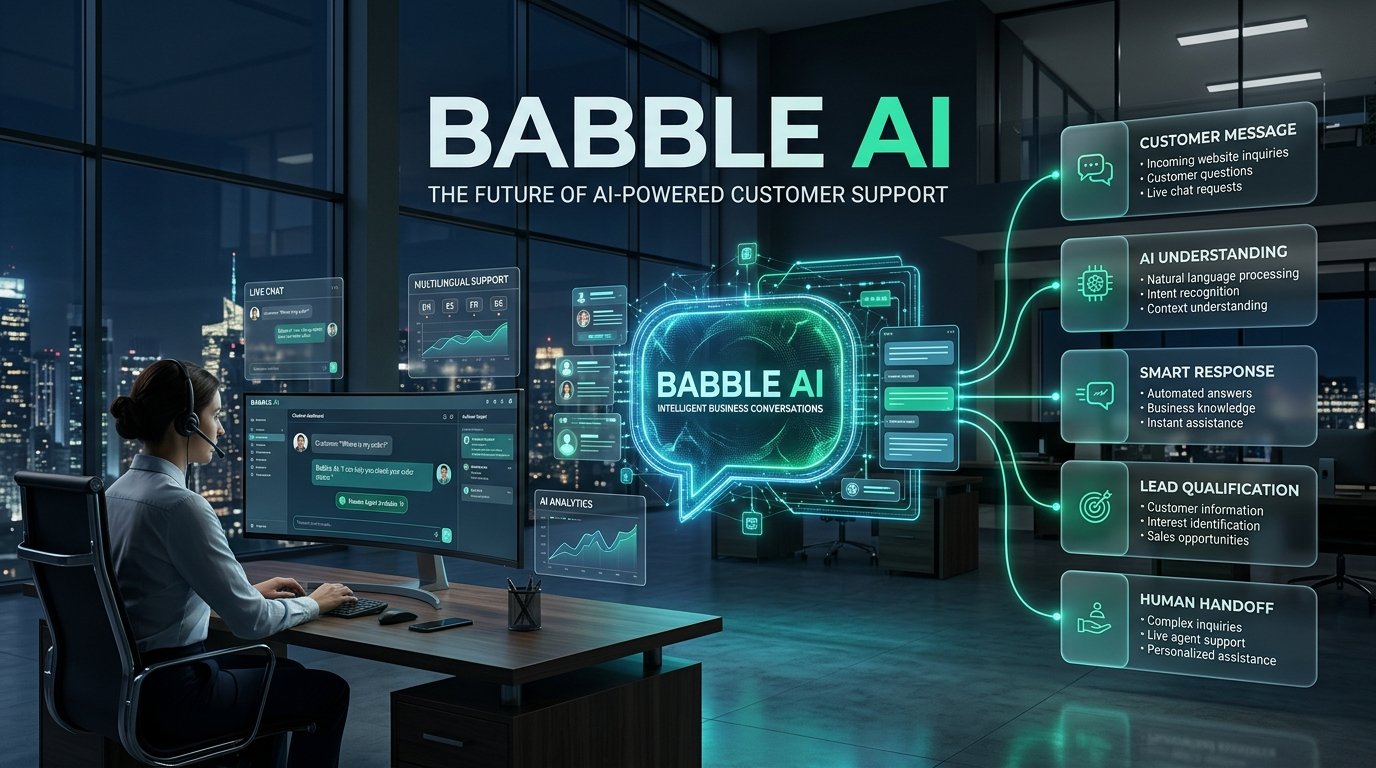
Babble AI is a no-code AI chatbot platform that helps businesses automate website conversations, answer customer questions, and generate sales leads. It offers chatbot customization, multilingual support, analytics, and business-focused automation, with free and paid plans listed on its official website.
Babble AI at a Glance
Babble AI
Free plan listed
Babble AI – Desktop App – Mac, Windows – WebCatalog
webcatalog.io
| Category | Information |
|---|---|
| Product type | AI chatbot builder |
| Developer | Ionaught Technologies |
| Official website | babble-ai.com |
| Free plan | $0 |
| Starter | $14.99/month |
| Pro | $44.99/month |
| Main audience | Businesses and website owners |
| Deployment | Website chatbot |
Key takeaways
- Build chatbots without traditional programming.
- Train bots using documents and written instructions.
- Automate frequently asked customer questions.
- Support sales conversations and lead qualification.
- Monitor chatbot activity through analytics.
- Check message limits and privacy terms before deployment.
babble-ai.com+2
What Is Babble AI?
Babble AI is a conversational AI platform developed by Ionaught Technologies. It helps businesses create customized chatbots for websites and customer-facing operations.
Instead of building a chatbot from scratch, users can configure an assistant through a no-code interface. They can provide business information, upload documents, and customize chatbot responses.
The platform focuses on several business requirements:
- Customer support automation.
- Product and service inquiries.
- Lead generation and qualification.
- Sales assistance.
- Appointment-related conversations.
- Order and reservation updates.
Its main appeal is accessibility. Businesses can introduce automated conversations without hiring a dedicated AI development team.
According to its official website, Babble AI also supports live chat, multilingual communication, chatbot customization, and analytics. babble-ai.com+1
Is Babble AI the Same as Babble.sh?
No. This distinction matters because several products use the Babble name.
Babble AI at babble-ai.com is a chatbot product associated with Ionaught Technologies. Babble.sh is a separate service that has published a shutdown notice.
They should not be treated as the same company or product. babble.sh+1
How Does Babble AI Work?
Babble AI follows a relatively straightforward chatbot creation process. Users configure an assistant, provide relevant information, and deploy it for customer interactions.
Here is how a typical implementation works.
1. Create an Account
Start by visiting the official Babble AI website and registering an account.
The registration page requests basic organization and user information. Once registered, users can access the chatbot creation environment. babble-ai.com+1
2. Configure Your Chatbot
The next step involves defining the chatbot’s purpose.
For example, an online clothing store might create an assistant that answers questions about:
- Product availability.
- Clothing sizes.
- Shipping policies.
- Return procedures.
- Payment methods.
- Delivery estimates.
Clear instructions help establish the chatbot’s role and expected behavior.
3. Add Business Knowledge
A chatbot needs relevant information to answer customer questions.
Babble AI describes document uploads and written instructions as ways to train and customize bots.
A business could provide product descriptions, service information, frequently asked questions, and company policies.
However, users should test whether the chatbot consistently retrieves the correct information. Uploading documents alone does not guarantee accurate responses.
4. Customize the Experience
Businesses can configure the chatbot around their requirements.
This includes tailoring responses and creating a conversational experience that reflects the company’s services.
A useful chatbot should communicate clearly, avoid unnecessary questions, and recognize when a customer needs human assistance.
5. Deploy the Chatbot
After configuration and testing, the chatbot can be added to a website.
The official website promotes website integration and chatbot deployment without requiring traditional coding. babble-ai.com+1
6. Monitor Customer Interactions
Once deployed, businesses need to evaluate how customers interact with the assistant.
Analytics can help identify frequently asked questions, engagement patterns, and areas where the chatbot needs improvement.
Regular monitoring is particularly important when business information changes.
Key Features of Babble AI
Babble AI focuses on practical chatbot functionality rather than requiring users to build complex AI infrastructure.
Here are its main advertised features.
No-Code Chatbot Builder
One of Babble AI’s central features is its no-code chatbot creation interface.
Users can configure assistants without writing traditional application code. This makes chatbot development more accessible to small businesses and nontechnical teams.
The platform describes document uploads and written instructions as part of the customization process.
Why it matters: Businesses can experiment with customer support automation without immediately hiring developers.
AI-Powered Customer Support
Babble AI promotes automated responses to common customer questions.
For example, a service provider could configure a chatbot to explain its operating hours, pricing structure, and booking procedures.
This can reduce repetitive work for support employees.
However, complex complaints and sensitive customer situations should still reach human representatives.
Live Chat and Human Handoff
Babble AI advertises live chat functionality that allows human agents to take over conversations.
This is important because automated systems cannot reliably resolve every customer issue.
A practical support workflow should recognize when a conversation requires human attention.
Businesses should confirm how agent assignment, notifications, and conversation history work before depending on this feature.
Multilingual Support
The platform advertises multilingual chatbot capabilities.
This can help businesses communicate with customers who prefer different languages.
However, multilingual availability does not automatically guarantee equal response quality across languages.
Companies serving international audiences should test local expressions, regional terminology, and complex customer questions.
Real-Time Analytics
Babble AI promotes analytics for monitoring chatbot interactions.
Useful measurements for businesses include:
- Total conversations.
- Frequently asked questions.
- Customer engagement.
- Unanswered questions.
- Lead generation activity.
- Human handoff frequency.
The exact analytics fields and reporting capabilities should be confirmed inside the current dashboard.
Lead Generation and Qualification
A chatbot can collect information from interested website visitors.
For example, a digital marketing agency might ask visitors about their business type, marketing requirements, and estimated budget.
The information can help sales representatives prioritize relevant inquiries.
Babble AI’s product listings also describe lead qualification and CRM integration. However, buyers should confirm the exact supported CRM integrations before purchasing. Techjockey US+1
Website Integration
Babble AI promotes embedding chatbots into websites.
A website chatbot can provide assistance without requiring visitors to leave the current page.
Before implementation, check compatibility with your CMS, website builder, and existing scripts.
Practical Use Cases of Babble AI
The usefulness of Babble AI depends on the type of business and the questions customers regularly ask.
Here are several realistic applications.
E-commerce Businesses
Online stores receive repetitive questions about products, delivery, returns, and payments.
A chatbot can provide basic information and help customers find relevant products.
For example, a visitor asking about delivery availability could receive an answer based on the store’s published shipping policy.
The business should regularly update its product and shipping information to avoid outdated answers.
Healthcare and Clinics
Healthcare organizations may use chatbots for general administrative questions.
Potential applications include:
- Clinic operating hours.
- Appointment procedures.
- Department information.
- General service descriptions.
- Contact information.
However, businesses should not assume Babble AI is suitable for processing sensitive patient information.
Healthcare deployments require appropriate privacy safeguards, regulatory review, and clear boundaries around medical advice.
Educational Institutions
Schools, training centers, and educational organizations receive recurring inquiries about admissions, courses, schedules, and fees.
A chatbot could answer common administrative questions using approved institutional information.
This may help administrative employees focus on more complicated requests.
Professional Service Providers
Law firms, consulting agencies, and marketing companies can use website chatbots to collect initial inquiries.
For example, a consulting company could ask visitors about their industry and the type of assistance they require.
The chatbot can then direct qualified prospects toward a consultation process.
It should not provide unreviewed legal or professional advice.
Small and Medium-Sized Businesses
Small businesses often operate with limited customer support resources.
An automated chatbot can help handle repetitive questions outside normal working hours.
This is particularly useful when a company receives website inquiries while employees are unavailable.
Benefits of Using Babble AI
Babble AI offers several potential advantages for businesses that want to introduce chatbot automation.
1. Reduced Repetitive Work
Customer support employees frequently answer the same questions.
A properly configured chatbot can handle routine inquiries and reduce the need for manual responses.
2. Continuous Website Assistance
An automated chatbot can remain available when employees are offline.
This gives website visitors another way to find basic information outside regular business hours.
Actual availability depends on the platform’s service and configuration.
3. Easier Chatbot Development
The no-code approach reduces the technical knowledge required to create a chatbot.
Small businesses can experiment with conversational automation without developing a custom AI application.
4. Better Lead Collection
Chatbots can collect information from potential customers before a sales representative contacts them.
This creates a more organized starting point for sales conversations.
5. Scalable Customer Conversations
Businesses can use automated responses to manage recurring inquiries as website traffic grows.
However, increased conversation volume does not automatically mean better customer service. Response accuracy and escalation processes remain essential.
Babble AI Limitations: What Should You Consider?
No chatbot platform is suitable for every business. Babble AI also has areas that deserve careful evaluation.
Limited Independent Technical Documentation
Public product information describes the main chatbot features, but detailed technical documentation is less prominent.
Businesses with complex requirements should request documentation covering integrations, APIs, deployment, and administration.
AI Response Accuracy
AI chatbots can misunderstand questions or produce incorrect information.
This risk becomes more significant when the chatbot receives incomplete, outdated, or contradictory training material.
Businesses should test common questions and unusual scenarios before allowing customer-facing deployment.
Integration Compatibility
Babble AI advertises CRM integration and website connectivity.
However, the availability of a particular integration should not be assumed from general marketing statements.
Confirm whether your existing CRM, helpdesk, e-commerce platform, and communication channels are supported.
Message and User Limits
The published pricing tiers include different user and message allowances.
A growing business could exceed its monthly allocation sooner than expected.
Check how the platform handles usage limits, overages, additional messages, and account upgrades.
Limited Public Security Detail
Businesses should understand how customer conversations and uploaded documents are handled.
Publicly available product descriptions are not enough to establish specific security certifications or data-retention guarantees.
Request the relevant documentation before processing confidential information.
Babble AI Pricing: How Much Does It Cost?
Babble AI publishes a free option alongside two paid subscription plans and custom pricing.
The following prices and allowances are displayed on its official pricing page in the available published snapshot. They should be reconfirmed at checkout before purchasing. babble-ai.com+1
Babble AI pricing
Published prices in USD, before applicable taxes
Free
$0
- 1 chatbot
- 100 users
- 500 unique messagesGetting started
Starter
$14.99 /month
- Fine-tuned model
- 2 chatbots
- 800 users
- 4,000 unique messages
- 8 × 5 supportSmall websites
Pro
$44.99 /month
- Fine-tuned model
- 5 chatbots
- 3,000 users
- 15,000 unique messages
- 24 × 7 supportGrowing businesses
Custom Plan
Custom pricing
- Designed for higher interaction volumes
- Contact the provider for requirements and pricing
Source: Official Babble AI pricing page and published plan details. The free-plan allowance is also reported by third-party listings; verify it directly with the provider.
Which Babble AI Plan Should You Choose?
Free plan: Suitable for initial experimentation and testing a basic chatbot.
Starter plan: Worth evaluating if your website needs multiple chatbots and receives a moderate number of customer inquiries.
Pro plan: More appropriate for businesses managing several chatbot deployments or higher interaction volumes.
Custom plan: Consider requesting a quote if your business expects substantially higher traffic.
Hidden Costs and Pricing Questions
The subscription price is only one part of the purchasing decision.
Before upgrading, ask the provider:
- What happens when the monthly message allowance is exhausted?
- Are additional messages charged separately?
- Does the subscription renew automatically?
- Are there setup or integration fees?
- Are advanced integrations included?
- Is chatbot training included in the subscription?
- Can unused messages roll over?
- Are there additional charges for human agents?
These details can significantly affect the actual cost of operating a chatbot.
Babble AI Privacy and Security
Privacy is an important consideration when introducing conversational AI into a business.
Customers may share contact information, order details, personal questions, or other sensitive information through website chatbots.
Businesses should understand where this information goes and how it is processed.
Before using Babble AI commercially, review the following areas.
Customer Data Collection
Determine what information the chatbot collects during conversations.
Check whether the platform stores customer names, email addresses, contact details, uploaded documents, and conversation histories.
Data Retention
Ask how long conversation records remain stored.
Also determine whether administrators can delete individual conversations or request complete data removal.
Third-Party AI Processing
Ask whether Babble AI processes conversations through its own infrastructure or external AI model providers.
If external providers are involved, identify their data-processing and retention policies.
Enterprise Security
For business deployments, request information about:
- Encryption during transmission and storage.
- Administrative access controls.
- Data deletion procedures.
- Security incident handling.
- Data-processing agreements.
- Applicable compliance certifications.
- Data residency options.
Important: Do not assume that Babble AI offers SOC 2 certification, Zero Data Retention, or a particular encryption standard without receiving supporting documentation.
Its publicly available marketing information does not establish those specific guarantees.
Babble AI Alternatives and Competitors
Babble AI is not the only option for businesses interested in conversational automation.
Several established platforms provide overlapping chatbot, customer support, and AI agent capabilities.
The right alternative depends on your technical requirements, budget, and existing business systems.
1. Tidio
Best for small businesses and e-commerce stores.
Tidio combines live chat, ticketing, automation, and its Lyro AI agent. It also provides integrations with popular commerce and website platforms.
Pricing: Free plan; paid Starter pricing starts at $24.17/month with annual billing in the published US pricing. Tidio+1
Botpress – Generative AI Platform for Building ChatGPT Chatbots – ToolPilot
2. Botpress
Best for developers and businesses requiring advanced chatbot customization.
Botpress provides an AI agent development environment, knowledge management, integrations, and conversation-based usage plans.
Pricing: Free plan; Plus is listed at $150/month with annual billing. botpress.com
Home – AI Agents Directory | aiagentsly
3. Intercom
Best for growing support teams and businesses with established customer service operations.
Intercom provides customer messaging, support workflows, and its Fin AI agent.
Pricing: Subscription and usage-based costs; check the official pricing page for current rates.
Official website
Chatbase Logo PNG, Vector (AI, EPS, CDR, PDF, SVG) – iconLogoVector
4. Chatbase
Best for companies that want to create knowledge-based AI assistants.
Chatbase focuses on building chatbots using business information and connecting conversational assistants to customer-facing workflows.
Pricing: Offers paid plans; confirm current usage allowances and prices directly.
Official website
CXPA Global | CX Day
5. Zendesk
Best for organizations that need structured customer support and ticket management.
Zendesk offers support workflows, helpdesk functionality, automation, and AI-powered customer service capabilities.
Pricing: Multiple subscription tiers; AI and advanced capabilities may affect the total cost.
Official website
Babble AI vs. Its Alternatives
| Platform | Target user | Main strength | Pricing transparency | Main consideration |
|---|---|---|---|---|
| Babble AI | Small businesses | Simple chatbot creation | Published tiers | Verify integrations |
| Tidio | E-commerce | Live chat and AI support | Public pricing | Conversation limits |
| Botpress | Developers | Custom AI agents | Public pricing | More technical setup |
| Intercom | Support teams | Customer service workflows | Public pricing | Usage-based costs |
| Chatbase | Website owners | Knowledge-based chatbots | Public pricing | Usage allowances |
| Zendesk | Support departments | Helpdesk management | Public pricing | Broader platform complexity |
Editorial assessment: Babble AI may appeal to businesses looking for a straightforward chatbot builder. Tidio is worth comparing for e-commerce support, while Botpress deserves consideration for more customized AI workflows.
These products are not identical. Compare actual requirements instead of choosing solely by advertised starting prices.
Who Should Use Babble AI?
Babble AI may be worth evaluating for the following audiences.
Small business owners: Businesses that receive repeated website inquiries can explore chatbot automation.
E-commerce operators: Online stores may use conversational assistants to answer common product and delivery questions.
Marketing teams: Marketers can investigate chatbot-based lead collection and customer engagement.
Service providers: Agencies and consultants can explore automated responses to initial customer inquiries.
Startups: Early-stage businesses can experiment with automated support before expanding their customer service operations.
Who Should Avoid It?
Babble AI may not be the right choice for organizations that require extensive developer documentation, verified enterprise security certifications, complex omnichannel workflows, or guaranteed AI response accuracy.
Those businesses should evaluate enterprise-focused alternatives and request technical documentation before committing.
Practical Tips for Getting Better Results
Choosing a chatbot is only the first step. Its performance also depends on configuration and ongoing maintenance.
Here are five useful practices.
- Start with common questions: Identify the 20 most frequent questions your customers ask.
- Use accurate documents: Upload current product information, policies, and service descriptions.
- Write clear instructions: Define the chatbot’s role, response style, and limitations.
- Test difficult questions: Include ambiguous questions and situations requiring human assistance.
- Review conversations: Regularly identify incorrect answers and update the underlying information.
A chatbot should complement your customer service team rather than replace human judgment.
Common Mistakes to Avoid When Using Babble AI
Even a simple chatbot can create customer frustration when configured incorrectly.
Avoid these common mistakes:
- Uploading outdated product information.
- Providing contradictory chatbot instructions.
- Assuming every AI response is accurate.
- Ignoring unanswered customer questions.
- Failing to establish human handoff procedures.
- Collecting unnecessary personal information.
- Ignoring message limits and subscription conditions.
- Deploying the chatbot without testing it on mobile devices.
The most effective approach is to start with a narrow purpose, measure results, and expand gradually.
Frequently Asked Questions
1. What is Babble AI used for?
Babble AI is used to create AI-powered chatbots for business websites. It helps automate customer support, answer frequently asked questions, collect leads, and manage routine customer interactions.
2. Is Babble AI free?
Yes. Babble AI lists a free plan that includes one chatbot, 100 users, and 500 unique messages. Paid subscriptions start at $14.99 per month for the Starter plan. Confirm the current allowances on its official website.
3. Does Babble AI require coding skills?
No. Babble AI promotes a no-code chatbot builder. Users can configure chatbots through its interface, provide written instructions, and upload business documents without traditional programming.
4. Is Babble AI suitable for e-commerce businesses?
It may be suitable for online stores that want to automate basic product inquiries, customer support, and lead collection. However, businesses should verify e-commerce integrations, order-management capabilities, and customer data handling before deployment.
5. Is Babble AI safe for business use?
Its suitability depends on the company’s security and privacy requirements. Businesses should review its data-retention policies, encryption practices, third-party AI providers, and compliance documentation before sharing confidential customer information.
Conclusion
Babble AI is a business-focused chatbot platform designed to simplify conversational automation.
Its no-code builder, document-based customization, live chat, multilingual support, and analytics make it an interesting option for businesses exploring AI-powered customer communication.
Its published pricing also provides an accessible starting point for smaller organizations.
However, buyers should look beyond the advertised features. Integration compatibility, response accuracy, message allowances, data retention, and customer support are important considerations.
For small businesses seeking a straightforward chatbot, Babble AI is worth evaluating. Organizations with advanced technical or compliance requirements should compare it with established alternatives such as Tidio, Botpress, Intercom, and Zendesk.
The best approach is to test the free offering, evaluate real customer conversations, and upgrade only when the platform meets your business requirements.