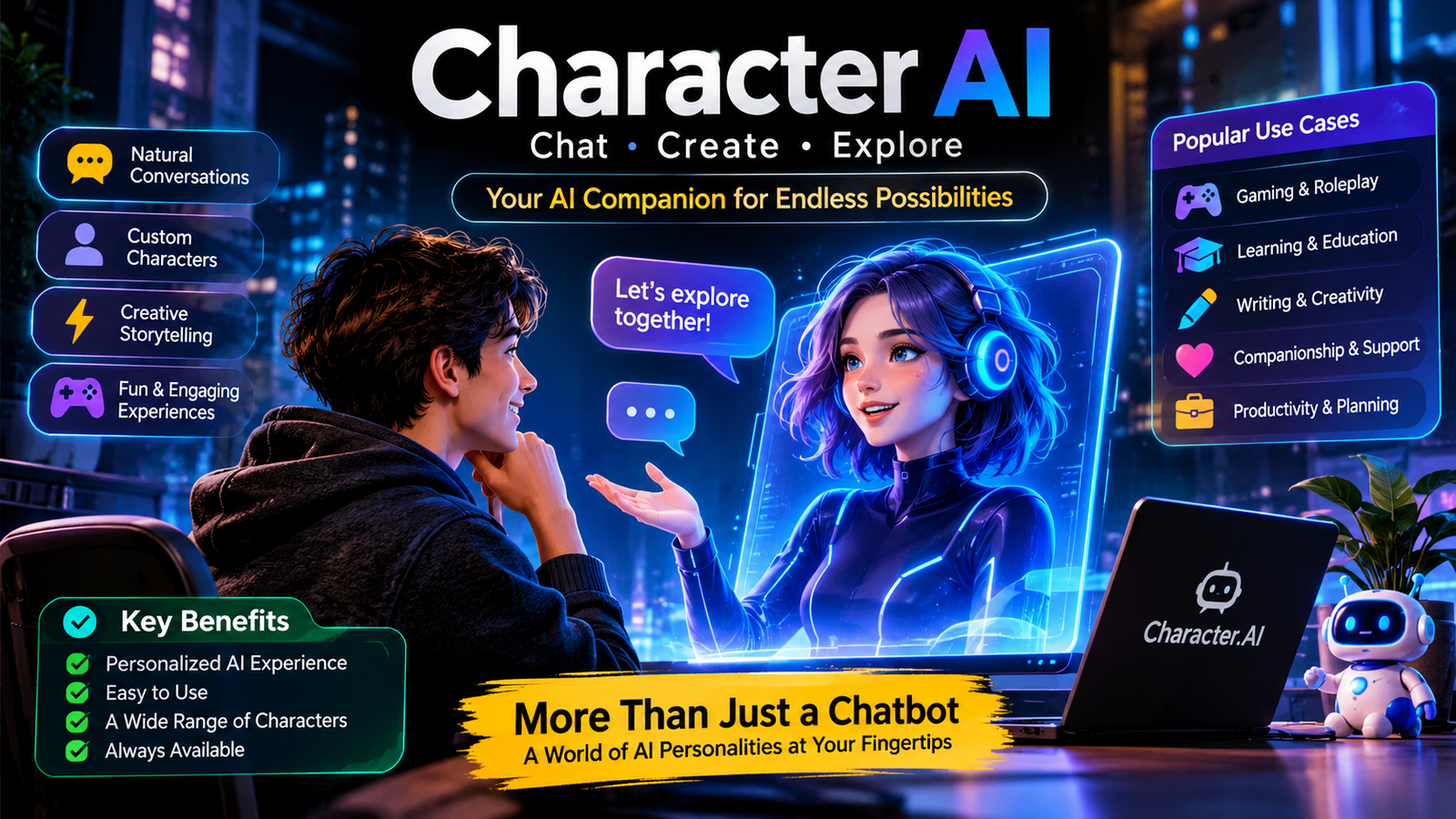
Character AI is an AI-powered chatbot platform that lets users create, discover, and interact with virtual characters through personalized conversations, roleplay, and voice features. It combines generative AI with customizable character profiles, memory tools, and interactive storytelling, although age restrictions, privacy considerations, and occasional response inconsistencies deserve attention.
Character AI at a Glance
Character AI: Chat, Talk, Text App – App Store
Character.AI
AI chatbot and character creation platform
Free access available
Official website
- Main purpose: AI-powered conversations and interactive storytelling.
- Character creation: Build personalized AI characters with descriptions, personalities, avatars, and voices.
- Communication: Text conversations and supported voice experiences.
- Memory: Story Memory, pinned messages, and character facts.
- Premium plan: c.ai+ subscription with additional benefits.
- Important restriction: Under-18 users are placed in a reading-only experience under the age-assurance policy published in July 2026.
What Is Character AI?
Character AI, commonly written as Character.AI or C.AI, is a conversational artificial intelligence platform developed by Character Technologies.
It allows users to interact with AI-generated personalities instead of communicating with a conventional question-and-answer chatbot.
These personalities are called Characters. Each one can have its own name, personality, background, speaking style, and conversational behavior.
For example, users might discover:
- Fictional characters inspired by fantasy and science fiction.
- Historical personalities recreated for educational conversations.
- AI tutors that explain complicated subjects.
- Original characters created by community members.
- Interactive storytelling companions.
- Virtual personalities designed for casual conversation.
The platform’s main appeal is its emphasis on personality and interaction.
Instead of simply asking an AI assistant to explain something, users can enter a fictional scenario and develop a conversation over multiple exchanges.
Character AI is therefore better understood as an AI entertainment and interactive storytelling platform than a traditional productivity chatbot.
Character AI Review 2026 – Best AI Character Chat Platform
File:A user conversing with a Character.ai simulation of Wikipedia.png – Wikimedia Commons
AI Chatbots Can Create Big Character IP Faster Than Hollywood
8
How Does Character AI Work?
Character AI uses generative AI models to produce responses based on conversation history, character instructions, and contextual information.
Large language models (LLMs) power this type of experience. They process text and generate responses that resemble natural human conversation.
However, a character’s personality does not mean it has human emotions, consciousness, or independent understanding.
1. Character Definitions and Personalities
Every character has information that influences its responses.
Creators can configure details such as:
- Character name and appearance.
- Personality traits and behavioral patterns.
- Background and fictional history.
- Greeting messages.
- Conversation style.
- Example dialogue and character definitions.
These instructions provide context for the AI model.
For instance, a character described as a medieval historian may respond differently from a futuristic robot or a fictional detective.
2. Natural Language Processing
Natural language processing helps the platform interpret user messages and generate relevant replies.
When someone sends a message, the underlying AI system processes the conversation and predicts an appropriate response.
This process can include:
- Reading the latest message.
- Considering available conversation context.
- Applying character-specific instructions.
- Generating a response.
- Returning the generated text to the user.
The output is generated dynamically rather than selected from a fixed collection of prerecorded answers.
3. Context and Memory
Conversation memory is particularly important for interactive storytelling.
Without sufficient context, an AI character may forget previous events, relationships, or details.
Character AI introduced several memory-related features in 2026, including Story Memory, Facts, and Memory Usage.
Users can preserve important details and manage information that should remain relevant during longer conversations. Pinned Memories also allow users to save up to five messages per chat under the September 2026 free-feature announcement. character.ai blog+1
4. Response Generation
After processing the available information, the AI generates a response.
The quality depends on several factors:
- Character definition quality.
- Available conversational context.
- Model capabilities.
- Prompt clarity.
- Memory management.
- Safety and content restrictions.
This explains why two characters can respond differently to identical messages.
It also explains why a conversation may occasionally become repetitive, inconsistent, or unrelated to the original scenario.
Key Features of Character AI
Character AI offers more than basic text-based chatbot functionality. Its character creation, memory, voice, and entertainment features make the platform particularly interesting for interactive content.
1. Custom AI Character Creation
Character creation is one of the platform’s central features.
Users can build original characters by providing a name, avatar, greeting, tags, and additional personality information.
The creation process also supports different visibility settings:
| Visibility | How it works |
|---|---|
| Public | Other users can discover and interact with the character. |
| Unlisted | Access is available through a direct link. |
| Private | Only the creator can access the character. |
Creators can also develop character definitions and example dialogue to establish more consistent personalities.
Character AI’s official creation guide documents these settings and the character publishing process. C.AI Help Center+1
2. AI Voice Features
Voice functionality adds another dimension to character interactions.
Character AI supports a voice library, custom voice creation, and voice assignment to characters.
Users can select available voices or create one using an audio sample, subject to the platform’s applicable requirements and restrictions.
This makes conversations feel more interactive than conventional text exchanges.
Voice features are especially relevant to people interested in character-driven entertainment and spoken interactions. C.AI Help Center
3. Story Memory and Pinned Memories
Long conversations often require the AI to remember earlier events.
Character AI addresses this through memory-related functionality.
Story Memory allows important background information and events to remain available during a conversation.
Pinned Memories let users preserve selected messages.
The platform also introduced Facts, which can capture details about users, characters, and side characters.
An important distinction is that memory features do not guarantee perfect recall. Users should still review important story details and correct inconsistencies when necessary. character.ai blog+1
4. Community Character Discovery
Character discovery makes it possible to explore personalities created by other users.
The platform’s discovery experience includes different categories, character profiles, and searchable content.
This creates a community-driven ecosystem where individual creators contribute new conversational experiences.
5. Lorebook for Interactive Worldbuilding
One particularly interesting 2026 development is Lorebook.
Introduced in July 2026, Lorebook gives creators a way to build structured knowledge around fictional worlds.
Its entries can describe:
- Locations.
- Side characters.
- Important events.
- Objects and artifacts.
- Organizations and factions.
- Fictional rules and histories.
Characters can access relevant entries when associated keywords appear in conversations.
For example, mentioning a fictional kingdom can activate information about its history, characters, and political relationships.
This helps separate worldbuilding information from an individual character’s basic personality definition.
At launch, Lorebook was introduced in beta with early access for c.ai+ subscribers. character.ai blog
6. Character-Based Entertainment
Character AI has also expanded beyond traditional chatbot interactions.
In August 2026, the company introduced c.ai series, a collection of studio-produced vertical microdramas.
The concept connects video storytelling with interactive character conversations.
Users can watch a story and then interact with characters from that story through the platform.
This represents a broader move toward AI-powered entertainment rather than chatbot functionality alone. character.ai blog
Character AI Pricing: Is It Free?
Character AI offers free access and a separate premium subscription called c.ai+.
The free experience provides access to character conversations, while the paid plan focuses on additional convenience and premium benefits.
Free Plan
The free version is suitable for exploring the platform and trying different characters.
According to the September 2026 c.ai+ FAQ, free users continue to receive unlimited messaging.
Free access is useful for:
- Exploring community-created characters.
- Creating personalized characters.
- Participating in text conversations.
- Trying supported voice features.
- Using available memory functionality.
- Discovering interactive stories.
However, free users may encounter waiting rooms during periods of high traffic.
c.ai+ Premium Subscription
c.ai+
Optional subscription
Premium access and convenience features
Character AI’s published subscription FAQ identifies these benefits:
- Skip waiting rooms.
- Faster message generation.
- Access to an exclusive community channel.
- Faster feedback and support.
- Early access to selected new features.
The company states that c.ai+ messages can generate approximately two to three times faster under its published FAQ. This is a company-reported figure, not an independently verified benchmark. C.AI Help Center
How Much Does Character AI Cost?
The official 2026 promotional terms list the following US-dollar subscription examples:
| Subscription | Promotional price | Subsequent price |
|---|---|---|
| Three-month offer | $14.99 upfront | $9.99/month |
| Annual offer | $59.99 for the first year | $94.99/year |
These were limited promotional offers published in June 2026, not guaranteed November 2026 prices. Offer Terms – C.AI Help Center
Important pricing considerations:
- Promotional eligibility can vary.
- Subscriptions automatically renew unless canceled.
- Regional pricing and taxes may change the final amount.
- App Store, Google Play, and website billing can differ.
- Unused subscription time may not qualify for partial refunds.
For users in Pakistan and other international markets, the checkout price in the relevant currency is more useful than an old US-dollar comparison.
Check the current subscription details before purchasing.
Character AI Safety and Age Restrictions
Safety is one of the most important considerations when evaluating Character AI.
AI characters can produce inaccurate, inappropriate, or unexpected responses. Their conversational style may also make fictional interactions feel more personal than they actually are.
This matters particularly when younger users interact with AI companions.
Character AI’s Age-Assurance Policy
Character AI published an updated age-assurance policy in July 2026.
According to its official documentation:
- All users must complete an age-assurance check.
- Users verified as 18 or older retain access to character chats and standard platform features.
- Users verified as under 18 are placed in a restricted experience.
- The under-18 experience includes reading mode, without character chat.
The company identifies Persona as its third-party age-assurance provider and states that it does not directly handle or store submitted verification documents. C.AI Help Center
This is an important distinction from older Character AI reviews that describe unrestricted chatbot access for teenage users.
Those older descriptions may no longer reflect the current platform policy.
Can Character AI Produce Inaccurate Information?
Yes.
Character AI generates responses using probabilistic AI systems. A convincing answer is not necessarily a correct answer.
Characters can:
- Invent historical details.
- Misinterpret questions.
- Contradict previous statements.
- Produce misleading explanations.
- Present fictional information as factual.
Users should independently verify information involving education, health, finance, legal matters, or other important decisions.
Emotional Attachment and Responsible Use
Another consideration is emotional dependency.
Because characters can maintain conversational personalities, users may develop strong attachments to fictional AI companions.
There is nothing inherently wrong with enjoying fictional conversations. However, an AI character is not a human relationship or a substitute for professional mental health support.
Maintaining realistic expectations and healthy usage habits is important.
Character AI Privacy and Data Protection
Privacy deserves attention because character conversations can contain personal information.
Users sometimes share private experiences, relationship details, personal problems, and other sensitive information during extended conversations.
Before using the platform extensively, it is worth understanding its published data practices.
What Information Does Character AI Collect?
Character AI’s privacy documentation describes several categories of information, including:
- Account information.
- Information users submit directly.
- Conversation and interaction data.
- Usage information.
- IP addresses and related technical information.
- Information from certain connected third-party services.
The company explains that information may be used to operate, personalize, maintain, and improve its services. C.AI Help Center
Can Character AI Use Conversations for AI Training?
Character AI publishes documentation describing its use of different datasets for model development and improvement.
Its March 2026 training-data documentation identifies publicly available information, user interaction data, internally generated safety data, synthetic data, and information obtained through commercial agreements.
However, its July 2026 privacy update provides an important qualification: the company states that it no longer carries out the particular initial-training data processing described in that update.
The regional privacy disclosures also describe an option to opt out of certain personal-data uses for AI training and improvement. Availability and applicable rights depend on the user’s region. C.AI Help Center+1
Practical recommendation: Review the current privacy policy and available account settings before sharing personal information.
Do not assume that a private character or private conversation automatically means zero data retention.
Benefits and Limitations of Character AI
Character AI has a distinct purpose. Its strengths become clearer when evaluated as an interactive entertainment platform rather than a general-purpose AI assistant.
| Benefits | Limitations |
|---|---|
| Large variety of community-created characters | Responses can become inconsistent |
| Custom character creation | Character behavior depends on instructions and context |
| Interactive storytelling | Long conversations may require memory management |
| Voice-related functionality | Voice availability and controls can vary |
| Memory and Lorebook features | Memory does not guarantee perfect recall |
| Free messaging option | Waiting rooms can affect free access |
| Community discovery | Public characters can vary significantly in quality |
| Multiple entertainment formats | Not designed as a verified information source |
What Makes Character AI Different?
Its biggest differentiator is the combination of user-generated characters and conversational storytelling.
Many AI assistants focus on answering questions or completing tasks.
Character AI focuses on maintaining an identity within a conversation.
That distinction makes it more suitable for roleplay, fictional scenarios, and character-driven experiences.
However, it also creates different expectations. Users looking for dependable research, accurate business information, or advanced coding assistance may prefer another platform.
Character AI Alternatives: Which Platforms Are Worth Considering?
Character AI is not the only platform offering conversational AI characters.
Several alternatives target different audiences, including roleplay enthusiasts, virtual companion users, mobile chatbot users, and people interested in customizing AI personalities.
Replika Review
1. Replika
Best suited to: Personal AI companionship
Replika focuses on building an ongoing relationship with one virtual AI companion. It is more companion-oriented than Character AI’s community character discovery model.Official website
Janitor AI | Converse com Personagens e Viva Suas Histórias Favoritas
2. Janitor AI
Best suited to: Character roleplay and customization
Janitor AI offers community-created characters and roleplay experiences. Its model options and usage arrangements can differ from Character AI.Official website
CHAI: Social AI Platform- Chat App – App Store
3. Chai
Best suited to: Casual AI character conversations
Chai provides a mobile-focused chatbot experience built around conversations with AI personalities.Official website
Talkie Lab | Your Multimodal AI Creative Playground
4. Talkie
Best suited to: Character discovery and visual interaction
Talkie combines AI character interactions with a more visually oriented mobile experience.Official website
File:SillyTavern logo (dark background).png – Wikimedia Commons
5. SillyTavern
Best suited to: Technical users and customization
SillyTavern is an open-source frontend for interacting with AI models. It offers extensive customization, but users must configure compatible model connections and understand the associated costs and privacy implications.Official documentation
Character AI Alternatives Comparison
| Platform | Target user | Main strength | Pricing transparency | Main limitation |
|---|---|---|---|---|
| Character AI | General character-chat users | Character discovery and storytelling | Published subscription information | Memory and response consistency |
| Replika | Companion users | Individual AI companion | Subscription-based, regional variations | Less focused on community characters |
| Janitor AI | Roleplay enthusiasts | Character customization | Model and plan dependent | Setup and model costs can vary |
| Chai | Mobile users | Casual character conversations | Check regional app pricing | Usage limits and plan details can change |
| Talkie | Visual character enthusiasts | Character discovery and presentation | Check current in-app pricing | Features may vary by region |
| SillyTavern | Technical users | Customization and model flexibility | Software is open-source; model costs vary | Requires technical setup |
These are functional comparisons, not independently tested performance rankings. Subscription prices and availability should be verified on each platform before purchasing.
How to Create Your Own Character on Character AI
Creating a character is relatively straightforward, even for users without programming experience.
The platform provides a guided creation process.
What is Character AI: Engage with a host of personalities | TechRadar
Community Update – September 2024 – C.AI Help Center
6
Follow these steps:
- Open Character AI: Visit the official website or supported mobile application.
- Select Create: Choose the character creation option.
- Add a name: Give your character a recognizable identity.
- Choose an avatar: Upload an image or use the available generation functionality.
- Select a voice: Choose an available voice or create one using supported audio input.
- Write a greeting: Create an opening message that establishes the character’s personality.
- Add a description: Explain the character’s background, behavior, and purpose.
- Configure visibility: Choose public, unlisted, or private access.
- Publish: Create the character and begin testing conversations.
Tips for Creating Better AI Characters
A detailed character definition generally produces more consistent results than a vague description.
Consider including:
- Personality traits and motivations.
- Speaking style and vocabulary.
- Background and relationships.
- Behavioral boundaries.
- Example conversations.
- Specific information about the fictional world.
For example, instead of writing:
An intelligent detective.
Use a more descriptive definition:
An analytical detective who speaks calmly, examines evidence carefully, asks follow-up questions, and avoids making conclusions without supporting details.
The second description gives the AI more useful behavioral guidance.
Who Should Use Character AI?
Character AI is most relevant to people interested in conversational entertainment and interactive fictional experiences.
| Audience | Potential use |
|---|---|
| Creative writers | Explore dialogue and fictional personalities |
| Roleplay enthusiasts | Develop interactive scenarios |
| Storytellers | Experiment with character-driven narratives |
| AI enthusiasts | Explore conversational AI behavior |
| Character creators | Build and share virtual personalities |
| Entertainment users | Enjoy interactive fictional conversations |
It may be less suitable for people who need reliable factual research, professional customer support, business automation, or highly controlled enterprise AI deployments.
For those requirements, dedicated AI assistants and business platforms are generally more appropriate.
Common Character AI Mistakes to Avoid
Even experienced users can get inconsistent results when interacting with AI characters.
Here are some common mistakes and practical solutions.
1. Writing vague character definitions
A character without a clear personality may respond inconsistently.
Provide specific behavioral instructions and examples.
2. Expecting perfect memory
AI memory is not equivalent to permanent human memory.
Use Story Memory and pinned messages to preserve important information.
3. Treating fictional responses as facts
Characters can generate convincing but inaccurate statements.
Verify important information independently.
4. Sharing personal information
Avoid entering passwords, financial details, private identification documents, or sensitive personal information.
5. Ignoring subscription conditions
Review renewal dates, promotional eligibility, and cancellation terms before purchasing c.ai+.
6. Assuming all characters behave identically
Different character definitions and conversation histories produce different experiences.
Test a character before investing significant time in a long-running story.
Latest Character AI Developments in 2026
Character AI has continued developing its platform beyond conventional chatbot conversations.
Three developments are particularly relevant.
Expanded Memory Features
The May 2026 memory announcement introduced Story Memory, Facts, and Memory Usage.
These features aim to make extended conversations easier to manage and help characters maintain important details. character.ai blog
Lorebook Introduction
The July 2026 Lorebook announcement introduced structured worldbuilding.
This is particularly useful for creators developing interconnected characters, fictional locations, and longer storylines. character.ai blog
Expansion Into Microdramas
The August 2026 c.ai series launch demonstrated a broader entertainment strategy.
Rather than limiting users to chatbot conversations, Character AI began connecting original short-form video stories with interactive characters. character.ai blog
Together, these developments suggest a shift toward a broader character-based entertainment ecosystem.
However, they do not mean that the platform has become a general-purpose AI production or automation tool.
Frequently Asked Questions
1. What is Character AI used for?
Character AI is used to create and interact with AI-generated personalities. People use it for fictional conversations, roleplay, interactive storytelling, character experimentation, and entertainment.
2. Is Character AI free to use?
Yes. Character AI offers a free experience with unlimited messaging according to its September 2026 subscription FAQ. Its optional c.ai+ subscription provides additional benefits, including waiting-room priority and faster message generation.
3. Is Character AI safe for children?
Character AI requires age assurance. Under its July 2026 policy, users verified as under 18 receive a reading-only experience without character chat. Parents should review the platform’s current safety and privacy policies before allowing access.
4. Can you create your own AI character on Character AI?
Yes. Users can create characters by adding names, avatars, greetings, descriptions, tags, voices, and personality definitions. Characters can be published publicly, shared through unlisted links, or kept private.
5. Does Character AI remember previous conversations?
Character AI offers memory tools, including Story Memory, Facts, and pinned messages. These features help preserve important information, but they do not guarantee perfect recall or completely consistent responses.
Conclusion
Character AI is an interactive AI platform built around virtual personalities, character creation, and conversational storytelling.
Its main strengths include community-created characters, customizable personalities, voice functionality, memory tools, and expanding entertainment features.
The platform is particularly relevant to creative writers, roleplay enthusiasts, and people interested in AI-powered entertainment.
However, response inconsistencies, privacy considerations, age restrictions, and subscription conditions deserve attention.
Before choosing Character AI, evaluate its current features, account eligibility, data policies, and pricing. Compare alternatives if you need deeper customization, different memory capabilities, or a more specialized AI experience.
Ultimately, Character AI is most valuable when users understand what it does well: creating interactive fictional experiences rather than replacing human relationships or providing guaranteed factual expertise.

Alex Carter is a technology writer at AI SpaceZ.com, who covers AI tools, software reviews, practical tutorials and emerging artificial intelligence trends. He aims to make AI easier to understand and help readers discover useful tools and technologies for everyday productivity.