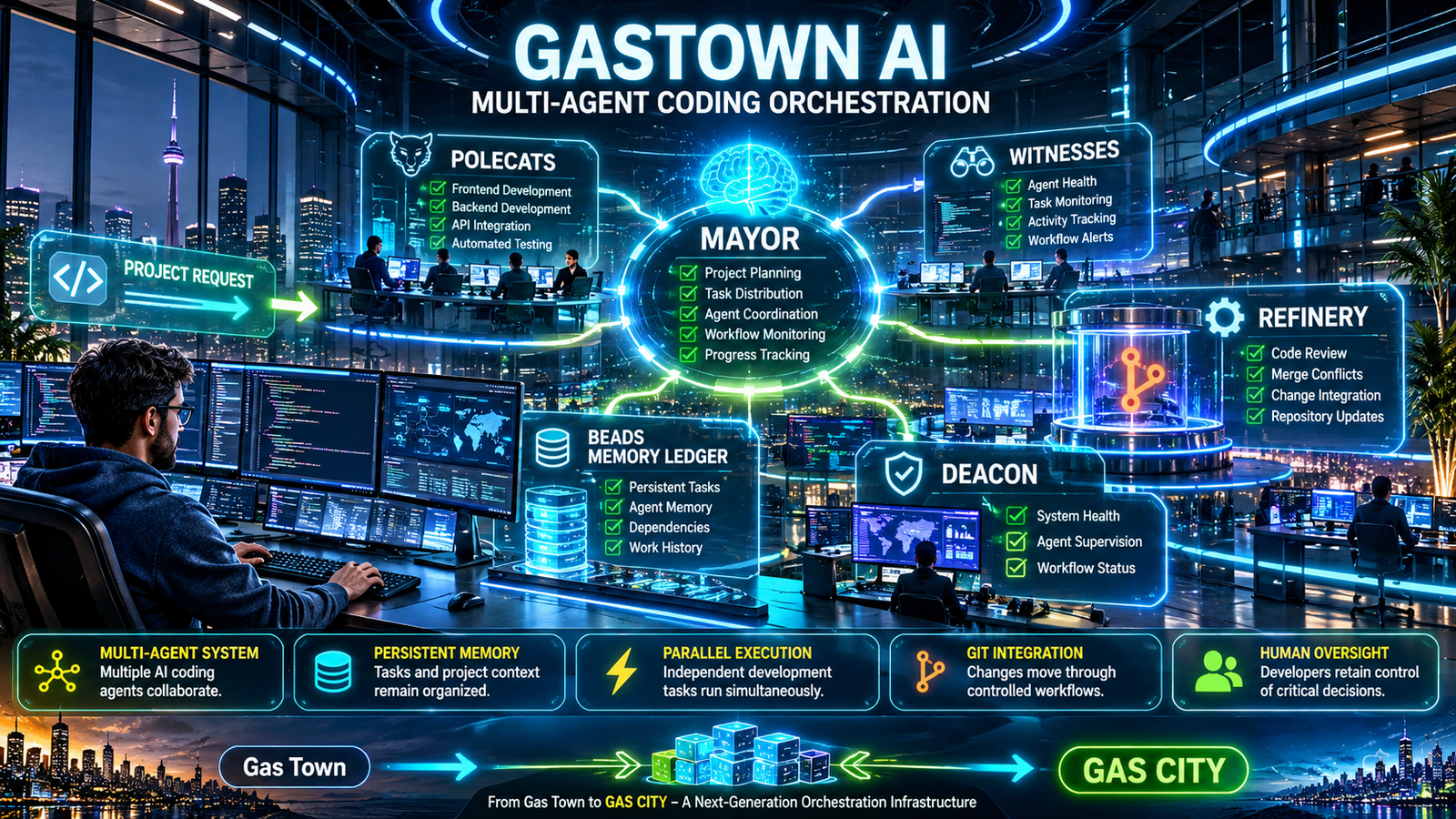
Gastown AI, commonly called Gas Town, is an open-source multi-agent orchestration system created by software engineer Steve Yegge. It coordinates multiple AI coding agents through specialized roles, persistent task tracking, and Git-based workflows, although the original project has now been retired in favor of its successor, Gas City.
At a Glance
- What it is: An orchestration framework for managing multiple AI coding agents.
- Creator: Software engineer Steve Yegge.
- Core technology: Beads, Git worktrees, tmux sessions, and coordinated agent roles.
- Main purpose: Automating complex software development through parallel AI workers.
- Availability: Its original codebase is publicly available under the MIT license.
- Current status: Gas Town is retired; Gas City is its successor.
What Is Gastown AI?
Gastown AI refers to Gas Town, an open-source software development orchestration system created by Steve Yegge.
Unlike conventional AI coding assistants, Gas Town does not simply generate code from prompts. It coordinates multiple AI agents that collaborate on larger software engineering projects.
Think of it as a virtual software development team.
One agent manages the project. Other agents handle individual programming tasks. Additional agents monitor progress, coordinate communication, and manage code integration.
The system was designed to address a major limitation of AI coding assistants: working with multiple agents becomes difficult when each session has separate context, responsibilities, and code changes.
Gas Town introduced a structured approach to solving this problem.
Steve Yegge open-sourced the project on January 1, 2026. It reached its version 1.0 milestone during 2026. However, his current project overview explicitly identifies Gas Town as retired and names Gas City as its successor.
This distinction is important. People researching Gastown AI today should understand both the original architecture and the newer project.
How Does Gas Town AI Work?
Gas Town uses a coordinated system of AI agents, persistent work records, and Git-based development environments.
Instead of asking one AI assistant to complete an entire application, developers divide a large project into smaller tasks.
The system assigns those tasks to specialized agents and tracks their progress.
1. The Mayor Coordinates the Project
The Mayor is the central coordination agent.
It receives the developer’s instructions, understands the overall objective, and organizes the work.
For example, imagine asking Gas Town to develop an e-commerce application.
The Mayor might divide the project into:
- User authentication
- Product catalog development
- Shopping cart functionality
- Payment integration
- Database configuration
- Automated testing
It then organizes these tasks and delegates appropriate work to other agents.
2. Polecats Handle Individual Tasks
Polecats are the worker agents in Gas Town.
Each Polecat receives a specific assignment and works within an isolated development environment.
For example:
- One agent develops the authentication system.
- Another creates product management functionality.
- A third implements the shopping cart.
- Another prepares automated tests.
This parallel approach allows independent development tasks to progress simultaneously.
However, parallel execution does not automatically guarantee better results. Tasks still need clear boundaries, compatible interfaces, and proper review.
3. Beads Preserve Work and Context
One of Gas Town’s most important components is Beads.
Beads is a persistent work-tracking and memory system designed for AI coding agents.
It stores individual units of work, including:
- Tasks and subtasks
- Project instructions
- Dependencies
- Agent notes
- Progress updates
- Completion records
This information remains available beyond an individual AI conversation.
Consequently, an agent can resume work using recorded project information instead of depending entirely on its previous conversation history.
Beads is also an independent project. Developers can use it without adopting the complete Gas Town architecture.
4. Witnesses Monitor Agent Activity
Witnesses supervise individual project environments, known as rigs.
Their responsibilities include monitoring agent activity and identifying situations that require attention.
This creates an additional layer of operational oversight.
Rather than relying entirely on a human developer to inspect every agent, Gas Town distributes some monitoring responsibilities across specialized agents.
5. The Refinery Manages Code Integration
Parallel development introduces a significant problem: different agents may modify related parts of the same application.
Their changes can conflict.
The Refinery handles the integration process by managing incoming changes and coordinating their progression toward the main codebase.
This helps prevent uncontrolled merging when multiple workers finish their assignments.
6. The Deacon Supervises the Wider System
The Deacon acts as a higher-level supervisor.
It helps maintain the overall orchestration environment and monitors system activity.
Together, these components create a development workflow in which task assignment, execution, monitoring, and integration operate as coordinated processes.
Key Features of Gastown AI
Gas Town’s architecture includes several features that distinguish it from ordinary AI programming assistants.
Multi-Agent Orchestration
Gas Town allows multiple AI coding agents to work on different tasks within a coordinated environment.
Instead of managing separate terminal sessions manually, developers can use a central coordination structure.
Persistent Agent Memory
Its Beads integration provides durable task records.
This is particularly useful for projects that extend beyond individual AI sessions.
Git Worktree Isolation
Git worktrees allow multiple working directories to share one Git repository.
Gas Town uses this approach to separate agent work and reduce interference between concurrent development tasks.
Automated Task Distribution
The Mayor organizes work and delegates assignments to available agents.
This reduces the amount of manual coordination required for complex development workflows.
Agent Communication
Specialized agents can exchange information through structured messaging and shared project state.
This helps maintain coordination when several agents contribute to the same application.
Automated Merge Coordination
The Refinery provides a structured mechanism for handling agent changes.
It helps organize integration rather than allowing every worker to modify the main branch independently.
Persistent Agent Identities
Gas Town distinguishes between an agent’s identity and its temporary execution session.
This makes it possible to maintain continuity across separate working sessions.
What Makes Gas Town Different From Traditional AI Coding Tools?
Traditional AI coding assistants generally focus on helping one developer complete programming tasks.
Gas Town focuses on coordinating the work of multiple coding agents.
Consider the following comparison:
| Capability | Traditional AI coding assistant | Gas Town |
|---|---|---|
| Code generation | Yes | Through coding agents |
| Multiple agents | Depends on the product | Core architecture |
| Central coordination | Usually limited | Mayor |
| Persistent task tracking | Product-dependent | Beads |
| Parallel development | Varies | Core workflow |
| Agent monitoring | Varies | Witness and Deacon |
| Code integration | Often developer-managed | Refinery |
| Human supervision | Commonly interactive | Human oversight remains important |
The fundamental difference is the level of automation.
A traditional coding assistant helps complete individual programming activities. Gas Town attempts to coordinate an entire development workflow.
This makes it closer to an AI software factory than a conventional coding chatbot.
Practical Use Cases of Gastown AI
Gas Town was designed for software engineering workflows involving multiple independent tasks.
Here are several practical applications.
Large Application Development
Developers can divide an application into smaller components.
Different agents can work on frontend development, backend functionality, database operations, and testing.
The central coordination system helps keep those activities organized.
Automated Bug Fixing
A developer can assign separate bugs to different agents.
Each worker can investigate its assigned problem, implement a solution, and prepare changes for integration.
Human review remains important, particularly for security-sensitive fixes.
Code Refactoring
Large refactoring projects often involve repetitive changes across multiple files.
Multiple agents can handle independent modules while the orchestration system tracks their progress.
Software Testing
Different agents can work on unit tests, integration tests, test coverage, and potential regression issues.
This can help teams expand testing coverage without manually assigning every individual activity.
Multi-Repository Development
Gas Town supports a project-oriented structure called rigs.
This makes it possible to organize development work across multiple repositories within a broader workspace.
The usefulness of this approach depends on the relationships between projects and the complexity of their dependencies.
Benefits of Using Gastown AI
Gas Town introduced several useful ideas for developers exploring autonomous software development.
1. Better parallelization: Independent programming tasks can run simultaneously rather than waiting for one agent to finish everything.
2. Reduced context loss: Beads preserves important work information beyond individual sessions.
3. Structured responsibilities: Specialized roles give agents clearer responsibilities.
4. More organized collaboration: Messaging and task records provide a shared coordination mechanism.
5. Improved integration workflows: The Refinery provides a controlled approach to handling multiple agents’ changes.
6. Flexible agent ecosystem: Its provider architecture supports integration with different coding-agent environments.
The overall benefit is not simply faster code generation. It is the ability to coordinate longer and more complicated development processes.
However, these are architectural advantages, not independently verified guarantees of higher productivity or better software quality.
Limitations and Challenges of Gas Town
Despite its ambitious architecture, Gas Town is not suitable for every developer or project.
Understanding its limitations is essential before adopting a multi-agent development workflow.
1. High Infrastructure Complexity
Gas Town requires more setup than a conventional coding assistant.
Its documented environment includes tools such as:
- Go
- Dolt
- Beads CLI
- tmux
- Git
- An AI coding-agent CLI
Developers must understand how these components interact.
This creates a learning curve, particularly for people unfamiliar with terminal-based development environments.
2. Increased AI Usage Costs
Running multiple agents can increase model consumption.
Every worker may require separate prompts, context processing, code generation, and review operations.
For example, assigning five agents to a project does not necessarily cost the same as using one agent five times.
Agents may repeat investigations, generate overlapping code, or require additional review cycles.
Gas Town itself is open-source software, but the AI model usage behind its agents may incur separate charges.
3. Coordination Overhead
Parallel development sounds straightforward, but software projects contain dependencies.
A frontend agent may need an API that another agent has not finished.
Two workers may also change the same interface or introduce incompatible assumptions.
The Mayor and Refinery help manage these situations, but they cannot eliminate every coordination problem.
4. Human Review Is Still Necessary
AI-generated code can contain bugs, security vulnerabilities, and incorrect assumptions.
Multiple agents do not automatically provide independent verification.
Developers should still review:
- Code changes
- Dependency updates
- Authentication logic
- Database migrations
- Security-sensitive functionality
- Test results
- Production deployments
A successful automated workflow needs meaningful human approval points.
5. Retired Project Status
This is particularly important for new users.
Steve Yegge’s current project page identifies Gas Town as retired and points developers toward Gas City.
The original repository remains publicly accessible, but prospective adopters should distinguish between an available codebase and an actively developed successor.
For a new production system, this distinction can affect long-term maintenance, integration planning, and technical support.
Is Gastown AI Free?
Gas Town is an open-source project released under the MIT license.
Its software can be inspected, modified, and used under the license’s terms without purchasing a conventional hosted subscription.
However, free software does not mean free AI execution.
There are several potential cost categories:
| Cost category | What to expect |
|---|---|
| Gas Town software | Open-source, MIT licensed |
| Beads | Open-source project |
| AI model usage | Depends on the selected provider and account |
| API consumption | May generate additional charges |
| Local infrastructure | Depends on hardware and hosting |
| Maintenance | Requires developer time |
Are There Paid Plans?
Gas Town is not presented as a conventional SaaS product with publicly advertised monthly subscription tiers.
Its primary cost consideration is the infrastructure and AI services required to operate it.
For example, developers using Claude Code, Codex, Gemini, or other supported coding environments should check the relevant provider’s current usage limits and billing terms.
Do not assume that one AI subscription automatically covers unlimited concurrent agent sessions.
Important: Gas City’s current commercial offerings should also be evaluated separately. They should not be confused with Gas Town’s original MIT-licensed software.
Privacy and Security Considerations
Multi-agent coding environments can access sensitive development resources.
These may include source code, configuration files, credentials, internal documentation, and deployment settings.
Gas Town’s persistent work records introduce another consideration: information written to task records may remain available after an agent session ends.
Before using such a system with private repositories, developers should establish clear security boundaries.
Recommended precautions include:
- Use dedicated API credentials with restricted permissions.
- Never expose production secrets to unrestricted agents.
- Review file-system and shell access.
- Keep sensitive configuration outside shared work contexts.
- Require approval for production deployments.
- Audit generated code before merging.
- Review data-retention policies from the selected model provider.
There is an important distinction between open-source licensing and security certification.
The MIT license does not establish SOC 2 compliance, Zero Data Retention, or enterprise security approval.
Those claims require separate, verifiable evidence.
Gas Town vs. Gas City: What Is the Difference?
This is one of the most important questions for anyone researching Gastown AI in November 2026.
Gas City is the successor to Gas Town, created to extract its reusable orchestration infrastructure into a more flexible software development toolkit.
Rather than treating the entire Gas Town environment as one fixed architecture, Gas City focuses on reusable components and configurable workflows.
| Area | Gas Town | Gas City |
|---|---|---|
| Project status | Retired | Successor project |
| Main purpose | Complete multi-agent workspace | Orchestration-builder SDK |
| Architecture | Opinionated agent roles | Configurable orchestration primitives |
| Workflow | Mayor-led coordination | Formula-driven workflows |
| Work tracking | Beads | Beads-based infrastructure |
| Flexibility | Established operating structure | More modular design |
| Intended users | Developers operating agent fleets | Developers building orchestration systems |
Gas City introduces a more configurable approach to creating software factories.
Its documented concepts include:
- Formulas for defining repeatable workflows
- Agent sessions and runtime providers
- Work routing
- Persistent work tracking
- Health monitoring
- Declarative configuration
The distinction matters because Gas City is not simply a renamed version of Gas Town.
It represents a shift toward reusable orchestration infrastructure.
According to Steve Yegge’s project overview, Gas City is designed to support larger agent fleets and more extensive automation scenarios. Those scale descriptions should be understood as project claims, not independently verified performance benchmarks.
For developers considering a new implementation, Gas City’s official GitHub repository is the more relevant starting point.
Best Gastown AI Alternatives in 2026
Gas Town belongs to a growing category of multi-agent development and orchestration tools.
However, not every alternative solves the same problem.
Some coordinate coding sessions, while others automate development tasks from issue assignment to pull requests.
Here are several relevant options.
The following comparison describes product positioning, not independently benchmarked performance.
| Platform / Tool | Target User | Key Strength | Pricing Transparency | Core Limitation |
|---|---|---|---|---|
| Gas City | AI infrastructure developers | Configurable agent orchestration | Open-source core | Requires technical implementation |
| Symphony | Developers automating coding tasks | Issue-driven agent execution | Open-source project | Different workflow and integration model |
| Superpowers | AI-assisted developers | Structured coding skills and workflows | Open-source | Not a full fleet orchestration platform |
| OpenHands | Developers and engineering teams | AI software development agents | Open-source and commercial offerings | Different deployment and orchestration approach |
| Beads | Developers needing persistent agent memory | Structured, durable work tracking | Open-source | Not a complete coding-agent orchestrator |
Gas City
Gas City is the most directly relevant alternative because it is Gas Town’s official successor.
It focuses on reusable orchestration infrastructure and configurable workflows.
It makes more sense for developers interested in building their own software factories rather than adopting a fixed agent structure.
Symphony
Symphony takes an issue-driven approach to coding automation.
Its workflow centers on turning work-tracker items into isolated coding-agent runs.
It is worth investigating for teams that want to automate ticket-based development rather than operate a Gas Town-style environment.
Superpowers
Superpowers focuses on structured development practices for AI coding agents.
Its emphasis is on skills, planning, and disciplined implementation.
It is useful for improving individual agent workflows, although it is not a direct replacement for Gas Town’s complete multi-agent infrastructure.
OpenHands
OpenHands provides an open-source platform for AI software development agents.
It offers a different approach to autonomous coding and development environments.
Developers should compare its execution model and deployment requirements with their actual orchestration needs.
Beads
Beads deserves separate attention.
It was a foundational component of Gas Town, but it can also operate independently.
Developers who mainly need persistent agent memory and structured task tracking may find Beads more appropriate than adopting a complete orchestration environment.
Who Should Use Gastown AI?
Gas Town’s original architecture is most relevant to developers who need to coordinate multiple AI coding agents.
It is particularly interesting for:
Experienced software engineers: Developers comfortable with Git, terminals, and distributed development workflows can better understand its architecture.
AI engineering researchers: Researchers exploring agent collaboration can study its task management and coordination patterns.
Technical founders: Founders building AI-powered development environments may find its software-factory concept useful.
Open-source contributors: Developers interested in agent orchestration can examine its implementation and related projects.
Engineering teams: Teams experimenting with parallel AI development can learn from its structured division of responsibilities.
Who Should Avoid It?
Gas Town may be unnecessary for:
- Beginners who only need simple code suggestions.
- Developers working on small scripts.
- People unfamiliar with command-line tools.
- Teams that require a fully managed coding platform.
- Organizations that need formally documented enterprise security guarantees.
For these users, a conventional AI coding assistant may be easier to operate.
Technical Requirements and Installation Considerations
Gas Town is a developer-oriented system rather than a browser-based application.
Its original installation documentation describes several dependencies.
These include Go, Dolt, Beads, Git, and tmux for its standard operating environment.
Claude Code is documented as the default agent runtime, with alternatives including Codex, GitHub Copilot, Gemini, and Cursor.
The installation process varies by operating system.
Supported Development Environments
| Environment | Consideration |
|---|---|
| macOS | Homebrew installation is documented |
| Linux | Go and Dolt setup is required |
| Windows | CLI installation is documented; WSL is recommended for full tmux-backed workflows |
| Docker | A container-based installation path is available |
Basic Installation Workflow
The general process involves:
- Installing the required development dependencies.
- Installing the
gtandbdcommand-line tools. - Creating a Gas Town headquarters directory.
- Initializing the orchestration environment.
- Starting the required background services.
- Adding a Git repository as a project rig.
- Configuring the AI agent runtime.
- Testing task assignment and agent execution.
The exact commands should come from the repository’s installation guide.
Developers should avoid blindly following older installation tutorials because the project has evolved and its successor now represents the forward-looking development path.
Official resources:
- Gas Town GitHub repository
- Gas Town documentation
- Gas City GitHub repository
- Beads project
Frequently Asked Questions
1. What is Gastown AI used for?
Gastown AI, also called Gas Town, was designed to coordinate multiple AI coding agents. It distributes software development tasks, maintains persistent work records, monitors agent activity, and manages code integration.
2. Is Gas Town AI free to use?
Yes. The original Gas Town project is released under the MIT open-source license. However, AI model usage, API calls, computing resources, and infrastructure may involve separate costs.
3. Who created Gas Town AI?
Software engineer Steve Yegge created Gas Town. He open-sourced the project on January 1, 2026, as an experiment in building autonomous AI-powered software development environments.
4. Is Gas Town still maintained in 2026?
Steve Yegge’s current project overview identifies Gas Town as retired and names Gas City as its successor. The original repository remains publicly accessible, but new developers should investigate Gas City for ongoing development.
5. What is the difference between Gas Town and Gas City?
Gas Town is the original multi-agent workspace with predefined roles such as Mayor, Polecats, Witnesses, and Refinery. Gas City extracts its reusable orchestration infrastructure into a more configurable SDK for building multi-agent software workflows.
Conclusion
Gastown AI represents an important experiment in autonomous software development.
Its biggest contribution is the idea that multiple AI coding agents can operate as a coordinated engineering team rather than isolated assistants.
Its architecture combines persistent task tracking, specialized agent roles, parallel execution, and controlled code integration.
However, its retirement changes the recommendation for new users.
Gas Town remains valuable as an architectural reference and open-source project. Developers building new agent orchestration systems should investigate Gas City and Beads instead.
Before choosing either approach, evaluate infrastructure requirements, model usage costs, agent reliability, security boundaries, and maintenance commitments.
The future of AI-assisted programming is not simply about generating code faster. It is also about coordinating agents, maintaining reliable workflows, and ensuring that humans retain control over important engineering decisions.

Alex Carter is a technology writer at AI SpaceZ.com, who covers AI tools, software reviews, practical tutorials and emerging artificial intelligence trends. He aims to make AI easier to understand and help readers discover useful tools and technologies for everyday productivity.