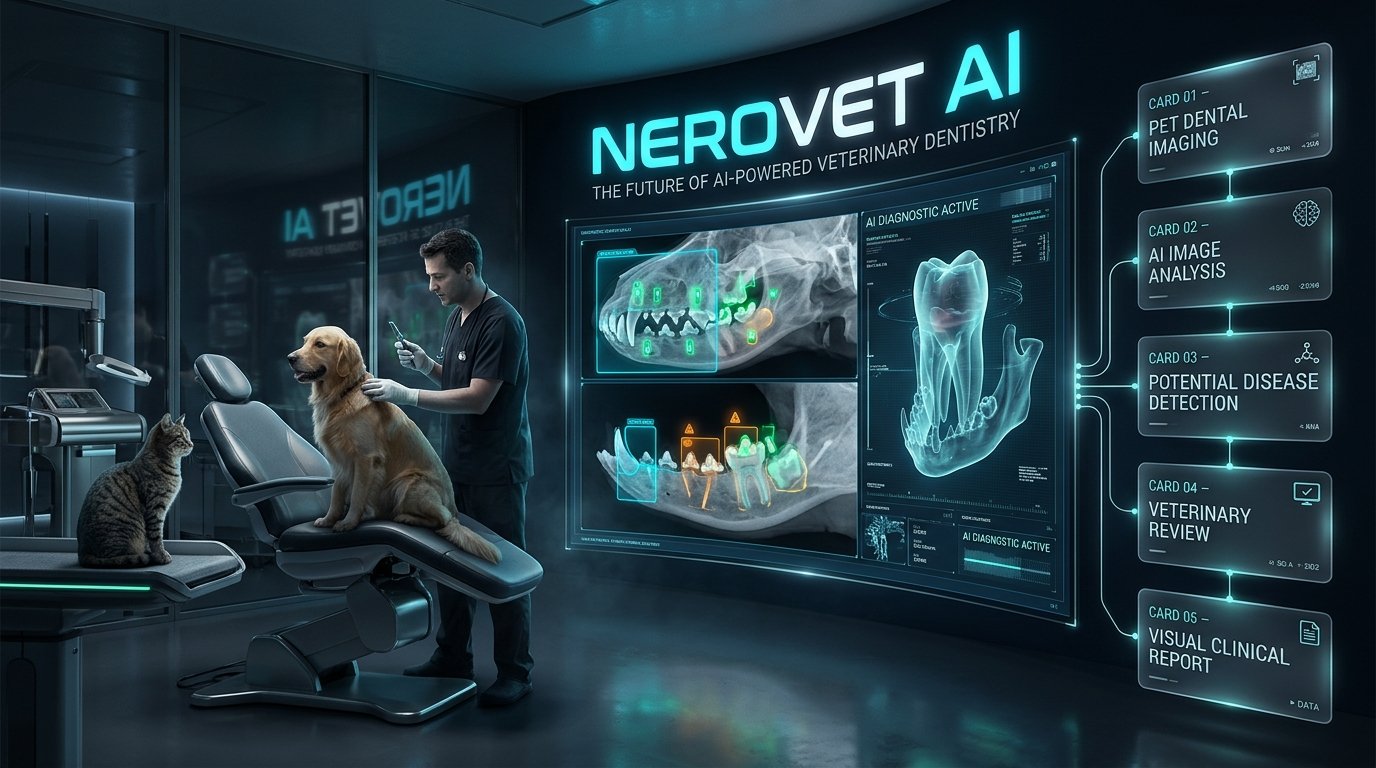
Nerovet AI is marketed as an AI-assisted veterinary dentistry platform designed to help analyze dental images and X-rays for dogs and cats. It promotes automated detection of potential oral health problems, but its advertised accuracy, clinical validation, pricing, and commercial capabilities require further independent verification.
Nerovet AI at a Glance
- Primary focus: AI-assisted veterinary dental imaging.
- Target users: Veterinary clinics, animal healthcare professionals, and pet owners interested in dental health.
- Advertised capabilities: Dental image analysis, periodontal disease detection, tooth resorption identification, and visual reporting.
- Supported animals: Primarily dogs and cats, according to its public website.
- Accuracy: The website advertises figures above 90%, but independent clinical validation has not been established here.
- Pricing: A public pricing link exists, but a complete, independently confirmed subscription structure is not available in the reviewed information.
What Is Nerovet AI?
Nerovet AI is a veterinary dentistry technology offering that promotes artificial intelligence for analyzing pet dental images. Its public website positions the platform around helping veterinary professionals identify potential dental problems in dogs and cats.
The central idea is straightforward: use AI-powered image analysis to support the examination of animal teeth and surrounding structures.
Veterinary dental conditions can be difficult to identify through visual examination alone. Some problems develop below the gumline or affect tooth roots, making appropriate dental radiographs important.
Nerovet describes capabilities involving periodontal disease, tooth resorption, root abscesses, and dental fractures. It also promotes visual reports intended to help communicate findings to pet owners.
However, there is an important distinction between advertised capabilities and independently demonstrated clinical performance.
Nerovet’s website provides product positioning and marketing claims. The public evidence reviewed for this article does not establish a peer-reviewed Nerovet-specific clinical validation study or independently confirmed diagnostic accuracy.
Is Nerovet AI for Human Dentistry or Veterinary Dentistry?
This distinction matters because online articles sometimes describe Nerovet as a general dental AI company.
The Nerovet.com website primarily presents a veterinary dentistry offering for dogs, cats, and clinics.
Its focus is therefore different from human dental AI platforms that analyze patient radiographs for cavities, bone loss, and other oral conditions.
Veterinary and human dentistry share some imaging principles. However, they involve different anatomy, diagnostic datasets, clinical workflows, and validation requirements.
Readers should not assume that a product marketed for animal dental imaging is suitable for human patients.
What Does Nerovet AI Actually Offer?
Based on its public product descriptions, the offering centers on several capabilities:
- AI-assisted examination of pet dental images.
- Identification of possible periodontal abnormalities.
- Detection support for feline tooth resorption.
- Recognition of possible root abscesses and fractures.
- Visual reporting for veterinary communication.
- Clinic demonstration and product information access.
These are vendor-advertised capabilities, not independently confirmed results from a clinical product evaluation.
How Does Nerovet AI Work?
Nerovet describes its technology using artificial intelligence, machine learning, and deep learning.
Although the company does not publicly provide enough technical documentation to reconstruct its complete architecture, the general workflow of veterinary dental AI can be explained.
1. Dental Image Collection
The process begins with dental imaging.
Veterinary professionals obtain appropriate dental radiographs during an examination. These images provide information about tooth roots, surrounding bone, and structures that cannot be fully assessed through an external visual inspection.
Image quality matters. Incorrect positioning, overlapping structures, and inadequate exposure can affect interpretation.
2. AI-Based Image Analysis
Computer vision models can examine digital images and identify patterns associated with dental abnormalities.
Deep learning systems learn these patterns from labeled training images. During inference, the trained model evaluates a new image and generates predictions.
In veterinary dentistry, relevant findings may include:
- Periodontal bone loss.
- Tooth resorption.
- Root abnormalities.
- Suspected fractures.
- Periapical changes.
- Other visible dental pathologies.
Nerovet advertises several of these detection capabilities. Its exact model architecture, training dataset composition, and independently tested performance remain unclear from the public materials reviewed.
3. Identification of Potential Problems
An AI system may highlight suspicious regions or classify image findings.
This can help veterinarians focus their attention on areas requiring additional examination.
However, a flagged region is not automatically a confirmed diagnosis. Image interpretation must consider the animal’s clinical history, examination findings, and other diagnostic information.
4. Report Generation
Nerovet also advertises visual reports for communication with pet owners.
Such reports can help explain why a particular tooth or surrounding structure requires attention.
A useful clinical report should distinguish suspected abnormalities from confirmed findings. It should also provide enough detail for a veterinarian to review and document the case.
5. Veterinary Review
The final step is professional assessment.
A veterinarian evaluates the AI output alongside clinical examination, dental charting, and radiographic evidence.
The AI should function as a supporting tool, not an independent authority responsible for treatment decisions.
Key Features of Nerovet AI
The following features reflect the capabilities promoted on Nerovet’s public website.
AI-Powered Dental Imaging
Dental imaging is central to the platform’s positioning.
AI-assisted image analysis can help identify patterns that deserve closer examination. It may also support more consistent image review across cases.
The practical value depends on image compatibility, model performance, and how accurately the software identifies clinically relevant findings.
Periodontal Disease Detection
Periodontal disease affects the tissues supporting an animal’s teeth.
Potential signs include inflammation, periodontal pocketing, and loss of supporting bone.
Nerovet advertises periodontal disease detection through dental imaging. However, radiographic interpretation alone cannot replace periodontal probing and a complete oral examination.
Tooth Resorption Identification
Tooth resorption is particularly important in feline dentistry.
The condition involves the progressive destruction of dental hard tissue. Some lesions are difficult to identify during an ordinary visual examination.
Dental radiographs play an important role in determining the extent of the condition and supporting treatment planning.
Nerovet specifically advertises tooth resorption identification in cats.
Root Abscess and Fracture Detection
Dental infections and fractures can cause significant discomfort.
Radiographic examination may reveal abnormalities around tooth roots and surrounding structures.
Nerovet lists root abscesses and fractures among the conditions its technology aims to identify.
These findings still require veterinary interpretation and, when appropriate, additional investigation.
Visual Reports for Pet Owners
Communication is an important part of veterinary dentistry.
Pet owners may struggle to understand dental radiographs without explanation.
Visual reports can help clinicians explain potential abnormalities, recommended procedures, and the reasons behind treatment decisions.
The usefulness of this feature depends on the clarity and clinical accuracy of the generated information.
What Does Nerovet AI’s Accuracy Claim Mean?
Accuracy is one of the most important considerations when evaluating healthcare-related AI.
Nerovet’s homepage advertises diagnostic accuracy above 94%. Other promotional text references a range of 92% to 98%.
These figures should be treated as company claims rather than independently established clinical results.
The public information reviewed does not provide enough detail to establish:
- The number of animals included in testing.
- Whether the dataset included different breeds and age groups.
- The number of dental images evaluated.
- Which dental conditions were included.
- Whether testing used independent external datasets.
- How the AI performed against board-certified veterinary dentists.
- Whether results were measured using sensitivity, specificity, or overall accuracy.
These details are essential.
Why Accuracy Alone Is Not Enough
Imagine an AI model that correctly classifies 95 out of 100 images.
That sounds impressive, but the result does not explain which conditions the model missed.
Veterinary professionals should also examine:
| Evaluation metric | What it tells you |
|---|---|
| Sensitivity | How often the system identifies actual disease cases |
| Specificity | How often it correctly identifies cases without disease |
| Positive predictive value | How often a positive result is genuinely positive |
| Negative predictive value | How often a negative result is genuinely negative |
| External validation | Whether performance holds on independent data |
| Interobserver agreement | How consistently AI findings compare with expert assessments |
For a clinical tool, missing a serious abnormality can have different consequences from incorrectly flagging a healthy structure.
Therefore, a single percentage cannot establish clinical reliability.
Benefits of AI-Assisted Veterinary Dentistry
AI-assisted dentistry has potential advantages when properly developed and integrated into clinical practice.
Faster Image Review
AI can help screen images and highlight areas requiring attention.
This may reduce repetitive review work and help veterinary teams organize examinations more efficiently.
However, actual time savings should be measured in real clinical settings.
Earlier Identification of Potential Problems
Some dental abnormalities are difficult to recognize without appropriate imaging.
AI-assisted analysis may help identify suspicious findings that deserve further investigation.
Earlier recognition can support timely treatment when a veterinarian confirms the diagnosis.
Better Clinical Communication
Visual annotations and structured reports can make dental findings easier to explain.
This may help pet owners understand treatment recommendations and make informed decisions.
More Consistent Documentation
Standardized reports can support organized clinical records.
They may also help veterinary teams communicate findings between appointments and across different professionals.
Support for Veterinary Workflows
Specialized dental analysis tools can potentially reduce administrative and interpretive friction.
However, clinics should evaluate how the software fits their existing imaging systems and documentation processes before adopting it.
Nerovet AI Limitations and Potential Risks
Despite the potential of AI dentistry, several important limitations deserve attention.
Limited Independent Clinical Evidence
The most significant issue is the lack of independently established Nerovet-specific performance evidence in the public materials reviewed.
A product’s advertised accuracy does not automatically establish its clinical reliability.
Veterinary clinics should request validation documentation before using AI outputs in clinical workflows.
Unclear Technical Specifications
The public website does not establish a complete technical specification for the platform.
Important unanswered questions include supported image formats, model architecture, training dataset details, integration options, and processing requirements.
These details matter when comparing veterinary diagnostic products.
Dependence on Image Quality
AI cannot reliably interpret information that an image does not capture.
Poor positioning, image artifacts, overlapping structures, and insufficient exposure can affect diagnostic performance.
Veterinary professionals must obtain appropriate images and review their quality.
Risk of False Positives and False Negatives
AI models can produce incorrect results.
A false positive may lead to unnecessary concern or additional testing. A false negative may create false reassurance.
Neither outcome should be ignored.
Human Expertise Remains Essential
Veterinary dental diagnosis involves more than image recognition.
A complete assessment may require:
- Oral examination.
- Periodontal probing.
- Dental radiographs.
- Medical history.
- Clinical symptoms.
- Professional judgment.
AI should support these processes rather than replace them.
Nerovet AI Pricing: Is It Free?
Pricing is an important consideration for veterinary clinics evaluating new diagnostic software.
Nerovet’s website provides a dedicated pricing link and promotes clinic demonstrations. However, the complete pricing structure could not be independently confirmed from the accessible public information reviewed for this article.
There is insufficient verified information to publish specific subscription prices or claim that a particular paid plan includes defined features.
Before purchasing, ask the provider about:
- Free trials and demonstration access.
- Monthly and annual subscription costs.
- Per-image or per-report charges.
- Usage limits and included credits.
- Additional clinic or staff accounts.
- Image storage and retention charges.
- Cancellation and refund policies.
- Technical support and onboarding fees.
A demonstration is not the same as a free commercial subscription.
Veterinary practices should request written pricing terms before committing to the platform.
Nerovet AI Privacy and Security Considerations
Veterinary dental images and patient records can contain sensitive information.
Clinics should understand how software providers collect, store, process, and share this information.
Nerovet publishes a privacy policy dated February 28, 2026. The accessible policy discusses contact information submitted through forms and analytics information used to understand website activity.
However, the reviewed policy does not establish a comprehensive technical explanation of clinical image processing, diagnostic data retention, encryption standards, or deletion procedures.
This distinction is important.
A website privacy policy does not automatically establish the security arrangements of a clinical AI product.
Before uploading patient information, veterinary clinics should ask:
- Where are dental images stored?
- Are uploaded images retained after analysis?
- Can users request permanent deletion?
- Are images used to train future AI models?
- Which third-party processors can access the information?
- Is data encrypted during transmission and storage?
- Are access controls and audit logs available?
- What happens to patient information after account cancellation?
Do not assume that a provider offers Zero Data Retention simply because it publishes a privacy policy.
Similarly, do not assume SOC 2 compliance or other security certifications without appropriate documentation.
Nerovet AI Alternatives: Other Veterinary AI Platforms
Nerovet is not the only option in veterinary AI.
Several established providers offer diagnostic imaging or veterinary dental analysis services. However, their capabilities are not necessarily identical.
The following comparison highlights relevant alternatives.
| Platform | Target user | Main strength | Pricing transparency | Important consideration |
|---|---|---|---|---|
| Nerovet AI | Veterinary clinics | Advertised pet dental image analysis | Full pricing unconfirmed | Independent validation needs verification |
| Antech RapidRead Dental | Veterinary professionals | AI-assisted canine and feline dental radiograph interpretation | Contact provider | Clinical workflow and expert oversight matter |
| Metron IQ | Veterinary clinics | AI-assisted radiograph analysis and reporting | $12 per report after trial, according to its website | Broader veterinary imaging, not a direct dental-only equivalent |
| SignalPET | Veterinary clinics | AI-assisted veterinary radiology | Confirm with provider | Broader diagnostic imaging focus |
| Vetology AI | Veterinary professionals | Veterinary radiology and diagnostic support | Confirm with provider | Broader imaging applications |
1. Antech RapidRead Dental
Antech’s RapidRead Dental is one of the most relevant alternatives because it specifically addresses veterinary dental radiographs.
Its public documentation describes tooth-by-tooth annotations and AI-assisted analysis for dogs and cats.
Antech also reports that its dental AI was developed using more than 55,000 images and 275,000 teeth.
These are provider-published specifications, not an independent comparative benchmark against Nerovet.
For clinics prioritizing a dedicated dental workflow, RapidRead Dental deserves consideration.
2. Metron IQ
Metron IQ provides AI-assisted veterinary radiograph interpretation.
Its software supports canine, feline, and equine imaging applications and can generate PDF reports.
Its website advertises a 10-day free trial followed by usage-based pricing of $12 per report.
It may be useful for practices seeking broader veterinary radiology support rather than a dedicated dental platform.
3. SignalPET
SignalPET focuses on AI-assisted veterinary radiology.
Its broader diagnostic imaging capabilities make it relevant to clinics evaluating AI-supported image interpretation.
However, veterinary radiology is not identical to specialized dental radiograph analysis.
Clinics should verify whether a particular service supports their required dental workflows.
4. Vetology AI
Vetology AI provides veterinary imaging and radiology support.
Its services include AI-assisted image assessment and radiology-related reporting.
It is worth considering for clinics that need broader diagnostic imaging support.
As with other alternatives, confirm the specific imaging modalities, service availability, and pricing before choosing.
Nerovet AI vs. Traditional Veterinary Dental Diagnosis
Traditional veterinary dentistry relies on clinical examination, periodontal probing, and appropriate imaging.
AI introduces another layer of image interpretation.
The two approaches should complement each other.
| Area | Traditional approach | AI-assisted approach |
|---|---|---|
| Image examination | Professional visual interpretation | Algorithm-assisted image review |
| Abnormality detection | Clinical expertise | Automated pattern recognition |
| Diagnosis | Veterinarian-led | Veterinarian-led with AI support |
| Documentation | Manual or existing software | Potential automated annotations and reports |
| Clinical responsibility | Veterinary professional | Veterinary professional |
| Limitations | Human variability and workload | Model errors and dataset limitations |
The main distinction is not that AI replaces traditional dentistry.
Instead, it may help veterinarians review information and organize clinical findings.
Who Should Consider Nerovet AI?
Nerovet’s advertised positioning may interest several groups.
Veterinary Clinic Owners
Clinic owners exploring AI-assisted dental workflows may want to investigate the platform.
They should first assess its clinical evidence, pricing, compatibility, and data-handling arrangements.
Veterinary Dentists
Dental specialists may find automated image review worth evaluating as an additional decision-support resource.
The most important requirement is reliable performance across relevant dental conditions.
General Veterinary Practitioners
General practitioners may benefit from tools that help identify suspicious dental findings.
However, AI results should never replace referral to a veterinary dental specialist when clinically appropriate.
Pet Owners
Pet owners may encounter Nerovet while researching modern dental care for dogs and cats.
They should understand that AI screening is not a substitute for a veterinary examination.
If a pet shows signs of oral pain, difficulty eating, bleeding gums, or facial swelling, professional veterinary assessment is important.
What Should Veterinary Clinics Check Before Adopting Nerovet?
Before investing in an emerging veterinary AI platform, clinics should evaluate more than its advertised features.
A practical assessment should cover six areas.
1. Clinical validation: Request independent testing results, including sensitivity, specificity, and external validation.
2. Image compatibility: Confirm which radiographic formats, resolutions, and imaging systems are supported.
3. Clinical workflow: Determine whether the product integrates with existing dental charting and practice management software.
4. Data protection: Review retention, deletion, encryption, access controls, and third-party processing arrangements.
5. Commercial terms: Obtain written information about subscriptions, usage limits, additional fees, and cancellation.
6. Professional oversight: Confirm that clinicians can review, correct, and reject AI-generated findings.
A product demonstration should answer these questions before a clinic makes a purchasing decision.
The Future of AI in Veterinary Dentistry
Veterinary dentistry is an interesting area for specialized AI development.
Dental imaging contains complex visual information, and some abnormalities can be difficult to identify without detailed examination.
As computer vision improves, AI systems may become better at identifying dental structures, measuring bone changes, and organizing clinical findings.
The next stage of development will depend on more than increasingly sophisticated algorithms.
High-quality training datasets, independent validation, transparent reporting, and integration with veterinary workflows will determine whether these systems provide meaningful clinical value.
Antech’s expansion of RapidRead Dental to feline imaging in 2026 illustrates that specialized veterinary dental AI is moving beyond general technology concepts into more focused commercial applications.
However, each product must be assessed on its own evidence.
Nerovet’s future credibility will similarly depend on demonstrating measurable clinical performance and providing clearer technical and commercial documentation.
Frequently Asked Questions
1. What is Nerovet AI used for?
Nerovet AI is marketed as a veterinary dentistry platform that uses artificial intelligence to analyze pet dental images and X-rays. Its advertised capabilities include identifying potential periodontal disease, tooth resorption, root abscesses, and dental fractures.
2. Is Nerovet AI designed for dogs and cats?
Yes. Nerovet’s public website primarily promotes veterinary dental imaging for dogs and cats. It specifically mentions periodontal disease detection and tooth resorption identification in cats.
3. How accurate is Nerovet AI?
Nerovet advertises diagnostic accuracy above 94%, with other website text referencing 92% to 98%. However, these figures have not been independently established through the clinical validation evidence reviewed for this article.
4. Is Nerovet AI free to use?
A complete, independently confirmed pricing structure is not available in the reviewed public information. The website provides a pricing link and clinic demonstration options. Prospective users should request current subscription details directly from the provider.
5. Can Nerovet AI replace a veterinarian?
No. AI-assisted dental imaging should support veterinary assessment rather than replace it. A qualified veterinarian must interpret findings alongside physical examinations, periodontal probing, medical history, and appropriate diagnostic imaging.
Conclusion
Nerovet AI represents an emerging offering in the specialized field of AI-assisted veterinary dentistry.
Its public website promotes dental image analysis for dogs and cats, including support for identifying potential oral health problems.
However, advertised capabilities should not be confused with independently proven clinical performance.
The most important considerations are diagnostic validation, supported imaging formats, transparent pricing, data privacy, and compatibility with veterinary workflows.
Veterinary clinics may find Nerovet worth investigating through a product demonstration. However, they should request supporting documentation before relying on it in clinical practice.
For pet owners, the essential point is simple: AI can support better-informed veterinary care, but it cannot replace a professional dental examination.
Editorial verdict: Nerovet AI is an interesting veterinary dental technology offering, but its clinical credibility and commercial readiness require further independent evidence.