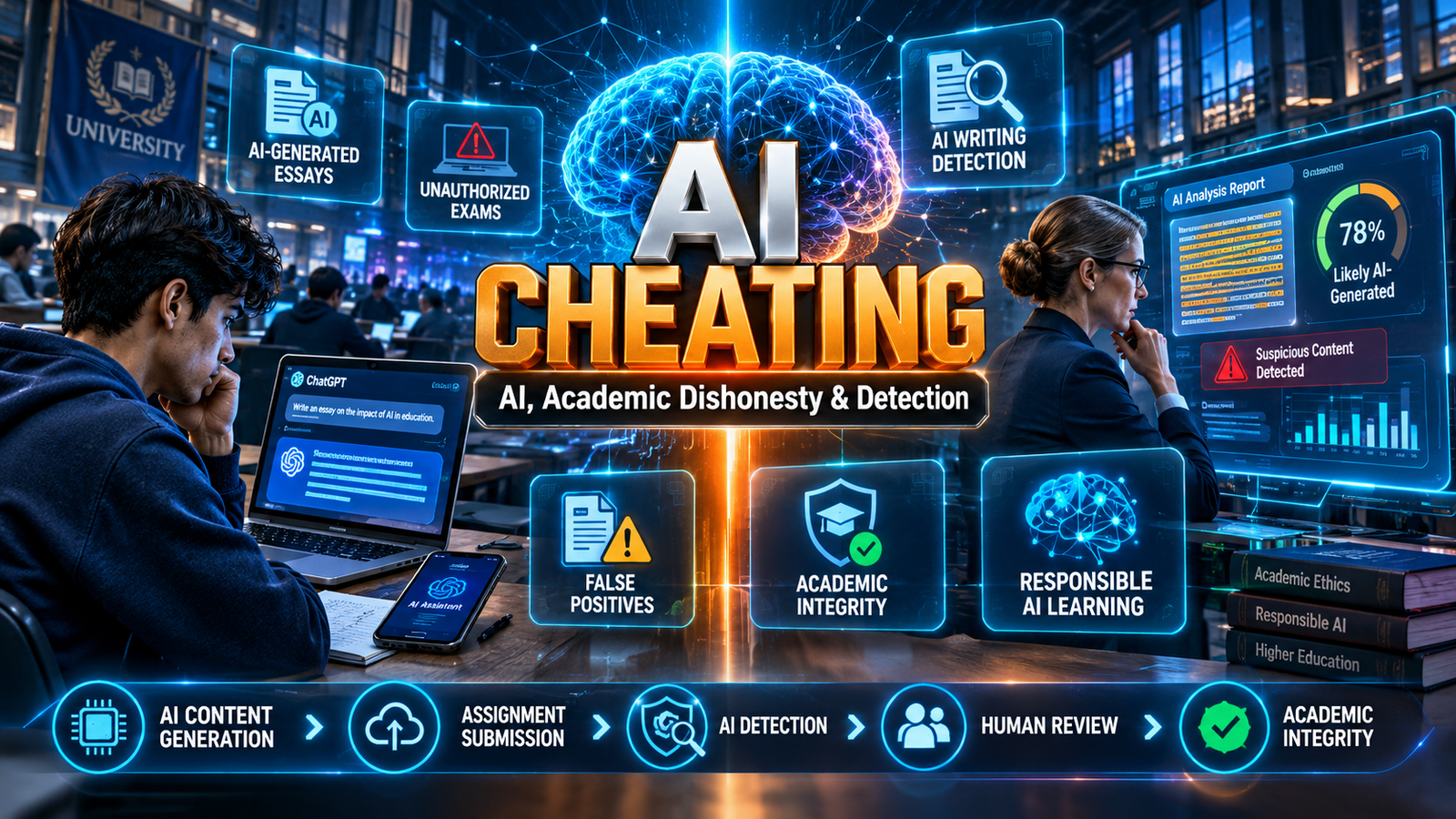
AI cheating occurs when students use artificial intelligence to complete academic work in ways that violate institutional rules or misrepresent their own abilities. Common examples include submitting unauthorized AI-generated essays, using chatbots during restricted examinations, and presenting fabricated research as genuine academic work.
Understanding the difference between helpful AI assistance and academic dishonesty is now essential for students, teachers, and universities.
AI Cheating at a Glance
- AI cheating involves using artificial intelligence to gain an unfair academic advantage.
- ChatGPT, Gemini, and Claude can generate essays, explanations, and programming solutions.
- AI detection tools can identify suspicious writing patterns, but their results are not conclusive proof.
- Unauthorized AI use can lead to academic penalties and weaken students’ learning.
- Clear university policies can reduce confusion about acceptable AI assistance.
- Responsible AI use requires transparency, fact-checking, and independent understanding.
What Is AI Cheating?
AI cheating refers to using artificial intelligence to complete academic tasks dishonestly or violate the rules of an assignment or examination.
Generative AI tools can produce essays, answer questions, summarize research, and write computer code. These capabilities make studying easier, but they also create opportunities for academic misconduct.
For example, a student might use ChatGPT to understand a difficult subject before writing an assignment. This can be a legitimate learning activity when the instructor permits it.
However, asking ChatGPT to complete an entire graded assignment and submitting the response as independent work may constitute cheating.
The distinction depends on three things:
- Permission: Does the institution allow AI assistance for this task?
- Transparency: Has the student disclosed AI involvement when required?
- Original contribution: Does the submitted work accurately represent the student’s own understanding and effort?
AI use is not automatically academic dishonesty. The circumstances and assessment rules determine whether a particular use is acceptable.
Common Examples of AI Cheating in Schools and Universities
Students can misuse artificial intelligence in several ways. Some involve generating complete assignments, while others involve unauthorized assistance during assessments.
1. Submitting AI-Generated Essays
One common example involves asking an AI chatbot to write an entire essay.
The student provides a topic or assignment question and receives a structured response. Submitting that response as entirely original work may violate academic integrity rules.
The problem is not simply that AI helped with writing. It is the misrepresentation of authorship and independent effort.
2. Using AI During Examinations
Some students access chatbots during online examinations or restricted assessments.
They may use AI to answer questions, solve mathematical problems, or complete tests without permission.
When external assistance is prohibited, this behavior can constitute examination misconduct.
3. Misusing AI Paraphrasing Tools
AI writing applications can rewrite sentences, change vocabulary, and restructure paragraphs.
However, paraphrasing does not automatically make copied material original. Students must still acknowledge sources and follow their institution’s citation requirements.
4. Creating Fake Research and References
AI chatbots can sometimes produce incorrect citations or invent academic references.
Students who include these references without checking the original publications risk submitting inaccurate research.
Every academic source should be verified before it appears in an assignment.
5. Submitting AI-Generated Programming Code
AI coding assistants can generate functions, explain errors, and suggest solutions.
Using these tools may be acceptable in some programming courses. However, submitting generated code as independent work can violate assignment rules when students are expected to demonstrate their own programming skills.
Why Are Students Using AI to Cheat?
The growing use of AI in education is connected to several academic and practical challenges.
Academic Pressure and Deadlines
Students often manage several assignments, examinations, and projects simultaneously.
When deadlines become difficult to manage, AI-generated answers may appear to offer a convenient shortcut.
Limited Subject Understanding
Some students struggle with complicated topics and lack confidence in their academic abilities.
Instead of using AI to understand difficult concepts, they may depend on generated answers to complete assignments.
Easy Access to AI Tools
Modern AI applications are available through websites, mobile devices, and integrated writing tools.
Students can generate explanations and academic content without advanced technical knowledge.
Unclear University Policies
Not every institution explains AI restrictions in the same way.
One instructor may permit AI-assisted brainstorming, while another may prohibit AI-generated content in graded assignments.
Without clear instructions, students may misunderstand what constitutes acceptable assistance.
Misunderstanding AI Detection
Some students believe that AI-generated content cannot be identified.
Others assume that an AI detection score automatically proves cheating. Both assumptions are incorrect.
Detection systems have limitations, and academic misconduct should be evaluated using relevant evidence.
Can Teachers Detect AI Cheating?
Teachers can identify suspicious AI-assisted work, but detecting AI-generated writing with complete accuracy remains difficult.
AI detection software examines patterns in text and estimates whether certain passages resemble machine-generated content.
These systems do not provide a reliable record of who wrote a document.
How AI Writing Detection Works
AI detectors generally use machine learning models to examine writing characteristics.
Depending on the platform, these characteristics may include:
- Sentence structure and consistency.
- Word choice and language patterns.
- Statistical predictability of text.
- Repeated linguistic structures.
- Patterns associated with AI-generated writing.
Two technical concepts sometimes discussed in AI detection are perplexity and burstiness.
Perplexity describes how predictable a sequence of words is to a language model. Burstiness describes variation in sentence structure and length.
Some detection approaches use these concepts, but they are not universal indicators of AI authorship.
Popular AI Detection Tools
Several platforms offer AI writing detection for educational and professional use.
| Platform | Main purpose | Intended users | Important limitation |
|---|---|---|---|
| Turnitin | Similarity checking and AI writing reports | Universities and educators | AI reports can produce incorrect classifications |
| GPTZero | Identifying potentially AI-generated text | Teachers and individual users | Detection results are not definitive proof |
| Copyleaks | AI content and plagiarism analysis | Education providers and businesses | Results require human interpretation |
Features, subscription options, and access requirements vary. Check each provider’s official website before choosing a platform.
Can Turnitin Detect AI-Generated Essays?
Turnitin offers an AI Writing Report that estimates whether qualifying text may have been generated or modified using AI.
Its AI writing percentage is separate from its similarity score. A similarity report identifies matching text, while an AI writing report evaluates patterns associated with AI-generated writing.
Turnitin also acknowledges that its detection system can produce incorrect results. Its documentation advises educators against using AI detection as the sole basis for adverse decisions.
This distinction is important because a high AI detection percentage does not independently establish academic misconduct.
Why AI Detectors Sometimes Make Mistakes
AI detectors can produce two types of errors.
False positives: Human-written content is incorrectly classified as AI-generated.
False negatives: AI-generated content is incorrectly classified as human-written.
These errors can create serious problems in educational environments.
Students who write in a second language may be particularly concerned about incorrect accusations. Conventional academic vocabulary and predictable sentence structures can also affect detection results.
A 2026 advisory from Mount Royal University raised concerns about AI detection reliability, fairness, and the consequences of using detector results in academic misconduct decisions.
The practical lesson is simple: detection software should support further investigation, not replace human judgment.
What Are the Consequences of AI Cheating?
The consequences depend on institutional policies, the nature of the misconduct, and the seriousness of the violation.
Academic Penalties
Universities and schools may impose penalties for unauthorized AI use.
These can include:
- Receiving a zero for an assignment.
- Losing marks for an examination.
- Repeating an assessment.
- Facing an academic misconduct investigation.
- Receiving suspension or other disciplinary action.
Not every institution applies the same penalties. Students should consult their university’s academic integrity policy.
Reduced Learning and Critical Thinking
Relying on AI to complete every assignment can prevent students from developing important academic skills.
These include independent research, writing, reasoning, and problem-solving.
A student may receive a completed assignment without understanding the subject well enough to explain it.
Loss of Academic Credibility
Academic qualifications are intended to demonstrate knowledge and competence.
When students misrepresent AI-generated work as their own, confidence in academic assessments can decline.
Incorrect Research and Information
AI systems can produce convincing but inaccurate explanations.
Unverified statistics, fabricated citations, and incorrect academic claims can reduce the quality of student research.
Unfair Accusations
Overreliance on AI detection software can also harm honest students.
A false positive may lead to unnecessary investigations, stress, and disputes between students and teachers.
Educational institutions should provide fair review procedures before imposing penalties.
How Can Schools and Universities Prevent AI Cheating?
Preventing AI cheating requires a balanced approach. Simply banning every AI application is unlikely to address the underlying challenges.
Schools and universities should focus on clear expectations, effective assessment methods, and responsible AI education.
1. Establish Clear AI Usage Policies
Students need to understand exactly when AI assistance is permitted.
Institutions should explain whether students can use AI for brainstorming, research, grammar correction, programming, and content generation.
Assignment instructions should also identify prohibited activities and disclosure requirements.
2. Introduce Process-Based Assessments
Teachers can evaluate how students develop their assignments instead of examining only the final document.
Useful assessment materials include:
- Initial research notes.
- Assignment outlines.
- Draft versions.
- Source lists.
- Revision explanations.
- Short presentations.
These materials help instructors understand a student’s contribution and development.
3. Include Oral Assessments
Short discussions and presentations provide opportunities to evaluate subject knowledge.
Students can explain their arguments, describe their research, and answer questions about their assignments.
4. Teach Responsible AI Literacy
Students should understand how generative AI works and why its answers require verification.
They should also learn about inaccurate information, fabricated references, data privacy, and appropriate AI disclosure.
5. Use Detection Tools Carefully
AI detection software can provide supporting information, but educators should not treat its output as automatic proof.
Before making a decision, they should consider assignment instructions, previous drafts, source accuracy, and the student’s explanation.
6. Provide Better Academic Support
Some students misuse AI because they struggle with academic workloads or difficult subjects.
Universities can address these problems through tutoring, writing assistance, accessible learning resources, and better academic guidance.
How Students Can Use AI Without Cheating
Students do not need to avoid artificial intelligence completely.
When institutional rules permit it, AI can support learning, research, and academic preparation.
The key is to use these tools without replacing independent thinking.
| Academic activity | Responsible AI use |
|---|---|
| Understanding difficult topics | Ask AI to explain concepts with examples |
| Preparing for examinations | Generate practice questions and quizzes |
| Brainstorming | Explore possible research topics |
| Grammar correction | Review spelling and sentence clarity |
| Research | Identify useful sources and verify original publications |
| Programming | Understand suggested code and test its functionality |
| Academic writing | Develop original arguments and disclose permitted assistance |
Verify AI-Generated Information
Never assume that an AI-generated answer is accurate simply because it sounds convincing.
Check statistics, quotations, academic references, and technical explanations against reliable sources.
Follow Assignment Instructions
Read the course guidelines before using AI for graded work.
If the rules are unclear, ask the instructor whether a particular activity is permitted.
Disclose AI Assistance When Required
Students should explain how they used AI whenever their institution requests disclosure.
For example:
“I used ChatGPT to brainstorm ideas and clarify selected concepts. I reviewed the information, verified the sources, and developed the final submission in accordance with the assignment requirements.”
This is an illustrative disclosure statement. Students should follow their institution’s preferred format.
AI Cheating in Pakistan: What Does HEC Say?
AI academic integrity is particularly relevant to Pakistan’s higher education sector.
The Higher Education Commission (HEC) has published a framework addressing the use of generative AI tools in higher education institutions.
The framework recognizes that AI can support teaching, learning, and research. It also emphasizes academic integrity and responsible use.
Rather than treating every use of AI as misconduct, the framework distinguishes productive assistance from inappropriate use.
Pakistani university students should take several practical steps before using AI for academic work:
- Review their university’s AI usage policy.
- Read assignment-specific instructions.
- Ask instructors about permitted AI assistance.
- Verify research and references independently.
- Disclose AI involvement when required.
- Keep relevant drafts and research records.
Students should also consult the HEC’s official framework and their university’s latest academic integrity requirements.
Official resource: HEC Framework on Use of Generative AI in Higher Education.
The Future of AI and Academic Integrity
Artificial intelligence will continue to influence how students learn and how teachers evaluate academic performance.
Traditional assignments often focus on a final essay, report, or programming solution. Generative AI can now assist with many of these tasks, making the final submission a less complete measure of independent understanding.
Educational institutions will need assessment methods that reveal how students think, research, and apply their knowledge.
Changing Assessment Methods
Universities can strengthen academic assessment through:
- Supervised classroom activities.
- Oral examinations.
- Practical demonstrations.
- Research-based projects.
- Individual problem-solving tasks.
- Draft and revision reviews.
- Reflective explanations of AI-assisted work.
These methods cannot eliminate every form of cheating, but they provide more opportunities to evaluate genuine understanding.
Why AI Literacy Matters
Students will encounter AI in education and professional environments.
They need to understand how to evaluate generated information, recognize potential errors, protect sensitive data, and use AI responsibly.
UNESCO’s guidance on generative AI in education also emphasizes human-centered approaches and the importance of appropriate educational safeguards.
The goal should not be to eliminate AI from classrooms. It should be to ensure that artificial intelligence supports learning instead of replacing the student’s intellectual contribution.
Frequently Asked Questions
1. What is considered AI cheating in school?
AI cheating occurs when students use artificial intelligence in ways that violate academic rules or misrepresent their own work. Examples include submitting unauthorized AI-generated essays, using chatbots during restricted examinations, and presenting fabricated references as genuine research.
2. Can teachers prove that a student used ChatGPT?
Not reliably through an AI detector alone. Detection software can identify patterns associated with AI-generated writing, but false positives and false negatives are possible. Teachers should consider drafts, source accuracy, assignment requirements, and discussions with students before reaching a conclusion.
3. Is using ChatGPT for homework considered cheating?
Not necessarily. Using ChatGPT to understand difficult concepts, brainstorm ideas, or practice questions may be acceptable. However, submitting AI-generated answers as independent work can violate academic policies. Students should follow their instructor’s specific requirements.
4. Can Turnitin detect AI-generated essays?
Turnitin provides an AI Writing Report that estimates how much qualifying text may have been generated or modified using AI. However, its detection model can make mistakes. Its results should not be treated as definitive proof of academic misconduct.
5. How can students avoid AI cheating?
Students should use AI as a learning assistant rather than a replacement for independent work. They should verify information, write their own arguments, follow assignment rules, disclose AI assistance when required, and understand everything they submit.
Conclusion
AI cheating has become an important academic integrity issue as generative AI tools become part of everyday education.
The real challenge is distinguishing responsible AI assistance from the dishonest submission of work that does not represent a student’s own understanding.
Students should follow academic policies, verify AI-generated information, and disclose assistance when required. Teachers and universities should establish clear rules and use fair assessment methods.
AI detection tools can help identify suspicious work, but their results should never replace proper investigation and human judgment.
Ultimately, artificial intelligence should help students become better learners, not become a substitute for learning.

Alex Carter is a technology writer at AI SpaceZ.com, who covers AI tools, software reviews, practical tutorials and emerging artificial intelligence trends. He aims to make AI easier to understand and help readers discover useful tools and technologies for everyday productivity.