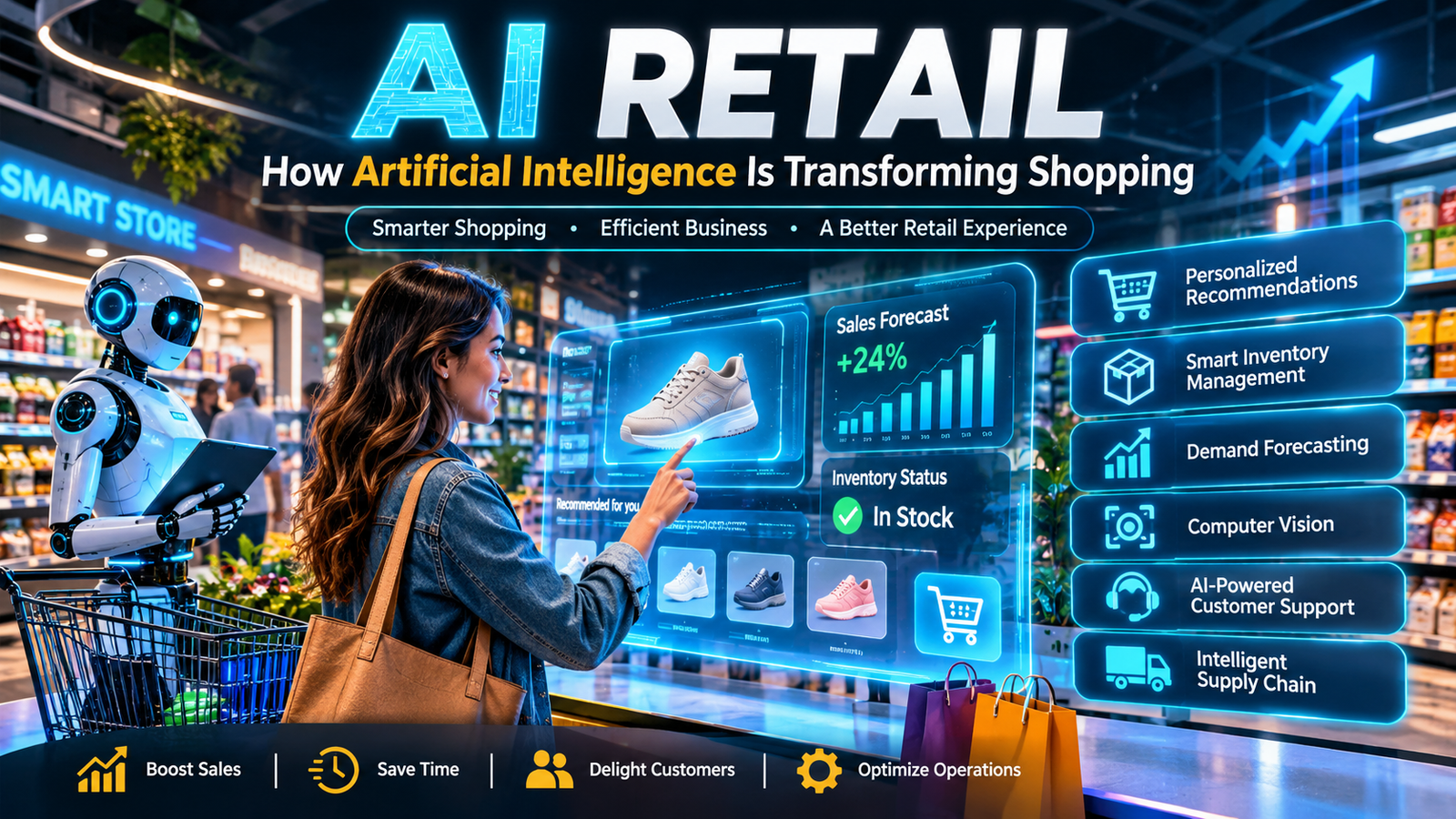
Artificial intelligence is changing how retailers understand customers, manage products, and run their businesses. From personalized product recommendations to smarter inventory planning, AI retail is helping stores and ecommerce businesses make better decisions using data.
What makes this shift important is that AI is no longer limited to online shopping assistants. Retailers are also using it to improve supply chains, monitor store operations, predict demand, and support employees.
AI Retail at a Glance
- Personalized recommendations: Suggest products based on customer interests and shopping behavior.
- Inventory management: Predict demand and help retailers avoid unnecessary stock shortages.
- Customer service: Answer common questions and assist shoppers through AI-powered conversations.
- Smarter pricing: Analyze demand, competition, and inventory when evaluating prices.
- Store operations: Use computer vision to monitor shelves and identify operational issues.
- Business decisions: Turn sales and customer data into useful insights.
What Is AI Retail?
AI retail means using artificial intelligence to improve different parts of the retail business. It includes technologies that help retailers understand customer behavior, predict sales, organize inventory, and automate repetitive work.
A simple example is an online clothing store that recommends matching shoes after a customer views a dress. The recommendation system analyzes shopping activity and identifies products that may interest that customer.
A supermarket can use AI for a different purpose. It can analyze previous sales, seasonal demand, and current stock levels to estimate how much fresh produce it should order.
Both examples involve AI, but they solve very different business problems.
The technology is useful across several areas:
- Online shopping and product discovery.
- Customer service and engagement.
- Inventory and warehouse management.
- Sales forecasting and merchandising.
- Pricing and promotional planning.
- Fraud detection and loss prevention.
- Supply chain operations.
The goal is not to replace every traditional retail process. It is to make existing processes more informed, efficient, and responsive.
How Does AI Work in Retail?
Most AI retail applications follow a straightforward process. They collect relevant information, analyze it, and provide predictions or recommendations.
1. Collecting Retail Data
AI systems need information before they can identify useful patterns.
Retailers may use data from:
- Online orders and store transactions.
- Product searches and browsing activity.
- Customer feedback and reviews.
- Loyalty programs.
- Inventory management systems.
- Warehouse and delivery records.
For example, a retailer can combine previous sales with seasonal information to understand when demand for winter clothing usually increases.
Customer data should only be collected and processed in accordance with applicable privacy requirements.
2. Finding Patterns
Machine learning models examine the available information to identify relationships.
A demand forecasting model might discover that certain products sell faster during weekends or holiday periods.
A recommendation system might identify products that customers frequently purchase together.
These patterns help retailers understand what is happening and anticipate what may happen next.
3. Making Predictions or Recommendations
Once the information has been analyzed, an AI system can produce useful outputs.
These might include:
- Recommended products.
- Estimated future sales.
- Potential inventory shortages.
- Unusual transaction alerts.
- Suggested promotional opportunities.
Some systems simply provide recommendations. Others connect with business software to perform approved actions.
4. Monitoring Results
AI predictions are not always correct. Customer preferences, market conditions, and product availability can change.
Retailers need to monitor performance and update their systems when necessary.
Good results depend on reliable information, suitable models, and regular evaluation.
8 Practical Ways AI Is Used in Retail
AI has several applications in modern commerce. Some are already common in ecommerce, while others are becoming increasingly relevant to physical stores and supply chains.
1. Personalized Product Recommendations
Personalization helps customers discover products that match their interests.
AI recommendation systems examine information such as previous purchases, viewed products, searches, and shopping preferences.
An online electronics store, for example, might recommend a laptop bag or wireless mouse after someone purchases a laptop.
Fashion retailers can suggest matching clothing, accessories, and shoes.
These recommendations can make product discovery easier. However, retailers should avoid excessive tracking and recommendations based on incomplete or misleading information.
2. Inventory Management
Poor inventory planning creates two expensive problems: products that remain unsold and products that customers cannot find.
AI helps retailers understand how much stock they may need.
It can examine historical sales, seasonal trends, current inventory, and promotional activity to estimate future demand.
A grocery store might use these predictions to plan fresh food orders. An online retailer can use them to identify products that may need replenishment.
AI does not eliminate inventory problems. Supplier delays, unexpected demand, and inaccurate stock records can still affect availability.
3. Customer Service and Shopping Assistants
Customers often have simple questions about products, shipping, payments, and returns.
AI-powered assistants can handle many of these requests through natural-language conversations.
For example, a customer might ask:
“Can I return a product if it arrives damaged?”
An assistant connected to the retailer’s actual return policy can explain the relevant steps.
Modern generative AI can also help customers compare products and understand specifications.
However, these systems need reliable information. Retailers should provide a clear way to contact a human representative when a question involves a complaint, payment problem, or unusual situation.
4. Demand Forecasting
Retailers need to estimate future demand before deciding how much stock to purchase.
AI forecasting systems analyze previous sales alongside relevant factors such as seasonal changes, promotions, and regional purchasing patterns.
Consider a business selling air conditioners.
It may experience higher demand during warmer months. An AI model can examine previous sales and current trends to help the purchasing team prepare.
The predictions are useful for planning, but unexpected weather, economic changes, and supply disruptions can affect the outcome.
5. Pricing and Promotional Decisions
Pricing is one of the most important decisions in retail.
AI can help businesses understand how demand, competitor prices, inventory levels, and promotions affect sales.
For example, a retailer might discover that a product has remained in stock longer than expected. Its pricing system can recommend evaluating a discount or promotional campaign.
AI can also help businesses compare the performance of different offers.
However, automated pricing requires oversight. Retailers must consider consumer protection laws, pricing transparency, and potential fairness issues.
6. Computer Vision in Physical Stores
Computer vision allows computers to analyze images and video.
Retailers can use this technology to monitor store conditions and identify problems that may otherwise require manual inspections.
Possible applications include:
- Detecting empty shelves.
- Identifying misplaced products.
- Monitoring checkout activity.
- Understanding store traffic patterns.
- Supporting loss prevention.
Amazon’s Just Walk Out technology is a practical example. It combines computer vision, sensors, and machine learning to track items customers select and create a virtual shopping cart.
The exact setup depends on the store configuration. Some locations authenticate shoppers before entry, while others use payment at exit.
This type of technology can reduce checkout friction, although installation and maintenance require investment.
7. Visual Product Search
Sometimes customers know what a product looks like but do not know its name.
Visual search addresses this problem by allowing shoppers to upload an image.
Computer vision analyzes the image and searches for visually similar products.
For example, someone who sees a particular sofa in a photograph can upload the image to a furniture retailer’s website.
The search system can return products with similar colors, shapes, patterns, or designs.
This application is particularly useful for fashion, furniture, home decoration, and lifestyle products.
8. Marketing and Content Creation
Retail marketing teams regularly produce product descriptions, advertisements, emails, and social media content.
Generative AI can help create initial drafts and adapt content for different campaigns.
It can also assist with:
- Product description writing.
- Advertising variations.
- Email campaign ideas.
- Customer feedback summaries.
- Marketing data analysis.
- Product image editing.
For example, a retailer launching a new collection can use AI to prepare initial product descriptions.
An editor should still verify specifications, prices, promotional terms, and brand messaging before publishing.
AI can speed up content production, but it should not become a source of inaccurate product claims.
Real-World Examples of AI in Retail
Several major companies demonstrate how AI is being applied to different parts of the retail industry.
Amazon: AI-Assisted Shopping
Amazon has developed AI-powered shopping experiences that help customers discover products, compare options, and receive personalized recommendations.
An important update for 2026 is that Amazon renamed its Rufus shopping assistant to Alexa for Shopping on May 13, 2026.
This is a useful example of how conversational AI is becoming part of the shopping experience.
Amazon also offers Just Walk Out technology for retailers that want checkout-free shopping capabilities.
Walmart: AI for Retail Operations
Walmart is an example of a large retailer working with AI across different operational areas.
For businesses operating numerous stores and distribution centers, connecting sales, inventory, logistics, and customer information is particularly important.
AI can support these activities by helping teams analyze demand, improve planning, and identify operational problems.
The broader lesson is that retail AI is not only about customer-facing applications. Back-office decisions can benefit just as much.
Shopify: AI for Online Merchants
Shopify offers Sidekick, an AI-powered commerce assistant for merchants.
According to Shopify’s documentation, Sidekick can help users work with store data, complete technical tasks, build workflows, and perform calculations.
It also presents proposed changes for merchant review before applying them.
This makes it relevant to businesses that want AI assistance within their existing ecommerce platform.
AI Retail Platforms and Tools Worth Knowing
Different platforms serve different parts of the retail industry. Choosing between them depends on the size of the business and the problem that needs solving.
| Platform | Main purpose | Suitable for | Important consideration |
|---|---|---|---|
| Shopify Sidekick | AI-assisted store management | Shopify merchants | Shopify ecosystem dependency |
| Salesforce | Customer relationship and commerce workflows | Growing and enterprise retailers | Licensing and implementation complexity |
| Blue Yonder | Supply chain and inventory planning | Large retailers | Enterprise deployment requirements |
| NVIDIA | AI infrastructure and retail technology | Developers and enterprises | Requires suitable technical infrastructure |
These are not direct substitutes. Shopify Sidekick focuses on merchant assistance, Salesforce supports customer and commerce operations, Blue Yonder specializes in supply chain planning, and NVIDIA provides underlying AI technology.
Pricing note: Enterprise pricing depends on the selected products, usage, integrations, and contract. Check the provider’s current pricing or request a quotation rather than relying on outdated third-party figures.
Benefits of AI Retail for Businesses
The value of AI depends on how well it solves an existing business problem.
For retailers, the most useful benefits include:
Better shopping experiences: Relevant recommendations and faster product discovery can make shopping more convenient.
Improved inventory planning: Demand forecasts can help businesses make more informed purchasing decisions.
Faster customer support: AI assistants can handle routine questions and reduce repetitive workloads.
More useful sales insights: Retailers can identify purchasing patterns and understand product performance.
Marketing efficiency: Generative AI can help teams prepare content and campaign variations more quickly.
Operational visibility: Connected systems can help managers identify problems across stores, warehouses, and supply chains.
These benefits are opportunities, not guaranteed outcomes. Actual results depend on implementation, data quality, employee adoption, and ongoing costs.
Challenges Retailers Should Consider Before Using AI
AI can improve retail operations, but adopting it without proper planning can create new problems.
Data Quality
An AI system cannot reliably predict demand if its sales records or inventory information are inaccurate.
Retailers should review their existing data before investing in advanced solutions.
Customer Privacy
Personalization and store analytics may involve sensitive customer information.
Businesses should understand what information a provider collects, where it is processed, how long it is retained, and who can access it.
They should also review relevant privacy laws and customer consent requirements.
Implementation Costs
The actual cost of AI includes more than a software subscription.
Retailers may also need to pay for integrations, employee training, cloud services, hardware, maintenance, and technical support.
A small business should calculate these costs before committing to a platform.
Incorrect Predictions and AI Responses
AI models can make mistakes.
A chatbot might provide an outdated return policy, while a forecasting system might underestimate demand.
Retailers should verify important information and maintain human oversight for decisions that affect customers or business finances.
Integration With Existing Systems
Retail businesses often use separate systems for ecommerce, accounting, inventory, payments, and logistics.
If an AI tool cannot access the right information, its usefulness may be limited.
Check integrations and data compatibility before selecting a solution.
How Small Retail Businesses Can Start Using AI
AI is not limited to major retailers with large technology budgets.
Small businesses can start with tools already available through ecommerce platforms and business software.
A practical approach is to begin with one task.
For an online store:
- Use AI to prepare product description drafts.
- Improve product discovery.
- Analyze frequently purchased products.
- Assist customers with common questions.
For a local shop:
- Review sales patterns.
- Prepare seasonal inventory plans.
- Create promotional content.
- Analyze customer feedback.
For a grocery business:
- Estimate demand for frequently purchased items.
- Monitor stock levels.
- Identify products approaching expiration.
- Improve replenishment planning.
The best starting point is usually a repetitive task that consumes employee time or creates avoidable costs.
A Simple AI Adoption Plan
- Identify a problem that affects daily operations.
- Check whether the necessary business data is available.
- Compare tools that solve that particular problem.
- Test one solution on a small scale.
- Measure the results against the existing process.
- Expand only when the benefits justify the investment.
Useful measurements include stockout frequency, forecast accuracy, customer satisfaction, support response time, conversion rate, and operating costs.
What Is Changing in AI Retail in 2026?
One of the biggest developments is the shift from AI that simply answers questions to systems that can help complete more complex shopping and business tasks.
Generative AI is making product discovery more conversational. Customers can describe what they need instead of relying entirely on traditional search filters.
Agentic AI takes this further. An AI agent can work through several connected steps, such as reviewing inventory information, checking demand forecasts, and preparing a replenishment recommendation.
Deloitte’s 2026 Global Retail Industry Outlook highlights the movement from AI experimentation toward operational use. Its survey of 330 retail executives also found that nearly 68% expected to deploy agentic AI for important operational or enterprise activities within the following 12 to 24 months.
This figure represents executives’ expectations, not confirmed adoption across the entire retail industry.
McKinsey’s June 2026 research also highlights a potential €240 billion to €320 billion AI opportunity across the European retail value chain.
These findings point toward a broader change. Retailers are increasingly evaluating AI as part of their business operations rather than treating it as an isolated technology experiment.
Still, adoption will depend on reliable data, integration, costs, and customer trust.
Frequently Asked Questions
1. What is AI retail in simple terms?
AI retail means using artificial intelligence to improve shopping and business operations. Retailers use it for product recommendations, inventory planning, customer service, sales forecasting, and other everyday tasks.
2. How is AI used in retail stores?
Physical retailers use AI for inventory monitoring, demand forecasting, customer service, checkout automation, and computer vision. These applications help employees identify operational problems and make better-informed decisions.
3. Can AI help small retail businesses?
Yes. Small retailers can use existing AI tools for product descriptions, customer support, sales analysis, marketing, and inventory planning. They can start with affordable software instead of building their own AI systems.
4. What are the biggest challenges of AI in retail?
The main challenges include poor data quality, customer privacy, integration difficulties, implementation costs, and inaccurate AI outputs. Businesses should address these issues before expanding AI across their operations.
5. What is the future of AI in retail?
AI retail is moving toward conversational shopping, agentic commerce, smarter inventory systems, and connected store operations. Human oversight, accurate data, and customer trust will remain essential as these technologies develop.
Conclusion
AI retail is changing how businesses understand shoppers and manage their operations. Its applications range from personalized product recommendations to inventory forecasting, customer support, and supply chain planning.
However, adopting AI does not automatically improve a retail business. The technology must solve a real problem, work with reliable data, and justify its cost.
For small retailers, starting with one practical application is often the sensible approach. Larger businesses can explore connected systems across multiple departments.
Ultimately, the value of AI retail comes from making shopping more convenient and business operations more informed, not from using artificial intelligence simply because it is available.