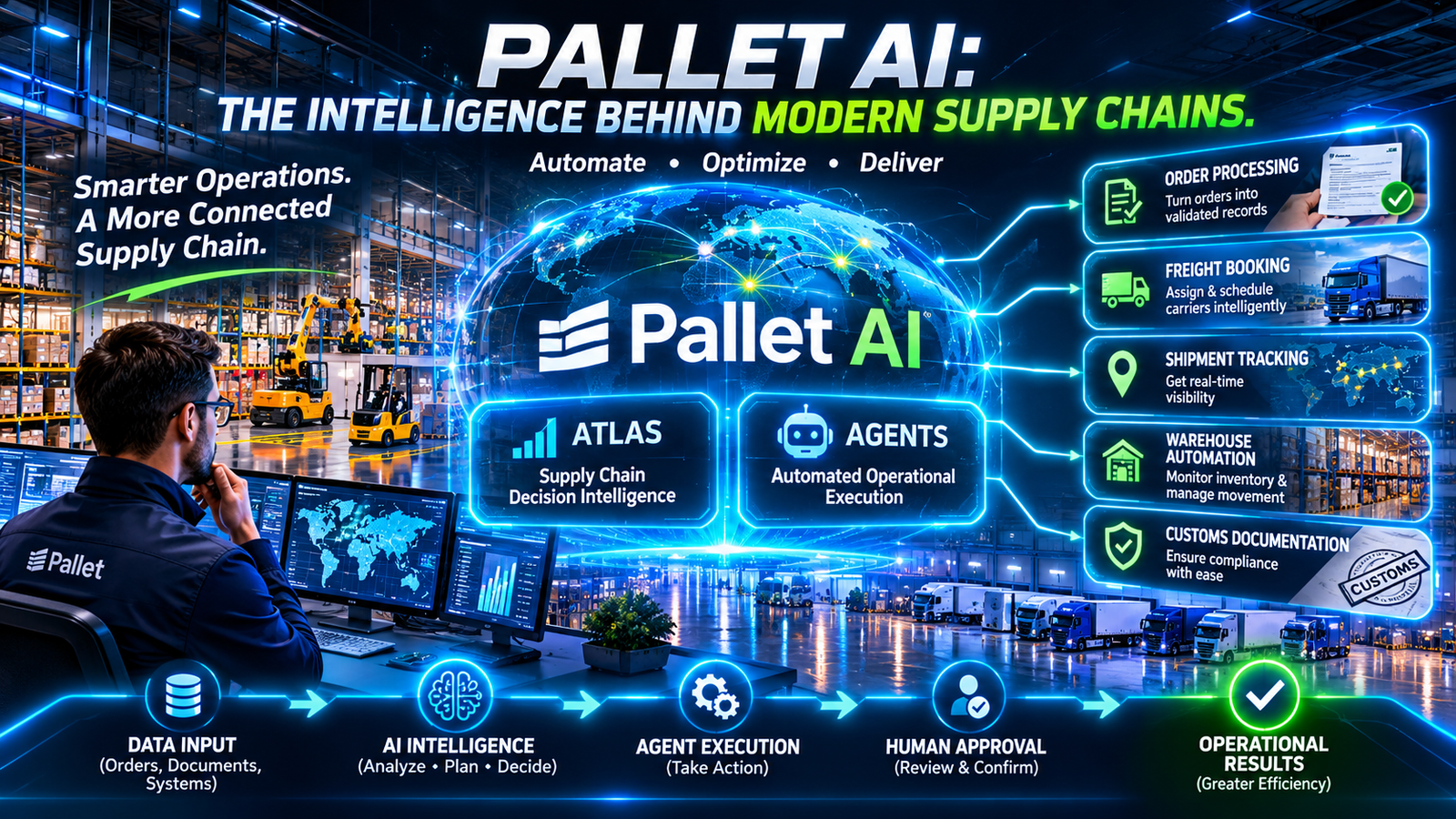
Pallet AI is an enterprise AI platform that helps logistics, manufacturing, distribution, and supply chain companies automate complex operational workflows. It uses specialized AI agents, connected business data, and company-specific operating rules to handle tasks such as shipment tracking, order processing, freight booking, and document management.
Pallet AI at a Glance
Platform overview
Active platform
AI Innovation: Pallet Secures $27M for Workflow Solution | DC Velocity
dcvelocity.com
| Category | Details |
|---|---|
| Platform | Pallet |
| Official website | Pallet.com |
| Main purpose | Enterprise workflow automation |
| Core technology | AI agents and operational intelligence |
| Target users | Logistics providers, manufacturers, distributors, retailers |
| Main products | Atlas and Agents |
| Deployment | Enterprise implementation |
| Pricing | Custom, outcome-based commercial model |
| Access | Demo-based |
Key takeaways
- Automates complex logistics and supply chain workflows.
- Connects with existing enterprise software and operational systems.
- Uses company-specific procedures and institutional knowledge.
- Supports documents, email, voice, APIs, EDI, and browser workflows.
- Includes testing and simulation before production deployment.
- Public pricing is not listed as a fixed subscription.
What Is Pallet AI?
Pallet is an enterprise technology platform designed to bring artificial intelligence into physical business operations.
Unlike general-purpose AI assistants, it focuses on the work happening behind supply chains. These operations include processing purchase orders, coordinating shipments, updating warehouse records, handling customer requests, and preparing customs documentation.
The platform combines two main capabilities: operational intelligence and AI-powered execution.
Its Atlas product helps businesses understand operational data, analyze performance, and make decisions. Its Agents product automates workflows by interacting with business systems and communication channels.
Pallet’s central idea is straightforward: companies should not need employees to manually move information between emails, spreadsheets, portals, and enterprise applications all day.
Instead, AI agents can handle repeatable tasks while employees supervise exceptions and important decisions.
The company describes its technology as an AI platform for businesses that make, move, and sell physical goods. Pallet+1
How Does Pallet AI Work?
Pallet connects business information, operating procedures, and existing software to create agents capable of completing operational tasks.
A typical implementation involves several stages.
Logistics AI Readiness Playbook | Atomic Loops
atomicloops.com
1. Connect Existing Business Systems
Pallet works with information stored across enterprise applications, communication channels, and documents.
Depending on the workflow, these connections can include:
- Transportation management systems (TMS).
- Warehouse management systems (WMS).
- Enterprise resource planning (ERP) platforms.
- Email and messaging applications.
- PDF documents and spreadsheets.
- REST APIs and EDI connections.
- Web portals and remote desktop applications.
This approach matters because many logistics businesses still rely on older software that lacks modern integration capabilities.
Pallet also describes browser and remote desktop access for workflows that cannot be handled through conventional APIs. Pallet+1
2. Understand Company-Specific Rules
Logistics operations involve more than processing information.
An employee might know that a particular customer requires a specific carrier, that certain products need special handling, or that a warehouse accepts deliveries only during designated hours.
These rules are often scattered across documents, conversations, and employee experience.
Pallet uses its operational knowledge and memory capabilities to capture standard operating procedures, customer requirements, and previous human corrections.
This helps agents apply relevant instructions instead of treating every transaction as an isolated request.
3. Build and Test AI Agents
Pallet uses its Forge platform to build and deploy customized agents.
The company says these agents are tested through simulations and adversarial scenarios before production deployment.
This is particularly important for operational environments. A seemingly small error in a shipment address, purchase order, or customs document can create expensive downstream problems.
Simulation helps identify workflow failures before an agent handles real transactions.
4. Execute Tasks and Escalate Exceptions
Once deployed, agents can perform approved actions across connected systems.
For example, an agent might receive a shipment request, extract its details, check carrier availability, arrange a pickup, and update the transportation system.
If information conflicts or an important approval is required, the workflow can involve a human operator.
The goal is not simply to generate AI responses. It is to complete business processes with appropriate operational controls. Pallet+1
Main Features of Pallet AI
Pallet’s features focus on operational execution rather than general-purpose content generation.
1. AI-Powered Logistics Automation
The platform supports several common logistics workflows:
- Shipment booking and scheduling.
- Freight tracking and status updates.
- Bill of lading (BOL) processing.
- Warehouse receiving.
- Delivery appointment coordination.
- Customs documentation.
- Shipment exception management.
For example, an agent can extract shipment details from a bill of lading and compare them with purchase order records.
This reduces repetitive data entry and helps operators identify discrepancies.
2. Supply Chain Decision Intelligence
Pallet Atlas provides an intelligence layer for analyzing operational information.
Its capabilities include conversational analysis, dynamic dashboards, and alerts.
Businesses can use connected information about orders, inventory, suppliers, and facilities to understand operational conditions.
Another important feature is the ability to apply business rules during analysis.
For example, inventory decisions may need to consider reserved stock, customer priorities, supplier agreements, and existing commitments.
3. Institutional Memory
Institutional knowledge is one of the more interesting parts of Pallet’s approach.
Traditional automation often struggles when business rules change or when an unusual situation occurs.
Pallet’s memory capabilities aim to preserve standard operating procedures, customer-specific requirements, and corrections made by human operators.
This can make repeated workflows more consistent.
4. Multi-Channel Communication
Pallet agents are designed to work across several business interfaces.
| Channel | Potential application |
|---|---|
| Order processing and customer communication | |
| Voice | Shipment coordination and calls |
| Documents | PDF and spreadsheet extraction |
| APIs | Direct enterprise system integration |
| EDI | Structured logistics data exchange |
| Browser | Partner portals and web applications |
| Remote desktop | Legacy desktop software |
The ability to work across different interfaces is valuable because supply chain processes rarely exist inside one application. Pallet+1
5. Custom AI Models
Pallet also describes custom models trained using company data.
According to the company’s product information, this approach aims to improve operational accuracy, efficiency, and control over business intelligence.
It also promotes flexibility between frontier and open-source models.
However, businesses should request technical documentation before assuming that every model is independently trained, fully portable, or available for unrestricted deployment.
6. Enterprise Testing and Accuracy Controls
Operational automation needs more than convincing AI-generated responses.
It requires reliable execution, validation, and exception handling.
Pallet says it tests agents using thousands of simulations and adversarial tests before deployment.
That is a company-reported development and validation approach, not independent proof that every workflow achieves perfect accuracy.
Organizations should evaluate performance using their own documents, systems, and operational edge cases.
What Can You Use Pallet AI For?
Pallet is particularly relevant to companies managing large volumes of orders, shipments, documents, and customer interactions.
Its applications extend across several business functions.
1. Freight and Shipment Management
Freight operations involve constant communication between carriers, dispatchers, customers, and warehouses.
Pallet agents can support:
- Collecting carrier rates.
- Checking freight availability.
- Booking shipments.
- Scheduling pickup and delivery appointments.
- Monitoring shipment progress.
- Coordinating delayed deliveries.
- Collecting proof-of-delivery records.
This can reduce the manual coordination required to move freight between locations.
2. Warehouse Operations
Warehouse teams frequently process receiving documents, purchase orders, stock adjustments, and delivery records.
Pallet can automate parts of these workflows by matching information across documents and enterprise systems.
For example, an agent can compare received quantities against a purchase order and flag shortages or damaged goods.
Human operators can then review discrepancies before approving adjustments.
3. Order Processing
Order entry is another suitable application.
Businesses often receive purchase orders through email attachments, spreadsheets, and other communication channels.
Pallet agents can extract relevant information, validate product references, and create structured records in connected systems.
This reduces repetitive entry while helping teams process incoming orders more consistently.
4. Customer Service
Customer service teams in logistics frequently answer questions about:
- Order availability.
- Shipment status.
- Estimated delivery times.
- Product shortages.
- Returns and cancellations.
- Freight quotations.
Pallet agents can retrieve information from connected operational records and respond through supported communication channels.
They can also process approved changes and send proactive updates when shipments experience delays.
5. Customs and International Shipping
Cross-border shipments require accurate documentation and coordination.
Pallet supports workflows involving customs paperwork, import documentation, export records, and Importer Security Filing (ISF) data.
Agents can collect documents, extract relevant fields, identify missing information, and coordinate filing processes.
However, businesses should maintain appropriate human review for regulatory decisions and submissions requiring specialized authorization.Pallet+2
Pallet AI Pricing: How Much Does It Cost?
One of the most important considerations when evaluating Pallet is pricing transparency.
Pallet does not publish a standard monthly subscription price on its main product pages.
Instead, its commercial model is based on enterprise implementations and measurable business outcomes.
The company describes a proof-of-concept approach and says customers pay for results delivered rather than simply paying per user seat or software license. Pallet+1
Pallet pricing overview
Custom pricing
Contact sales
No verified public dollar amount or standard monthly plan
What to discuss during a sales consultation:
- Initial proof-of-concept costs.
- Integration and implementation expenses.
- Number of workflows and agents.
- Ongoing support and maintenance.
- Usage-related costs, if applicable.
- How delivered results are measured.Visit Pallet’s official website
Is Pallet Suitable for Small Businesses?
Pallet appears primarily designed for organizations with complex operational processes.
A small company processing a limited number of shipments may not need a customized enterprise automation platform.
However, a growing distributor or logistics provider handling thousands of transactions could potentially benefit from reducing repetitive work.
The important question is whether the financial value of automation justifies implementation costs.
Before signing an agreement, request a detailed commercial proposal that explains the payment structure and how ROI will be calculated.
Pallet AI Integrations and Compatibility
Integration capabilities are central to Pallet’s value proposition.
An AI agent cannot automate a complete business process if it cannot access the systems where the relevant information lives.
Pallet describes support for APIs, EDI, browser-based applications, remote desktop environments, documents, email, and voice.
Its logistics solution also identifies compatibility with several established enterprise platforms.
| Platform | Business function |
|---|---|
| SAP | Enterprise resource planning |
| Oracle | Enterprise applications |
| Manhattan Associates | Warehouse management |
| Blue Yonder | Supply chain management |
| Kinaxis | Supply chain planning |
| CargoWise | Logistics operations |
| Descartes | Transportation and logistics |
| McLeod | Transportation management |
These are platforms identified in Pallet’s integration materials. Actual compatibility, connection methods, and available actions should be confirmed for the customer’s specific software version and configuration. Pallet
Why Legacy Software Support Matters
Many established logistics businesses cannot replace their existing software simply to introduce AI.
Their operational systems may contain years of customer records, customized workflows, and important business rules.
Pallet’s ability to work through browser interfaces and remote desktop environments may help address this problem.
However, interface-based automation needs careful testing because software updates, changing layouts, and authentication requirements can affect reliability.
Pallet AI Security and Data Privacy
Supply chain systems handle commercially sensitive information.
This can include customer details, shipment records, supplier agreements, financial information, and business documents.
Therefore, security should be a major part of any evaluation.
Pallet identifies the following compliance and privacy frameworks on its official website:
- SOC 2 Type II: Independent auditing of security, availability, and confidentiality controls.
- GDPR: European data protection requirements.
- CCPA: California consumer privacy requirements.
The company also states that customer data remains theirs and is not shared. Pallet+1
However, compliance statements should not replace a proper security review.
Questions Businesses Should Ask
Before connecting operational systems, request clear answers about:
- Data encryption during transmission and storage.
- User access permissions and role-based controls.
- Data retention and deletion procedures.
- Whether customer information is used for model training.
- Third-party AI model providers and subprocessors.
- API authentication and credential management.
- Audit logs and human approval mechanisms.
- Data residency and incident response procedures.
One distinction deserves particular attention: SOC 2 Type II does not automatically guarantee Zero Data Retention (ZDR).
Companies should request explicit documentation about retention periods and model-provider data handling.
Pallet AI Benefits
Pallet’s approach offers several potential advantages for businesses with complicated operational processes.
Reduced Manual Work
Employees often spend hours copying information between emails, documents, spreadsheets, and enterprise applications.
Automating these tasks can free staff to focus on exceptions and higher-value responsibilities.
Better Workflow Consistency
Agents can apply documented customer requirements and operating procedures repeatedly.
This may reduce variations caused by manual processes and inconsistent information handling.
Faster Operational Coordination
Shipment delays, appointment changes, and missing documents require communication between multiple parties.
Automated agents can coordinate supported steps without waiting for someone to manually process every update.
Better Use of Existing Software
Businesses may be able to automate processes without completely replacing their current TMS, WMS, or ERP infrastructure.
Measurable Business Outcomes
Pallet emphasizes operational ROI rather than selling automation solely through user licenses.
This makes implementation success easier to evaluate when the company and customer agree on measurable performance indicators.
However, the actual benefits depend on workflow quality, integration reliability, data accuracy, and adoption.
Limitations and Potential Drawbacks
Despite its capabilities, Pallet is not automatically suitable for every organization.
Understanding its limitations is important before investing in an enterprise implementation.
1. Limited Public Pricing Information
Businesses cannot easily compare Pallet against competitors using published subscription prices.
They need a sales conversation and a customized commercial proposal.
2. Implementation Requires Operational Planning
Connecting systems is only one part of deployment.
Organizations must also document operating procedures, define permissions, establish escalation rules, and test exceptions.
Poorly documented workflows can produce disappointing automation results.
3. Enterprise Focus
Pallet’s positioning is centered on complex business operations.
Individuals, freelancers, and smaller businesses seeking a simple AI assistant may find the platform unnecessarily specialized.
4. Integration Complexity
Compatibility does not necessarily mean every integration works immediately.
Legacy software, customized databases, authentication restrictions, and inconsistent records can increase implementation effort.
5. AI Agents Still Need Human Oversight
AI agents can misunderstand documents, encounter unexpected situations, or work with incomplete information.
Critical activities involving customs, financial adjustments, contractual obligations, or customer commitments should have appropriate approval mechanisms.
6. Independent Performance Evidence Is Limited
Pallet publishes customer success stories and product performance claims.
However, companies should not treat vendor-reported results as universal performance guarantees.
Request customer references, workflow-specific test results, and a controlled proof of concept before making a long-term commitment.
Pallet AI vs. Competitors and Alternatives
Pallet operates in a competitive market that includes logistics automation, freight management, supply chain visibility, and AI agent platforms.
However, not every competitor solves the same problem.
Some platforms focus on shipment visibility, while others automate freight communication or broader supply chain operations.
Here are several relevant alternatives.
RyderVentures Capital Fund | Transportation & Logistics Investments
1. HappyRobot
HappyRobot develops AI agents for logistics communication and operational workflows. It is relevant for companies looking to automate repetitive interactions across freight operations.
Website: HappyRobot
Vooma Scores Over $16 Million in Seed and Series A Funding Led by Index and Craft Ventures
2. Vooma
Vooma focuses on freight workflows, including quoting, load coverage, and shipment coordination. It is worth comparing for transportation companies with communication-heavy processes.
Website: Vooma
FourKites – AI-Powered Supply Chain & Logistics Platform – Daidu.ai
3. FourKites
FourKites focuses on supply chain visibility, shipment tracking, and operational intelligence. It is a relevant alternative for organizations prioritizing shipment monitoring and exception management.
Website: FourKites
GoComet – AI-Powered Supply Chain Risk & Compliance Platform – Daidu.ai
4. GoComet
GoComet provides logistics technology for freight procurement, shipment visibility, and supply chain management. It may suit businesses looking for freight-focused software.
Website: GoComet
Blue Yonder – AI-Powered Supply Chain Management Platform – Daidu.ai
5. Blue Yonder
Blue Yonder offers broader supply chain planning, warehouse, and transportation technology. It is relevant for enterprises evaluating established supply chain software ecosystems.
Website: Blue Yonder
Competitor Comparison
| Platform | Target user | Main strength | Pricing transparency |
|---|---|---|---|
| Pallet | Enterprise operators | AI workflow execution | Custom |
| HappyRobot | Logistics teams | AI communications and agents | Custom |
| Vooma | Freight companies | Freight workflow automation | Custom |
| FourKites | Large supply chains | Shipment visibility | Custom |
| GoComet | Shippers and logistics teams | Freight management | Plan-dependent |
| Blue Yonder | Large enterprises | Supply chain planning and execution | Custom |
Pricing transparency describes publicly available pricing information, not a verified quotation. Feature scope differs across these platforms.
What Makes Pallet Different?
Pallet’s positioning combines operational decision intelligence with agents that can execute business tasks.
This distinction matters.
A shipment visibility platform might tell an operator that a delivery is delayed. An execution-focused agent platform aims to take approved next steps, such as contacting relevant parties, updating records, and coordinating a reschedule.
Pallet’s approach is therefore most interesting when businesses want to move beyond dashboards and automate the work that follows operational decisions.
That does not mean it replaces every transportation or warehouse management system. It is better understood as an automation and intelligence layer that works alongside existing infrastructure.
Who Should Use Pallet AI?
Pallet is worth evaluating for organizations that manage complicated, repetitive, and interconnected physical operations.
It may be particularly useful for:
- Third-party logistics providers: Automating shipment bookings, tracking, documentation, and customer communication.
- Freight forwarders: Coordinating shipment information and customs paperwork.
- Manufacturers: Managing supplier communication, purchase orders, and inbound deliveries.
- Distributors: Improving order processing, warehouse receiving, and inventory coordination.
- Retailers: Managing distribution center operations and store deliveries.
- Enterprise operations teams: Connecting disconnected workflows across existing business applications.
Who may not need it?
- Individuals looking for a general AI chatbot.
- Freelancers seeking writing or productivity tools.
- Small businesses with very low shipment volumes.
- Companies without sufficiently documented operational processes.
- Organizations unwilling to provide the required system access or implementation resources.
Real-World Examples: How Pallet Could Improve Operations
Consider a distributor receiving hundreds of purchase orders every day.
Without automation, employees may need to open emails, download attachments, check inventory, verify product references, and manually enter orders into an ERP.
An appropriately configured Pallet agent could automate supported parts of this process.
Here are three practical examples.
Example 1: Delayed Shipment
A carrier reports that a shipment will arrive three days late.
An agent could retrieve the shipment record, check inventory availability at nearby facilities, identify possible alternatives, and prepare a transfer recommendation.
An authorized employee can review and approve the proposed adjustment.
Example 2: Incoming Purchase Order
A customer emails a purchase order containing product references and quantities.
An agent could extract the details, validate them against customer records, check relevant inventory, and create a structured order.
Missing or conflicting information can be escalated.
Example 3: International Shipment
A freight forwarder receives several customs documents from different parties.
An agent could organize the files, extract shipment information, compare required fields, and identify missing documents.
This helps employees spend less time assembling paperwork and more time reviewing important exceptions.
These examples illustrate possible workflow applications, not guarantees that every implementation will perform identically.
Latest Pallet AI Developments
One important product announcement came on February 9, 2026, when Pallet introduced Pallet Core.
The announcement described a platform for deploying AI agents across complex supply chain operations.
Its stated approach combines a supply chain-focused foundational model, customer-specific operating rules, and system-level accuracy controls.
This development highlights Pallet’s broader strategy: moving beyond isolated AI assistants toward specialized agents that understand and execute operational workflows. Pallet
The platform’s current product positioning also emphasizes Atlas for decision intelligence and Agents for automated execution.
For the latest capabilities and commercial details, consult the official Pallet website rather than relying on older third-party descriptions.
Common Mistakes to Avoid When Evaluating Pallet
Before choosing an enterprise AI platform, avoid these common evaluation mistakes:
- Confusing AI responses with workflow automation: Ask whether the agent actually updates business systems or only recommends actions.
- Ignoring exception handling: Test missing documents, conflicting quantities, delayed shipments, and unusual customer instructions.
- Assuming every integration is turnkey: Verify the exact systems, versions, permissions, and connection methods.
- Accepting performance claims without testing: Run a proof of concept using representative operational data.
- Overlooking data retention: Review the privacy policy, contractual terms, and model-provider arrangements.
- Calculating ROI using labor savings alone: Include implementation, support, error correction, and ongoing operating costs.
These checks can help businesses separate genuine operational improvements from attractive product demonstrations.
Frequently Asked Questions
1. What is Pallet AI used for?
Pallet AI is used to automate enterprise workflows across logistics, manufacturing, distribution, and supply chain operations. Its agents can support order processing, shipment booking, warehouse receiving, customer communication, freight tracking, and customs documentation.
2. Is Pallet AI free to use?
Pallet does not advertise a standard free consumer plan or publicly listed subscription price. Its platform follows an enterprise sales model, with customized commercial arrangements and proof-of-concept engagements.
3. Does Pallet AI integrate with existing logistics software?
Yes. Pallet describes integrations and workflow connections through APIs, EDI, email, browser interfaces, and remote desktop environments. Its materials identify enterprise platforms such as SAP, Oracle, Manhattan Associates, and CargoWise.
4. Is Pallet AI suitable for small businesses?
Pallet is primarily positioned for enterprises and organizations with complex operational workflows. Smaller businesses may find its implementation approach excessive unless they manage enough transactions to justify customized automation.
5. Is Pallet AI safe for enterprise data?
Pallet identifies SOC 2 Type II, GDPR, and CCPA compliance on its website. However, businesses should independently review its security documentation, data retention terms, access controls, and third-party model arrangements before connecting sensitive systems.
Conclusion
Pallet represents a specialized approach to enterprise AI automation.
Instead of focusing on chatbots or content generation, it aims to automate the operational processes that keep supply chains moving.
Its combination of Atlas decision intelligence, AI agents, institutional memory, and enterprise integrations makes it relevant to logistics providers, manufacturers, distributors, and large retailers.
However, custom pricing, implementation requirements, integration complexity, and the need for human oversight deserve careful consideration.
For businesses handling substantial operational workloads, a proof of concept is the most sensible starting point. Test real workflows, measure accuracy, evaluate security, and calculate the financial impact before committing to deployment.

Alex Carter is a technology writer at AI SpaceZ.com, who covers AI tools, software reviews, practical tutorials and emerging artificial intelligence trends. He aims to make AI easier to understand and help readers discover useful tools and technologies for everyday productivity.